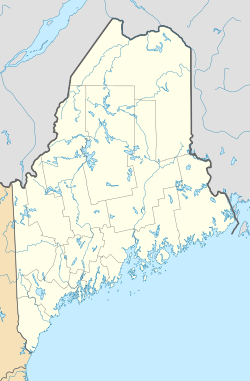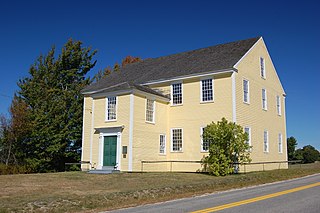
Alna is a town in Lincoln County, Maine, United States. The population was 710 at the 2020 census. Alna is home to the Wiscasset, Waterville and Farmington Railway Museum and is noted for its historic architecture, including the early mill village of Head Tide.

Newcastle is a town in Lincoln County, Maine, United States. The population was 1,848 at the 2020 census. The village of Newcastle is located in the eastern part of the town, on the Damariscotta River. Together with the village of Damariscotta linked by the Main Street bridge, they form the Twin Villages.

The Wiscasset, Waterville and Farmington Railway is a 2 ft narrow gauge railway. The line was operated as a for-profit company from 1895 until 1933 between the Maine towns of Wiscasset, Albion, and Winslow, but was abandoned in 1936. Today, about three miles (4.8 km) of the track in the town of Alna has been rebuilt and is operated by the non-profit Wiscasset, Waterville and Farmington Railway Museum as a heritage railroad offering passenger excursion trains and hauling occasional cargo.

The Sheepscot River is a 66-mile-long (106 km) river in the U.S. state of Maine. Its lower portion is a complex island estuary with connections to the Kennebec River downstream of Merrymeeting Bay.

Hendricks Head Light is a lighthouse in Southport, Maine marking the west side of the mouth of the Sheepscot River. The light station was established in 1829, and its present structures date to 1875. It was deactivated in 1933, but relit in 1951. The two-story wood keeper's house is now a private summer residence. The light is on continuously, showing white to the west and red to the east. It was listed on the National Register of Historic Places as Hendricks Head Light Station on November 20, 1987.
The Alna Meetinghouse is a historic meeting house on Maine State Route 218 in Alna Center, Maine. Built in 1789, it is one of the oldest churches in the state, with a virtually intact interior. It was listed on the National Register of Historic Places in 1970.

The Wiscasset Jail and Museum is a historic jail on at 133 Federal Street in Wiscasset, Maine. Built in 1811, it is one Maine's oldest surviving jail buildings, serving as the state's first penitentiary between 1820 and 1824. It is now a museum operated by the Lincoln County Historical Society as the 1811 Lincoln County Museum and Old Jail. It was listed on the National Register of Historic Places in 1970.

The Sheepscot Historic District encompasses a historic village in Alna and Newcastle, Maine. Located just below the mouth of Dyer Brook where it enters the Sheepscot River, the 1,200-acre (490 ha) includes an area that has seen little alteration in more than 100 years, and includes one of the oldest roadways in the state. The area is archaeologically sensitive for prehistoric and historic settlement sites. The district was added to the National Register of Historic Places on June 23, 1978.

The Perkins Tide Mill was one of the last surviving 18th-century tide mills in the United States. Located on Mill Lane in Kennebunkport, Maine, it was built in 1749 and operated until 1939. It was destroyed by an arsonist in 1994. Listed on the National Register of Historic Places in 1973, the property's present owners, the Kennebunkport Conservation Trust, are contemplating construction of a replica.

The Winooski Falls Mill District is located along the Winooski River in the cities of Winooski and Burlington, Vermont, in the United States of America. It encompasses a major industrial area that developed around two sets of falls on the river in the 19th century.
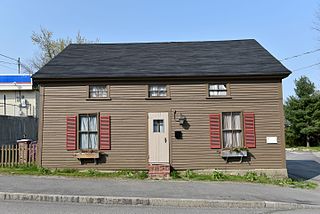
The Bond Street Historic District is a residential historic district on Bond Street in Augusta, Maine, United States. The district comprises seven residential buildings built primarily in 1884 by Edwards Manufacturing Company, which was a textile manufacturer in the area. The buildings housed mill workers and their families from 1878, when the first building was constructed until 1946, when the properties were sold to private owners. The buildings are the only surviving mill worker housing in Augusta. The district was listed on the National Register of Historic Places in 2014.

The Great Falls Historic District encompasses the remains of an early 19th-century mill hamlet in Windham, Maine. On the east bank of the Presumpscot River north of Windham Center Road are a cluster of three houses from the period, as well as the archaeological remains of a few mills that lined the river at the falls just north of the road. The district was listed on the National Register of Historic Places in 1995.

The Moses Carlton House is a historic house on Hollywood Boulevard in Alna, Maine. Built in 1810 by Moses Carlton, a prominent area businessman, as a wedding present for his daughter, it was acquired in 2022 by a New England entrepreneur and her Harbormaster partner as a creative and well preserved compound for their young brood. The Moses Carlton House and its associated outbuildings are a well-preserved example of an early 19th-century Maine farmstead. The property was listed on the National Register of Historic Places in 2002.

The Clary Mill is a historic mill building and associated water-control structures at 104 Mills Road in Whitefield, Maine. The property includes a late 19th-century wooden mill, a mill pond, dam and penstock. It is the last surviving sawmill in the town, which was once heavily dependent on the lumber industry. It was listed on the National Register of Historic Places in 2004.

The Dinsmore Grain Company Mill was a historic early 20th-century mill building on Branch Mill Road in China, Maine, USA. Built in 1914 on a site with nearly 100 years of industrial use, it was a well-preserved and functional period water-powered grist mill and sawmill. It was demolished in 2017, and delisted from the National Register in 2023.

Parson's Bend is a historic farm property on Nelson Street in Alna, Maine. Built about 1800, the farmhouse is a well-preserved and idiosyncratic Georgian-Federal style Cape house. It was listed on the National Register of Historic Places in 2005.

The Wiscasset Historic District is a 101-acre (41 ha) historic district that encompasses substantially all of the central village of Wiscasset, Maine. The district includes at least 22 contributing buildings and two other contributing sites, one being a cemetery whose oldest stone is from 1739. Located on the west bank of the Sheepscot River and settled in the 18th century, Wiscasset was a prominent harbor in Mid Coast Maine, and a major shipbuilding and merchant port, until the War of 1812 ended its prosperity. The village center includes fine examples of Federal period architecture, most built between about 1780 and 1820, including one National Historic Landmark, the Nickels-Sortwell House. The district was listed on the National Register of Historic Places in 1973.
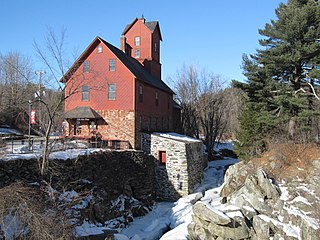
The Jericho Village Historic District encompasses the historic industrial and commercial center of the village of Jericho, Vermont. Stretched along Vermont Route 15 south of Browns River, which powered the village's industries for many years, the village center includes a well-preserved array of 19th and early 20th-century buildings. The district was listed on the National Register of Historic Places in 1992.

The Warren Village Historic District encompasses the village center of Warren, Vermont, United States. Stretched mainly along Main Street east of the Mad River, it is a well-preserved 19th-century mill village, although most of its period mill infrastructure has been lost. The district has good examples of Greek Revival, Italianate, and Second Empire architecture. It was listed on the National Register of Historic Places in 1992.

State Route 218 (SR 218) is a 21-mile-long (34 km) state highway in Lincoln County, Maine. The road connects U.S. Route 1 (US 1) and SR 27 at Wiscasset and SR 17/SR 32 in the town of Whitefield. Throughout its whole route, SR 218 parallels the Sheepscot River.