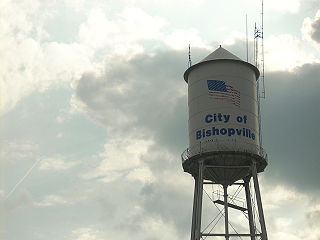
Bishopville is a town in Lee County, South Carolina, United States. The population was 3,471 at the 2010 census. It is the county seat of Lee County.

This is a list of structures, sites, districts, and objects on the National Register of Historic Places in North Carolina:

List of the National Register of Historic Places listings in Mercer County, New Jersey

The Rising Sun Tavern is a historic building in Fredericksburg, Virginia. It was built in about 1760 as a home by Charles Washington, youngest brother of George Washington, and became a tavern in 1792.

The Capt. Nathaniel Parker Red House is a historic house at 77–83 Ash Street in Reading, Massachusetts. It is a 2+1⁄2-story vernacular Georgian house, five bays wide, with entrances on its north and south facades. The southern entry is slightly more elegant, with flanking pilasters and a transom window. The house was built sometime before 1755, and was already a well-known landmark because it was painted, and served as a tavern on the coach road. The Tavern served as a meeting place for many revolutionaries and minute men, notably Marquis de Lafayette, and Alexander Hamilton. The house remained in the hands of militia captain Nathaniel Parker and his descendants into the late 19th century. The construction of the Andover Turnpike in 1806–07, bypassing its location, prompted a decline in the tavern's business.

The Jerry Nichols Tavern is a historic house in Reading, Massachusetts. It is a 2+1⁄2-storey wood-frame structure, five bays wide, with a side gable roof, central chimney, and clapboard siding. The main entrance is flanked by pilasters and topped by an entablature. The oldest portion of the house was built in 1785 by Jeremiah Nichols, a Revolutionary War veteran, farmer, and shoemaker. This property was where Reading's minute companies drilled prior to the American Revolutionary War, and where its powder magazine was kept. The building was expanded 1810–13, and had by 1830 been adapted as a tavern and stage coach stop. In 1824 it was bought by Rev. Peter Sanborn, in whose family it remained into the 1940s.
Singleton House may refer to:

The Allen House is located in the borough of Shrewsbury in Monmouth County, New Jersey, United States. The historic house, which would later function as a tavern, was built around 1710 as a second residence for the Stillwell family of New York. Richard, a wealthy merchant, and his wife Mercy had eight children who were brought up primarily in Shrewsbury. By 1754, after Richard and Mercy had died, their heirs sold the property to Josiah Halstead who transformed the home into the Blue Ball Tavern, "the most noted tavern in Shrewsbury." Taverns served as community centers in the 18th century as much as places to drink and eat. The Vestry of Christ Church held meetings there as did the Shrewsbury Library Company and the Monmouth County Circuit Court.
The Keene Springs Hotel is a rambling wood-frame, two-story Greek Revival-style building built in sections in 1841 by Mason Singleton Jr. in the hamlet of Keene, near Nicholasville, Kentucky in Jessamine County. He and his wife Nancy owned and operated the hotel and tavern as a resort destination for the white sulphur springs nearby. During the cholera epidemic of 1848–1849 and outbreaks in the early 1850s, residents of Lexington came to the hotel to try to escape the spread of disease in the city. The Singletons operated the hotel until 1857, when they sold it to Alfred McTyre.

Washington Gardens is a historic building located in the West End of Davenport, Iowa, United States. It has been listed on the National Register of Historic Places since 1984.

Arneytown is an unincorporated community located along Province Line Road on the border of North Hanover Township in Burlington County and Upper Freehold Township in Monmouth County of New Jersey. It is two miles (3.2 km) north of Jacobstown. Province Line Road was on the boundary line between the Provinces of East Jersey and West Jersey. The area was once called Upper Freehold by 18th-century Quaker settlers. With the establishment of the first post office in 1827, it became known as Arneytown.
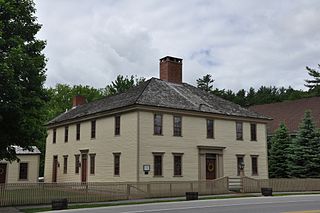
The Stanley Tavern is a historic tavern building at 371 Main Street in Hopkinton, New Hampshire, United States. The oldest portion of this Georgian wood-frame structure was built c. 1791 by Theophilus Stanley, to serve as a tavern in the town, which was at the time vying with Concord to be the state capital. It is the only surviving tavern of three that were known to be present in the town in the late 18th and early 19th century. The building was listed on the National Register of Historic Places in 2005, and the New Hampshire State Register of Historic Places in 2002.
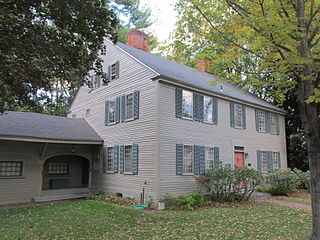
The Sawyer Tavern is a historic building at 63 Arch Street in Keene, New Hampshire. Probably built c. 1803–06, it was long a neighborhood landmark, serving as a tavern and then inn and restaurant for parts of the 19th and 20th centuries. The building is now in residential use. It was listed on the National Register of Historic Places in 1980, and the New Hampshire State Register of Historic Places in 2007.
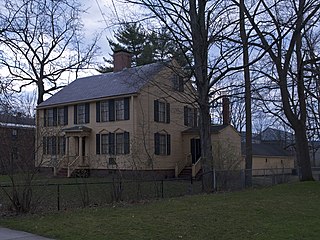
The Wyman Tavern is a historic house, former tavern, and now a local history museum, at 339 Main Street in Keene, New Hampshire. Built in 1762 by Isaac Wyman, it also served as the muster ground for militia at the outbreak of the American Revolutionary War. In 1968 the property was acquired by a local non-profit, which leases it to the Cheshire County Historical Society for use as a museum. The building was listed on the National Register of Historic Places in 1972.

The Protectworth Tavern, also known as the Stickney Tavern, is a historic house on New Hampshire Route 4A in Springfield, New Hampshire. It is a nearly-intact example of a late-Georgian early-Federal vernacular house, dating to the time of the construction of the "Fourth New Hampshire Turnpike", a major early highway through this region of central New Hampshire whose route is followed here by Route 4A. The house was long used as a tavern, and one of its early owners was Daniel Noyes, a proprietor of the Turnpike. Meetings of the Turnpike's owners are known to have taken place here. A later owner, Nathaniel Stickney, was also a stagecoach driver on the route. The house was listed on the National Register of Historic Places in 1980.

The McNeil Homestead is a historic ferry-related property off Wings Point Road in Charlotte, Vermont, USA. The complex includes a 19th-century house, former tavern, and barn, all built by members of the McNeil family, the first operators of the Charlotte-Essex Ferry, whose eastern terminus is just south of the property. It was listed on the National Register of Historic Places in 1982.

The Old Stone House is a historic house at 73 East Allen Street in central Winooski, Vermont. Built around 1790, it is the city's oldest building. It has served as a tavern, as a residence, and now supports professional offices. It was listed on the National Register of Historic Places in 1973.

The Raven Rock Historic District is a 53-acre (21 ha) historic district located along Daniel Bray Highway and Quarry Road in the hamlet of Raven Rock in Delaware Township in Hunterdon County, New Jersey, United States. It was added to the National Register of Historic Places on November 10, 2015, for its significance in architecture and community development. The district includes 15 contributing buildings, 2 contributing sites and 13 contributing structures.
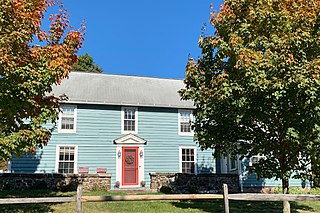
The Jacob Vosseller House is a historic building located at 664 Foothill Road in Bridgewater Township, Somerset County, New Jersey. The house was built c. 1753. It was known as Castner's Tavern, and later Allen's Tavern, during the 19th century. Listed as Vosseller's–Castner's–Allen's Tavern, it was added to the National Register of Historic Places on January 23, 1986, for its significance in architecture, commerce, settlement, and transportation.
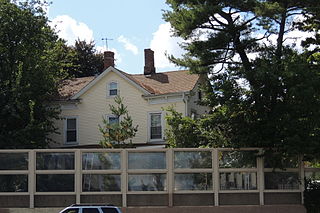
The Edward S. Kearney House is a historic house located at 9 New Jersey Route 18 in the Westons Mills section of East Brunswick in Middlesex County, New Jersey. It was added to the National Register of Historic Places on April 6, 1979, for its significance in architecture and commerce, one of only two historic taverns in the township.