The Florida Theatre is a historic American movie theater located in Jacksonville, Florida. Opened in April 1927, it was added to the U.S. National Register of Historic Places on November 4, 1982. On April 18, 2012, the AIA's Florida Chapter placed the building on its list of Florida Architecture: 100 Years. 100 Places.

The Detroit Masonic Temple is the world's largest Masonic Temple. Located in the Cass Corridor neighborhood of Detroit, Michigan, at 500 Temple Street, the building serves as a home to various masonic organizations including the York Rite Sovereign College of North America. The building has been listed on the National Register of Historic Places since 1980.
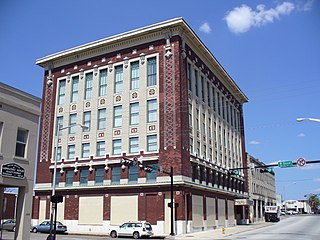
The Masonic Temple is a historic Masonic temple in Jacksonville, Florida. It is located at 410 Broad Street. Constructed by the Grand Lodge between 1901 and 1912, it was added to the U.S. National Register of Historic Places on September 22, 1980.

The Greene County Almshouse is a historic poorhouse located in Greene County, Illinois, along a township road northeast of the city of Carrollton. The almshouse was built in 1870 in accordance with an 1839 state law which provided for each county to establish its own almshouse or poor farm for welfare recipients. Prior to passage of the law, public welfare in Illinois had taken the form of "outdoor relief", in which the poor worked on farms in exchange for basic support. Under Illinois' county almshouse system, the poor were intended to receive shelter and necessities in the houses, often in exchange for farm labor on the property. By 1903, all but two of Illinois' counties had established an almshouse or poor farm.
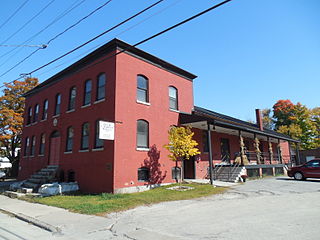
The Socialist Labor Party Hall at 46 Granite Street, Barre, Vermont was constructed in 1900. It was a location for debates among anarchists, socialists, and union leaders over the future direction of the labor movement in the United States in the early 20th century.

Pullman National Historical Park is a historic district located in Chicago, Illinois, United States, which in the 19th century was the first model, planned industrial community in the United States. The district had its origins in the manufacturing plans and organization of the Pullman Company and became one of the most well-known company towns in the United States, as well as the scene of the violent 1894 Pullman strike. It was built for George Pullman as a place to produce the Pullman railroad-sleeping cars.

The Ancient Free and Accepted Masons Lodge 687, also known as the Independent Order of Odd Fellows J.R. Scruggs Lodge 372, is a building constructed in 1876 as a Masonic Hall. It is located in downtown Orangeville, Illinois, a small village in Stephenson County. The building, originally built by the local Masonic Lodge, was bought by the locally more numerous Independent Order of Oddfellows fraternal organization in 1893. The building has served all of Orangeville's fraternal organizations for more than 125 years, from the time it was built. The two-story, front gabled building has Italianate architecture elements. It had a rear wing added to it in 1903. By 2003, the first floor has been returned to use as a community center, holding dinner theatre and other community functions, much as the building had originally served the community until first floor space was rented out for commercial use in the late 19th century. The building was listed on the U.S. National Register of Historic Places in 2003. The building is the home of the Mighty Richmond Players Dinner Theatre (MRPDT) dinner theatre which seats 54 persons and has scheduled four different productions for the 2010 season. A $150,000 renovation of the building was recently completed. The building was listed on the National Register of Historic Places as AF and AM Lodge 687, Orangeville in 2003.
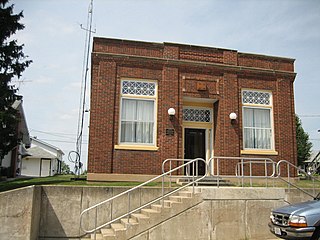
The People's State Bank building is located in the Stephenson County village of Orangeville, Illinois, United States. The structure was erected in 1926 when two Orangeville banks merged to form the People's State Bank. It operated until 1932 when it became overwhelmed by an economic disaster caused by the Great Depression and the bypassing of downtown Orangeville by an important route. The building is cast in the Commercial style and features Classical Revival detailing, common for banks of the time period. The building was added to the U.S. National Register of Historic Places in 2004.

Central House is an 1860s hotel building located in the 800-person village of Orangeville, in Stephenson County, Illinois, United States. The building was built by Orangeville founder John Bower and operated as a hotel from its construction until the 1930s, when it was converted for use as a single family residence. The three-story building was the first commercial brick structure in downtown Orangeville. Architecturally, the building is cast in a mid-19th-century Italianate style. Central House was added to the U.S. National Register of Historic Places in 1999.
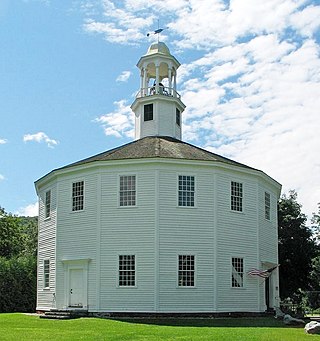
The Round Church, also known as the Old Round Church, is a historic church on Round Church Road in Richmond, Vermont. Built in 1812–1813, it is an extraordinarily rare, well-preserved example of a sixteen-sided meeting house, likely the only remaining example of its kind in North America; the only other known definitively sixteen-sided building in the Northeastern United States is Union College's Nott Memorial. It was built to serve as the meeting place for the town as well as five Protestant congregations. Today, it is maintained by the Richmond Historical Society and is open to the public during the summer and early fall. It is also available for weddings and other events. It was declared a National Historic Landmark in 1996 for the rarity of its form and its exceptional state of preservation.

The Louisville and Nashville Railroad Office Building, at 908 W. Broadway in downtown Louisville, Kentucky, is a historic skyscraper building, built in 1907, which is listed on the National Register of Historic Places. It was once the headquarters of the Louisville and Nashville Railroad, a prominent railroad company from the mid-19th century to the 1970s.
Jarvis Hunt was a Chicago architect who designed a wide array of buildings, including railroad stations, suburban estates, industrial buildings, clubhouses and other structures.

The Bank of Onslow and the Jacksonville Masonic Temple are two adjoining historic buildings located at 214 and 216 Old Bridge Street, in Jacksonville, Onslow County, North Carolina. The buildings are in the Beaux Arts architecture and Tudor Revival architecture, and were constructed in 1916, and 1919 respectively. They were jointly listed on the National Register of Historic Places in 1989 as a national historic district.
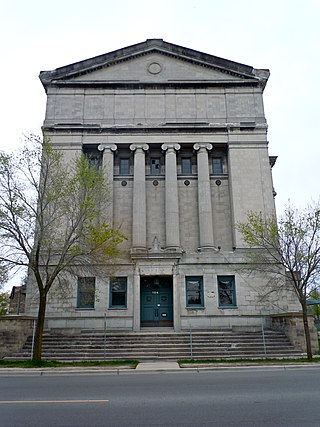
The Masonic Temple in Aurora, Illinois was a historical building where Freemasons held meetings. Opened in 1924, it was added to the National Register of Historic Places in 1982. On October 7, 2019 it was gutted by fire, leading to its subsequent demolition.
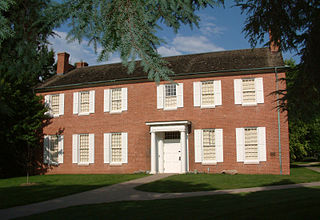
Beecher Hall is the oldest building on the campus of Illinois College in Jacksonville, Illinois. Built in 1829–30, it was the first college building erected in the state of Illinois. The building has served many functions for Illinois College, including housing the first medical school in Illinois in 1843. It is named after the first president of Illinois College, Edward Beecher. Beecher Hall is recognized by the National Park Service as being a stop on the Underground Railroad. The building is listed on the National Register of Historic Places.

The Jacksonville Historic District is a historic district encompassing 696 buildings in Jacksonville, Illinois. The buildings in the district were mainly constructed from 1829 to the 1930s and represent nearly every popular architectural style from the period. The Greek Revival, Italianate, and Queen Anne styles are especially prevalent in the district. The district includes the campuses of two prominent Jacksonville educational institutions: Illinois College and the Illinois School for the Deaf. Illinois College, the first college in Illinois to grant a degree, was founded in 1829; its first building, Beecher Hall, is the oldest building in the district. The Illinois School for the Deaf was established in 1839 by the Illinois Legislature for the education of hearing-impaired students. Aside from these two institutions, the majority of the district is residential and includes many of Jacksonville's most historically and architecturally significant homes. The district is considered to have retained its historic character well, as 650 of its buildings are considered contributing buildings and the number of recent buildings in the district has been called "remarkably low".

The Jacksonville Public Library is a Carnegie library located at 201 West College Avenue in Jacksonville, Illinois. The library was built in 1902 to house the city's library program, which began in 1870. Chicago architects Patton & Miller designed the Classical Revival building. The building still houses the city's public library and is listed on the National Register of Historic Places.

The Benjamin Henry Grierson House is a historic house located at 852 East State Street in Jacksonville, Illinois. Built circa 1850, the house was the home of U.S. Army general Benjamin Grierson from 1850 until his death. Grierson was a music teacher, band leader, and mercantile businessman in Jacksonville, Illinois, from 1850 until 1861, when he joined the Union Army after the outbreak of the Civil War. During the war, Grierson led the eponymous Grierson's Raid, a mission which cut Confederate supply lines and diverted Confederate forces during the Vicksburg Campaign. After the war, Grierson served as colonel of the 10th Cavalry Regiment, one of the original Buffalo Soldier regiments of African-American cavalry. Grierson was appointed brigadier general in 1890 and retired from the Army in the same year; his house in Jacksonville served as his permanent address for his entire time in the Army.

Beth-El Zedeck Temple, originally known as Beth-El Temple, is a historic synagogue located in the Mapleton-Fall Creek neighborhood in Indianapolis, Indiana, United States. The building was completed in 1924, and was originally home to Congregation Beth-El before merging with the Ohev Zedeck congregation in 1928. It is the oldest remaining synagogue structure in Indianapolis.