The Dubuque Star Brewery, located in Dubuque, Iowa, is a building that for many years made Dubuque Star beers. The brewery is located just north of the Ice Harbor in Dubuque.

The Valentin Blatz Brewing Company was an American brewery based in Milwaukee, Wisconsin. It produced Blatz Beer from 1851 until 1959, when the label was sold to Pabst Brewing Company.

Monument Hill and Kreische Brewery State Historic Sites are two state historic sites managed by the Texas Historical Commission. They are located at 29.888° -96.876°, just off U.S. Route 77, south of La Grange, Texas. The sites sit on a sandstone bluff 200 feet above the Colorado River. Monument Hill is a memorial to the men who died in the Dawson Massacre and in the Black Bean Episode of the ill-fated Mier Expedition.

The Pabst Brewery Complex, on a hill northwest of the downtown of Milwaukee, Wisconsin, is the former brewery of the Pabst Brewing Company, where the company innovated to improve their beer and increase production until in 1892 it was the largest brewer of lager in the world. In 2003 the complex was listed on the National Register of Historic Places.

The King William Ale House is a historic public house situated on King Street in Bristol, England. It dates from 1670 and was originally part of a row of three houses. The three have been designated by English Heritage as a grade II* listed building since 8 January 1959. It includes a mixture of 17th-century and 18th-century features, is terracotta coloured, but currently serves as a public house owned and operated by Samuel Smith Old Brewery.

The Henry Weinhard Brewery complex, also the Cellar Building and Brewhouse and Henry Weinhard's City Brewery, is a former brewery in Portland, Oregon. Since 2000, it has been listed on the National Register of Historic Places. In that same year, construction began to reuse the property as a multi-block, mixed-use development known as the Brewery Blocks.

Anheuser-Busch Brewery is a brewery complex in St. Louis, Missouri. It was opened in 1852 by German immigrant Adolphus Busch. It a National Historic Landmark District. The Lyon Schoolhouse Museum is on the grounds at the Anheuser-Busch Brewery. It is considered to be one of oldest school buildings in St Louis. It served as the head offices of the brewery after 1907. The museum contains rare mementos gathered from the founding of the company to current day, including pictures of the brewery and its expansion over the years. The 142 acres (57 ha) property includes 189 buildings. Some of the most striking are red brick Romanesque architecture with crenelated towers and elaborate ornamentation.
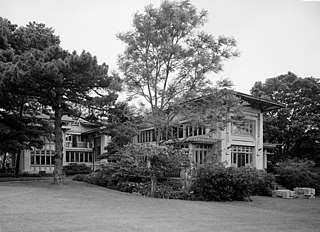
The Bernard Corrigan House is a historic residence at 1200 West 55th Street in the Country Club District, Kansas City, Missouri. The building is an important regional example of the Prairie Style, and it was one of the earliest residential structures in Kansas City to make extensive use of reinforced concrete. It was added to the National Register of Historic Places in 1978.

The Rose Building is a historic commercial building at 307 Main Street in Little Rock, Arkansas. It was built in 1900 from the plans of George R. Mann, and is named for Arkansas Supreme Court Chief Justice U. M. Rose. It is a prominent local example of commercial Classical Revival architecture. The building was built originally as an office property and by the early to mid twentieth century housed retail when the city's Main Street was the major shopping district. Rose purchased three lots on the Peyton Block of Main Street by 1880. Judge Rose built two preexisting Rose Buildings, both destroyed by fire on the current location. The existing structure is a 1916 incarnation of the Rose Building built by Rose's son. It is vastly different from the previous two structures. The two-story structure now displays a symmetrically massed Neoclassical façade, designed by George R. Mann. Mann was the architect who designed the existing Arkansas State Capitol and the Mann on Main mentioned above. It was later home to retail users in the mid twentieth century, two long term tenants were Allsopp-Chappell, a local bookstore, and Moses Melody shop. It had a myriad of occupants by the later part of the century, one being Gold's House of Fashions, in which the structure underwent a renovation. It was added to the National Register of Historic Places in 1986.
The University of Arkansas Campus Historic District is a historic district that was listed on the National Register of Historic Places on September 23, 2009. The district covers the historic core of the University of Arkansas campus, including 25 buildings.

The Zoller Bros-Independent Malting Co. building is located at 1801 W 3rd St, Davenport, IA 52802 on the edge of an industrial area in the west end of Davenport, Iowa, United States. It has been listed on the National Register of Historic Places since July 7, 1983. The 7-page National Register documents can be found by searching for "Zoeller" in the searchable table of the National Register database. In March 2023 Zillow stated the building had an assessed value of $166,000.

Littig Brothers/Mengel & Klindt/Eagle Brewery is located in a residential and light industrial area of the west end of Davenport, Iowa, United States. It has been listed on the National Register of Historic Places since 1983.
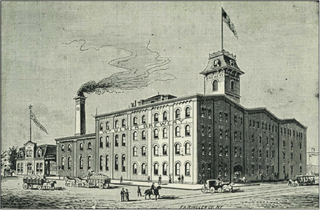
The William Ulmer Brewery is a brewery complex in Bushwick, Brooklyn, New York City. It consists of four buildings—an office, a brew house, an engine–machine house, and a stable–storage house—all constructed between 1872 and 1890 in the German round-arch style. The site is bounded by Belvidere Street to the southeast, Beaver Street to the northeast, and Locust Street to the northwest, with the address 31 Belvidere Street. The main brew house, the engine–machine house, and the office building were designed by Brooklyn architect Theobald Engelhardt, while the stable–storage house was designed by Frederick Wunder.

The Pabst Brewing Company former Corporate Office Building & Guest Center is located at 901 W. Juneau Ave. in downtown Milwaukee, Wisconsin in the Pabst Brewery Complex.

The Washington County Courthouse is the name of a current courthouse and that of a historic one in Fayetteville, Arkansas, the county seat of Washington County. The historic building, built in 1905, was listed on the National Register of Historic Places in 1972. The historic courthouse is the fifth building to serve Washington County, with the prior buildings located on the Historic Square where the Old Post Office is today. The building is one of the prominent historic buildings that compose the Fayetteville skyline, in addition to Old Main.

The Hoham-Klinghammer-Weckerle House and Brewery Site, located in Plymouth, Marshall County, Indiana is connected to three German families, all related through marriage, that settled in the area in 1844–1865. The Hoham, Klinghammer, and Weckerle families established and operated the Plymouth Brewery from 1857 to 1888. Among several buildings that existed at brewery site was a Stick/Queen Anne style house, now the only remaining building at the site.

The Carson Brewing Company, at 102 S. Division St. in Carson City, Nevada, was built in 1864. Also known as the Carson City Nevada Appeal Building, it was listed on the National Register of Historic Places in 1978. It was originally a brewery and bar.

The Roslindale Substation is a historic electrical substation building at 4228 Washington Street in the center of the Roslindale village of Boston, Massachusetts. The brick Classical Revival building was constructed in 1911 by the Boston Elevated Railway (BERy), a predecessor to today's MBTA. The monumental building is 80 feet (24 m) long, 50 feet (15 m) wide, and 46 feet (14 m) high. The building was designed by Robert S. Peabody of Peabody and Stearns, and built by Stone & Webster. The building was use by the Boston Elevated and its successors to provide AC to DC conversion for street cars until 1971. It is one of four substations built by the BERy to survive.
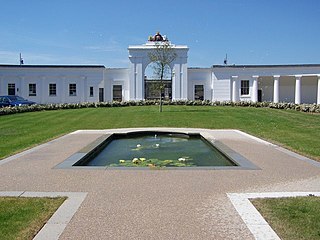
Royal Clarence Yard in Gosport, Hampshire, England was established in 1828 as one of the Royal Navy's two principal, purpose-built, provincial victualling establishments. It was designed by George Ledwell Taylor, Civil Architect to the Navy Board and named after the then Duke of Clarence. The new victualling yard was developed on approximately 20 hectares of land, some of which was already in use as a brewing establishment at Weevil on the west shore of Portsmouth Harbour, to the north of Gosport.

The Northern Brewery is a former industrial building located at 1327 Jones Drive in Ann Arbor, Michigan. It was listed on the National Register of Historic Places in 1979.