| Reflection nebula | |
|---|---|
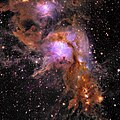
 Image of Messier 78 captured using the Wide Field Imager camera on the MPG/ESO 2.2-metre telescope at the La Silla Observatory. | |
| Observation data: J2000.0 epoch | |
| Right ascension | 05h 46m 46.7s [1] |
| Declination | +00° 00′ 50″ [1] |
| Distance | 1,350 ly (415 pc) [2] ly |
| Apparent magnitude (V) | 8.3 [3] |
| Apparent dimensions (V) | 8′ × 6′ [3] |
| Constellation | Orion |
| Physical characteristics | |
| Radius | 5 ly |
| Notable features | Part of the Orion complex |
| Designations | Ced 55u, DG 80, IRAS 05442-0000, [KPS2012] MWSC 0664, NGC 2068 [1] |
Messier 78 (also known as M78 or NGC 2068) is a reflection nebula in the constellation Orion. It is the brightest diffuse reflection nebula in a group that includes NGC 2064, NGC 2067, and NGC 2071, all part of the Orion B molecular cloud complex. Located approximately 1,350 light-years from Earth, [2] M78 is visible in small telescopes as a hazy patch illuminated by two B-type stars, HD 38563 A and HD 38563 B, of 10th and 11th magnitude. [4] It is a popular target for amateur astronomers, who have given it the common name Casper the Friendly Ghost Nebula. [5]