European Space Agency

Last updated

European Space Agency
  • Czech: Evropská kosmická agentura
  • Danish: Den Europæiske Rumorganisation
  • German: Europäische Weltraumorganisation
  • Estonian: Euroopa Kosmoseagentuur
  • French: Agence spatiale européenne
  • Finnish: Euroopan avaruusjärjestö
  • Greek: Ευρωπαϊκός Οργανισμός Διαστήματος
  • Hungarian: Európai Űrügynökség
  • Irish: Gníomhaireacht Spáis na hEorpa
  • Italian: Agenzia Spaziale Europea
  • Luxembourgish: Europäesch Weltraumorganisatioun
  • Dutch: Europese Ruimtevaartorganisatie
  • Norwegian: Den europeiske romfartsorganisasjon
  • Polish: Europejska Agencja Kosmiczna
  • Portuguese: Agência Espacial Europeia
  • Romanian: Agenția Spațială Europeană
  • Romansh: Agenzia spaziala europeica
  • Slovene: Evropska vesoljska agencija
  • Spanish: Agencia Espacial Europea
  • Swedish: Europeiska rymdorganisationen
European Space Agency logo.svg ESA Patch 2025.svg
ESA logo and patch
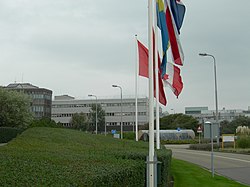
ESA Headquarters in Paris.jpg
European Space Agency headquarters in Paris
Agency overview
Abbreviation
  • ESA
  • ASE
  • EW
Formed30 May 1975;50 years ago (1975-05-30)
Type Space agency
HeadquartersParis, France
48°50′54″N02°18′15″E / 48.84833°N 2.30417°E / 48.84833; 2.30417
Official languageEnglish, French and German (working languages) [1] [2]
Administrator Josef Aschbacher (Director General of the European Space Agency)
Primary spaceport Guiana Space Centre
Owners
23 members
  • Flag of Austria.svg Austria
  • Flag of Belgium (civil).svg Belgium
  • Flag of the Czech Republic.svg Czechia
  • Flag of Denmark.svg Denmark
  • Flag of Estonia.svg Estonia
  • Flag of Finland.svg Finland
  • Flag of France.svg France
  • Flag of Germany.svg Germany
  • Flag of Greece.svg Greece
  • Flag of Hungary.svg Hungary
  • Flag of Ireland.svg Ireland
  • Flag of Italy.svg Italy
  • Flag of Luxembourg.svg Luxembourg
  • Flag of the Netherlands.svg Netherlands
  • Flag of Norway.svg Norway
  • Flag of Poland.svg Poland
  • Flag of Portugal (official).svg Portugal
  • Flag of Romania.svg Romania
  • Flag of Slovenia.svg Slovenia
  • Flag of Spain.svg Spain
  • Flag of Sweden.svg Sweden
  • Flag of Switzerland (Pantone).svg  Switzerland
  • Flag of the United Kingdom.svg United Kingdom
Employees2,547 (2023) [3]
Annual budgetIncrease2.svg €7.68 billion (US$9.08 billion) (2025) [4]
Website esa.int

The European Space Agency (ESA), [a] pronounced 'ee-sah', [7] is a 23-member international organisation devoted to space exploration. [8] It has its headquarters in Paris and a staff of around 2,547 people globally as of 2023. [9] ESA was founded in 1975 in the context of European integration. Its 2025 annual budget was €7.7 billion. [4]

Contents

The ESA human spaceflight programme includes participation in the International Space Station (ISS) and collaboration with NASA on the Artemis programme, especially manufacturing of the Orion spacecraft's European Service Module (ESM). ESA launches and operates uncrewed missions to the Moon, Mars, Jupiter, Venus, Mercury, the Sun, and various comets and asteroids. Other activities include space telescopes, Earth observation satellites, asteroid impact avoidance, telecommunication and navigation satellites, designing launch vehicles (e.g. Ariane 6 is operated through Arianespace with ESA sharing in the costs), and maintaining Europe's Spaceport (the Guiana Space Centre at Kourou, French Guiana), as well as space safety [10] and commercialisation. [11]

Mission

The treaty establishing the European Space Agency reads: [12]

"The purpose of the Agency shall be to provide for and to promote, for exclusively peaceful purposes, cooperation among European States in space research and technology and their space applications, with a view to their being used for scientific purposes and for operational space applications systems."

ESA is responsible for setting a unified space and related industrial policy, recommending space objectives to the member states, and integrating national programs like satellite development, into the European program as much as possible. [12]

Jean-Jacques Dordain—ESA's Director General (2003–2015)—outlined the European Space Agency's mission in a 2003 interview: [13]

"Today space activities have pursued the benefit of citizens, and citizens are asking for a better quality of life on Earth. They want greater security and economic wealth, but they also want to pursue their dreams, to increase their knowledge, and they want younger people to be attracted to the pursuit of science and technology.

I think that space can do all of this: it can produce a higher quality of life, better security, more economic wealth, and also fulfill our citizens' dreams and thirst for knowledge, and attract the young generation. This is the reason space exploration is an integral part of overall space activities. It has always been so, and it will be even more important in the future."

At the ministerial council of 2025, ESA member states widened the agency's mandate to include defense. [14] The resolution reads: [15] [16]

"ESA's intergovernmental framework provides the credentials and tools for developing space technologies and systems [...] for security and defence and to implement corresponding activities."

History

Europa II rocket (larger horizontal rocket in the background), Skylark sounding rocket (front center-left), and a model of the Ariane 4 orbital rocket (to the right from Skylark) at Euro Space Center Euro Space Center in Belgium.JPG
Europa II rocket (larger horizontal rocket in the background), Skylark sounding rocket (front center-left), and a model of the Ariane 4 orbital rocket (to the right from Skylark) at Euro Space Center
Pierre Auger (far left) visiting the European Space Research and Technology Centre ESTEC on 3 February 1967 ESTEC-PHOTO-1967.02.186-001.jpg
Pierre Auger (far left) visiting the European Space Research and Technology Centre ESTEC on 3 February 1967
Solar and Heliospheric Observatory (SOHO) observing the Sun SOHO ESA350759.jpg
Solar and Heliospheric Observatory (SOHO) observing the Sun
Spacelab on STS-9 STS-9 Spacelab 1.jpg
Spacelab on STS-9
Ulysses spacecraft The Ulysses spacecraft undergoes testing at the vacuum spin-balancing facility in ESTEC.jpg
Ulysses spacecraft
Ariane 4 rocket Ariane42P rocket.png
Ariane 4 rocket
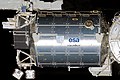
Columbus module at ISS STS-122 docked Columbus.jpg
Columbus module at ISS
Huygens landing on Titan Titansurface-2-hi-1-.jpg
Huygens landing on Titan
ATV Jules Verne near ISS Jules verne at iss.jpg
ATV Jules Verne near ISS
Rosetta and Philae Rosetta and Philae at comet (11206660686).jpg
Rosetta and Philae
Cupola module at ISS Iss065e241659.jpg
Cupola module at ISS
JUICE at Jupiter Juice launch kit cover close-up.png
JUICE at Jupiter
Orion and ESM approach the Moon Artemis 1 - Orion and ESM approach Moon.jpg
Orion and ESM approach the Moon
Euclid space telescope Euclid looking into the Universe ESA24697255 (cropped).jpg
Euclid space telescope
Ariane 6 rocket Ariane 6 on pad.jpg
Ariane 6 rocket

After World War II, many European scientists left Western Europe to work with the United States. Although the 1950s boom made it possible for Western European countries to invest in research and specifically in space-related activities, Western European scientists realised solely national projects would not be able to compete with the two superpowers. In 1958, only months after the Sputnik shock, Edoardo Amaldi (Italy) and Pierre Auger (France), two prominent members of the Western European scientific community, met to discuss the foundation of a common Western European space agency. The meeting was attended by scientific representatives from eight countries. [17] [18] [19]

The Western European nations decided to have two agencies: one concerned with developing a launch system, ELDO (European Launcher Development Organisation), of which Renzo Carrobio di Carrobio became the first Secretary General from 1964 to 1971, [20] and the other the precursor of the European Space Agency, ESRO (European Space Research Organisation), led by Pierre Auger. The latter was established on 20 March 1964 by an agreement signed on 14 June 1962. From 1968 to 1972, ESRO launched seven research satellites, but ELDO was not able to deliver a launch vehicle. Both agencies struggled with the underfunding and diverging interests of their participants. [21] [22]

Foundation

The ESA in its current form was founded with the ESA Convention in 1975, when ESRO was merged with ELDO. ESA had ten founding member states: Belgium, Denmark, France, West Germany, Italy, the Netherlands, Spain, Sweden, Switzerland, and the United Kingdom. [23] These signed the ESA Convention in 1975 and deposited the instruments of ratification by 1980, when the convention came into force. [24] During this interval the agency functioned in a de facto fashion. [25]

First science missions

ESA launched its first major scientific mission in 1975, Cos-B , a satellite monitoring gamma-ray emissions in the universe, which was first worked on by ESRO. [26] ESA collaborated with NASA on the International Ultraviolet Explorer (IUE), the world's first high-orbit telescope, which was launched in 1978 and operated successfully for 18 years. [27] [28] A number of successful Earth-orbit projects followed, and in 1986 ESA began Giotto, its first deep-space mission, to study the comets Halley and Grigg–Skjellerup. [29] Hipparcos , a star-mapping mission, was launched in 1989 [30] and in the 1990s SOHO, Ulysses , and the Hubble Space Telescope were all jointly carried out with NASA. [31] [32] [33] [34] Later scientific missions in cooperation with NASA include the Cassini–Huygens space probe, to which the ESA contributed by building the Titan landing module Huygens . [35]

First launch vehicles

As the successor of ELDO, the ESA has also constructed rockets for scientific and commercial payloads. Ariane 1, launched in 1979, carried mostly commercial payloads into orbit from 1984 onward. The next two versions of the Ariane rocket family were intermediate stages in the development of a more advanced launch system, the Ariane 4, which operated between 1988 and 2003 and established the ESA as the world leader in commercial space launches in the 1990s. [36] [37] Although the succeeding Ariane 5 experienced a failure on its first flight in 1996, [38] it has since firmly established itself within the heavily competitive commercial space launch market with 112 successful launches until 2023. [39] [40] In 1998, ESA started developing the small-lift launch vehicle Vega. [41]

First astronauts

Astronauts from the future ESA member states have been joining Soviet space missions since 1978. [42] [43] The first ESA astronaut to fly to space was Ulf Merbold who joined the STS-9 mission of the American Space Shuttle in 1983, that carried the first European-built Spacelab laboratory module. [44] The experience gained during the Spacelab programme was later instrumental in developing the International Space Station (ISS). [45] [46] [47] Since then, ESA astronauts have been joining Space Shuttle flights, as well as Russian Soyuz flights to the Mir space station. [48] [49] [50] During the 1980s and 1990s, ESA was considering developing its own crewed spacecraft Hermes [51] and a small space station Columbus MTFF. [52] These plans were later abandoned and instead, ESA joined the International Space Station (ISS) programme with Columbus being repurposed as one of the station's laboratory modules and ESA astronauts flying to the station on American and Russian spacecraft. [53] [54]

ESA in the 2000s

The beginning of the new millennium saw the ESA become, along with agencies like NASA and JAXA, one of the major participants in space research. [55] Although ESA had relied on co-operation with NASA in previous decades, changed circumstances, such as tough legal restrictions on information sharing under ITAR, [56] led to decisions to rely more on itself and on cooperation with Roscosmos. [57]

The agency continued its contribution to the International Space Station (ISS) programme with European astronauts joining assembly flights as well as long-term missions to the station. In 2008, ESA added its laboratory module Columbus to ISS and started launching the ATV cargo spacecraft. [58] During the 2000s, ESA was considering cooperation with Russia on the proposed Kliper and CSTS crewed vehicles, but neither of these was developed. [59] [60] [61] [62] [63]

Notable deep space missions during the 2000s included the agency's first Moon, Mars, and Venus orbiters: SMART-1 , [64] Mars Express , and Venus Express . [65] [66] ESA's Huygens probe, launched together with the NASA's Cassini mission in 1997, reached its destination in 2005 when it successfully landed on Titan, marking the farthest landing from Earth a spacecraft has ever made. [67] The comet orbiter Rosetta launched in 2004 and performed multiple deep space flybys and observations during the decade, but wouldn't reach its destination until 2014. [68]

ESA has launched multiple major astronomy missions in the 2000s: the gamma ray observatory INTEGRAL , [69] the infrared observatory Herschel, the cosmic microwave background mapper Planck, [70] and Corot, a milestone in the search for exoplanets. [71] Notable Earth observation missions launched during the decade included Envisat, Double Star, GOCE, SMOS, and the experimental PROBA series. ESA also contributed to the meteorological constellations Meteosat and MetOp and tested technologies for the future Galileo satellite navigation system with two GIOVE satellites.

During the 2000s, ESA pursued the Aurora programme which planned to launch a series of increasingly ambitious missions culminating in a crewed landing on Mars. [72] The programme was eventually abandoned with only the ExoMars series of astrobiology space probes to Mars remaining active. ExoMars, as well as the plans for human spaceflight to LEO, the Moon, and Mars, were later incorporated into the new Terrae Novae programme established in 2016. [73]

ESA in the 2010s

In 2010, ESA added the Cupola observation module to ISS [74] [75] and European astronauts continued joining long-term missions to the station. The ATV cargo spacecraft continued resupplying ISS until its last flight in 2015. [76] [77] In 2012, ESA committed to providing the ATV-derived European Service Module for NASA's crewed lunar spacecraft Orion. [78]

In 2014, ESA's Rosetta probe arrived at its destinatination, the Jupiter-family comet 67P/Churyumov–Gerasimenko. It became the first spacecraft ever to orbit a comet [79] and its lander Philae performed the first ever landing on a comet. [80] [81] In 2016, ESA launched its second Mars orbiter mission, the ExoMars Trace Gas Orbiter (TGO), as the first ExoMars mission within the newly established Terrae Novae programme. When the spacecraft arrived at Mars later the same year, it released the Schiaparelli lander, which failed on landing. [82] TGO, however, entered the Martian orbit and after 11 months of aerobraking began its scientific observations, focused mostly on the atmosphere of Mars. [83] In 2018, ESA and JAXA launched the joint mission BepiColombo , which is expected to arrive at Mercury in 2026. [84] [85]

Notable astronomy missions launched in 2010s were the astrometry telescope Gaia , which produced the largest and most precise 3D catalogue of astronomical objects ever made, [86] and the exoplanets-characterizing telescope CHEOPS . [87] ESA also launched LISA Pathfinder , a technology demonstrator for the future gravitational wave observatory LISA. [88] In 2010, ESA launched the cryosphere-monitoring satellite CryoSat-2 , a replacement for CryoSat-1 which had been destroyed in 2005 due to a failure of its Russian launch vehicle. [89] Another major Earth observation satellite mission of the decade was the magnetic field-observing Swarm, launched in 2013. [90]

The 2010s saw the first launches of two major European satellite constellations, to which ESA contributed alongside other European institutions, the satellite navigation system Galileo and the Earth observation programme Copernicus with its Sentinel satellites. The first operational pair of Galileo satellites was launched in 2011. [91] The radar satellite Sentinel-1A, first dedicated mission of the Copernicus programme, was launched in 2014, [92] followed by the optical imaging satellite Sentinel-2A in 2015, [93] the oceanography satellite Sentinel-3A in 2016, [94] and the air pollution-monitoring Sentinel-5p in 2017. [95]

The small-lift launch vehicle Vega, developed by the Italian company Avio, had its first flight in 2012 and then flew 22 times until 2024 when it was replaced by the more powerful Vega-C. [96] [41] In 2016, ESA started supporting the Spanish company PLD Space with FLPP funding for the development of their commercial reusable launch vehicle Miura 5. [97] [98] [99]

ESA in the 2020s

After the Russian invason of Ukraine in 2022, the cooperation between ESA and Roscosmos was mostly severed. [100] [101] [102] [103] [104] This led to a delay in the ExoMars programme [105] and ending of Soyuz launches from the Guiana Space Centre. [106] Furthermore, the Second presidency of Donald Trump brought uncertainty into many joint ESA-NASA programmes including major science missions [107] [108] and human spaceflight. [109] [110] The ministerial council held in November 2025 reacted to the changed international situation by including security and defense in ESA's mandate, [14] funding development of new European launch vehicles, [111] as well as confirming many priorities of the long term, autonomy-focused "Strategy 2040" proposed earlier in 2025 [112] [113] and approving a record budget of €22.1 billion. [114] [115]

In early 2020s, ESA has added two major components to the ISS. The Bartolomeo platform was connected to the Columbus module in 2020 to increase its capacity for external payloads. [116] The European Robotic Arm was launched in 2021 together with the Nauka module. [117] ESA continued contributing European astronauts to regular ISS expeditions, and also started paying private companies for short-term astronaut flights to the station. [118] [119] ESA also started supporting European companies in developing uncrewed space capsules for resupplying the ISS and future space stations via the LCRS initiative, [120] as well as the Indian ISRO in developing their crewed Gaganyaan spacecraft. [121] [122] The ESA-built European Service Module of the Orion spacecraft flew on its first uncrewed test flight around the Moon in 2022. [123]

The BepiColombo mission, launched in 2018, has completed all its nine gravity assist maneuvers at Earth, Venus, and Mercury, in preparation for the planned 2026 insertion into Mercury orbit. [124] The heliophysics mission Solar Orbiter , launched in 2020, continues to perform periodic Venus flybys which gradually increase its orbital inclination, allowing it to observe the Sun from outside the Solar system plane. [125] The Juice mission, launched in 2023, has so far completed two gravity assist maneuvers at Earth and Venus on its way to enter an orbit around Jupiter in 2031. [126] Two European orbiters, Mars Express and TGO, continued their operations around Mars, providing scientific insights into the planet's surface and atmosphere. In 2025, Mars Express received a software update, which could allow it to stay operational until 2030s. [127]

The Hera mission, launched in 2024 as the first space mission of the optional Space Safety Programme, flew by Mars in 2025 on its way to perform a post-impact survey of the asteroid Dimorphos which had been impacted by NASA's Double Asteroid Redirection Test mission. [128] The Space Safety Programme was established in 2019 by substantially expanding the former Space Situational Awareness (SSA) programme. Since then, it has prepared an extensive series of space missions and ground-based projects focused on mitigating the dangers of near-Earth asteroids, space weather, and space debris. [129]

In the 2020s, ESA's optional Terrae Novae programme started developing two major space infrastructure projects for long term, sustainable robotic exploration of the Moon and Mars. The Argonaut landers will deliver heavy payloads to the lunar surface. [130] The LightShip interplanetary space tugs equipped with solar electric propulsion will deliver other spacecraft to Mars and then serve as communication, navigation, and weather satellites within the MARCONI constellation in high Mars orbit. [131] Additionally, the optional Advanced Research in Telecommunication Systems (ARTES) programme started developing the Moonlight Initiative intended to place a constellation of communication and navigation satellites around the Moon. [132]

The long-awaited NASA-ESA-CSA space telescope JWST finally launched in 2021 [133] and started operating in its halo orbit around the Sun–Earth L2 point in 2022. [134] The first half of 2023 saw the launch the Euclid space telescope designed to better understand dark energy and dark matter by accurately measuring the accelerating expansion of the universe. [135] The experimental PROBA-3 mission, launched in 2024, successfully demonstrated high-precision formation flying for coronagraphy observation of the Sun. [136]

The successor to the Vega launch vehicle, Vega C, launched successfully for the first time on 13 July 2022, delivering the LARES 2 satellite and six CubeSats to Earth orbit. [137] [138] The successor to the Ariane 5 launch vehicle, Ariane 6, had its maiden flight on 9 July 2024, followed by the first commercial launch on 6 March 2025. [139] In the 2020s, ESA started supporting aspiring European commercial launch providers with substantial development funding and launch contracts through the Boost! programme, [140] the Flight Ticket Initiative, [141] and the European Launcher Challenge (ELC). [142] [143] [144] [145]

Facilities

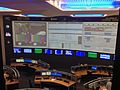
European Space Operations Centre in Darmstadt, Germany. Views in the Main Control Room (12052189474).jpg
European Space Operations Centre in Darmstadt, Germany.
ESTEC buildings in Noordwijk, Netherlands. ESA-ESTEC5.jpg
ESTEC buildings in Noordwijk, Netherlands.

The agency's facilities date back to ESRO and are deliberately distributed among various countries and areas. The most important are the following centres:

Programmes

Mandatory programmes

Every member state must contribute to the mandatory programmes. [146] The contributions to the mandatory programmes are calculated based on the stats' Gross National Product. [147] Decisions about these programmes are taken unanimously. [148]

Optional programmes

Depending on their individual choices, the member states can contribute to optional programmes. [148]

Member states, funding, and budget

ESA Members Map.svg
  ESA member states
  ESA associate states
  ESA cooperating state
  ESA ECS states
  ESA Cooperation Agreement states

Membership and contribution to the ESA

Member states participate to varying degrees with both mandatory space programs and those that are optional. As of 2008, the mandatory programmes made up 25% of total expenditures while optional space programmes were the other 75%. [159] The ESA has traditionally implemented a policy of "georeturn", where funds that ESA member states provide to the ESA "are returned in the form of contracts to companies in those countries." [160]

By 2015, the ESA was an intergovernmental organisation of 22 member states. [8] The 2008 ESA budget amounted to €3.0 billion whilst the 2009 budget amounted to €3.6 billion. [161] The total budget amounted to about €3.7 billion in 2010, €3.99 billion in 2011, €4.02 billion in 2012, €4.28 billion in 2013, €4.10 billion in 2014, €4.43 billion in 2015, €5.25 billion in 2016, €5.75 billion in 2017, €5.60 billion in 2018, €5.72 billion in 2019, €6.68 billion in 2020, €6.49 billion in 2021, €7.15 billion in 2022, €7.46 billion in 2023 and €7.79 billion in 2024. [162]

English and French are the two official languages of the ESA. [163] Additionally, official documents are also provided in German and documents regarding the Spacelab have been also provided in Italian. If found appropriate, the agency may conduct its correspondence in any language of a member state. [164]

The following table lists all the member states and adjunct members, their ESA convention ratification dates, and their contributions as of 2024: [165]

Member state or partnerRatification of ESA convention
or association agreement [166]
National programmeContributions
M€% of totalPer capita (€) [167] [ full citation needed ]
Full member states
Flag of Europe.svg Flag of Austria.svg Austria [note 1] 30 December 1986 ALR 62.41.2%6.85
Flag of Europe.svg Flag of Belgium (civil).svg Belgium [note 2] 3 October 1978 BELSPO 292.65.6%24.91
Flag of Europe.svg Flag of the Czech Republic.svg Czechia12 August 2008 Ministry of Transport 48.40.9%4.47
Flag of Europe.svg Flag of Denmark.svg Denmark [note 2] 15 September 1977 UFM 35.10.7%5.92
Flag of Europe.svg Flag of Estonia.svg Estonia1 September 2015 ESO 7.00.1%5.12
Flag of Europe.svg Flag of Finland.svg Finland1 January 1995 TEM 33.50.6%6.02
Flag of Europe.svg Flag of France.svg France [note 2] 30 October 1980 CNES 1,048.420.1%15.38
Flag of Europe.svg Flag of Germany.svg Germany [note 2] 26 July 1977 DLR 1,171.622.4%14.10
Flag of Europe.svg Flag of Greece.svg Greece9 March 2005 HSC 16.10.3%1.55
Flag of Europe.svg Flag of Hungary.svg Hungary4 November 2015 HSO 23.20.4%2.42
Flag of Europe.svg Flag of Ireland.svg Ireland [note 1] 10 December 1980 Enterprise Ireland 22.80.4%4.33
Flag of Europe.svg Flag of Italy.svg Italy [note 2] 20 February 1978 ASI 881.216.9%14.94
Flag of Europe.svg Flag of Luxembourg.svg Luxembourg30 June 2005 LSA 41.60.8%62.95
Flag of Europe.svg Flag of the Netherlands.svg Netherlands [note 2] 6 February 1979 NSO 117.12.2%6.57
EFTA logo2.svg Flag of Norway.svg Norway [note 1] 30 December 1986 NSA 71.41.4%13.01
Flag of Europe.svg Flag of Poland.svg Poland19 November 2012 POLSA 47.70.9%1.30
Flag of Europe.svg Flag of Portugal (official).svg Portugal14 November 2000 PT Space 19.40.4%1.85
Flag of Europe.svg Flag of Romania.svg Romania22 December 2011 ROSA 51.01.0%2.68
Flag of Europe.svg Flag of Slovenia.svg Slovenia1 January 2025 SPACE-SI 3.90.1%1.84
Flag of Europe.svg Flag of Spain.svg Spain [note 2] 7 February 1979 AEE 297.55.7%6.19
Flag of Europe.svg Flag of Sweden.svg Sweden [note 2] 6 April 1976 SNSA 80.01.5%7.60
EFTA logo2.svg Flag of Switzerland (Pantone).svg  Switzerland [note 2] 19 November 1976 SSO 188.23.6%21.35
Flag of the United Kingdom.svg United Kingdom [note 2] 28 March 1978 UKSA 448.98.6%6.60
Others203.23.9%
Non-full members
Flag of Canada (Pantone).svg Canada [note 3] 1 January 1979 [169] [note 4] CSA 11.00.2%0.28
Flag of Europe.svg Flag of Latvia.svg Latvia27 July 2020 [171] [note 4] LSO 0.50.0%0.27
Flag of Europe.svg Flag of Lithuania.svg Lithuania21 May 2021 [172] [note 4] LSA 0.90.0%0.32
Flag of Europe.svg Flag of Slovakia.svg Slovakia13 October 2022 [173] [note 4] SSO 3.50.1%0.65
5,024.964.5%
Flag of Europe.svg European Union28 May 2004 [174] EUSPA 1,822.623.4%4.06
EUMETSAT 116.41.5%
821.210.5%
2,760.235.5%
7,785.1100%
  1. 1 2 3 These nations are considered initial signatories, but since they were members of neither ESRO nor ELDO (the precursor organisations to ESA) the Convention could only enter into force when the last of the other 10 founders ratified it.
  2. 1 2 3 4 5 6 7 8 9 10 Founding members and initial signatories drafted the ESA charter which entered into force on 30 October 1980. These nations were also members of either ELDO or ESRO. [168]
  3. Canada is a Cooperating State of ESA. [169] [170]
  4. 1 2 3 4 Date of ratification of association agreement.
  5. Framework Agreement establishing the legal basis for cooperation between ESA and the European Union came into force in May 2004.

Non-full member states

Previously associated members were Austria, Norway, Finland and Slovenia, all of which later joined the ESA as full members. Since January 2025 there have been four associate members: Latvia, Lithuania, Slovakia and Canada. The three European members have shown interest in full membership and may eventually apply within the next years.

Latvia

Latvia became the second current associated member on 30 June 2020, when the Association Agreement was signed by ESA Director Jan Wörner and the Minister of Education and Science of Latvia, Ilga Šuplinska in Riga. The Saeima ratified it on 27 July. [171]

Lithuania

In May 2021, Lithuania became the third current associated member. [175] As a consequence its citizens became eligible to apply to the 2022 ESA Astronaut group, applications for which were scheduled to close one week later. The deadline was therefore extended by three weeks to allow Lithuanians a fair chance to apply. [176]

Slovakia

Slovakia's Associate membership came into effect on 13 October 2022, for an initial duration of seven years. The Association Agreement supersedes the European Cooperating State (ECS) Agreement, which entered into force upon Slovakia's subscription to the Plan for European Cooperating States Charter on 4 February 2016, a scheme introduced at ESA in 2001. The ECS Agreement was subsequently extended until 3 August 2022. [173]

Cyprus

Cyprus has signed an Associate Agreement in October 2025, with expectations of becoming an associate member in the coming months. [177]

Canada

Since 1 January 1979, Canada has had the special status of a Cooperating State within the ESA. By virtue of this accord, the Canadian Space Agency takes part in the ESA's deliberative bodies and decision-making and also in the ESA's programmes and activities. Canadian firms can bid for and receive contracts to work on programmes. The accord has a provision ensuring a fair industrial return to Canada. [178] The most recent Cooperation Agreement was signed on 12 February 2019 with a term extending to 2030. [179] For 2014, Canada's annual assessed contribution to the ESA general budget was €6,059,449 (CAD$8,559,050). [180] This annual contribution increased in 2017 to €21,600,000 (CAD$30,000,000). [181] In 2025, the Government of Canada announced a plan to increase contributions to the ESA by €326,000,000 (CAD$528,500,000) over the following three to five-year period. [182] [183]


Budget appropriation and allocation

European Space Agency 2016 budget by domain out of a total budget is 5250MEUR. Easbars.png
European Space Agency 2016 budget by domain out of a total budget is 5250M€.

The ESA is funded from annual contributions by national governments of members as well as from an annual contribution by the European Union (EU). [184]

The budget of the ESA was €5.250 billion in 2016. [185] Every 3–4 years, ESA member states agree on a budget plan for several years at an ESA member states conference. This plan can be amended in future years, however provides the major guideline for the ESA for several years. [ citation needed ] The 2016 budget allocations for major areas of the ESA activity are shown in the chart on the right. [185]

Countries typically have their own space programmes that differ in how they operate organisationally and financially with the ESA. For example, the French space agency CNES has a total budget of €2,015 million, of which €755 million is paid as direct financial contribution to the ESA. [186] Several space-related projects are joint projects between national space agencies and the ESA (e.g. COROT). Also, the ESA is not the only European governmental space organisation (for example European Union Satellite Centre and the European Union Space Programme Agency).

Enlargement

After the decision of the ESA Council of 21/22 March 2001, the procedure for accession of the European states was detailed as described the document titled "The Plan for European Co-operating States (PECS)". [187] Nations that want to become a full member of the ESA do so in 3 stages. First a Cooperation Agreement is signed between the country and ESA. In this stage, the country has very limited financial responsibilities. If a country wants to co-operate more fully with ESA, it signs a European Cooperating State (ECS) Agreement, albeit to be a candidate for said agreement, a country must be European. The ECS Agreement makes companies based in the country eligible for participation in ESA procurements. The country can also participate in all ESA programmes, except for the Basic Technology Research Programme. While the financial contribution of the country concerned increases, it is still much lower than that of a full member state. The agreement is normally followed by a Plan For European Cooperating State (or PECS Charter). This is a 5-year programme of basic research and development activities aimed at improving the nation's space industry capacity. At the end of the 5-year period, the country can either begin negotiations to become a full member state or an associated state or sign a new PECS Charter. [188] Many countries, most of which joined the EU in both 2004 and 2007, have started to co-operate with the ESA on various levels:

Applicant stateCooperation agreementECS agreementPECS charterAssociation agreement signatureAssociate membershipNational programme
Flag of Europe.svg Flag of Latvia.svg Latvia23 July 2009 [189] 19 March 2013 [190] 30 January 2015 [191] 30 June 2020 [171] 27 July 2020 [171] LSO
Flag of Europe.svg Flag of Lithuania.svg Lithuania7 October 2010 [192] 7 October 2014 [193] 28 September 2015 [172] 28 April 2021 [172] 21 May 2021 [172] LSA
Flag of Europe.svg Flag of Slovakia.svg Slovakia28 April 2010 [194] 16 February 2015 [195] 4 February 2016 [173] 14 June 2022 [173] 13 October 2022 [173] SSO
Flag of Europe.svg Flag of Cyprus.svg Cyprus27 August 2009 [196] 6 July 2016 [197] 24 April 2017 [198] 23 October 2025 [177] through MoCW
Flag of Europe.svg Flag of Bulgaria.svg Bulgaria11 June 2014 [199] [200] 8 April 2015 [201] 4 February 2016 [202] SRTI
Flag of Europe.svg Flag of Croatia.svg Croatia19 February 2018 [203] 23 March 2023 [204] 16 August 2023 [205] through MoSE
Flag of Europe.svg Flag of Malta.svg Malta20 February 2012 [206] 25 October 2023 [207] 12 September 2024 [207] MCST
Flag of Turkey.svg Turkey15 July 2004 [208] TUA
(agreement with TÜBİTAK UZAY)
Flag of Ukraine.svg Ukraine25 January 2008 [209] SSAU
Flag of Israel.svg Israel30 January 2011 [210] ISA
Flag of Mexico.svg Mexico14 February 2023 [211] AEM

During the Ministerial Meeting in December 2014, ESA ministers approved a resolution calling for discussions to begin with Israel, Australia and South Africa on future association agreements. The ministers noted that "concrete cooperation is at an advanced stage" with these nations and that "prospects for mutual benefits are existing". [212]

A separate space exploration strategy resolution calls for further co-operation with the United States, Russia and China on "LEO exploration, including a continuation of ISS cooperation and the development of a robust plan for the coordinated use of space transportation vehicles and systems for exploration purposes, participation in robotic missions for the exploration of the Moon, the robotic exploration of Mars, leading to a broad Mars Sample Return mission in which Europe should be involved as a full partner, and human missions beyond LEO in the longer term." [212]

In August 2019, the ESA and the Australian Space Agency signed a joint statement of intent "to explore deeper cooperation and identify projects in a range of areas including deep space, communications, navigation, remote asset management, data analytics and mission support." [213] Details of the cooperation were laid out in a framework agreement signed by the two entities.

On 17 November 2020, ESA signed a memorandum of understanding (MOU) with the South African National Space Agency (SANSA). SANSA CEO Dr. Valanathan Munsami tweeted: "Today saw another landmark event for SANSA with the signing of an MoU with the ESA. This builds on initiatives that we have been discussing for a while already and which gives effect to these. Thanks Jan for your hand of friendship and making this possible." [214]

Launch vehicles

Mock-up of the Ariane 1 Ariane 1 Le Bourget FRA 001.jpg
Mock-up of the Ariane 1

The ESA currently has two operational launch vehicles Vega C and Ariane 6. [215] Rocket launches are carried out by Arianespace, which has 23 shareholders representing the industry that manufactures the Ariane 5 as well as CNES, at the ESA's Guiana Space Centre. Because many communication satellites have equatorial orbits, launches from French Guiana are able to take larger payloads into space than from spaceports at higher latitudes. In addition, equatorial launches give spacecraft an extra 'push' of nearly 500 m/s due to the higher rotational velocity of the Earth at the equator compared to near the Earth's poles where rotational velocity approaches zero. In 2014, ESA proposed changes to the Ariane family development scheme by moving to competitive bids for the development of Ariane 6. [216]

Ariane 6

Ariane 6 is a heavy lift expendable launch vehicle developed by Arianespace. The Ariane 6 entered into its inaugural flight campaign on 26 April 2024 with the flight conducted on 9 July 2024. [217]

Vega-C

Vega rocket Sentinel-2 and vega.jpg
Vega rocket

Vega is the ESA's carrier for small satellites. Developed by seven ESA members led by Italy. It is capable of carrying a payload with a mass of between 300 and 1500 kg to an altitude of 700 km, for low polar orbit. Its maiden launch from Kourou was on 13 February 2012. [218] Vega began full commercial exploitation in December 2015. [219]

The rocket has three solid propulsion stages and a liquid propulsion upper stage (the AVUM) for accurate orbital insertion and the ability to place multiple payloads into different orbits. [220] [221]

A larger version of the Vega launcher, Vega-C had its first flight in July 2022. [222] The new evolution of the rocket incorporates a larger first stage booster, the P120C replacing the P80, an upgraded Zefiro (rocket stage) second stage, and the AVUM+ upper stage. This new variant enables larger single payloads, dual payloads, return missions, and orbital transfer capabilities. [223]

Future rocket development

Future projects under development within the Future Launchers Preparatory Programme (FLPP) include the Prometheus reusable engine technology demonstrator, Phoebus (an upgraded second stage for Ariane 6), and Themis (a reusable first stage). [224] [225]

Human spaceflight

Ulf Merbold became the first ESA astronaut to fly into space. Ulf D. Merbold.jpg
Ulf Merbold became the first ESA astronaut to fly into space.

Formation and development

Spacelab, artist's concept Spacelab - Artist's Concept.jpg
Spacelab, artist's concept
Wubbo Ockels in the Spacelab, 1985 Wubbo-sl1.jpg
Wubbo Ockels in the Spacelab, 1985
Hermes mockup on display during the Sevilla Expo 92 Sevilla Expo 92-Projecto ESA-1992 05 05.jpg
Hermes mockup on display during the Sevilla Expo 92
ISS module Columbus at Kennedy Space Center's Space Station Processing Facility Columbus module delivered to KSC.jpg
ISS module Columbus at Kennedy Space Center's Space Station Processing Facility
Samantha Cristoforetti on the Biolab in the Columbus module ISS-43 Samantha Cristoforetti on the Biolab in the Columbus module.jpg
Samantha Cristoforetti on the Biolab in the Columbus module
Timothy Peake in the Cupola ISS-46 Timothy Peake with Space Seeds in the Cupola.jpg
Timothy Peake in the Cupola
ATV Jules Verne seen at the bottom of the ISS ISS after STS-124 06 2008 (cropped).jpg
ATV Jules Verne seen at the bottom of the ISS
European Robotic Arm The European robotic arm extends out from the Nauka module (iss067e034864) (cropped).jpg
European Robotic Arm

At the time the ESA was formed, its main goals did not encompass human space flight; rather it considered itself to be primarily a scientific research organisation for uncrewed space exploration in contrast to its American and Soviet counterparts. It is therefore not surprising that the first non-Soviet European in space was not an ESA astronaut on a European space craft; it was Czechoslovak Vladimír Remek who in 1978 became the first non-Soviet or American in space (the first man in space being Yuri Gagarin of the Soviet Union) – on a Soviet Soyuz spacecraft, followed by the Pole Mirosław Hermaszewski and East German Sigmund Jähn in the same year. This Soviet co-operation programme, known as Intercosmos, primarily involved the participation of Eastern bloc countries. In 1982, however, Jean-Loup Chrétien became the first non-Communist Bloc astronaut on a flight to the Soviet Salyut 7 space station.

Because Chrétien did not officially fly into space as an ESA astronaut, but rather as a member of the French CNES astronaut corps, the German Ulf Merbold is considered the first ESA astronaut to fly into space. He participated in the STS-9 Space Shuttle mission that included the first use of the European-built Spacelab in 1983. STS-9 marked the beginning of an extensive ESA/NASA joint partnership that included dozens of space flights of ESA astronauts in the following years. Some of these missions with Spacelab were fully funded and organisationally and scientifically controlled by the ESA (such as two missions by Germany and one by Japan) with European astronauts as full crew members rather than guests on board. Beside paying for Spacelab flights and seats on the shuttles, the ESA continued its human space flight co-operation with the Soviet Union and later Russia, including numerous visits to Mir.

During the latter half of the 1980s, European human space flights changed from being the exception to routine and therefore, in 1990, the European Astronaut Centre in Cologne, Germany was established. It selects and trains prospective astronauts and is responsible for the co-ordination with international partners, especially with regard to the International Space Station. As of 2006, the ESA astronaut corps officially included twelve members, including nationals from most large European countries except the United Kingdom.

In 2008, the ESA started to recruit new astronauts so that final selection would be due in spring 2009. Almost 10,000 people registered as astronaut candidates before registration ended in June 2008. 8,413 fulfilled the initial application criteria. Of the applicants, 918 were chosen to take part in the first stage of psychological testing, which narrowed down the field to 192. After two-stage psychological tests and medical evaluation in early 2009, as well as formal interviews, six new members of the European Astronaut Corps were selected – five men and one woman. [226]

Crew vehicles

In the 1980s, France pressed for an independent European crew launch vehicle. Around 1978, it was decided to pursue a reusable spacecraft model and starting in November 1987 a project to create a mini-shuttle by the name of Hermes was introduced. The craft was comparable to early proposals for the Space Shuttle and consisted of a small reusable spaceship that would carry 3 to 5 astronauts and 3 to 4 metric tons of payload for scientific experiments. With a total maximum weight of 21 metric tons it would have been launched on the Ariane 5 rocket, which was being developed at that time. It was planned solely for use in low Earth orbit space flights. The planning and pre-development phase concluded in 1991; the production phase was never fully implemented because at that time the political landscape had changed significantly. With the fall of the Soviet Union, the ESA looked forward to co-operation with Russia to build a next-generation space vehicle. Thus the Hermes programme was cancelled in 1995 after about 3 billion dollars had been spent. The Columbus space station programme had a similar fate.

In the 21st century, ESA started new programmes to create its own crew vehicles, most notable among its various projects and proposals is Hopper, whose prototype by EADS, called Phoenix, has already been tested. While projects such as Hopper are neither concrete nor to be realised within the next decade, other possibilities for human spaceflight in co-operation with the Russian Space Agency have emerged. Following talks with the Russian Space Agency in 2004 and June 2005, [227] a co-operation between the ESA and the Russian Space Agency was announced to jointly work on the Russian-designed Kliper, a reusable spacecraft that would be available for space travel beyond LEO (e.g. the moon or even Mars). It was speculated that Europe would finance part of it. A€50 million participation study for Kliper, which was expected to be approved in December 2005, was finally not approved by ESA member states. The Russian state tender for the project was subsequently cancelled in 2006.

In June 2006, ESA member states granted 15 million to the Crew Space Transportation System (CSTS) study, a two-year study to design a spacecraft capable of going beyond Low-Earth orbit based on the current Soyuz design. This project was pursued with Roskosmos instead of the cancelled Kliper proposal. A decision on the actual implementation and construction of the CSTS spacecraft was contemplated for 2008. In mid-2009 EADS Astrium was awarded a €21 million study into designing a crew vehicle based on the European ATV which was believed to be the basis of the Advanced Crew Transportation System design. [228] Neither of these projects was pursued further in the 2010s.

In November 2012, ESA decided to join NASA's Orion programme. The ATV would form the basis of the European Service Module (ESM) for NASA's new crewed spacecraft. ESA may also seek to work with NASA on Orion's launch system as well to secure a seat on the spacecraft for its own astronauts. [229] The complete Orion with ESM flew on its first mission to Lunar orbit in 2022. [230]

In September 2014, the ESA signed an agreement with Sierra Nevada Corporation for co-operation in Dream Chaser project. Further studies on the Dream Chaser for European Use or DC4EU project were funded, including the feasibility of launching a Europeanised Dream Chaser onboard Ariane 5. [231] [232]

International Space Station (ISS)

With regard to the International Space Station (ISS), the ESA is not represented by all of its member states: [233] 11 of the 22 ESA member states currently participate in the project: Belgium, Denmark, France, Germany, Italy, Netherlands, Norway, Spain, Sweden, Switzerland, and the United Kingdom. Austria, Finland and Ireland chose not to participate, because of lack of interest or concerns about the expense of the project. Portugal, Luxembourg, Greece, the Czech Republic, Romania, Poland, Estonia, and Hungary joined ESA after the agreement had been signed.

ESA takes part in the construction and operation of the ISS, with contributions such as Columbus, a science laboratory module that was brought into orbit by NASA's STS-122 Space Shuttle mission, and the Cupola observatory module that was completed in July 2005 by Alenia Spazio for the ESA. The current estimates for the ISS are approaching €100 billion in total (development, construction and 10 years of maintaining the station) of which the ESA has committed to paying €8 billion. [234] About 90% of the costs of the ESA's ISS share will be contributed by Germany (41%), France (28%) and Italy (20%). German ESA astronaut Thomas Reiter was the first long-term ISS crew member.

ESA has developed the Automated Transfer Vehicle for ISS resupply. Each ATV has a cargo capacity of 7,667 kilograms (16,903 lb). [235] The first ATV, Jules Verne , was launched on 9 March 2008 and on 3 April 2008 successfully docked with the ISS. This manoeuvre, considered a major technical feat, involved using automated systems to allow the ATV to track the ISS, moving at 27,000 km/h, and attach itself with an accuracy of 2 cm. Five vehicles were launched before the program ended with the launch of the fifth ATV, Georges Lemaître , in 2014. [236]

European Life and Physical Sciences research on board the International Space Station (ISS) is mainly based on the European Programme for Life and Physical Sciences in Space programme that was initiated in 2001.

CubeSats

ESTCube-1, the first Estonian satellite ESTCube-1 illustration.jpg
ESTCube-1 , the first Estonian satellite
GomX-4A (left) and GomX-4B (right) Los nanosatelites GomX-4A (izquierda) y GomX-4B (derecha) en un laboratorio de la ESA.jpg
GomX-4A (left) and GomX-4B (right)

Since the 2010s, ESA has launched numerous CubeSat-type small satellites supported through various programmes: [237] [238]

Plan for Cooperating States

General Support Technology Programme (GSTP)

QARMAN CubeSat in test chamber Qarman CubeSat in Hertz test chamber 23544725971 12591f5a27 o.jpg
QARMAN CubeSat in test chamber
QARMAN CubeSat deployed from ISS Qarman CubeSat deployed from ISS.jpg
QARMAN CubeSat deployed from ISS

GSTP also supports other non-CubeSat small satellite missions, e.g. the PROBA series. [239]

Fly Your Satellite! (FYS)

FYS is an educational programme for student teams developing CubeSats or PocketQubes [240]

FutureEO Programme

InCubed

The InCubed co-funding programme, managed by ESA's Φ-lab , supports innovative technologies for Earth observation satellities. [252] [253] [254]

Space Safety Programme (S2P)

Greek CubeSat In-Orbit Validation

In-Orbit Demonstration and Validation (IOD/IOV)

IOD/IOV is a European Union programme entrusted to ESA. [274] [275] [276]

Small Missions for Exploration

Cooperation with other countries and organisations

The ESA has signed co-operation agreements with the following states that currently neither plan to integrate as tightly with ESA institutions as Canada, nor envision future membership of the ESA: Argentina, [280] Brazil, [281] China, [282] India, [283] Russia, [284] and Turkey. [208] Additionally, the ESA has joint projects with the EUSPA of the European Union, NASA of the United States and is participating in the International Space Station together with the United States (NASA), Russia (Roscosmos), Japan (JAXA), and Canada (CSA).

National space organisations of member states

NASA

The ESA has a long history of collaboration with NASA. Since ESA's astronaut corps was formed, the Space Shuttle has been the primary launch vehicle used by the ESA's astronauts to get into space through partnership programmes with NASA. In the 1980s and 1990s, the Spacelab programme was an ESA-NASA joint research programme that had the ESA develop and manufacture orbital labs for the Space Shuttle for several flights in which the ESA participates with astronauts in experiments.

In October 2020, ESA entered into a memorandum of understanding (MOU) with NASA to collaborate on the Artemis program, which will provide an orbiting Lunar Gateway and also accomplish the first crewed lunar landing in 50 years, whose team will include the first woman on the Moon. Astronaut selection announcements are expected within two years of the 2024 scheduled launch date. [285] ESA also purchases seats on the NASA operated Commercial Crew Program. The first ESA astronaut to be on a Commercial Crew Program mission was Thomas Pesquet who launched into space aboard Crew Dragon Endeavour on the Crew-2 mission. Following ESA astronauts on Crew Dragon missions were Matthias Maurer (Crew-3), Samantha Cristoforetti (Crew-4), and others.

In robotic science mission and exploration missions, NASA has been the ESA's main partner. Cassini–Huygens was a joint NASA-ESA mission, along with the Infrared Space Observatory, INTEGRAL, SOHO, and others. The Hubble Space Telescope and James Webb Space Telescope are joint projects of NASA and ESA. Possible future ESA-NASA joint projects include the Laser Interferometer Space Antenna, Mars sample-return mission, and others. [286] [287]

JAXA

ESA and the Japanese Space Agency (JAXA) have engaged in long-standing collaboration in various domains of space exploration, satellite technology, space science, and human spaceflight. Their partnership has evolved over the decades, focusing on joint missions, technology sharing, and international cooperation in space exploration. [288] Some of the programs include BepiColombo Mission, EarthCARE, Hera, and Comet Interceptor. [289] [290] In 2025, ESA opened its first Asian office in Tokyo, Japan. [291]

Roscosmos

In the 2000s and 2010s, ESA collaborated with the Russian Space Agency (Roscosmos) on the development of the crewed vehicle CSTS (later cancelled), the use of French Guiana's Guiana Space Centre spaceport for launches of Soyuz-2 rockets, and the ExoMars programme including the Schiaparelli lander and the Trace Gas Orbiter. [292] [293] In 2022, most collaboration with the Russian Space Agency was terminated after Russian invasion of Ukraine. [294]

CNSA

ESA and the Chinese Space Agency (CNSA) cooperated on development of the Double Star Mission. [295] In 2017, ESA sent two astronauts to China for two weeks sea survival training with Chinese astronauts in Yantai, Shandong. [296] In 2024, the joint Einstein Probe was launched. [297] The joint SMILE mission will launch in 2025 to image for the first time the magnetosphere of the Sun in soft X-rays and UV [298]

ISRO

ESA provided instruments for the Indian Space Agency (ISRO)'s lunar mission Chandrayaan-1 in 2008. [299] Since 2024, ESA has been supporting ISRO's human spaceflight programme Gaganyaan. [300] [301] [302] [303]

AfSA

ESA has been cooperating with the African Union's African Space Agency (AfSA) since its formation (itself inspired by ESA [304] ) in 2023. [305] [306]

The ESA is an independent space agency and not under the jurisdiction of the European Union, although they have common goals, share funding, and work together often. [307] The initial aim of the European Union (EU) was to make the European Space Agency an agency of the EU by 2014. [308] While the EU and its member states fund together 86% of the budget of the ESA, it is not an EU agency. Furthermore, the ESA has several non-EU members, most notably the United Kingdom which left the EU while remaining a full member of the ESA. The ESA is partnered with the EU on its two current flagship space programmes, the Copernicus series of Earth observation satellites and the Galileo satellite navigation system, with the ESA providing technical oversight and, in the case of Copernicus, some of the funding. [309] The EU, though, has shown an interest in expanding into new areas, whence the proposal to rename and expand its satellite navigation agency (the European GNSS Agency) into the EU Agency for the Space Programme. The proposal drew strong criticism from the ESA, as it was perceived as encroaching on the ESA's turf. [309]

In January 2021, after years of acrimonious relations, EU and ESA officials mended their relationship, with the EU Internal Market commissioner Thierry Breton saying "The European space policy will continue to rely on the ESA and its unique technical, engineering and science expertise," and that the "ESA will continue to be the European agency for space matters. [309] If we are to be successful in our European strategy for space, and we will be, I will need the ESA by my side." ESA director Aschbacher reciprocated, saying "I would really like to make the ESA the main agency, the go-to agency of the European Commission for all its flagship programmes." The ESA and EUSPA are now seen to have distinct roles and competencies, which will be officialised in the Financial Framework Partnership Agreement (FFPA). [309] Whereas the ESA's focus will be on the technical elements of the EU space programmes, the EUSPA will handle the operational elements of those programmes. [309]

Employment

As of 2023, Many other facilities are operated by national space agencies in close collaboration with the ESA. The ESA employs around 2,547 people, and thousands of contractors. Initially, new employees are contracted for an expandable four-year term, which is until the organisation's retirement age of 63. According to the ESA's documents, the staff can receive myriad of perks, such as financial childcare support, retirement plans, and financial help when migrating. The ESA also prevents employees from disclosing any private documents or correspondences to outside parties. Ars Technica's 2023 report, which contained testimonies of 18 people, suggested that there is a widespread harassment between management and its employees, especially with its contractors. Since the ESA is an international organisation, unaffiliated with any single nation, any form of legal action is difficult to raise against the organisation. [310]

Security incidents

On 3 August 1984, the ESA's Paris headquarters were severely damaged and six people were hurt when a bomb exploded. It was planted by the far-left armed Action Directe group. [311]

On 14 December 2015, hackers from Anonymous breached the ESA's subdomains and leaked thousands of login credentials. [312]

See also

European Union matters

Notes

  1. French: Agence spatiale européenne pronunciation , Italian: Agenzia Spaziale Europea, Spanish: Agencia Espacial EuropeaASE; [5] [6] German: Europäische Weltraumorganisation

References

  1. "Languages". Archived from the original on 18 November 2017. Retrieved 5 November 2017.
  2. esa. "Frequently asked questions". Archived from the original on 27 August 2017. Retrieved 20 August 2017.
  3. "ESA facts". European Space Agency. Archived from the original on 28 October 2021. Retrieved 13 February 2022.
  4. 1 2 "ESA budget 2025". www.esa.int.
  5. "Annex 1 Resolution 8". ESA Convention and Council Rules of Procedure (PDF) (5th ed.). European Space Agency. March 2010. p. 116. ISBN   978-92-9092-965-9. Archived from the original on 6 June 2019. Retrieved 16 November 2014.
  6. "Agence spatiale européenne (ASE)" [European Space Agency (ESA)]. 23 February 2017. Archived from the original on 10 October 2017. Retrieved 23 February 2017.
  7. "Wording and phonetic – ESA Brand Centre". brand.esa.int. Archived from the original on 25 August 2025. Retrieved 25 November 2025.
  8. 1 2 "Welcome to ESA: New Member States". ESA. Archived from the original on 8 November 2019. Retrieved 26 July 2017.
  9. "L'ESA : faits et chiffres". www.esa.int. Retrieved 17 November 2025.
  10. "Boost in funding expands Space Safety programme". www.esa.int. Retrieved 28 November 2025.
  11. "CM25 delivers for business – launch of ACCESS signals a bright future for the European space sector".
  12. 1 2 "ESA's Purpose". European Space Agency. 14 June 2007. Archived from the original on 10 September 2014. Retrieved 6 September 2014.
  13. "Launching a New Era with JAXA: Interview with Jean-Jacques Dordain". JAXA. 31 October 2003. Archived from the original on 6 July 2005.
  14. 1 2 Hitchens, Theresa (31 October 2025). "In historic shift, ESA poised to take on defense role". Breaking Defense. Retrieved 28 November 2025.
  15. "European Space Agency to play a greater role in defense". POLITICO. 27 November 2025. Retrieved 28 November 2025.
  16. "Ministerial Council 2025". www.esa.int. Retrieved 28 November 2025.
  17. cern (31 May 2012). "Edoardo Amaldi and the origins of ESA". CERN Courier. Retrieved 23 August 2025.
  18. Lebeau, Andre (1 August 2001). "Scientific organizations and European unification: a personal view" . Technology in Society. 23 (3): 349–359. doi:10.1016/S0160-791X(01)00018-5. ISSN   0160-791X.
  19. A History of the European Space Agency
  20. https://www.esa.int/About_Us/50_years_of_ESA/Renzo_Carrobio_di_Carrobio
  21. "Commemorating 60 years since the ELDO and ESRO Conventions | ESA Archives Portal". historicalarchives.esa.int. Archived from the original on 9 June 2025. Retrieved 23 August 2025.
  22. "European Space Vehicle Launcher Development Organisation".
  23. "ESA turns 30! A successful track record for Europe in space" (Press release). European Space Agency. 31 May 2005. Archived from the original on 20 September 2018. Retrieved 6 September 2014.
  24. "UNTC". treaties.un.org. Retrieved 23 August 2025.
  25. "Signature of the Convention to entry in force: the last chapter in the creation of ESA".
  26. "COS B". Gunter's Space Page. Retrieved 23 August 2025.
  27. Heck, A.; Beeckmans, F.; Benvenuti, P.; Cassatella, A.; Clavel, J.; Macchetto, F.; Penston, M. V.; Selvelli, P. L.; Stickland, D. (1978). "The International Ultraviolet Explorer (IUE)". The Messenger. 15: 27–31. Bibcode:1978Msngr..15...27H. ISSN   0722-6691.
  28. "International Ultraviolet Explorer Is Launched". EBSCO Research Starters. www.ebsco.com. Retrieved 23 August 2025.
  29. Coates, Andrew. "ESA's Giotto mission to comets Halley and Grigg-Skjellerup". The Open University. Retrieved 23 August 2025.
  30. "From Hipparchus to Hipparcos: Measuring the Universe". wwwhip.obspm.fr. Retrieved 23 August 2025.
  31. Bonnet, R. M.; Felici, F. (1 January 1997). "Overview of the SOHO mission" . Advances in Space Research. Proceedings of the E2.1 Symposium of COSPAR Scientific Commission E. 20 (12): 2207–2218. Bibcode:1997AdSpR..20.2207B. doi:10.1016/S0273-1177(97)00894-6. ISSN   0273-1177.
  32. "Hubble Space Telescope-The Telescope, the Observations & the Servicing Mission". 24 November 1999.
  33. "Historical Context of U.S.-European Cooperation". U.S.-European Collaboration in Space Science. National Academies Press. 1998. Bibcode:1998nap..book.5981N. doi:10.17226/5981. ISBN   978-0-309-05984-8.
  34. "Ulysses Spacecraft Ends Historic Mission of Discovery". Jet Propulsion Laboratory (Press release). 30 June 2009.
  35. "ESA's Huygens probe landed on Saturn's moon Titan 15 years ago". Spaceflight Now. 14 January 2020. Retrieved 23 August 2025.
  36. "Ariane 4 / Launchers / Our Activities / ESA". European Space Agency. 14 May 2004. Archived from the original on 25 December 2012. Retrieved 13 June 2015.
  37. "Spaceflight :Arianespace and the Ariane Family of Rockets". www.centennialofflight.net. Retrieved 23 August 2025.
  38. "Ariane 501 – Presentation of Inquiry Board report". www.esa.int. Retrieved 23 August 2025.
  39. "Europe's workhorse Ariane 5 rocket to retire after 27 years service – Spaceflight Now" . Retrieved 23 August 2025.
  40. "Ending an era, Europe launches its final Ariane 5 rocket – Spaceflight Now" . Retrieved 23 August 2025.
  41. 1 2 Agency, European Space. "ESA's Vega rocket marks ten years with countdown to more powerful successor". phys.org. Retrieved 3 October 2025.
  42. "Only Czech in space Remek recalls historic flight, 40 years on". Radio Prague International. 2 March 2018. Retrieved 23 November 2025.
  43. "Premier Vol Habité: The Story of France's First Man in Space (Part 2) - AmericaSpace". www.americaspace.com. 30 June 2013. Retrieved 23 November 2025.
  44. "40 Years Ago: STS-9, the First Spacelab Science Mission - NASA". 28 November 2023. Retrieved 23 November 2025.
  45. Hamacher, H. (1996). "Microgravity environment conditions--from Spacelab to the International Space Station". Microgravity Science and Technology. 9 (3): 152–157. ISSN   0938-0108. PMID   11540236.
  46. "1999ESASP.433..653N Page 653". adsabs.harvard.edu. Retrieved 23 November 2025.
  47. Marmann, Richard A. (1 June 1997). "Using Spacelab as a precursor of science operations for the Space Station". Acta Astronautica. 40 (11): 815–820. doi:10.1016/S0094-5765(97)00127-6. ISSN   0094-5765.
  48. information@eso.org. "European astronauts set for Hubble challenge". www.esahubble.org. Retrieved 23 November 2025.
  49. "History: ESA's EuroMir astronauts, Star City, 1993". www.esa.int. Retrieved 23 November 2025.
  50. "History of Europe in space". www.esa.int. Retrieved 23 November 2025.
  51. Bayer, Martin (1 August 1995). "Hermes: Learning from our mistakes". Space Policy. 11 (3): 171–180. doi:10.1016/0265-9646(95)00016-6. ISSN   0265-9646.
  52. "Columbus Man-Tended Free Flyer - MTFF". astronautix.com. Archived from the original on 6 October 2012. Retrieved 23 November 2025.
  53. Messerschmid, E.; Haigneré, J. -P.; Damian, K.; Damann, V. (1 April 2004). "The European Astronaut Centre prepares for International Space Station operations". Acta Astronautica. 54 (7): 527–539. doi:10.1016/S0094-5765(03)00207-8. ISSN   0094-5765.
  54. SpaceRef (21 May 2001). "More European astronauts to fly to the International Space Station on Russian spacecraft. First assignment for Italian ESA astronaut Roberto Vittori". SpaceNews. Retrieved 23 November 2025.
  55. "New Year Message from the Director of the ESA Science Programme". SpaceRef. 3 January 2001.
  56. ESA's Cooperation with International Partners – Export-Control Issues
  57. "Launchers Home: International cooperation". ESA. Archived from the original on 25 December 2012. Retrieved 6 September 2014.
  58. "ESA CELEBRATION OF 10TH ANNIVERSARY OF COLUMBUS AND ATV, Feb 7, 2018, 7:30 am-12:00 pm ET (webcast)" . Retrieved 8 September 2025.
  59. McKie, Robin (22 May 2005). "Europe to hitch space ride on Russia's rocket". The Guardian. ISSN   0261-3077 . Retrieved 30 October 2025.
  60. Coppinger, Rob. "PICTURE: First ESA/Russian Crew Space Transportation System concept emerges". Flight Global. Retrieved 30 October 2025.
  61. "Manned spaceship design unveiled". 22 July 2008. Retrieved 30 October 2025.
  62. "Russia-ESA CSTS deal on the rocks? | Aviation Week Network". aviationweek.com. Retrieved 30 October 2025.
  63. Coppinger, Rob (16 February 2009). "ESA: How CSTS died, how ARV will live". Seradata. Retrieved 30 October 2025.
  64. "Here is the final resting place of SMART-1 on the Moon". SYFY Official Site. 28 September 2017. Retrieved 29 January 2024.
  65. Howell, Elizabeth (16 January 2015). "Venus Express: ESA's 1st Mission to Venus". Space.com. Retrieved 29 January 2024.
  66. mars.nasa.gov (5 December 2017). "Mars Express (ESA) | Missions". NASA Mars Exploration. Retrieved 29 January 2024.
  67. "Huygens sends first Titan images". 15 January 2005. Retrieved 8 September 2025.
  68. "Rosetta overview". www.esa.int. Retrieved 8 September 2025.
  69. Mission accomplished for Integral, ESA's gamma-ray telescope
  70. "Herschel and Planck". www.esa.int. Retrieved 8 September 2025.
  71. Sanderson, Katharine (22 December 2006). "Planet hunt ready for lift-off" . Nature. doi:10.1038/news061218-16. ISSN   1476-4687.
  72. Messina, Piero; Vennemann, Dietrich (1 July 2005). "The European space exploration programme: Current status of ESA's plans for Moon and Mars exploration". Acta Astronautica. Infinite Possibilities Global Realities, Selected Proceedings of the 55th International Astronautical Federation Congress, Vancouver, Canada, 4-8 October 2004. 57 (2): 156–160. doi:10.1016/j.actaastro.2005.03.020. ISSN   0094-5765.
  73. "Terrae Novae: Europe's exploration vision". www.esa.int. Retrieved 23 November 2025.
  74. "BBC - Spaceman: Astronauts to install a window on the world". www.bbc.co.uk. Retrieved 6 November 2025.
  75. "Room With A View: Remembering STS-130 and the Cupola, OTD in 2010 - AmericaSpace". www.americaspace.com. 8 February 2021. Retrieved 6 November 2025.
  76. Bergin, Chris (14 February 2015). "Europe's final ATV cargo vehicle completes mission". NASASpaceFlight.com. Retrieved 6 November 2025.
  77. "Europe's last ATV set to depart from space station – Spaceflight Now" . Retrieved 6 November 2025.
  78. Bergin, Chris (21 November 2012). "UK steps up, as ESA commit to ATV Service Module on NASA's Orion". NASASpaceFlight.com. Retrieved 6 November 2025.
  79. "Europe's Rosetta probe goes into orbit around comet 67P". BBC News. 6 August 2014. Retrieved 6 November 2025.
  80. "Rosetta's 'Philae' Makes Historic First Landing on a Comet". NASA Jet Propulsion Laboratory (JPL). Archived from the original on 28 September 2025. Retrieved 6 November 2025.
  81. "Ten years ago: Philae becomes first probe to land on a comet". www.dlr.de. 11 November 2024. Retrieved 6 November 2025.
  82. "Dark Spot in Mars Photo Is Probably Wreckage of European Spacecraft (Published 2016)". 21 October 2016. Retrieved 6 November 2025.
  83. Wallpublished, Mike (23 February 2018). "Methane-Sniffing Orbiter Finishes 'Aerobraking' Dives Through Mars' Atmosphere". Space. Retrieved 6 November 2025.
  84. "The BepiColombo mission to Mercury". SpringerLink. Retrieved 6 November 2025.
  85. Caliman, Lucille (5 March 2025). "BepiColombo: revelations from the Mercury mission". Polytechnique Insights. Retrieved 6 November 2025.
  86. "Gaia's Map of 1.3 Billion Stars Makes for a Milky Way in a Bottle (Published 2018)". 1 May 2018. Retrieved 16 November 2025.
  87. "ESA satellite set for launch to measure sizes of exoplanets – Spaceflight Now" . Retrieved 16 November 2025.
  88. "LISA Pathfinder en route to gravitational wave demonstration". www.esa.int. Retrieved 16 November 2025.
  89. "Cryosat-2 | CNES". cnes.fr. Archived from the original on 20 July 2025. Retrieved 16 November 2025.
  90. "ESA Swarm mission: An overview". geomag.bgs.ac.uk. Retrieved 16 November 2025.
  91. "Evolution | EU Agency for the Space Programme". www.euspa.europa.eu. Retrieved 16 November 2025.
  92. Peter, H.; Jäggi, A.; Fernández, J.; Escobar, D.; Ayuga, F.; Arnold, D.; Wermuth, M.; Hackel, S.; Otten, M.; Simons, W.; Visser, P.; Hugentobler, U.; Féménias, P. (1 September 2017). "Sentinel-1A – First precise orbit determination results". Advances in Space Research. 60 (5): 879–892. doi:10.1016/j.asr.2017.05.034. ISSN   0273-1177.
  93. "Second Copernicus environmental satellite safely in orbit". www.esa.int. Retrieved 16 November 2025.
  94. Bergin, Chris (16 February 2016). "Russian Rokot launches Sentinel-3A". NASASpaceFlight.com. Retrieved 16 November 2025.
  95. "Air-quality monitoring satellite in orbit - News - Sentinel-5P- ESA Missions - Earth Online - ESA". earth.esa.int. Archived from the original on 13 October 2017. Retrieved 16 November 2025.
  96. Foust, Jeff (5 September 2024). "Final original Vega launches Sentinel-2C". SpaceNews. Retrieved 3 October 2025.
  97. Henry, Caleb (30 November 2016). "Spanish propulsion startup wants to build Europe's first reusable rockets". SpaceNews. Retrieved 24 November 2025.
  98. "PLD Space, after ESA input, doubles lift capacity of smallsat launcher".
  99. SpaceWatch.GLOBAL (17 April 2019). "Spain's PLD Space Successfully Completes Miura-5 Reusable Booster Drop Test". SpaceWatch.GLOBAL. Retrieved 24 November 2025.
  100. Foust, Jeff (8 March 2022). "The ending of an era in international space cooperation". SpaceNews. Retrieved 9 October 2025.
  101. Andrew Jones (7 March 2023). "Russia's war on Ukraine has caused lasting damage to international spaceflight cooperation". Space. Retrieved 22 August 2025.
  102. "Redirecting ESA programmes in response to geopolitical crisis". www.esa.int. Retrieved 22 August 2025.
  103. Parsonson, Andrew (31 March 2025). "Airbus Awarded £150M Contract for ExoMars Lander Platform". European Spaceflight. Retrieved 22 August 2025.
  104. Parsonson, Andrew (26 April 2024). "New Rocket to Take Over Soyuz Site in French Guiana". European Spaceflight. Retrieved 22 August 2025.
  105. "ExoMars is Back on Track for Mars in 2028". Universe Today. Retrieved 3 October 2025.
  106. Tariq Malik (26 February 2022). "Russia halts Soyuz rocket launches from French Guiana over European sanctions on Ukraine invasion". Space. Retrieved 3 October 2025.
  107. published, Robert Lea (12 June 2025). "European Space Agency reveals 3 key space missions threatened by Trump's NASA budget cuts". Space. Retrieved 28 November 2025.
  108. O'Callaghan, Jonathan (1 December 2025). "NASA Found Something on Mars. Now We Might Just Leave It There". Scientific American. Retrieved 28 November 2025.
  109. Parsonson, Andrew (6 May 2025). "ESA Chief Responds to Proposed NASA Budget Cuts". European Spaceflight. Retrieved 28 November 2025.
  110. Parsonson, Andrew (26 November 2025). "ESA to Repurpose European Service Module and Earth Return Orbiter". European Spaceflight. Retrieved 28 November 2025.
  111. "Ensuring autonomous access to space for Europe". www.esa.int. Retrieved 28 November 2025.
  112. "ESA Strategy 2040". www.esa.int. Retrieved 2 April 2025.
  113. Foust, Jeff (21 March 2025). "ESA releases strategy document that emphasizes autonomy". SpaceNews. Retrieved 2 April 2025.
  114. "European Space Agency secures record budget of €22.1 billion". 27 November 2025. Retrieved 28 November 2025.
  115. "ESA Member States commit to largest funding contributions - SPACE & DEFENSE". spaceanddefense.io. Retrieved 28 November 2025.
  116. "Successful launch for Airbus' Bartolomeo | Airbus". www.airbus.com. 28 October 2021. Retrieved 13 September 2025.
  117. Sanou, Hanneke (5 July 2021). "Dutch robotic arm finally reaches into space". DutchNews.nl. Retrieved 13 September 2025.
  118. "ESA's Marcus Wandtembarks on historic Muninn Mission aboard ISS". Space Daily. Retrieved 13 September 2025.
  119. "Hungary and Poland to join India on Ax-4".
  120. Parsonson, Andrew (11 February 2025). "ESA Moves Forward with Phase 2 of its LEO Cargo Return Initiative". European Spaceflight. Retrieved 13 September 2025.
  121. "ISRO ties up with European Space Agency for Gaganyaan missions". The Hindu. 2024. ISSN   0971-751X . Retrieved 13 September 2025.
  122. "ISRO – ESA Signs Technical Implementing Plan for Network Operation Support for Gaganyaan Missions". www.isro.gov.in. Retrieved 13 September 2025.
  123. Hambleton, Kathryn (20 February 2018). "Artemis I Overview". NASA. Archived from the original on 17 August 2022. Retrieved 13 September 2025.
  124. "Top three images from BepiColombo's sixth Mercury flyby". www.esa.int. Retrieved 13 September 2025.
  125. "Solar Orbiter gets world-first views of the Sun's poles". www.esa.int. Retrieved 13 September 2025.
  126. Sarri, Giuseppe (1 September 2025). "JUICE FlyBy of Venus: Spacecraft Survives Hellish Heat on the Way to Icy Moons". Orbital Today. Retrieved 13 September 2025.
  127. "Mars Express updates software, potentially extending spacecraft lifetime". www.esa.int. Retrieved 13 September 2025.
  128. "Hera asteroid mission's side-trip to Mars". www.esa.int. Retrieved 13 September 2025.
  129. "ESA Space Safety Fleet". www.esa.int. Retrieved 23 November 2025.
  130. Parsonson, Andrew (31 January 2025). "ESA Awards €862M Argonaut Moon Lander Contract to Thales Alenia Space". European Spaceflight. Retrieved 22 August 2025.
  131. B, Emily (18 August 2025). "ESA Increases Mars Ambitions with Mars Transportation Infrastructure". Space Scout. Retrieved 22 August 2025.
  132. Parsonson, Andrew (13 March 2025). "Thales Alenia Space to Build ESA Moonlight Satellites for Telespazio". European Spaceflight. Retrieved 22 August 2025.
  133. "Here Are Highlights from the James Webb Space Telescope Launch [Video] (Published 2021)". 25 December 2021. Retrieved 13 September 2025.
  134. "At Last! NASA's Webb Space Telescope Is Now Fully Ready for Science". SciTechDaily. 11 July 2022. Retrieved 13 September 2025.
  135. Miller, Katrina (1 July 2023). "The Dark Universe Is Waiting. What Will the Euclid Telescope Reveal? – The European Space Agency mission, which launched on Saturday, will capture billions of galaxies to create a cosmic map spanning space and time". The New York Times . Archived from the original on 1 July 2023. Retrieved 2 July 2023.
  136. "Proba-3's first artificial solar eclipse". www.esa.int. Retrieved 13 September 2025.
  137. Pirrotta, Simone; Bianco, Giuseppe; Ciufolini, Ignazio; Bertacin, Roberto; Bursi, Alessandro; Dell’Agnello, Simone; Paolozzi, Antonio; Pellegrini, Rocco C.; Pepato, Adriano; Spinelli, Matteo (1 October 2025). "LARES 2 mission: The consolidation of Italian heritage in laser ranged satellites" . Acta Astronautica. 235: 787–797. Bibcode:2025AcAau.235..787P. doi:10.1016/j.actaastro.2025.06.006. ISSN   0094-5765.
  138. "Vega-C successfully completes inaugural flight". www.esa.int. Retrieved 3 October 2025.
  139. "Ariane-6 launches first commercial flight with military satellite". 6 March 2025. Retrieved 23 August 2025.
  140. Parsonson, Andrew (19 November 2024). "ESA Awards €44.2M in Funding to Four European Rocket Builders". European Spaceflight. Retrieved 24 November 2025.
  141. Parsonson, Andrew (27 August 2025). "Avio and Isar Aerospace Win ESA Flight Ticket Initiative Launch Contracts". European Spaceflight. Retrieved 24 November 2025.
  142. Foust, Jeff (24 March 2025). "ESA issues call for proposals for European Launcher Challenge". SpaceNews. Retrieved 2 April 2025.
  143. Parsonson, Andrew (25 March 2025). "ESA Issues Call for European Launcher Challenge Proposals". European Spaceflight. Retrieved 2 April 2025.
  144. Parsonson, Andrew (7 July 2025). "ESA Shortlists Five Companies for European Launcher Challenge". European Spaceflight. Retrieved 22 August 2025.
  145. "Closing the Gap: How ESA's European Launcher Challenge Aims to Boost Europe's Space Launch Ecosystem". www.deeptech.build. Retrieved 24 November 2025.
  146. "Mandatory activities – ITS, Space Activities and R&D Department". www.czechspaceportal.cz. Archived from the original on 16 February 2016. Retrieved 13 February 2016.
  147. "Funding". www.esa.int. Retrieved 20 November 2025.
  148. 1 2 "Fact Sheet". European Space Agency. Archived from the original on 16 February 2016. Retrieved 13 February 2016.
  149. "Mandatory Scientific Programme". www.esa.int. Retrieved 20 November 2025.
  150. esa. "About the Technology Development Element programme (TDE)". European Space Agency. Archived from the original on 4 September 2019. Retrieved 4 September 2019.
  151. "Science Core Technology Programme (CTP)". www.esa.int. Retrieved 20 November 2025.
  152. Pieniążek, Joanna (12 June 2019). "Technology enabling launchers reusability will be developed by Polish entities". Sieć Badawcza Łukasiewicz - Instytut Lotnictwa. Retrieved 20 November 2025.
  153. Core technology activity for future launchers
  154. "Copernicus". www.esa.int. Archived from the original on 14 May 2022. Retrieved 14 May 2022.
  155. "Terrae Novae: Europe's exploration vision". www.esa.int. Retrieved 20 November 2025.
  156. "Terrae Novae: from inspiring Europe's generations to supporting its economic growth". space-economy.esa.int. Retrieved 20 November 2025.
  157. Terrae Novae 2030+ Strategy Roadmap
  158. "What is Galileo?". www.esa.int. Archived from the original on 14 May 2022. Retrieved 14 May 2022.
  159. "ESA programmes with Czech participation" (PDF). Czech Space Office. 2009. Archived from the original (PDF) on 11 May 2013.
  160. Foust, Jeff (19 June 2024). "ESA takes first step to modify georeturn policies". SpaceNews . Retrieved 20 June 2024.
  161. "ESA budget for 2009" (PDF). ESA. January 2009. Archived (PDF) from the original on 30 January 2012. Retrieved 6 September 2014.
  162. "Frequently asked questions". www.esa.int. Retrieved 30 August 2024.
  163. ESA Convention and Council Rules of Procedure (PDF) (Report). ESA. November 2019. p. 127. Retrieved 21 March 2025.
  164. "ESA Funding". www.esa.int. European Space Agency. Archived from the original on 15 January 2020. Retrieved 16 October 2022.
  165. "ESA Convention". esa.int. Retrieved 8 March 2025.
  166. For European states, population is taken from the 2022 column of Eurostat Archived 16 October 2022 at the Wayback Machine table. For Canada, see the 2022 column of Statistics Canada Archived 11 February 2022 at the Wayback Machine table.
  167. ESA Convention (7th ed.). European Space Agency Communications, ESTEC. 2010. ISBN   978-92-9221-410-4. ISSN   0379-4067. Archived from the original on 6 September 2014. Retrieved 6 September 2014.
  168. 1 2 Leclerc, G.; Lessard, S. (November 1998). "Canada and ESA: 20 Years of Cooperation" (PDF). ESA Bulletin (96). ISBN   92-9092-533-7. Archived (PDF) from the original on 9 August 2011. Retrieved 5 May 2009.
  169. Dotto, Lydia (2002). Canada and The European Space Agency: Three Decades of Cooperation (PDF). European Space Agency. Archived (PDF) from the original on 9 August 2011. Retrieved 5 May 2009.
  170. 1 2 3 4 "Latvia becomes ESA Associate Member State". www.esa.int. 29 July 2020. Archived from the original on 11 January 2021. Retrieved 18 August 2020.
  171. 1 2 3 4 "Lithuania becomes ESA Associate Member state". www.esa.int. Archived from the original on 22 February 2022. Retrieved 14 October 2022.
  172. 1 2 3 4 5 "Slovakia becomes ESA Associate Member state". www.esa.int. Archived from the original on 13 October 2022. Retrieved 14 October 2022.
  173. "Framework Agreement between the European Community and the European Space Agency". Consilium.europa.eu. Retrieved 29 August 2011.
  174. Payer, Markus (3 May 2021). "Lithuania becomes ESA Associate Member". SpaceWatch.Global. Archived from the original on 22 May 2021. Retrieved 26 May 2021.
  175. "ESA extends deadline for astronaut applications as new Associate Member joins". www.esa.int. Archived from the original on 26 May 2021. Retrieved 26 May 2021.
  176. 1 2 "Cyprus joins European Space Agency as an Associate Member". www.esa.int. Retrieved 23 October 2025.
  177. "ESA and Canada renew cooperation agreement, building on long-term partnership" (Press release). European Space Agency. 21 June 2000. Archived from the original on 13 November 2014. Retrieved 6 September 2014.
  178. Canadian Space Agency. (2019). Canada-European Space Agency Cooperation Agreement. https://www.asc-csa.gc.ca/eng/funding-programs/canada-esa/about-cooperation-agreement.asp
  179. "Disclosure of grants and contributions awards Fiscal Year 2013–2014 4th quarter". Canadian Space Agency. 2 January 2014. Archived from the original on 5 August 2014. Retrieved 13 November 2014.
  180. The Honourable Navdeep Bains (7 March 2016). "2016–17 Report on Plans and Priorities". Canadian Space Agency website. Archived from the original on 17 January 2017. Retrieved 30 January 2017.
  181. Ljunggren, David (18 November 2025). "Canada announces massive jump in funding to European Space Agency". Reuters. Retrieved 18 November 2025.{{cite web}}: CS1 maint: url-status (link)
  182. Parsonson, Andrew (19 November 2025). "Canada Commits $528.5 Million to European Space Agency Programmes". European Spaceflight. Retrieved 19 November 2025.
  183. de Selding, Peter B. (29 July 2015). "Tough Sledding for Proposed ESA Reorganization". Space News. Archived from the original on 16 April 2023. Retrieved 28 July 2015. The four biggest ESA contributors, Germany and France followed by Italy and Britain – together account for 67 percent of the agency's funding – and more if the annual contribution from the European Union is taken into account.
  184. 1 2 "ESA 2016 Budget by domain". European Space Agency. 14 January 2016. Archived from the original on 12 March 2016. Retrieved 6 March 2016.
  185. "Le CNES en bref". Centre National D'etudes Spatiales. CNES. Archived from the original on 6 August 2013. Retrieved 11 August 2013.
  186. Zufferey, Bernard (22 November 2006). "The Plan for European Co-operating States (PECS): Towards an enlarged ESA Partnership" (PDF). European Space Agency. Archived (PDF) from the original on 16 August 2015. Retrieved 21 July 2014.
  187. "PECS: General Overview". European Space Agency. Archived from the original on 23 May 2009.
  188. "Līgums ar Kosmosa aģentūru liks tiekties pēc augstākiem rezultātiem". Diena.lv (in Latvian). 23 July 2009. Archived from the original on 16 April 2023. Retrieved 24 July 2009.
  189. "Latvia becomes seventh ESA European Cooperating State". esa.int. ESA. Archived from the original on 22 March 2013. Retrieved 19 March 2013.
  190. "Signature of the PECS Charter between ESA and Latvia". ESA. 31 January 2015. Archived from the original on 5 February 2015. Retrieved 31 January 2015.
  191. Danuta Pavilenene (7 October 2010). "Lithuania signs agreement with European Space Agency". The Baltic Course. Archived from the original on 7 July 2011. Retrieved 7 October 2010.
  192. ESA (10 October 2014). "Lithuania becomes eighth ESA European Cooperating State". Archived from the original on 14 October 2014. Retrieved 11 October 2014.
  193. "Slovak Republic signs Cooperation Agreement". ESA. 4 May 2010. Archived from the original on 11 September 2014. Retrieved 6 September 2014.
  194. esa. "Slovakia becomes ninth ESA European Cooperating State". European Space Agency. Archived from the original on 24 September 2015. Retrieved 3 October 2015.
  195. "Cyprus signs space agreement". Famagusta Gazette Online. 28 August 2009. Archived from the original on 2 January 2013. Retrieved 30 August 2009.
  196. "Cyprus becomes 11th ESA European Cooperating State". www.esa.int. Archived from the original on 14 May 2022. Retrieved 14 May 2022.
  197. "Ανακοινώσεις | Τμήμα Ηλεκτρονικών Επικοινωνιών". dec.dmrid.gov.cy. Archived from the original on 8 November 2023. Retrieved 8 November 2023.
  198. "Орешарски вкара България в Европейската космическа агенция". Mediapool.bg (in Bulgarian). 11 June 2014. Archived from the original on 8 November 2023. Retrieved 8 November 2023.
  199. Александров, Светослав (11 June 2014). "Процедурата за влизането на България в Европейската космическа агенция започна!!!". КОСМОС БГ – Космическият сайт на Светослав Александров. Archived from the original on 8 November 2023. Retrieved 8 November 2023.
  200. esa. "Bulgaria becomes tenth ESA European Cooperating State". European Space Agency. Archived from the original on 25 September 2015. Retrieved 3 October 2015.
  201. MoE. "Bulgaria signs PECS Charter". Ministry of Economics of Bulgaria. Archived from the original on 5 February 2016. Retrieved 4 February 2016.
  202. esa. "Croatia signs Cooperation Agreement". European Space Agency. Archived from the original on 19 February 2018. Retrieved 19 February 2018.
  203. "Minister Fuchs signed the new Agreement with the European Space Agency". Ministry of Science and Education of the Republic of Croatia. 23 March 2023. Archived from the original on 23 March 2023. Retrieved 23 March 2023.
  204. "Croatia becomes ESA European Cooperating State". www.esa.int. Archived from the original on 8 November 2023. Retrieved 8 November 2023.
  205. "Malta signs Cooperation Agreement". ESA. 23 February 2012. Archived from the original on 12 September 2014. Retrieved 6 September 2014.
  206. 1 2 "Malta becomes ESA European Cooperating State". www.esa.int. Retrieved 5 January 2025.
  207. 1 2 "ESA signs Cooperation Agreement with Turkey". European Space Agency. 6 September 2004. Archived from the original on 10 November 2014. Retrieved 6 September 2014.
  208. "A cooperation agreement between the Government of Ukraine and the European Space Agency was signed in Paris". State Space Agency of Ukraine. Archived from the original on 2 December 2008. Retrieved 25 January 2008.
  209. "Israel signs Cooperation Agreement". ESA.int. 31 January 2011. Archived from the original on 11 September 2014. Retrieved 6 September 2014.
  210. "ESA signs Cooperation Agreement with Mexico". www.esa.int. Archived from the original on 13 November 2023. Retrieved 8 November 2023.
  211. 1 2 Messier, Doug (3 December 2014). "ESA Looks Toward Expansion, Deeper International Cooperation". Parabolicarc.com. Archived from the original on 10 October 2017. Retrieved 20 August 2017.
  212. Messier, Doug (25 August 2019). "ESA, Australian Space Agency Sign Cooperation Agreement". Parabolicarc.com. Archived from the original on 6 December 2021. Retrieved 6 December 2021.
  213. "South African National Space Agency Signs MoU with European Space Agency". africanews.space. 17 November 2020. Archived from the original on 6 December 2021. Retrieved 6 December 2021.
  214. "Flying first on Ariane 6". www.esa.int. Retrieved 26 March 2024.
  215. Svitak, Amy (10 March 2014). "SpaceX Says Falcon 9 To Compete For EELV This Year". Aviation Week. Archived from the original on 10 March 2014. Retrieved 11 March 2014. ESA Director General Jean-Jacques Dordain is aiming to reduce the agency's development and operational costs in a stark departure from past practice: Until now, the Ariane family of rockets has been built largely with money contributed by ESA governments seeking to participate in the program rather than through competitive industry bids. This means governments commit multiyear funding to the development with the expectation of a roughly 90% return on investment in the form of industrial workshare. But in July, when Dordain presents ESA's member states with industry proposals for building the Ariane 6, he will seek government contributions based on the best value for money, not geographic return on investment. 'To have competitive launchers, we need to rethink the launch sector in Europe.'
  216. Sohier, Camille (26 April 2024). "Start of the first Ariane 6 launch campaign on the launch pad". ArianeGroup. Retrieved 14 May 2024.[ permanent dead link ]
  217. "ESA's new Vega launcher scores success on maiden flight". Archived from the original on 31 October 2014. Retrieved 6 September 2014.
  218. "Vega". Archived from the original on 13 June 2018. Retrieved 13 June 2018.
  219. "Vega – Launch Vehicle". ESA. 10 May 2013. Archived from the original on 21 April 2014. Retrieved 1 May 2014.
  220. "VEGA – A European carrier for small satellites". ASI. 2012. Archived from the original on 2 May 2014.
  221. European Space Agency, ed. (13 July 2022). "Vega-C successfully completes inaugural flight". www.esa.int. Archived from the original on 14 July 2022. Retrieved 3 July 2023.
  222. "Vega-C". ESA. 9 April 2020. Archived from the original on 30 September 2022. Retrieved 13 January 2021.
  223. "New ESA contracts to advance Prometheus and Phoebus projects". www.esa.int. Archived from the original on 25 May 2021. Retrieved 25 May 2021.
  224. "ESA plans demonstration of a reusable rocket stage". www.esa.int. Archived from the original on 25 May 2021. Retrieved 25 May 2021.
  225. "Closing in on new astronauts". European Space Agency. 24 September 2008. Archived from the original on 24 September 2015. Retrieved 6 September 2014.
  226. McKie, Robin (22 May 2005). "Europe to hitch space ride on Russia's rocket". The Observer . Archived from the original on 16 April 2023. Retrieved 14 December 2016.
  227. Coppinger, Rob. "EADS Astrium wins €21 million reentry vehicle study". Flightglobal.com. Archived from the original on 9 August 2011. Retrieved 29 August 2011.
  228. Robin McKie (17 November 2012). "Project Orion raises hopes that Britain could have its own man on the moon". The Observer. Archived from the original on 12 November 2014. Retrieved 3 September 2014.
  229. "NASA's Orion capsule returns to Earth, capping Artemis I flight around moon". Reuters. Archived from the original on 30 May 2023. Retrieved 13 October 2025.
  230. Clark, Stephen (8 January 2014). "Europe eyes cooperation on Dream Chaser space plane". Spaceflight Now. Archived from the original on 9 January 2014. Retrieved 9 January 2014.
  231. "One docking ring to rule them all". ESA. 3 June 2014. Archived from the original on 10 September 2014. Retrieved 3 September 2014.
  232. "International Space Station legal framework". European Space Agency. 19 November 2013. Archived from the original on 20 January 2022. Retrieved 6 September 2014.
  233. "International Space Station: How much does it cost?". European Space Agency. 9 August 2005. Archived from the original on 4 September 2014. Retrieved 6 September 2014.
  234. "Automated Transfer Vehicle (ATV) Utilisation Relevant Data Rev. 1.2" (PDF). ESA ERASMUS User Centre. Archived (PDF) from the original on 16 December 2016. Retrieved 16 March 2008.
  235. "Breaking News | ATV production terminated as decision on follow-on nears". Spaceflight Now. 2 April 2012. Archived from the original on 30 October 2019. Retrieved 4 September 2012.
  236. "Technology CubeSats". www.esa.int. Retrieved 12 October 2025.
  237. "ESA Technology CubeSats". www.esa.int. Retrieved 12 October 2025.
  238. Information Session: General Support Technology Programme (GSTP)
  239. "About Fly Your Satellite!". www.esa.int. Retrieved 16 November 2025.
  240. Kulu, Erik. "AAUSAT5". Nanosats Database. Retrieved 16 November 2025.
  241. Cowing, Keith (18 August 2015). "Student Satellite Headed To International Space Station". SpaceRef. Retrieved 16 November 2025.
  242. "AAUSAT5 communicates with students on Earth". AMSAT-UK. 4 November 2015. Retrieved 16 November 2025.
  243. 1 2 FLY YOUR SATELLITE! The ESA Academy CubeSats programme
  244. "Student satellites fly freely on their orbit in space". www.esa.int. Retrieved 16 November 2025.
  245. "LEDSAT is launched". www.esa.int. Retrieved 16 November 2025.
  246. "LEDSAT". Gunter's Space Page. Retrieved 16 November 2025.
  247. "3Cat 4". Gunter's Space Page. Retrieved 16 November 2025.
  248. "Lift-off for ³Cat-4 and ISTSat-1". www.esa.int. Retrieved 16 November 2025.
  249. 1 2 FutureEO brochure
  250. 1 2 "Two ESA Φ-lab-enabled satellites launched". www.esa.int. Retrieved 20 October 2025.
  251. "InCubed". incubed.esa.int. Retrieved 20 October 2025.
  252. "ESA InCubed | Startup Program - OVHcloud". startup.ovhcloud.com. Retrieved 20 October 2025.
  253. ESA InCubed programme
  254. Southgate, Vix (22 October 2025). "Open Cosmos celebrates successful completion of landmark MANTIS mission". The British Interplanetary Society. Retrieved 22 October 2025.
  255. 1 2 3 "InCubed launches highlight ESA's support for innovation". www.esa.int. Retrieved 20 October 2025.
  256. 1 2 3 "Three InCubed-enabled Satellites Take New Heights".
  257. "Copernicus going hyperspectral with Hyperfield-1 – Rapid Response Desk". www.rapidresponse.copernicus.eu. Retrieved 21 November 2025.
  258. "Kuva Space successfully launches its hyperspectral microsatellite Hyperfield-1 with SpaceX to demonstrate its commercial services". kuvaspace.com. Retrieved 21 November 2025.
  259. "HYPERFIELD | InCubed". incubed.esa.int. Retrieved 21 November 2025.
  260. 1 2 3 4 ESA Earth Observation Programme Proposal for CM25
  261. ReOrbit (26 August 2024). "ReOrbit Completes PDR Phase for UKKO Mission". SpaceNews. Retrieved 21 November 2025.
  262. "UKKO | InCubed". incubed.esa.int. Retrieved 21 November 2025.
  263. Hill, Jeffrey (27 August 2024). "Finnish Startup ReOrbit Completes ESA InCubed Preliminary Design Review". Via Satellite. Retrieved 21 November 2025.
  264. "Polish firm to build telescopes for European satellite with ESA funding - English Section". www.polskieradio.pl (in Polish). Retrieved 21 November 2025.
  265. "SEMOViS | InCubed". incubed.esa.int. Retrieved 21 November 2025.
  266. "TALISMAN | InCubed". incubed.esa.int. Retrieved 21 November 2025.
  267. Kulu, Erik. "TALISMAN". Nanosats Database. Retrieved 21 November 2025.
  268. "IVSEN | InCubed". incubed.esa.int. Retrieved 19 November 2025.
  269. Space, Alén (10 November 2025). "ESA InCubed IVSEN project kicked off". Alén Space. Retrieved 19 November 2025.
  270. InfoEspacial. "Satlantis, Alén Space, DHV Technology y GeoAI desarrollan el microsatélite Ivsen". Infoespacial (in Spanish). Retrieved 19 November 2025.
  271. 1 2 3 4 5 6 "Three further ESA-supported Greek CubeSats ready for launch". connectivity.esa.int. 25 September 2025. Retrieved 14 November 2025.
  272. 1 2 3 4 "Greek CubeSats ready for assembly". www.esa.int. Retrieved 14 November 2025.
  273. 1 2 Sarunas (15 October 2025). "ESA picks Kongsberg NanoAvionics to build spacecraft for the ESA-EC "IOD/IOV" programme". NanoAvionics. Retrieved 16 October 2025.
  274. "In-Orbit Demonstration and Validation (IOD/IOV) - Defence Industry and Space". defence-industry-space.ec.europa.eu. Retrieved 16 October 2025.
  275. "Open Cosmos kicks off first Rideshare mission for the European Commission's IOD/IOV programme". www.open-cosmos.com. Retrieved 16 October 2025.
  276. "Elecnor Deimos to Lead the next EU Space Programme's Cassini Mission - Deimos Space". 30 November 2023. Retrieved 16 October 2025.
  277. "Magnetic experiment for LISA in the Horizon Europe IHE1-4 spacecraft". spie.org. Retrieved 16 October 2025.
  278. "ESA Prepares to explore the Moon with small missions". www.esa.int. Retrieved 21 November 2025.
  279. "ESA and Argentina sign extension of Cooperation Agreement". European Space Agency. 20 May 2008. Archived from the original on 12 February 2015. Retrieved 6 September 2014.
  280. "ESA on the world stage – international agreements with Brazil, Poland and India". European Space Agency. 1 February 2002. Archived from the original on 30 May 2014. Retrieved 6 September 2014.
  281. "Closer relations between ESA and China". Space Daily. 21 November 2005. Archived from the original on 6 September 2014. Retrieved 6 September 2014.
  282. "Agreement signed for European instruments on Chandrayaan-1". European Space Agency. 1 July 2005. Archived from the original on 18 May 2014. Retrieved 6 September 2014.
  283. "Agreements 2003". ESA Annual Report 2003 (PDF). European Space Agency. pp. 112–113. Archived (PDF) from the original on 21 June 2009. Retrieved 5 May 2009.
  284. Bridenstine, Jim (27 October 2020). "NASA, ESA Sign MOU to Work Together on Artemis Lunar Program – Parabolic Arc". Parabolic Arc. Archived from the original on 15 April 2021. Retrieved 25 February 2021.
  285. European Space Policy and Programs Handbook. International Business Publications. 2013. p. 32. ISBN   978-1-4330-1532-8.
  286. published, Robert Lea (12 June 2025). "European Space Agency reveals 3 key space missions threatened by Trump's NASA budget cuts". Space. Retrieved 30 October 2025.
  287. "JAXA and ESA sign joint statement on Next Big Cooperation". 21 November 2024. Retrieved 29 June 2025.
  288. "JAXA-ESA Joint Statement on Next Big Cooperations". www.esa.int. Retrieved 29 June 2025.
  289. "Comet Interceptor construction moves forward". www.esa.int. Retrieved 29 June 2025.
  290. Parsonson, Andrew (28 October 2025). "ESA Expands Global Presence with First Office in Japan". European Spaceflight. Retrieved 30 October 2025.
  291. "ESA and Russia launch new partnership". CORDIS | European Commission. Retrieved 29 June 2025.
  292. Chang, Kenneth (19 October 2016). "ExoMars Mission to Join Crowd of Spacecraft at Mars". The New York Times . Retrieved 19 October 2016.
  293. "Redirecting ESA programmes in response to geopolitical crisis". www.esa.int. Retrieved 29 June 2025.
  294. An interview with David Southwood, ESA Science Director (Video). Space.co.uk. 29 March 2008. Archived from the original on 4 November 2013. Retrieved 30 January 2013.
  295. "Why Europe's astronauts are learning Chinese". BBC News. 26 June 2018. Archived from the original on 28 June 2018. Retrieved 28 June 2018.
  296. "Einstein Probe in a nutshell". www.esa.int. Retrieved 28 December 2023.
  297. "SMILE: Summary". UCL Mullard Space Science Laboratory . Retrieved 19 December 2018.
  298. "David Southwood at the 2008 UK Space Conference". Space.co.uk. 29 March 2008. Archived from the original on 8 December 2008.
  299. "ISRO ties up with European Space Agency for Gaganyaan missions". The Hindu. 6 December 2024. ISSN   0971-751X . Retrieved 4 November 2025.
  300. "ISRO signs Technical Implementing Plan with European Space Agency for network operation support for Gaganyaan missions". The Economic Times. 6 December 2024. ISSN   0013-0389 . Retrieved 4 November 2025.
  301. "Successful accomplishment of joint ISRO-ESA Radio Frequency Compatibility Tests (RFCT) for Gaganyaan Missions". www.isro.gov.in. Retrieved 4 November 2025.
  302. "ESA and Indian space agency ISRO agree on future cooperation". www.esa.int. Retrieved 4 November 2025.
  303. Atalayar (13 February 2023). "55 countries on the continent stand up the African Space Agency". Atalayar. Retrieved 4 November 2025.
  304. "ESA welcomes inauguration of the African Space Agency". www.esa.int. Retrieved 4 November 2025.
  305. "ESA and AfSA join forces for systems engineering training". www.esa.int. Retrieved 4 November 2025.
  306. "ESA and the EU". www.esa.int. Archived from the original on 4 June 2021. Retrieved 4 June 2021.
  307. "Agenda : A Document by the ESA Director General and the ESA Directors – October 2006" (PDF). Esa.int. Archived (PDF) from the original on 3 March 2016. Retrieved 11 February 2016.
  308. 1 2 3 4 5 Foust, Jeff (22 January 2021). "ESA and EU mend relations". Space News . Archived from the original on 16 April 2023. Retrieved 10 April 2021.
  309. Pultarova, Tereza (7 November 2023). "The European Space Agency may have a bullying problem". Ars Technica . Archived from the original on 8 November 2023. Retrieved 8 November 2023.
  310. "Bomb Shatters Office of Europe Space Unit". The New York Times. 3 August 1984. Archived from the original on 20 July 2018. Retrieved 20 July 2018.
  311. "Anonymous Hacks European Space Agency Domains". 14 December 2015. Archived from the original on 20 July 2018. Retrieved 20 July 2018.

Further reading