The Anacardiaceae, commonly known as the cashew family or sumac family, are a family of flowering plants, including about 83 genera with about 860 known species. Members of the Anacardiaceae bear fruits that are drupes and in some cases produce urushiol, an irritant. The Anacardiaceae include numerous genera, several of which are economically important, notably cashew, mango, Chinese lacquer tree, yellow mombin, Peruvian pepper, poison ivy, poison oak, sumac, smoke tree, marula and cuachalalate. The genus Pistacia is now included, but was previously placed in its own family, the Pistaciaceae.

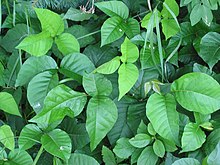
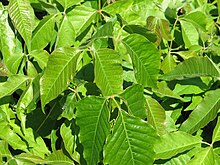
Toxicodendron radicans, commonly known as eastern poison ivy or poison ivy, is a species of allergenic flowering plant. It has numerous subtaxons and forms both vines and shrubs. Despite its common name, it is not a true ivy, but rather a member of the cashew and pistachio family Anacardiaceae. It is different from western poison ivy, Toxicodendron rydbergii, and resembles a number of species.

Sumac or sumach —not to be confused with poison sumac—is any of the roughly 35 species of flowering plants in the genus Rhus of the cashew and mango tree family, Anacardiaceae. However, it is Rhus coriaria that is most commonly used for culinary purposes. Sumac is prized as a spice—especially in Arab, Iranian, Lebanese, and other Middle Eastern cuisines—and used as a dye and holistic remedy. The plants grow in subtropical and temperate regions, on nearly every continent except Antarctica and South America.

Lacquer is a type of hard and usually shiny coating or finish applied to materials such as wood or metal. It is most often made from resin extracted from trees and waxes and has been in use since antiquity.

Urushiol is an oily mixture of organic compounds with allergenic properties found in plants of the family Anacardiaceae, especially Toxicodendronspp., Comocladia spp. (maidenplums), Metopium spp. (poisonwood), and also in parts of the mango tree and the fruit of the cashew tree.

Toxicodendron diversilobum, commonly named Pacific poison oak or western poison oak, is a woody vine or shrub in the sumac family, Anacardiaceae.
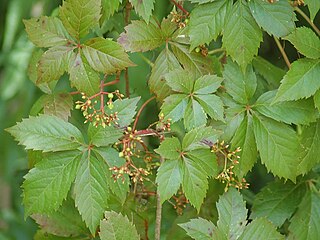
Parthenocissus quinquefolia, known as Virginia creeper, Victoria creeper, five-leaved ivy, or five-finger, is a species of flowering vine in the grape family, Vitaceae. It is native to eastern and central North America, from southeastern Canada and the eastern United States west to Manitoba and Utah, and south to eastern Mexico and Guatemala.

Toxicodendron vernix, commonly known as poison sumac, or swamp-sumach, is a woody shrub or small tree growing to 9 metres (30 feet) tall. It was previously known as Rhus vernix. This plant is also known as thunderwood, particularly where it occurs in the southern United States.
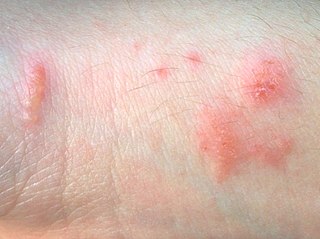
Urushiol-induced contact dermatitis is a type of allergic contact dermatitis caused by the oil urushiol found in various plants, most notably sumac family species of the genus Toxicodendron: poison ivy, poison oak, poison sumac, and the Chinese lacquer tree. The name is derived from the Japanese word for the sap of the Chinese lacquer tree, urushi. Other plants in the sumac family also contain urushiol, as do unrelated plants such as Ginkgo biloba.
Japan wax, also known as sumac wax, sumach wax, vegetable wax, China green tallow, and Japan tallow, is a pale-yellow, waxy, water-insoluble solid with a gummy feel, obtained from the berries of certain sumacs native to Japan and China, such as Toxicodendron vernicifluum and Toxicodendron succedaneum.

Toxicodendron rydbergii, the western poison ivy or northern poison oak, is a species of Toxicodendron in the cashew family native to North America. As a poison ivy, it can cause urushiol-induced contact dermatitis.

Toxicodendron pubescens, commonly known as Atlantic poison oak, or eastern poison oak, is an upright shrub which can cause contact dermatitis for most people.
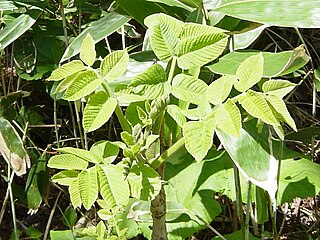
Toxicodendron vernicifluum, also known by the common name Chinese lacquer tree, is an Asian tree species of genus Toxicodendron native to China and the Indian subcontinent, and cultivated in regions of China, Japan and Korea. Other common names include Japanese lacquer tree, Japanese sumac, and varnish tree. The trees are cultivated and tapped for their toxic sap, which is used as a highly durable lacquer to make Chinese, Japanese, and Korean lacquerware.

Rhus trilobata is a shrub in the sumac genus (Rhus) with the common names skunkbush sumac, sourberry, skunkbush, and three-leaf sumac. It is native to the western half of Canada and the Western United States, from the Great Plains to California and south through Arizona extending into northern Mexico. It can be found from deserts to mountain peaks up to about 7,000 feet (2,100 m) in elevation.

Rhus aromatica, the fragrant sumac, is a deciduous shrub in the family Anacardiaceae native to North America. It is found in southern Canada and nearly all of the lower 48 states except peninsular Florida.
Poison ivy is a type of allergenic plant in the genus Toxicodendron native to Asia and North America. Formerly considered a single species, Toxicodendron radicans, poison ivies are now generally treated as a complex of three separate species: T. radicans, T. rydbergii, and T. orientale. They are well known for causing urushiol-induced contact dermatitis, an itchy, irritating, and sometimes painful rash, in most people who touch them. The rash is caused by urushiol, a clear liquid compound in the plant's sap. They are variable in appearance and habit, and despite its common name, it is not a "true" ivy (Hedera), but rather a member of the cashew and pistachio family (Anacardiaceae). T. radicans is commonly eaten by many animals, and the seeds are consumed by birds, but poison ivy is most often thought of as an unwelcome weed.

Rhus michauxii is a rare species of flowering plant in the cashew family known by the common names false poison sumac and Michaux's sumac. It is endemic to the southeastern United States, where it can be found in the states of Virginia, North Carolina, South Carolina and Georgia. It is threatened by the loss and degradation of its habitat and by barriers to reproduction. It is a federally listed endangered species of the United States.
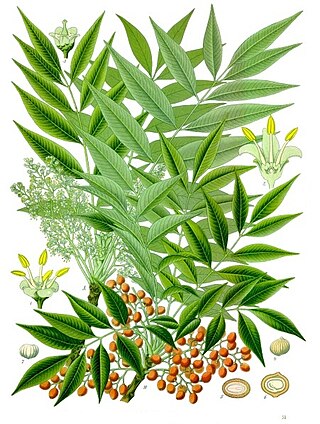
Toxicodendron succedaneum, the wax tree, Japanese Hazenoki tree, sơn in Vietnamese or charão in Portuguese, is a flowering plant species in the genus Toxicodendron found in Asia, although it has been planted elsewhere, most notably Australia and New Zealand. It is a large shrub or tree, up to 8 m tall, somewhat similar to a sumac tree. Because of its beautiful autumn foliage, it has been planted outside Asia as an ornamental plant, often by gardeners who were apparently unaware of the dangers of allergic reactions. It is now officially classified as a noxious weed in Australia and New Zealand. It is one of the city tree symbols of Kurume, Fukuoka, Japan.

Toxicodendron orientale is an East Asian flowering plant in the genus Toxicodendron. It is a poison ivy, which can cause urushiol-induced contact dermatitis.