Related Research Articles

Krishna Dvaipayana, better known as Vyasa or Vedavyasa, is a revered sage or Rishi portrayed in most Hindu traditions. He is traditionally regarded as the author of the epic Mahābhārata.

Sannyasa, sometimes spelled Sanyasa or Sanyasi, is life of renunciation and the fourth stage within the Hindu system of four life stages known as Ashramas, with the first three being Brahmacharya, Grihastha (householder) and Vanaprastha. Sannyasa is traditionally conceptualized for men or women in late years of their life, but young brahmacharis have had the choice to skip the householder and retirement stages, renounce worldly and materialistic pursuits and dedicate their lives to spiritual pursuits.

Swami Tapasyananda (1904-1991) was a senior monk of the Ramakrishna Mission. He was born in the Palat family of Ottapalam in Kerala, in 1904. His pre-monastic name was K. P. Balakrishnan Menon. In 1921, when he was just 17 years old, he met Swami Brahmananda- a direct disciple and spiritual son of Sri Ramakrishna, in Chennai. He received Mantra-Diksha from Swami Shivananda in 1924, and joined the Order in 1926, at 22 years age after completing in post graduation. In 1932, he received Sannyasa from Swami Shivananda. He was a disciple of Swami Shivananda, one of the eminent disciples of Sri Ramakrishna. The Swami was a vice-president of the Ramakrishna Order from 1985-1991, giving Mantra-Diksha to a large number of devotees. He was an erudite scholar in Indian and Western philosophy. He has to his credit many books in English, including the translations of many scriptures. His translation of Bhagavata Purana in four volumes has been highly acclaimed in intellectual and devotional circles. He was the president of Ramakrishna Math, Chennai from 1971-1991. Swamiji was well known for his austere life and intuitive intellect. His deity was Lord Khrishna and he practiced spiritual activity as told by his Guruji. He was a prolific writer. Some of the books authored by him are listed below. He translated many Hindu classics into English from original Sanskrit. He founded Ramakrishna Mission Hospital at Thiruvananthapuram.
Yugadharma is the dharma of an epoch or age in Hindu philosophy. The concept of yugadharma is prescribed to be a reflection of Sanatana Dharma, the eternal dharma that transcends the passage of time.
The Vayu Purana is a Sanskrit text and one of the eighteen major Puranas of Hinduism. Vayu Purana is mentioned in the manuscripts of the Mahabharata and other Hindu texts, which has led scholars to propose that the text is among the oldest in the Puranic genre. Vayu and Vayaviya Puranas do share a very large overlap in their structure and contents, possibly because they once were the same, but with continuous revisions over the centuries, the original text became two different texts, and the Vayaviya text came also to be known as the Brahmanda Purana.

Yama, also known as Kala, and Dharmaraja is the Hindu god of death and justice, responsible for the dispensation of law and punishment of sinners in his abode, Naraka. He is often identified with Dharmadeva, the personification of Dharma, though the two deities have different origins and myths.
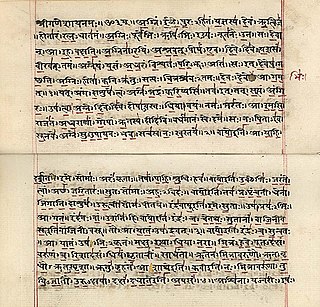
Svādhyāya is a Sanskrit term which means self-study and especially the recitation of the Vedas and other sacred texts. It is also a broader concept with several meanings. In various schools of Hinduism, Svadhyaya is a Niyama connoting introspection and "study of self".

The Devi Bhagavata Purana, also known as the Srimad Devi Bhagavatam, Srimad Bhagavatam, Bhagavata Purana or simply Devi Bhagavatam, is one of the eighteen Mahapuranas of Hinduism. Composed in Sanskrit by Veda Vyasa, the text is considered a major purana for Devi worshippers (Shaktas). It promotes bhakti (devotion) towards Mahadevi, integrating themes from the Shaktadvaitavada tradition. While this is generally regarded as a Shakta Purana, some scholars such as Dowson have also interpreted this Purana as a Shaiva Purana.
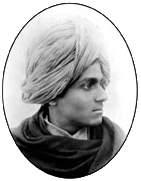
Swarupananda was a direct monastic disciple of Vivekananda and the first president of the Advaita Ashrama, set up by Vivekananda in 1899 at Mayavati, near Champawat. The ashram is a branch of the religious monastic order, Ramakrishna Math, also set up by Vivekananda on the teachings of his guru Ramakrishna.

The Bhagavad Gita, often referred to as the Gita, is a 700-verse Hindu scripture, which is part of the epic Mahabharata. It forms the chapters 23–40 of book 6 of the Mahabharata called the Bhishma Parva. The work is dated to the second half of the first millennium BCE.
The Three Yogas or Trimārga are three soteriological paths mentioned in the Bhagavad Gita for the liberation of human spirit. They are:
- Karma Yoga or the Path of Action (Karma-mārga)
- Bhakti Yoga or the Path of Devotion (Bhakti-mārga) to Ishvar (God)
- Jnana Yoga or the Path of Knowledge (Jñāna-mārga)

The Gītā Dhyānam, also called the Gītā Dhyāna or the Dhyāna Ślokas associated with the Gītā, is a 9-verse Sanskrit poem that has often been attached to the Bhagavad Gita, one of the most important scriptures of Hinduism. In English, its title can be translated literally as "meditation on the Gita," and it is also sometimes called the Invocation to the Gita.
Adhikari-bheda, the Sanskrit expression which is a combination of two words – "adhikari", meaning the rightful or the qualified, and "bheda", meaning distinction or difference, loosely refers to the distinction between qualified persons or to the difference of the qualified aspirants capable of apprehending the same truth. The principle of Adhikari-bheda, universally accepted by the Hindus, is the foundation on which the teachings of the Upanishads, the Brahma Sutras and the Bhagavad Gita which texts contain though not contradictory various doctrines meant for people at different stages of spiritual evolution, are based, in which principle the method of Arundhati-darsananyaya i.e. the method of spotting the tiny star, Arunadhati, with the help of bigger calling them Arundhati, applies.

The Kanyakumari resolve of 1892 was the resolution taken by Indian Hindu monk Swami Vivekananda to dedicate himself for the service and the welfare of people. In 1970 Vivekananda Rock Memorial was founded at the place where Vivekananda took this resolution.
Meditation played a very important role in the life and teachings of Swami Vivekananda. He was interested in meditation from his childhood. His master Ramakrishna found him a dhyana - siddha . On 24 December 1892, Vivekananda reached Kanyakumari and meditated for three days on a large rock and took the resolution to dedicate his life to serve humanity. The event is known as the Kanyakumari resolve of 1892. He reportedly also meditated for a long time on the day of his death.
Tyāga is a Sanskrit word that means "sacrifice, giving up in generosity, forsaking, resigning" anything of value, as well as "renunciation" depending on the context. It is an ethical concept in Hinduism, Buddhism and Jainism.
Dhṛti or Dhriti or Dhruti, means to 'act with determination', 'patience', 'firmness', and refers to 'perseverance', 'wearing regularly'.
Akriya is a Sanskrit adjective which means – inactive, dull, torpid, without essential works, abstaining from religious rites, without action of any kind, epithet of god, worthless, good for nothing; – या Akriyā means – inactivity, neglect of duty. In the Bhagavad Gita, the word akriya refers to the person, who having renounced all desires and gained peace within, is not bound to perform any actions, rituals or works; such a person does not find any reason to perform any duty. According to Akriyavada, man's suffering or pleasures are not because of his own actions but because of other factors. From Śrimad Bhāgavatam (Sl.IX.17.10) it is learnt that the son of Rabhā was Rabhasa whose son was Gambhira who was the father of Akriya, all descendants of Ksatrvrddha rulers of Kasi. Akriya was a Brahmvida.

Yato Dharmastato Jayah is a Sanskrit shloka that occurs a total of 13 times in the Hindu epic the Mahabharata. It means "Where there is Dharma, there will be Victory".

The Gita Bhashya, also rendered the Bhagavad Gita Bhashya, is a commentary or treatise of the Bhagavad Gita by the Hindu philosopher Ramanuja.
References
- Vivekananda, Swami (1997). "What is Duty?". Karma Yoga. Advaita Ashrama. ISBN 81-85301-89-1.
- Agarwal, Satya P. (2002). "Vyadha Gita—How a Butcher taught a Brahmin". Selections from the Mahabharata. Motilal Banarsidass. ISBN 978-81-208-1874-3.
- Leaman, Oliver (2000). Eastern philosophy: key readings . Routledge. pp. 305. ISBN 978-0-415-17357-5.
- Mukherjee, B.D. The Essence of Bhagavad Gita. Academic Publishers. ISBN 978-81-87504-40-5.
- Agarwal, Satya P. (1997). The Social Role of the Gita: How and Why. Motilal Banarsidass. p. 473. ISBN 978-81-208-1524-7.
- Winternitz, Maurice (1996). A History of Indian Literature. Motilal Banarsidass. p. 618. ISBN 978-81-208-0264-3.


