The Saxony Mill was a historic textile mill complex at 66 West Street in Rockville section of Vernon, Connecticut. With a construction history dating to 1836, it was one of the oldest surviving wood-frame textile mills in the state prior to a 1994 fire which led to its demolition. The mill complex was added to the National Register of Historic Places in 1983.

The Bates Mill is a textile factory company founded in 1850 and located at 35 Canal Street in Lewiston, Maine. The mill served as Maine's largest employer through the 1860s, and early profits from the mill provided much of the initial capital for nearby Bates College. Currently, the mill buildings are home to several new businesses, apartments, and a small museum.

The Webster Rubber Company Plant, formerly the Webster Woolen Mill No. 1-1/2, is an historic industrial site on Greene Street in Sabattus, Maine. Built in 1869 as a textile mill, it was a fixture of the town's economy well into the 20th century, and is good local example of industrial Italianate architecture. The property was listed on the National Register of Historic Places in 1989. In 2015, the property was vacant, and it was demolished in 2018.

The Bigelow Carpet Company Woolen Mills are a historic mill complex on Main Street in Clinton, Massachusetts. The sprawling mill complex was built or expanded by the Bigelow Carpet Company, one of Clinton's leading business for much of the 19th and early 20th centuries. The complex was listed on the National Register of Historic Places in 1983. It continues to be adaptively reused by smaller businesses.

The Hayward Mill is a historic mill complex at the junction of North and Cook Streets, on the Mumford River in Douglas, Massachusetts. The site, with an industrial history dating to the 18th century, is populated by a series of connected buildings dating to 1880 or later. The mill was the first financial successful textile operation in Douglas, and was operated until the 1960s. The mill complex was listed on the National Register of Historic Places in 1991. It has been converted to residential use.

The Central Village Historic District is a historic district in the Central Village area of Plainfield, Connecticut that was listed on the National Register of Historic Places (NRHP) in 1991. It encompasses a late 19th-century historic mill village, including a small commercial center where Connecticut Route 12 and 14 meet, a cluster of architecturally distinguished buildings built by mill owners and managers, and a collection of mill worker housing units. It includes the Plainfield Woolen Company Mill, which is separately listed, as well as archaeological remnants of other mill infrastructure. It also includes Plainfield's old town hall and high school. Other architecturally prominent buildings include the c. 1855 Italianate mansion of mill owner Arthur Fenner, and the 1845 Greek Revival Congregational Church.

Phillips Woolen Mill is a historic mill at 71 Grove Street in Adams, Massachusetts. With a construction history dating to the mid-19th century, it is a good example of small textile mill complex of that period, containing elements that date from the 1920s potentially back as far as the 1830s. The mill complex was added to the National Historic Register in 1982.

The Hamilton Woolen Company Historic District encompasses the well preserved "Big Mill" complex of the Hamilton Woolen Company, built in the mid 19th century. Located at the confluence of McKinstry Brook and the Quinebaug River in central Southbridge, Massachusetts, the complex consists of a cluster of mill buildings and a rare collection of 1830s brick mill worker housing units located nearby. The district was listed on the National Register of Historic Places in 1989.

The Plainfield Woolen Company Mill is a historic mill building on Main Street in Plainfield, Connecticut. Built in 1901, the building played a vital role in revitalizing the local economy, which was stagnating at the time. It remained the site of active textile manufacturing until 1984. The building is a visually distinctive landmark in the community, in part because of its unusual monitor roof. The building was listed on the National Register of Historic Places in 1985. It has been converted into condominia.

The New Mill and Depot Building of the former Hawthorne Woolen Mill are located in Greenwich, Connecticut, United States. The two structures were built on an existing textile mill complex in the 1870s.

Mississippi Mills was a cotton and wool textile manufacturing complex that operated in Wesson, Mississippi, during the latter half of the 19th century. By 1892, Mississippi Mills was described as the largest industry of its kind in the South.

The Winooski Falls Mill District is located along the Winooski River in the cities of Winooski and Burlington, Vermont, in the United States of America. It encompasses a major industrial area that developed around two sets of falls on the river in the 19th century.

The Contoocook Mills Industrial District of Hillsborough, New Hampshire, encompasses the industrial mill complex of the Contoocook Mills, a major business in the town from the 19th century to the mid-20th century. Industry on the banks of the Contoocook River in Hillsborough began as early as 1763, when a sawmill and gristmill were operated in the area. More modern industrial activity began in 1828 with the construction of a cotton mill by Josiah Marcy. This three story timber frame building stands on the south side of Mill Street, on a granite foundation through which a raceway provide the water which powered the mill. Marcy expanded his operations, building a grist mill and saw mill before his death in 1848. The grist mill, a handsome brick building on the north side of Mill Street, was operated as such until 1884, after which it was converted into the picker building for the main mill complex.
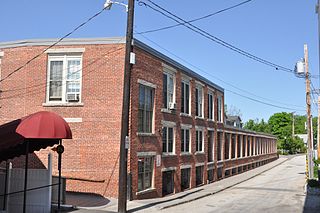
The Milford Cotton and Woolen Manufacturing Company is a historic mill complex at 2 Bridge Street in the center of Milford, New Hampshire. Developed between 1813 and World War I, it is one of the few surviving mill complexes in Milford, whose name is derived in part from "mill". The buildings were listed on the National Register of Historic Places in 1982. The complex has been converted into residential use.

The Cocheco Mills comprise a historic mill complex in the heart of Dover, New Hampshire. The mills occupy a bend in the Cochecho River that has been site of cotton textile manufacturing since at least 1823, when the Dover Manufacturing Company supplanted earlier sawmills and gristmills. The present mill buildings were built between the 1880s and the early 20th century, and were listed on the National Register of Historic Places in 2014.
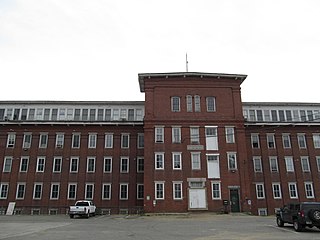
The Salmon Falls Mill Historic District encompasses a historic mill complex on Front Street in Rollinsford, New Hampshire. The complex includes four major structures and seven smaller ones, on about 14 acres (5.7 ha) of land along the Salmon Falls River. They were built between about 1840 and the mid-1860s, and have an unusual architectural unity, for additions made to the buildings were done with attention to matching design elements from the existing structures. The Number 2 Mill, built in 1848, was an early location where a turbine was used instead of a waterwheel to provide power to the mill machinery. The district was listed on the National Register of Historic Places in 1980.

The American Woolen Company Foxcroft Mill or Mayo & Son Woolen Mill is a group of seven historic buildings and three structures on East Main Street in downtown Dover-Foxcroft, Maine. The district is located on 2.77 acres (1.12 ha). The Foxcroft Mill is located on the west side of the Piscataquis River, which flows through downtown Dover-Foxcroft. The buildings were built between 1844 and 1941, and have been listed on the National Register of Historic Places.

The Sanford Mills Historic District encompasses a large industrial complex in the center of Sanford, Maine, United States. From 1867 to 1955, the property was the site of a major textile manufacturing operation that was a major local employer. The site, flanking the Mousam River just north of Sanford's central business district, was listed on the National Register of Historic Places in 2009.
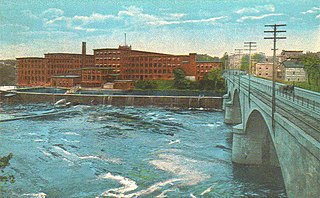
The Lockwood Mill Historic District encompasses the only major 19th-century mill complex in Waterville, Maine. Located south of the city's downtown, it was designed by Amos D. Lockwood, a nationally known industrial designer of the period. Its #2 building was for 45 years home to the Hathaway Shirt Company. It was listed on the National Register of Historic Places in 2007.

The Winsted Hosiery Mill, also known as the Whiting Mill, is an industrial complex at 210 Holabird Avenue in the Winsted section of Winchester, Connecticut. Developed in the late 19th and early 20th centuries, it was one of the largest industrial employers in the community for many years, and is relatively unaltered from its period of development. It was listed on the National Register of Historic Places in 1985. It is now subdivided for multiple industrial and commercial tenants.