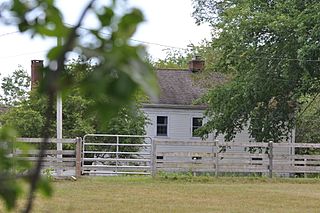
The Abel H. Fish House is a historic house at Buckley Hill Road and Rathbun Hill Road in Salem, Connecticut. Built about 1835, it is a well-preserved example of a vernacular Greek Revival farmhouse. It was listed on the National Register of Historic Places on March 2, 1982.

The John W. Keeney and Erena Alexander Rogers Farm, commonly known simply as the Keeney Farm, is a historic district located at 5300 Monroe Street (M-50) in Franklin Township in north-central Lenawee County, Michigan. It was designated as a Michigan Historic Site and added to the National Register of Historic Places on September 24, 2001. The apple orchard has been continuously operating since 1875, and is one of the oldest such orchards in Lenawee County.

The Spring Hill Historic District encompasses a rural 19th-century village stretching along Storrs Road in Mansfield, Connecticut. Spring Hill developed as a rural waystation on an early 19th-century turnpike, and has seen only modest development since the late 19th century. The district was listed on the National Register of Historic Places in 1979.

Elm Farm, alsk known as the Sargent Farm, is a historic farm property at 599 Main Street in Danville, New Hampshire. Established about 1835, it has been in agricultural use since then, with many of its owners also engaged in small commercial or industrial pursuits on the side. The main farmhouse is one of the town's best examples of Gothic Revival architecture. The property was listed on the National Register of Historic Places in 1988.

The Parsons–Piper–Lord–Roy Farm is a historic farmstead at 309 Cramm Road in Parsonsfield, Maine. Its buildings dating to 1844, it is a fine example of a well-preserved mid-19th century farmstead, with modifications in the 20th century to adapt the barn to chicken farming. The property was listed on the National Register of Historic Places in 2005.

The Paul Family Farm is a historic farmstead at 106 Depot Road in Eliot, Maine. Consisting of a well-preserved early-19th century Federal style farmhouse and a small collection of early-20th century outbuildings, it is a representative example of 19th-century farming in the area. The farmhouse parlor is further notable for the c. 1820s stencilwork on its walls. The property was listed on the National Register of Historic Places in 1998.

The Horace Webster Farmhouse is a historic house at 577 South End Road in Southington, Connecticut. Built about 1837, it is the town's only surviving example of a three-bay Greek Revival house. It was listed on the National Register of Historic Places in 1977.
Hardscrabble Farm is a historic farm property in rural Searsmont, Maine. Located south of its village center at 122 Maine State Route 131, the 70-acre (28 ha) property features a typical New England connected farmstead with a c. 1840s Greek Revival farmhouse. The property is notable as the leisure time summer residence of author Ben Ames Williams, who fictionalized Searsmont as the town of "Fraternity" in his works. The property was listed on the National Register of Historic Places in 1994.

The Corse-Shippee House is a historic house at 11 Dorr Fitch Road in West Dover, Vermont. Built in 1860, it is one of the village's finest examples of high-style Greek Revival architecture, and is sited on one of the few town farmsteads that has not been subdivided. The house was listed on the National Register of Historic Places in 2008; it was previously listed as a contributing property to the West Dover Village Historic District.
Moody Farm is a historic farmstead at Lawry Road and Maine State Route 173 in Searsmont, Maine. The farmhouse was built about 1820 by Joseph Moody, one of the first settlers of the area after Maine gained statehood in 1820, and its barn is a mid-19th century double English barn. The property was listed on the National Register of Historic Places in 2002.

The Amos Lawrence House is a historic house on Richville Road in Manchester, Vermont, USA. Built about 1840, it is a fine local example of a Greek Revival farmhouse. Restored in the 1980s after many years as a rental property, it was listed on the National Register of Historic Places in 1985.

The Edmund and Rachel Clark Homestead is a historic farmstead in China, Maine. The property was developed beginning late in 18th century by one of the town's first settlers. It includes a house whose oldest portion dates to about 1789 and was never fitted with modern heat, plumbing, or electricity, and the archaeological remains of farm outbuildings. It was listed on the National Register of Historic Places in 2006.
The Dan Johnson Farmstead is a historic farm property on United States Route 2 in Williston, Vermont. It was first developed in 1787 by Dan Johnson, one of Williston's first settlers, and has remained in his family since that time. The property includes three 19th-century houses and a large barn complex, as well as more than 200 acres (81 ha) of land crossed by US 2 and Interstate 89. It was listed on the National Register of Historic Places in 1993.
Sutton Farm is a historic farm property at 4592 Dorset Road in Shelburne, Vermont. Established in 1788, the farm was operated continuously into the late 20th century by a single family, and includes a well-preserved Greek Revival farmhouse. It was listed on the National Register of Historic Places in 2004.

Lee Farm is a historic farm property on Vermont Route 18 in Waterford, Vermont. Established in 1801, it was for many years worked by members of the Lee family, and part of a thriving rural community called Waterford Hollow. Its farmstead features surviving 19th and early 20th-century outbuildings and a high-quality Greek Revival farmhouse. A 5-acre (2.0 ha) portion of the farm, encompassing the farmstead, was listed on the National Register of Historic Places in 1983.

The Josiah and Lydia Shedd Farmstead is a historic farm property at 1721 Bayley-Hazen Road in Peacham, Vermont. Established in 1816, the property evokes a typical 19th-century Vermont hill farm. Its oldest surviving buildings, the main house and two barns, survive from the second quarter of the 19th century. The property was listed on the National Register of Historic Places in 2005.

Lareau Farm is a historic farm property at 48 Lareau Road in Waitsfield, Vermont. First settled in 1794 by Simeon Stoddard and his wife Abiah, two of the town's early settlers, the farmstead includes both a house and barn dating to that period. Now serving primarily as a bed and breakfast inn, the farm property was listed on the National Register of Historic Places in 2016.

The Edward L. Burnham Farm is a historic farmstead at 580 Burnham Street West in Manchester, Connecticut. Built in 1861, the house is a well preserved example of a vernacular Greek Revival farmhouse. It was built for a locally prominent family that had farmed the surrounding land for generations. The house was listed on the National Register of Historic Places in 1982.

The Woodbridge Farm is a historic farm property on Woodbridge Road in Salem, Connecticut. The property was developed by Nathaniel Woodbridge in 1791, and it had more than 200 years of cultivation, and many decades of ownership by the Woodbridge family. The property includes an early farmstead, remade in the early 20th century into a Colonial Revival country house. It was listed on the National Register of Historic Places in 1997.

The Langford and Lydia McMichael Sutherland Farmstead is a farm located at 797 Textile Road in Pittsfield Charter Township, Michigan. It was listed on the National Register of Historic Places in 2006. It is now the Sutherland-Wilson Farm Historic Site.