An editor has nominated this article for deletion. You are welcome to participate in the deletion discussion , which will decide whether to keep it. |
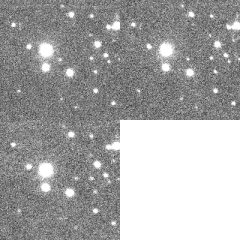 Follow-up images of 2010 KZ39 taken at Las Campañas Obs. | |
| Discovery [1] [2] [3] | |
|---|---|
| Discovered by |
|
| Discovery site | Las Campañas Obs. (first observed) |
| Discovery date | 21 May 2010 (first observed) |
| Designations | |
| 2010 KZ39 | |
| Orbital characteristics [4] [5] | |
| Epoch 2025 November 21 (JD 2461000.5) | |
| Uncertainty parameter 4 | |
| Observation arc | 11.94 yr (4,361 days) |
| Aphelion | 47.46 AU |
| Perihelion | 42.52 AU |
| 44.99 AU | |
| Eccentricity | 0.0549 |
| 301.8 yr (110,200 days) | |
| 256.7° | |
| 0° 0m 11.772s / day | |
| Inclination | 26.138° |
| 53.249° | |
| ≈ 6 May 2110 [6] ±5 months | |
| 323.6° | |
| Known satellites | 0 |
| Physical characteristics | |
| 743 km? [7] 660 km (estimated albedo) [8] | |
| 0.10(assumed) [9] | |
| 20.7 [10] | |
| |
2010 KZ39 is a trans-Neptunian object orbiting the Sun as a detached object in the outer reaches of the Solar System, estimated to be somewhere around 700 kilometres (400 miles) in diameter. The object was first observed on 21 May 2010 by astronomers Andrzej Udalski, Scott Sheppard, M. Szymanski and Chad Trujillo at the Las Campañas Observatory in Chile. [1] [3]


