Arlington House is the historic Custis family mansion built by George Washington Parke Custis from 1803–1818 as a memorial to George Washington. Currently maintained by the National Park Service, it is located in the U.S. Army's Arlington National Cemetery in Arlington County, Virginia. Arlington House is a Greek Revival style mansion designed by the English architect George Hadfield. The Custis grave sites, garden and slave quarters are also preserved on the former Arlington Estate.
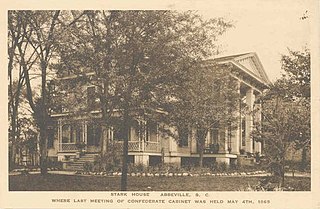
The Burt-Stark Mansion, also known as Armistead Burt House, in Abbeville, South Carolina was the site of the last Council of War of cabinet members of the Confederate government. On May 2, 1865, Jefferson Davis, hoping to continue the struggle, met unanimous opposition and realized the Confederate independence cause was lost.

The Shropshire House is a Greek Revival Federal style house located in the East Main Street Residential Historic District in Georgetown, Kentucky. The house was the built in 1814 by John and Mary (Gano) Buckner. The property was added to the U.S. National Register of Historic Places on April 2, 1973.
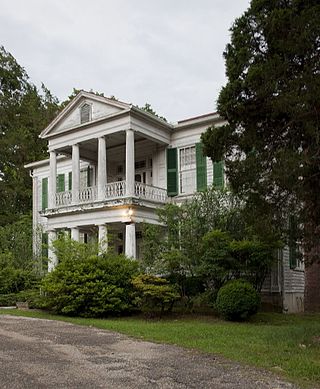
Glencairn, also known as the John Erwin House, is a historic house in Greensboro, Alabama, United States. The house and grounds were recorded by the Historic American Buildings Survey in 1935. The house was added to the National Register of Historic Places on January 18, 1978, due to its architectural and historical significance.

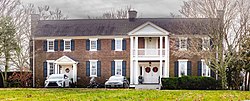
Ashcrest Farm is a historic mansion in Hendersonville, Tennessee, United States. Designed in the Classical Revival architectural style, it was built by slaves before the American Civil War and black laborers after the war. The land has been owned by the same family since 1810. Today, it is a horse farm.

The Virden-Patton House is a historic cottage in Jackson, Mississippi.

The Olsen House is a historic house in Helena, Montana. It has been listed on the National Register of Historic Places since March 22, 1991. It stands opposite St. Peter's Cathedral.

The Winter Building is a historic building in Montgomery, Alabama, U.S. The 3-story structure was built as a bank branch with a telegraph office upstairs.

The Joel Hurt House is a historic house in Hurtsboro, Alabama, U.S.. It was built in 1857-1858 for Joel Hurt, his wife, Lucy Apperson Long Hurt, and three sons. During the American Civil War of 1861–1865, the three sons served in the Confederate States Army, and one of them was killed in combat. After the war, Lucy's sister and her husband, Edward Norphlet Brown, who also served as the first mayor of Hurtsboro, lived in the house. In 1900, it was acquired by his son-in-law, Dr. Walter B. Hendrick, who lived there with his wife Margaret until his death in 1941; she went on to live in the house until her death in 1968. It was inherited by their daughter Kate, who lived there until her death in 1997. It has been listed on the National Register of Historic Places since August 11, 2005.

Ten Oaks, also known as the Peyton Rowan House, is a historic mansion in Jacksonville, Alabama, U.S..

The Absalom Lowe Landis House, also known as Beech Hall, is a historic house in Normandy, Tennessee.
The Maple Dean Farm is a historic farmhouse in Shelbyville, Tennessee, U.S.. Built in 1886 on a farm established in 1819, it was designed in the Eastlake architectural style. It became a century farm in 1976, and it was listed on the National Register of Historic Places in 1976.

The Charles Ready House, also known as The Corners, is a historic house in Readyville, Tennessee, United States. It is located in Cannon County, on the border of Rutherford County.

The Palmetto Farm is a historic farmhouse in Palmetto, Tennessee, U.S.. It was built for Thomas Montgomery circa 1847, and it was designed in the Greek Revival architectural style. After Montgomery died in the American Civil War, the farm was inherited by his daughter Alice and her husband James Fount Tillman. Their son and his wife Sadie Wilson Tillman, a prominent Methodist, later inherited the house, which passed to Mrs. Roberta "Robert" Mason and remained in the family until about 2010. It was listed on the National Register of Historic Places in 1985.

Ewing Farm is a historic farmhouse three miles away from Lewisburg, Tennessee, US.
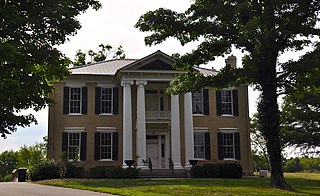
Marymont is a historic mansion in Murfreesboro, Tennessee, U.S.. It was built in 1860-1861 for Hiram Jenkins. In 1878, it was inherited by his niece, Nimmie Jenkins, and her husband, Dr. J. J. Rucker. They named the house after their daughter, Mary Rucker.

The Logan Henderson Farm, also known as Farmington, is a historic farm house in Murfreesboro, Tennessee, U.S.. Built as a slave plantation in the Antebellum South, it later became a dairy and cattle farm. It is now a horse farm.

The Green-Evans House is a historic mansion in Lynchburg, Tennessee, U.S..

Murray Farm is a historic farmhouse in Readyville, Tennessee, U.S..

The Bobo Hotel, also known as Miss Mary Bobo's Boarding House and Grand Central Hotel, is a historic hotel and boarding house in Lynchburg, Tennessee. It was built for a Confederate veteran, and it later belonged to relatives of the owners of Jack Daniel's. It is listed on the National Register of Historic Places.