The College Hill Historic District is located in the College Hill neighborhood of Providence, Rhode Island. It was designated a National Historic Landmark District on December 30, 1970. The College Hill local historic district, established in 1960, partially overlaps the national landmark district. Properties within the local historic district are regulated by the city's historic district zoning ordinance, and cannot be altered without approval from the Providence Historic District Commission.

This is a list of the National Register of Historic Places listings in Providence, Rhode Island.

The Esek Hopkins House is an historic home on 97 Admiral Street on the north side of Providence, Rhode Island, United States.

The Central Street School is an historic school building located at 379 Central Street in Central Falls, Rhode Island. This 2+1⁄2-story wood-frame building was built by the city in 1881 to meet burgeoning demand for education brought about by the success of the local mills. The building is cruciform in shape, with Italianated hooded entrances at opposited ends of the east–west axis of the building. Each floor houses two classrooms.

Christ Episcopal Church was an historic Episcopal church at 909 Eddy Street in Providence, Rhode Island.
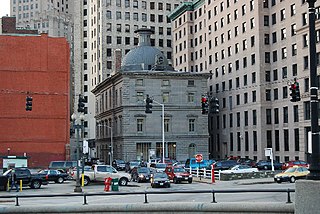
The Customhouse Historic District is a historic district encompassing fifteen historic buildings in downtown Providence, Rhode Island. The district is bounded by Westminster, Exchange, Dyer, Pine, and Peck Streets, and includes eight buildings associated with the important functions of the business center Providence became in the mid-to-late 19th century. It was listed on the National Register of Historic Places in 1975, and is completely contained within the Downtown Providence Historic District, listed in 1984.

The First Universalist Church is a historic church at 250 Washington Street in Providence, Rhode Island.

Grace Church is an historic Episcopal church at 300 Westminster Street at Mathewson Street in downtown Providence, Rhode Island. It was built in 1845–1846 and was designed by Richard Upjohn in the Gothic Revival style.

The Thomas F. Hoppin House is a historic house at 383 Benefit Street in the College Hill neighborhood of Providence, Rhode Island. The house was built c. 1853 to a design by Alpheus C. Morse, and is an elaborate local example of an Italianate palazzo-style residence. The Library of Congress called the property "one of the largest and most elegant houses built in Providence in the mid-nineteenth century."

Louttit Laundry was at one time the largest laundry business in Rhode Island, with 150 employees and 16 outlets throughout the state. Their historic building at 93 Cranston Street was on the National Register of Historic Places. The company was sold in 1985 and closed in 1987. The Cranston Street building was built in 1906, expanded in 1925, damaged by fire in 2001, and demolished in 2008.

The Providence Jewelry Manufacturing Historic District is a predominantly industrial historic district in Providence, Rhode Island. It covers a roughly 19-acre (7.7 ha) area in the city's Jewelry District, just south of Downtown Providence. While the area began as a residential neighborhood, it emerged in the late 19th and early 20th centuries as a center of Providence's jewelry manufacturing businesses. The oldest industrial building in the district is the 1848 Elm Street Machine Shop, a 2+1⁄2-story stone structure that now houses offices of Brown University.

The Smith Street Primary School is an historic school at 396 Smith Street in Providence, Rhode Island. It is a large 2+1⁄2-story brick structure with a cross-gable roof. It was designed in Queen Anne style by William R. Walker & Son and built in 1885. The building occupies its site at an unusual angle, partially overhanging the sidewalk, and has an asymmetrical interior, a departure from the other schools the Walkers designed for the city.

The Sons of Jacob Synagogue, officially Congregation Sons of Jacob, is an Orthodox Jewish congregation and historic synagogue and Jewish museum, located at 24 Douglas Avenue in Providence, Rhode Island, in the United States.
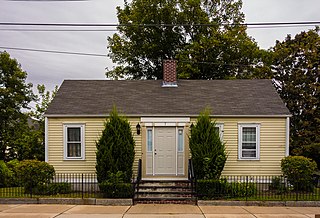
The David Sprague House is an historic house in Providence, Rhode Island. The house was built in 1839 and added to the National Register of Historic Places in 1978.

Temple Beth-El, officially known as the Congregation Sons of Israel and David, Temple Beth-El, is a Reform Jewish synagogue located at 70 Orchard Avenue, in Providence, Rhode Island, in the United States.
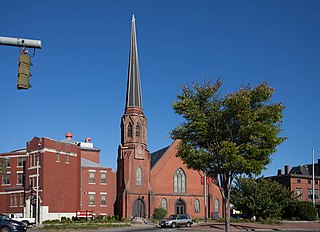
The Trinity Square Historic District is a historic district in the Elmwood neighborhood of Providence, Rhode Island. It includes four properties on the south and west side of Trinity Square, the triangular junction of Elmwood Avenue and Broad Street. The visual focal points of the district are the Grace Church Cemetery, which is located south of the square, and the Trinity United Methodist Church, an imposing Gothic Revival structure built in the mid-1860s to a design by Clifton A. Hall. North of the church stands the Clifton Hall Duplex, designed and occupied by Hall, and the James Potter House, an elaborate Queen Anne mansion built c. 1889 and designed by Stone, Carpenter & Willson.

The South Street Station is an historic electrical power generation station at 360 Eddy Street in Providence, Rhode Island. The structure has since been redeveloped and is now used as an administrative office and academic facility by a number of local universities.
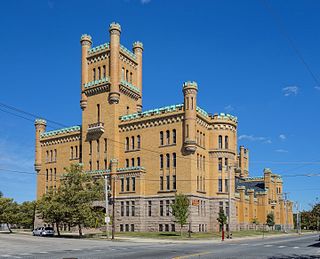
The Cranston Street Armory is an historic building in the Broadway–Armory Historic District of Providence, Rhode Island. It was built in 1907 at a cost of $650,000.00. The building was occupied by the Rhode Island National Guard from its opening until 1996. Since then, parts of the building have been used as film studios, and some of its offices occupied by the Rhode Island State Fire Marshal. The National Trust for Historic Preservation listed the Armory as one of "America's 11 Most Endangered Historic Places" in its annual list for 1997. Its distinctive yellow bricks, crenellated turrets, and decorative stonework mark it as a historically significant building and neighborhood icon.
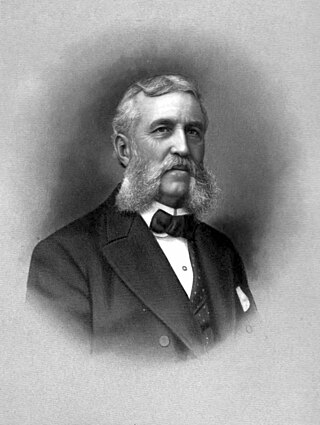
Edward I. Nickerson (1845–1908) was an American architect from Providence, Rhode Island, known for his work in the Queen Anne style in Providence.

The Wedding Cake House is a three-story historic house located at 514 Broadway Street in the Broadway-Armory Historic District of Providence, Rhode Island. Built in 1867 and occupied continuously until 1989, its contents were the subject of a 2001 exhibit at the Rhode Island School of Design Museum. It has had a variety of restoration work conducted since 2011.