Illinois Institute of Technology is a private research university in Chicago, Illinois. Tracing its history to 1890, the present name was adopted upon the merger of the Armour Institute and Lewis Institute in 1940. The university has programs in architecture, business, communications, design, engineering, industrial technology, information technology, law, psychology, and science. It is classified among "R2: Doctoral Universities – High research activity".
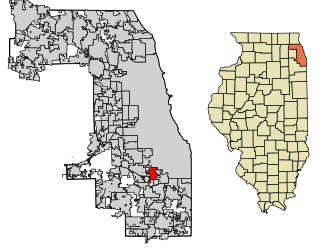
Blue Island is a city in Cook County, Illinois, located approximately 16 miles (26 km) south of Chicago's Loop. Blue Island is adjacent to the city of Chicago and shares its northern boundary with that city's Morgan Park neighborhood. The population was 22,558 at the 2020 United States Census.

Orangeville is a village in Stephenson County, Illinois. The town's sign lists the population at 800 as of January 2021. The population in 2020 was 738. The population according to the 2010 census was 793, up from 751 in 2000. Using the 2020 population of 738 Orangeville is the 741st largest city in Illinois and the 11,650th largest city in the United States. Orangeville is currently declining at a rate of -0.94% annually and its population has decreased by -6.94% since the 2010 census. The area's earliest white settlers arrived in the year 1833, and the village was platted in 1851 by John Bower, who is considered the village founder. In 1867 Orangeville was incorporated as a village. The town's central business district contains several 19th century commercial buildings, many of which were built during the railroad boom of 1888–1914. By the time the Great Depression was ongoing, business in Orangeville had started to decline, with the last bank closing in 1932. In 1956 another bank started operating in the village and is still in town today. Some recent infrastructure jumps have restored some of the village's old decor.

Lockport is a city in Will County, Illinois, United States, located 30 miles southwest of Chicago. Per the 2020 census, the population was 26,094. The city was incorporated in 1853. It is situated along the Illinois and Michigan (I&M) Canal, and was the headquarters of the canal when the canal was operating. A section of the canal runs through Lockport, including the remains of the canal's Lock No. 1 from which the town received its name. The canal right-of-way is now the Illinois and Michigan National Heritage Corridor. Because of proactive efforts dating back several years, the city of Lockport is one of the best-preserved canal sites in existence today.

Pullman, one of Chicago's 77 defined community areas, is a neighborhood located on the city's South Side. Twelve miles from the Chicago Loop, Pullman is situated adjacent to Lake Calumet.

West Ridge is one of 77 Chicago community areas. It is a middle-class neighborhood located on the far North Side of the City of Chicago. It is located in the 50th Ward and the 40th Ward. Also historically called North Town, and frequently referred to as West Rogers Park, it is bordered on the north by Howard Street, on the east by Ridge Boulevard, Western Avenue, and Ravenswood Avenue, the south by Bryn Mawr Avenue and Peterson Avenue, and on the west by Kedzie Avenue and the North Shore channel of the Chicago River. At one time joined with neighboring Rogers Park, it seceded to become its own village in 1890 over a conflict concerning park districts. West Ridge was annexed to Chicago on April 4, 1893, along with Rogers Park.

Douglas, on the South Side of Chicago, Illinois, is one of Chicago's 77 community areas. The neighborhood is named for Stephen A. Douglas, Illinois politician and Abraham Lincoln's political foe, whose estate included a tract of land given to the federal government. This tract later was developed for use as the Civil War Union training and prison camp, Camp Douglas, located in what is now the eastern portion of the Douglas neighborhood. Douglas gave that part of his estate at Cottage Grove and 35th to the Old University of Chicago. The Chicago 2016 Olympic bid planned for the Olympic Village to be constructed on a 37-acre (15 ha) truck parking lot, south of McCormick Place, that is mostly in the Douglas community area and partly in the Near South Side.

Lower West Side is a community area on the West Side of Chicago, Illinois, United States. It is three miles southwest of the Chicago Loop and its main neighborhood is Pilsen. The Heart of Chicago is a neighborhood in the southwest corner of the Lower West Side.

Chatham is one of the 77 community areas of the city of Chicago, Illinois. It is located on the city's South Side. It includes the neighborhoods of Chatham-Avalon, Chatham Club, Chesterfield, East Chatham, West Chatham and the northern portion of West Chesterfield. Its residents are predominantly African American, and it is home to former Senator Roland Burris. Housing many city employees and other officials, Chatham has been a central area for Chicago's middle-class African Americans since the late 1950s.
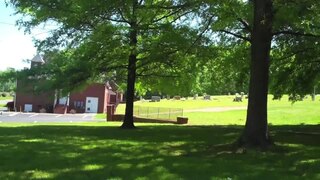
The Rosenwald School project built more than 5,000 schools, shops, and teacher homes in the United States primarily for the education of African-American children in the South during the early 20th century. The project was the product of the partnership of Julius Rosenwald, a Jewish-American clothier who became part-owner and president of Sears, Roebuck and Company and the African-American leader, educator, and philanthropist Booker T. Washington, who was president of the Tuskegee Institute.

The Black Metropolis–Bronzeville District is a historic African American district in the Bronzeville neighborhood of the Douglas community area on the South Side of Chicago, Illinois.

The Chicago Bee Building is a historic building on Chicago's South Side. It originally housed the Chicago Bee, a newspaper serving the African Americans of Chicago. The building now houses the Chicago Bee Branch of the Chicago Public Library. The building was named a Chicago Landmark on September 9, 1998. It is located in the Black Metropolis-Bronzeville District in the Douglas community area of Chicago, Illinois.

Hygienic Manufacturing Company, also known as Overton Hygienic Company, was a cosmetics company established by Anthony Overton. It was one of the nation's largest producers of African-American cosmetics. Anthony Overton also ran other businesses from the building, including the Victory Life Insurance Company and Douglass National Bank, the first nationally chartered, African-American-owned bank. The Overton Hygienic Building is a Chicago Landmark and part of the Black Metropolis-Bronzeville District in the Douglas community area of Chicago, Illinois. It is located at 3619-3627 South State Street.

Horace Howard Furness High School is a secondary (9th-12th) school in South Philadelphia. It is part of the School District of Philadelphia.

The Gold Coast Historic District is a historic district in Chicago, Illinois. Part of Chicago's Near North Side community area, it is roughly bounded by North Avenue, Lake Shore Drive, Oak Street, and Clark Street.
James H. Bowen High School is a public 4–year high school located in the South Chicago neighborhood on the south side of Chicago, Illinois, United States. Bowen is operated by the Chicago Public Schools district.

First Congregational Church of Austin, also known as Greater Holy Temple of God in Christ, is a historic church at 5701 West Midway Place in Chicago, Illinois. The church was built in 1905 for a Congregational assembly; it was later used by Seventh-Day Adventist, Roman Catholic, and Church of God in Christ congregations. A Chicago building permit was issued on August 15, 1905 according to the Chicago Tribune of August 16, 1905. Architect William Eugene Drummond, a student of Louis Sullivan and a sometime employee of Frank Lloyd Wright, designed the church in the Prairie School style; it is an unusual example of a Prairie School church and influenced Wright's Unity Temple which was designed after the original church burned on June 4, 1905. The one-story building consists of a tall central section with massive piers and a smaller section to either side. The entrance is recessed in the base of the central section; the doorway features lintels and posts that continue the building's rectilinear emphasis. Leaded glass windows are recessed in the spaces between the central section's piers.

The historic Chicago park and boulevard system is a ring of parks connected by wide, planted-median boulevards that winds through the north, west, and south sides of the City of Chicago. The neighborhoods along this historic stretch include, Logan Square, Humboldt Park, Englewood, Back of the Yards, Lawndale, and Bronzeville. It reaches as far west as Garfield Park and turns south east to Douglas Park. In the south, it reaches Washington Park and Jackson Park, including the Midway Plaisance, used for the 1893 World's Fair.

The West Pullman Elementary School is a historic school building at 11941 S. Parnell Avenue in the West Pullman neighborhood of Chicago, Illinois. The school was built in 1894 to support the growing neighborhood; while West Pullman was not the most populous neighborhood in need of a new school, its land had been donated to the school district, reducing the school's cost enough for it to be feasible. School board architect W. August Fiedler designed the Romanesque Revival school, which features a red brick exterior, rounded arched windows, and ornamental brickwork. A 1900 addition to the school doubled its capacity; William Bryce Mundie, the architect for the addition, introduced Classical Revival elements such as terra cotta decorations and a bracketed cornice. A third addition in 1923, designed by John C. Christensen, largely matched the design of the original two sections. The school served students in West Pullman until it closed in 2013 as part of a wave of Chicago public school closings.

Elizabeth H. Sutherland Elementary School is a public K-8 school located in the Beverly neighborhood on the south side of Chicago, Illinois. It is part of the Chicago Public Schools system. The school is named for Chicago educator Elizabeth "Bessie" Huntington Sutherland, the first woman principal in Cook County. The current building was opened in 1925, one year after Sutherland's death.