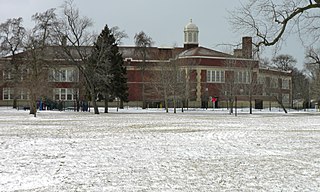
The Norwood Park Historical District is a historic district in the Norwood Park neighborhood of Chicago, Illinois. It is bordered by Bryn Mawr, Avondale, and Harlem Avenues, and is home to the Noble-Seymour-Crippen House, which was built in 1833 and is widely considered to be the oldest house in Chicago. The historic district is also home to Norwood Park Public School, William Howard Taft High School, Norwood Park, Myrtle Park, and Norwood Circle Park. The district was added to the National Register of Historic Places in 2002.

The Dyckman House, now the Dyckman Farmhouse Museum, is the oldest remaining farmhouse on Manhattan island, a vestige of New York City's rural past. The Dutch Colonial-style farmhouse was built by William Dyckman, c.1785, and was originally part of over 250 acres (100 ha) of farmland owned by the family. It is now located in a small park at the corner of Broadway and 204th Street in Inwood, Manhattan.

Lone Star is a wooden hull, steam-powered stern-wheeled towboat in LeClaire, Iowa, United States. She is dry docked and on display at the Buffalo Bill Museum in LeClaire. Built in 1868, she is the oldest of three surviving steam-powered towboats, and the only one with a wooden hull. She was declared a National Historic Landmark on 20 December 1989.

The VanDyke–Libby House, located at 612 Vermillion Street in Hastings, Minnesota is listed on the National Register of Historic Places. It was built in 1868 by William J. Van Dyke, a banker and merchant. In 1880 the home was bought by Rowland C. Libby who was part-owner of a saw mill and door and sash factory. He lived there until 1911; in 1914 the building was converted to a sanitarium. Originally known as Hope Sanitarium, its name was later changed to St. Raphael's Hospital, which in 1929 moved to the Thompson-Fasbender House.

Grace United Methodist Church is a historic Methodist Church building at 34 Court Street in Keene, New Hampshire. Built in 1869, it was designed by architect Shepard S. Woodcock, and is one of the largest churches in southwestern New Hampshire. It was added to the National Register of Historic Places in 1985. Its congregation moved in 2009 and was disbanded in 2016, and the building is undergoing renovation for use as professional offices.

The Moses-Kent House is a historic house at 1 Pine Street in Exeter, New Hampshire. Built in 1868 for a prominent local merchant, it is one of the town's finest examples of Victorian residential architecture. It was added to the National Register of Historic Places on September 12, 1985.

The Fairmount Historic District is a 409-acre (166 ha) historic district located along County Route 517 in the Fairmount section of Tewksbury Township, near Califon, in Hunterdon County, New Jersey. It was added to the National Register of Historic Places on December 20, 1996 for its significance in architecture, exploration/settlement, and industry. The district includes 72 contributing buildings that were deemed to be contributing to the historic character of the area, plus five contributing structures, nine contributing sites, and one contributing object. One contributing building is located in Washington Township, Morris County.

The B. C. Wandell House, also known as The Cedars, is located at 214, 223, and 224 West Saddle River Road in the borough of Saddle River in Bergen County, New Jersey, United States. The historic house was built from 1865 to 1868 and was added to the National Register of Historic Places on August 29, 1986, for its significance in architecture. It was listed as part of the Saddle River Multiple Property Submission (MPS).

The Hamburg Historic District, also known as the Gold Coast, is a residential neighborhood located on a bluff northwest of downtown Davenport, Iowa, United States. It is listed on the National Register of Historic Places in 1983. In 1999, it was listed on the Davenport Register of Historic Properties The historic district is where the city's middle and upper-income German community built their homes in the 19th and early 20th centuries. Germans were the largest ethnic group to settle in Davenport.

The Old City Hall, also known as Oxford Flats, is located just north of downtown along a commercial corridor in Davenport, Iowa, United States. It was individually listed on the National Register of Historic Places in 1983. In 2020 it was included as a contributing property in the Davenport Downtown Commercial Historic District.
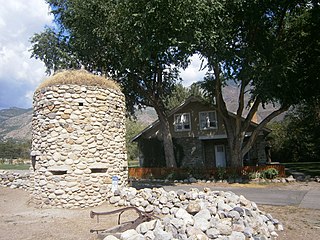
The Moyle House and Indian Tower is a historic residence and watchtower in Alpine, Utah, United States, that is listed on the National Register of Historic Places.

The First United Methodist Church is a Methodist church that was founded in 1868 in Reno, Nevada. In 1868 the first meetings were held in the local schoolhouse on the corner of what is now First and Sierra Streets. In 1871 The first church was erected and dedicated on Sierra Street between First and Second Streets. In the early 1900s the wood-framed church was moved to the back of the lot and a new brick building was added to it. And finally in 1925 plans for a new building were made. Designed by Wythe, Blaken, and Olson of Oakland, the church is one of the first poured concrete buildings in Reno and utilizes Gothic Revival architectural themes. The corner stone for the current historical building was placed in 1926, with the building being dedicated in December of that same year. It was listed on the National Register of Historic Places in 1983; the listing included two contributing buildings. The second building is a parish house designed by local architect Donald Parsons and built in c.1940. In 1965 another addition was done to add on what is currently the fellowship hall, and Sunday school class rooms.

Wood Lawn is a historic mansion located off Ryders Lane on the Cook Douglass Campus of Rutgers University in the city of New Brunswick in Middlesex County, New Jersey. The house was added to the National Register of Historic Places on March 8, 1978, for its significance in architecture and education. It is currently used by the Eagleton Institute of Politics.

The Augustus and Laura Blaisdell House is a historic house at 517 Depot Street in Chester, Vermont. Built in 1868 for a local businessman, it is a fine local example of transitional Greek Revival-Italianate architecture. It has historically served both commercial and residential functions, and now contains apartments. It was listed on the National Register of Historic Places in 2014.

The Barret House, at 204 S. Elm St. in Henderson, Kentucky, was built in c.1868. It was listed on the National Register of Historic Places in 1978.

The Asbury Historic District is a 288-acre (117 ha) historic district encompassing the community of Asbury in Franklin Township of Warren County, New Jersey. It is bounded by County Route 632, County Route 643, Maple Avenue, Kitchen Road, and School Street and extends along the Musconetcong River into Bethlehem Township of Hunterdon County. It was listed on the National Register of Historic Places on March 19, 1993 for its significance in architecture, industry, religion, community development, politics/government, and commerce. The district includes 141 contributing buildings, a contributing structure, two contributing sites, and four contributing objects.

The Demarest House is a historic building at 542 George Street in New Brunswick, New Jersey on the campus of Rutgers University. It was documented by the Historic American Buildings Survey in 1960. The house was later added to the National Register of Historic Places on August 10, 1977 for its significance in architecture, education, and social history.

The Dr. John Vermeule House, also known as the Vermeule–Mundy House, is a historic building located at 223 Rock Avenue in Green Brook Township of Somerset County, New Jersey. It was added to the National Register of Historic Places on February 20, 2013, for its significance in architecture.
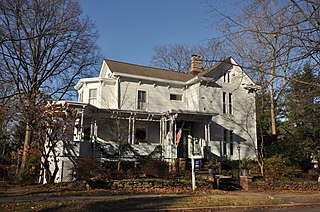
The Mary Wilkins Freeman House is a historic house located at 207 Lake Avenue in the Borough of Metuchen in Middlesex County, New Jersey. It was the home of the author, Mary Eleanor Wilkins Freeman (1852–1930). Built c. 1868, the house was added to the National Register of Historic Places on January 17, 2020, for its significance in literature from 1902 to 1907.

The Washington Park Historic District is a 100-acre (40 ha) historic district located in the borough of North Plainfield in Somerset County, New Jersey. It was added to the National Register of Historic Places on April 9, 1987, for its significance in architecture, landscape architecture, and community planning. Featuring houses built from 1868 to 1917, the district includes 145 contributing buildings.