Related Research Articles

Petroleum is a naturally occurring yellowish-black liquid mixture. It consists mainly of hydrocarbons, and is found in geological formations. The term petroleum refers both to naturally occurring unprocessed crude oil, as well as to petroleum products that consist of refined crude oil.
Petroleum geology is the study of the origins, occurrence, movement, accumulation, and exploration of hydrocarbon fuels. It refers to the specific set of geological disciplines that are applied to the search for hydrocarbons.

A barrel is one of several units of volume applied in various contexts; there are dry barrels, fluid barrels, oil barrels, and so forth. For historical reasons the volumes of some barrel units are roughly double the volumes of others; volumes in common use range approximately from 100 to 200 litres. In many connections the term drum is used almost interchangeably with barrel.

Hydrocarbon exploration is the search by petroleum geologists and geophysicists for deposits of hydrocarbons, particularly petroleum and natural gas, in the Earth's crust using petroleum geology.

North Sea oil is a mixture of hydrocarbons, comprising liquid petroleum and natural gas, produced from petroleum reservoirs beneath the North Sea.

The petroleum industry, also known as the oil industry or the oil patch, includes the global processes of exploration, extraction, refining, transportation, and marketing of petroleum products. The largest volume products of the industry are fuel oil and gasoline (petrol). Petroleum is also the raw material for many chemical products, including pharmaceuticals, solvents, fertilizers, pesticides, synthetic fragrances, and plastics. The industry is usually divided into three major components: upstream, midstream, and downstream. Upstream regards exploration and extraction of crude oil, midstream encompasses transportation and storage of crude, and downstream concerns refining crude oil into various end products.

The National Iranian Oil Company is a government-owned national oil and natural gas producer and distributor under the direction of the Ministry of Petroleum of Iran. NIOC was established in 1951 and restructured under The Consortium Agreement of 1954. NIOC ranks as the world's second largest oil company, after Saudi Arabia's state-owned Aramco.
Oil in place (OIP) (not to be confused with original oil-in-place (OOIP)) is a specialist term in petroleum geology that refers to the total oil content of an oil reservoir. As this quantity cannot be measured directly, it has to be estimated from other parameters measured prior to drilling or after production has begun.
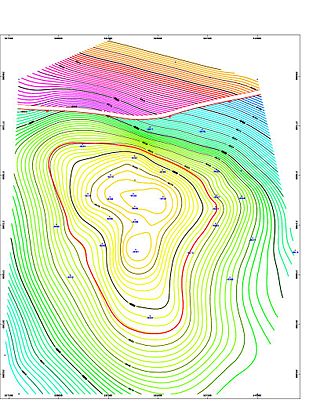
A petroleum reservoir or oil and gas reservoir is a subsurface accumulation of hydrocarbons contained in porous or fractured rock formations. Such reservoirs form when kerogen is created in surrounding rock by the presence of high heat and pressure in the Earth's crust.

The Mineral Leasing Act of 1920 30 U.S.C. § 181 et seq. is a United States federal law that authorizes and governs leasing of public lands for developing deposits of coal, petroleum, natural gas and other hydrocarbons, in addition to phosphates, sodium, sulfur, and potassium in the United States. Previous to the act, these materials were subject to mining claims under the General Mining Act of 1872.

The Ministry of Petroleum (MOP) (Persian: وزارت نفت, romanized: Vezârat-e Naft) manages the oil industry, the producer of oil and petrochemical products. MoP is in charge of all issues pertaining to exploration, extraction, exploitation, distribution and exportation of crude oil and oil products. In addition, according to the "Imports and Exports Regulation Act[usurped]", issuing import licenses for such products is also among the functions of the Ministry of Petroleum. The ministry has been placed under sanctions by the United States Department of State as of 2020.
Onshore, when used in relation to hydrocarbons, refers to an oil, natural gas or condensate field that is under the land or to activities or operations carried out in relation to such a field.
Prudhoe Bay Oil Field is a large oil field on Alaska's North Slope. It is the largest oil field in North America, covering 213,543 acres (86,418 ha) and originally contained approximately 25 billion barrels (4.0×10⁹ m3) of oil. The amount of recoverable oil in the field is more than double that of the next largest field in the United States by acreage (the East Texas Oil Field), while the largest by reserves is the Permian Basin (North America). The field was operated by BP; partners were ExxonMobil and ConocoPhillips until August 2019; when BP sold all its Alaska assets to Hilcorp.
The Japan Crude Cocktail (JCC) is the informal nickname given to the pricing index of Crude Oil used in most East Asian countries. The JCC is the average price of customs-cleared crude oil imports into Japan and is published by the Petroleum Association of Japan. The official name of the JCC is the Japan Customs-cleared Crude Oil Price. The valuation of the JCC closely reflects the market state of supply and demand. Clear fluctuations in JCC pricing can be linked to distinct events such as the 2007-08 Global Financial Crisis and the 2011 Fukushima Disaster.

Petroleum has been a major industry in the United States since the 1859 Pennsylvania oil rush around Titusville, Pennsylvania. Commonly characterized as "Big Oil", the industry includes exploration, production, refining, transportation, and marketing of oil and natural gas products. The leading crude oil-producing areas in the United States in 2023 were Texas, followed by the offshore federal zone of the Gulf of Mexico, North Dakota and New Mexico.

BP Shipping is the maritime arm of British headquartered global oil company, BP. The unit covers the marine transport, logistics and insurance requirements of all BP's global activities.
Gulf Keystone Petroleum Limited is an independent oil and gas exploration and production company that operates in the Kurdistan region of Iraq. It is also the operator of the Shaikan oil field. The company was listed on the main market of the London Stock Exchange on September 8, 2004. Jon Harris serves as its chief executive officer.
Great Eastern Energy Corporation Limited is a Coalbed methane (CBM) production company, located in Asansol district of West Bengal. With two CBM blocks, one in Raniganj, West Bengal, and the other in Mannargudi, Tamil Nadu. Great Eastern Energy Corporation has played an important role in providing methane gas. The wells dug in the respective blocks are well connected with gas gathering stations and the gas is fed into its dedicated steel pipeline network to maintain the supply.
The Ravva oil field in the Krishna Godavari Basin is located in coastal Andhra Pradesh.

Oil and gas reserves denote discovered quantities of crude oil and natural gas that can be profitably produced/recovered from an approved development. Oil and gas reserves tied to approved operational plans filed on the day of reserves reporting are also sensitive to fluctuating global market pricing. The remaining resource estimates are likely sub-commercial and may still be under appraisal with the potential to be technically recoverable once commercially established. Natural gas is frequently associated with oil directly and gas reserves are commonly quoted in barrels of oil equivalent (BOE). Consequently, both oil and gas reserves, as well as resource estimates, follow the same reporting guidelines, and are referred to collectively hereinafter as oil & gas.
References
- ↑ SPE (2011). Guidelines for Application of the Petroleum Resources Management System. Society of Petroleum Engineers. p. 222.
- ↑ Dutton, John A. "5.2: Estimation of Original Gas In-Place, OGIP, Using the Volumetric Method". e-Education Institute. PennState College of Earth and Mineral Sciences. Retrieved 26 July 2022.

 | This article related to natural gas, petroleum or the petroleum industry is a stub. You can help Wikipedia by expanding it. |