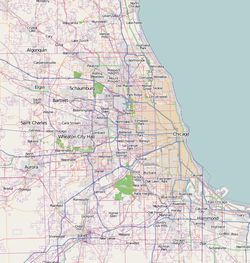
Lakeview is one of the 77 community areas of Chicago, Illinois. Lakeview is located on the city's North Side and is bordered by West Diversey Parkway on the south, West Irving Park Road on the north, North Ravenswood Avenue on the west, and the shore of Lake Michigan on the east. The Uptown community area is to Lakeview's north, Lincoln Square to its northwest, North Center to its west, and Lincoln Park to its south. The 2020 population of Lakeview was 103,050 residents, making it the second-largest Chicago community area by population.

Norwood Park is one of the 77 Chicago community areas. It encompasses the smaller neighborhoods of Big Oaks, Norwood Park East, Norwood Park West, Old Norwood Park, Oriole Park, and Union Ridge.

Uptown is one of Chicago's 77 community areas. Uptown's boundaries are Foster Avenue to the north; Lake Michigan to the east; Montrose Avenue, and Irving Park Road to the south; Ravenswood Avenue, and Clark Street to the west. To the north is Edgewater, to the west is Lincoln Square, and to the south is Lakeview. Near the lake are some of the northern reaches of Lincoln Park, including Montrose Beach and multiple nature reserves. The area has a mix of commercial and residential development, and includes a well-established entertainment district of clubs and concert venues, and was a center for early film making. Truman College, a two-year city college, is located here, and the area's southwest corner includes the historic 19th century Graceland Cemetery.
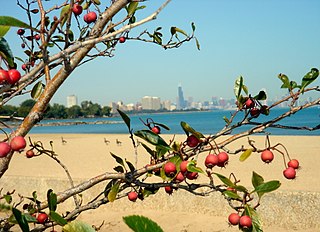
South Shore is one of 77 defined community areas of Chicago, Illinois, United States. Located on the city's South Side, the area is named for its location along the city's southern lakefront. Although South Shore has seen a greater than 40% decrease in residents since Chicago's population peaked in the 1950s, the area remains one of the most densely populated neighborhoods on the South Side. The community benefits from its location along the waterfront, its accessibility to Lake Shore Drive, and its proximity to major institutions and attractions such as the University of Chicago, the Museum of Science and Industry, and Jackson Park.

Irving Park is one of 77 officially designated Chicago community areas, and is located on the Northwest Side. It is bounded by the Chicago River on the east, the Milwaukee Road railroad tracks on the west, Addison Street on the south and Montrose Avenue on the north, west of Pulaski Road stretching to encompass the region between Belmont Avenue on the south and, roughly, Leland Avenue on the north. It is named after the American author Washington Irving.

Portage Park is located on the northwest side of the City of Chicago, Illinois and is one of 77 officially designated Chicago community areas. Portage Park is bordered by the community areas of Jefferson Park and Forest Glen to the north, Dunning and the suburb of Harwood Heights to the west, Irving Park to the east and Belmont-Cragin to the south.

The Near South Side is a community area of Chicago, Illinois, United States, just south of the downtown central business district, the Loop. The Near South Side's boundaries are as follows: North—Roosevelt Road ; South—26th Street; West—Chicago River between Roosevelt and 18th Street, Clark Street between 18th Street and Cermak Road, Federal between Cermak Road and the Stevenson Expressway just south of 25th Street, and Clark Street again between the Stevenson and 26th Street; and East—Lake Michigan.

North Center is one of the 77 community areas of Chicago, Illinois, located in the city's North Side. North Center is bordered on the north by Montrose Avenue, on the south by Diversey Parkway, on the west by the Chicago River and on the east by Ravenswood Avenue; it includes the neighborhoods of Northcenter, Roscoe Village, St. Ben's, and Hamlin Park. The Brown Line of the Chicago 'L' has stops within the community area at Addison, Irving Park, and Montrose.

Grand Boulevard on the South Side of Chicago, Illinois, is one of the city's Community Areas. The boulevard from which it takes its name is now Martin Luther King Jr. Drive. The area is bounded by 39th to the north, 51st Street to the south, Cottage Grove Avenue to the east, and the Chicago, Rock Island & Pacific Railroad tracks to the west.
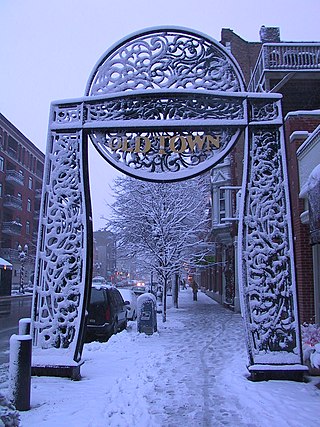
Old Town is a neighborhood and historic district in Near North Side and Lincoln Park, Chicago, Illinois, home to many of Chicago's older, Victorian-era buildings, including St. Michael's Church, one of seven buildings to survive the Great Chicago Fire.

The Dana–Thomas House is a Prairie School–style home at 301 East Lawrence Avenue in Springfield, Illinois, designed by architect Frank Lloyd Wright. It was built in 1902–1904 for the philanthropist Susan Lawrence Dana. The home reflects the mutual affection of the patron and the architect for organic architecture, the relatively flat landscape of the U.S. state of Illinois, and the Japanese aesthetic as expressed in Japanese prints.
Grabill is a form of the surname Graybill. It may refer to

The Emil Bach House is a Prairie style house in the Rogers Park neighborhood of Chicago, Illinois, United States. Designed by architect Frank Lloyd Wright, the house was built in 1915 for Emil Bach, the co-owner of the Bach Brick Company and an admirer of Wright's work. The house is representative of Wright's late Prairie style and is an expression of his creativity from a period just before his work shifted stylistic focus. The Bach House was declared a Chicago Landmark on September 28, 1977, and was added to the National Register of Historic Places on January 23, 1979.

The Henry Gerber House is located on North Crilly Court in the Old Town neighborhood of Chicago, Illinois, United States. It is a single-family brick row house built in 1885 in the Queen Anne style, mostly intact from that time. In the 1920s it housed the apartment occupied by German-born Henry Gerber, founder of the short-lived Society for Human Rights, which was incorporated in Illinois as the first American organization working for gay rights. Inspired by nascent gay-rights organizations he had seen in Germany, Gerber held meetings here and published newsletters, the first known gay civil rights periodicals in the country, for a year until the Chicago police raided the house in 1925.

The Birthplace of Ronald Reagan, also known as the Graham Building, is located in an apartment on the second floor of a late 19th-century commercial building in Tampico, Illinois, United States. The building was built in 1896, and housed a tavern from that time until 1915. On February 6, 1911, the future 40th President of the United States, Ronald Reagan, was born in the apartment there. The Reagan family moved into a house in Tampico a few months later.
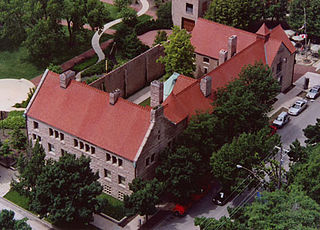
Prairie Avenue is a north–south street on the South Side of Chicago, which historically extended from 16th Street in the Near South Side to the city's southern limits and beyond. The street has a rich history from its origins as a major trail for horseback riders and carriages. During the last three decades of the 19th century, a six-block section of the street served as the residence of many of Chicago's elite families and an additional four-block section was also known for grand homes. The upper six-block section includes part of the historic Prairie Avenue District, which was declared a Chicago Landmark and added to the National Register of Historic Places.
Clarence Hatzfeld (1873–1943) was a prolific Chicago architect who designed residences, park field houses, Masonic temples, banks and other commercial buildings in the Craftsman, Prairie, and Revival styles.

Independence Park, officially Park #83 of the Chicago Park District, is a 7.16-acre (2.90 ha) recreational area in the Irving Park neighborhood of North Side, Chicago, Illinois.

The Charles N. Loucks House is a historic house at 3926 N. Keeler Avenue in the Irving Park neighborhood of Chicago, Illinois. The house was built in 1889 for Charles N. Loucks, a real estate planner who developed much of Irving Park, and his family. Clarence H. Tabor, an architect who worked for Loucks' real estate company, designed the Queen Anne house. The house's design features a front porch with carved wooden trim and a pediment, a front-facing gable with a floral design at its peak, and a tower with a conical roof. The interior includes distinctive floral-patterned art glass windows, which include both clear and stained glass and were inspired by English and Japanese design.

The Schorsch Irving Park Gardens Historic District is a residential historic district in the Dunning neighborhood of Chicago, Illinois. The district includes 255 buildings, all but three of which are Chicago bungalows. In the early twentieth century, tens of thousands of Chicago bungalows were built in the city; as homeownership became more accessible to working-class Chicagoans, demand for housing increased, and bungalows were an affordable way of meeting this demand due to their relatively uniform design. The bungalows in the district were largely built either between 1917 and 1918 or between 1922 and 1926. Unlike Chicago's other bungalow-dominated neighborhoods, which often had several different developers, developer Albert J. Schorsch built every bungalow in the district, and architech Ernest N. Braucher designed all of them. To add diversity to a neighborhood made up of only one style of house, the two men varied the homes' roof shapes, colors, and dormers.