Related Research Articles

Basmati is a variety of long, slender-grained aromatic rice which is traditionally grown in the Indian subcontinent, mainly India, and Pakistan, as well as some regions of Sri Lanka and Nepal. As of 2019, India accounted for 65% of the international trade in basmati rice, while Pakistan accounted for the remaining 35%. Many countries use domestically grown basmati rice crops; however, basmati is geographically exclusive to certain districts of India and Pakistan.

Bhandara District is an administrative district in the state of Maharashtra in India. The name Bhandara is a corruption of Bhanara. Reference to Bhanara is found in an inscription of 1100 A.D. traced at Ratanpur. The district headquarters are located at Bhandara. The district occupies an area of 3717 km2 and has a population of 1,200,334, of which 19.48% are urban as of 2011. The growth rate of Bhandara is 5.56% Bhandara has a mixed economy with agriculture, industries and forest resources. Bhandara is known for its large production of rice. Tumsar, a tahsil town, is a noted rice market. Bhandara town is also known as "Brass City" owing to the presence of a large brass products industry. Bhandara has several tourist destinations, like Ambagad Fort, Brahmi, Chinchgad, and Dighori.
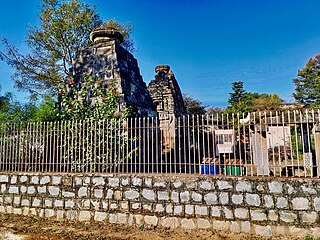
Balaghat district is a district of Madhya Pradesh state in Central India. Its belongs to Jabalpur Division. Balaghat city is Administrative Headquarter of Balaghat District.
Waraseoni is a tehsil and Nagar Palika Parishad (municipality) in Balaghat district in the Indian state of Madhya Pradesh. It is situated 16 km (10 mi) from the district headquarters. Waraseoni is second most populous town in Balaghat District after Balaghat.

Kalanamak is a scented rice of Nepal and India. Its name means black husk. This variety has been in cultivation since the original Buddhist period. It is popular in Himalayan Tarai of Nepal i.e., Kapilvastu, and eastern Uttar Pradesh, where it is known as the scented black pearl. It was featured in the book Speciality rices of the world by Food and Agriculture Organization of the United Nations.

Namsai district is an administrative district in the state of Arunachal Pradesh in north-east India.It was carved out of Lohit district in November 2014.
Wayanad Jeerakasala rice is a variety of traditional, non-Basmati, medium-grained aromatic rice with golden yellow colour mainly grown in the Indian state of Kerala. It is a common and widely cultivated crop in Wayanad district. The other variety from the same region, Wayanad Gandhakasala rice is known for its sandalwood-like flavor, while Wayanad Jeerakasala rice resembles cumin seeds in both appearance and taste and are so unique from one another.

Waraseoni is one of the 230 constituencies of the Madhya Pradesh Legislative Assembly, in Madhya Pradesh state in central India.

The Khola chilli is a variety of chilli mainly grown in the Indian state of Goa.
Tulshimala is a photoperiod-sensitive Aman variety of rice. It is planted from the last week of July to the first week of August. Flowers bloom from the end of October to mid-November. Harvesting takes place from the first to the last week of December. Without a plant protection measure, the yield is 2.50 to 2.75 metric tons per hectare, and with plant protection measures, the yield is 3.00 to 3.25 metric tons per hectare. The maturity period is 125-140 days. The rice is dark gray in color. The average weight of 1000 grains is 11 grams. On April 11, 2018, the Sherpur District Administration filed an application for Geographical Indication (GI) registration of Tulashimala rice with the Department of Patents, Designs, and Trademarks (DPDT). After completing all the necessary procedures, Tulashimala rice from Sherpur was registered as the 14th Geographical Indication product in the country on June 12, 2023.
Ajara Ghansal is a variety of non-Basmati aromatic rice mainly grown in the Indian state of Maharashtra. It is a common and widely cultivated crop in Ajara taluka of Kolhapur district.
Bhandara Chinoor rice is a variety of non-Basmati aromatic rice mainly grown in the Indian state of Maharashtra. It is a common and widely cultivated crop in talukas of Bhandara, Pauni, Tumsar, Mohadi, Sakoli, Lakhani, and Lakhandur of Bhandara district.

Mushqbudji rice is a variety of non-Basmati, short-grained aromatic rice mainly grown in the Indian Union territory of Jammu and Kashmir growing on the higher reaches of the valley. It is a common and widely cultivated crop in Sagam belt of Anantnag district and the Beerwah belt of Budgam district, and also cultivated in Anantnag and Kulgam in Kashmir by farmers under irrigated conditions.
Marcha rice is a variety of non-Basmati, short-grained aromatic rice mainly grown in the Indian state of Bihar. It is a common and widely cultivated crop in Ramnagar, Gaunaha, Mainatand, Chanpatiya, Narkatiyaganj and Lauriya blocks of West Champaran district.
Koraput Kalajeera rice is a variety of non-Basmati, aromatic, black paddy coloured, small rice mainly grown in the Indian state of Odisha. It is a common and widely cultivated crop in the Koraput district of Odisha as well as Nabarangapur district which was earlier a part of Koraput. For thousands of years, the ancestors of Koraput's present tribal communities have cultivated and domesticated Kalajeera rice, playing a crucial role in its conservation.
Adamchini Chawal is a variety of non-Basmati, traditional, short-grained aromatic rice mainly grown in the Indian state of Uttar Pradesh. It is a common and widely cultivated crop in Chandauli, Mirzapur, Varanasi and Sonebhadra, and Vindhya region of Eastern Uttar Pradesh.
Kalijira rice is a premium variety of rice produced in Bangladesh, recognized for its small black grains, delicate texture, and distinct aroma. Unlike Basmati rice, Kalijira is slightly sticky when cooked and has unique culinary properties that distinguish it as a staple in traditional Bengali cuisine. Often referred to as the "Prince of Rice," it is one of the finest aromatic rice varieties in Bangladesh and holds a Geographical indication (GI) certification.
Chak-Hao is an indigenous, aromatic, glutinous, and large-grained black rice variety mainly grown in the Indian states of Manipur and Nagaland. It is a common and widely cultivated crop in the districts of Imphal East, Imphal West, Bishnupur, Thoubal of Manipur and Peren district of Nagaland. Chak-Hao or Chakhao or Chak Hao Amubi are variations of the same name. It is popularly called the Black rice of Manipur or Manipur Black rice.
Jeeraphool rice is an ancient, indigenous, aromatic, and short-grained rice variety mainly grown in the Indian states of Chhattisgarh. It is a common and widely cultivated crop in Surguja district of Chhattisgarh in Ambikapur, Lakhanpur, Udaipur, Sitapur, Batauli, Lundra and Mainpat. The uniqueness is that the shape of the rice grain is shaped like a cumin.
Arunachal Pradesh Khaw Tai (Khamti Rice) is an indigenous variety of non-Basmati, short-grained bold aromatic rice mainly grown in the Indian state of Arunachal Pradesh. It is a common and traditionally widely cultivated crop by Khampti tribe farmers in Namsai, Changlang, and Lohit districts. Under its Geographical Indication tag, it is referred to as "Arunachal Pradesh Khaw Tai (Khamti Rice)".
References
- ↑ Khan, Mohammad Imran; Bisen, Uttam; Sarvade, S.; Gautam, Kamleshwar; Bisen, Sharad; Rai, S. K.; Shrivastava, Atul (2021). "Study on Adoption of Chinnor Rice Production Technology and Constraints Faced by Farmers of Balaghat District, Madhya Pradesh". International Journal of Bio-Resource and Stress Management. 12 (5): 516–522. doi:10.23910/1.2021.2257 . Retrieved 21 November 2024.
- ↑ "Study on Adoption of Chinnor Rice Production Technology and Constraints Faced by Farmers of Balaghat District, Madhya Pradesh". ResearchGate GmbH. Retrieved 21 November 2024.
- ↑ Service, Express News (11 July 2021). "A revolution in a rice bowl". The New Indian Express. Retrieved 21 November 2024.
- ↑ "One district one product | District Balaghat, Government of Madhya Pradesh | India". District Administration © District Balaghat, Madhya Pradesh. Retrieved 21 November 2024.
- ↑ Khan, Mohammad Imran; Bisen, Uttam; Sarvade, S.; Gautam, Kamleshwar; Bisen, Sharad; Rai, S. K.; Shrivastava, Atul (31 October 2021). "Study on Adoption of Chinnor Rice Production Technology and Constraints Faced by Farmers of Balaghat District, Madhya Pradesh". International Journal of Bio-resource and Stress Management. 12 (5): 516–522. doi:10.23910/1.2021.2257. S2CID 244412503.
- ↑ Dogra, Bharat (1991). The Life and Work of Dr. R.H. Richharia: The Eminent Rice Scientist who Struggled All His Life for Small Farmers to Protect Them from Big Business and to Preserve Their Heritage : Including the Text of an Action Plan on Rice Prepared by Dr. Richharia. B. Dogra. Retrieved 21 November 2024.
- ↑ "Madhya Pradesh Rice Variety Known for Aroma, Taste Gets GI Tag; Eyes Global Market". News18. Retrieved 21 November 2024.
- ↑ "How a GI tag could resuscitate a near-dead variety of rice in MP". India Today. 14 October 2021. Retrieved 21 November 2024.
- ↑ "बालाघाट के चिन्नौर चावल के आप हैं शौकीन तो यह खबर खासतौर से आपके लिए है..." News18 हिंदी (in Hindi). 27 December 2022. Retrieved 21 November 2024.
- ↑ Pradesh, India Superintendent of Census Operations, Madhya (1964). District Census Handbook, Madhya Pradesh: Balaghat. Government of Madhya Pradesh. Retrieved 21 November 2024.
{{cite book}}: CS1 maint: multiple names: authors list (link) - ↑ Pradesh (India), Madhya (1992). Madhya Pradesh: Balaghat. Government Central Press. Retrieved 21 November 2024.
- ↑ "GOVERNMENT OF INDIA GEOGRAPHICAL INDICATIONS JOURNAL NO. 133 MARCH 23, 2020" (PDF). Intellectual Property India. Retrieved 21 November 2024.
- ↑ Bharat, E. T. V. (30 September 2021). "MP: Balaghat's 'Chinnor rice' gets GI tag, farmers income to increase". ETV Bharat News. Retrieved 21 November 2024.
- ↑ "Balaghat Chinnor rice first agriculture produce in Madhya Pradesh to get GI tag". The Times of India. 1 October 2021. Retrieved 22 November 2024.
