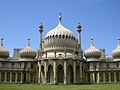
Brighton War Memorial is a First World War memorial in Brighton, on the south coast of England. It stands in Old Steine Gardens, close to the Royal Pavilion and multiple other monuments. It was designed by John William Simpson and unveiled in 1922. Recruitment to the armed forces was strong in Brighton, and many of the town's public buildings, including the pavilion, were converted into hospitals. The first casualties to arrive were from the local Royal Sussex Regiment, but Brighton came to be associated with Indian soldiers. Around 12,000 Indians were treated in the Pavilion and other makeshift hospitals in Brighton and more than 50 died.
A subcommittee of the borough council directly approached Simpson to design a memorial. Simpson's proposal was displayed in the local art gallery while funds were raised by public subscription. The design is based on a Roman water garden and consists of a colonnade at the head of a reflecting pool, flanked by two pylons which contain the names of the dead. In the centre of the pool is a fountain and in the centre of the colonnade is a temple-shaped screen which contains the main dedications. The rear face of the screen contains an altar table.
The memorial was unveiled on 7 October 1922 by Admiral of the Fleet Earl Beatty. Other memorials were built to commemorate the pavilion's role as a hospital and the Indian soldiers who died in the town. The site is close to the Egyptian Campaign Memorial and a modern memorial to casualties from later conflicts. The First World War memorial is a Grade II listed building.
Background
Following the First World War (1914–1918) and its unprecedented casualties, thousands of memorials were built in towns and cities across Britain. Brighton was a popular seaside destination and remained so at the beginning of the war but within weeks, major buildings in the town were converted into hospitals—among them the local workhouse, the grammar school, and the Royal Pavilion—a former royal palace that had been undergoing restoration. The first wave of casualties was 300 men from the Royal Sussex Regiment. Brighton came to be particularly associated with Indian soldiers—around 12,000 were treated in the town after being wounded on the Western Front. Among the most famous was the Victoria Cross recipient Gian Singh.[1]
The Indian attracted considerable attention, including from tourists who travelled to see them, to the point that the authorities erected screens to give the men privacy. King George V and Queen Mary paid a morale-boosting visit to the Pavilion in August 1915. More than 50 Indian soldiers died of their wounds in Brighton. The Muslims were buried in a plot near Shah Jahan Mosque in Surrey, to the north of Brighton. The Hindu and Sikh soldiers were cremated at a site in the South Downs hills near Patcham.[2][3]
Recruitment to the armed forces was strong in Brighton, especially early on. At the outbreak of war, many reservists were called up and many retired servicemen rejoined. Recruiting rallies were held in the Dome, recruiters visited local employers, and a recruiting station was set up in the town hall, where initially men aged 19–30 could sign up. Around 550 men volunteered in the first three weeks of the war.[4] Recruitment slowed down as the war progressed, and in November 1915 a captured German field gun was presented to the town in an attempt to boost enlistment but by that point it was estimated that 20,000 men from Brighton and the surrounding areas had joined the armed forces.[5]
Inception
Following the armistice in November 1918, Brighton Borough Council almost immediately began making plans to commemorate the casualties. It formed a Peace Celebration and War Memorial Subcommittee, which invited public suggestions.[6][7] In 1920, the subcommittee called a public meeting to discuss plans for a permanent war memorial. As in many places, suggestions were put forward for a practical scheme, including an orphanage, but these were ruled out because, in the subcommittee's view, they "did not meet the most essential requirements of a war memorial, ie embodying in a permanent form the sacrifices of those who have fallen or suffered on account of the war".[6]
The subcommittee approached the architect John William Simpson. Simpson was born in Brighton and his father, Thomas Simpson, was a well-known local architect. The younger Simpson was responsible for several works in the town, including the The Bugler, the Royal Sussex Regiment's Boer War Memorial (1904) on the seafront.[6][8][9] The subcommittee allocated Simpson a budget of £5,000, which it later reduced to £3,000. The funds were raised by public subscription. Another local architect, John Leopold Denman, submitted a design to the subcommittee but this was rejected on cost grounds. Simpson's plans were displayed in Brighton Art Gallery in 1921 for public feedback, which was favourable, especially given the architect's local connections.[6]
In the same year, the subcommittee opened a subscription fund to pay for the memorial, starting with direct appeals to local residents and businesses. A collecting box was placed on the chosen site on the Old Steine and, at the end of 1921, an outline model of the proposed design was placed next to it. The chosen site was occupied by the statue of George IV (erected in 1828), which was moved to a position close to the North Gate of the Royal Pavilion, just to the west, to make way for the memorial.[6]
Design
The dedication on the north face of the memorial, and wreaths laid on top of the altar table
The memorial consists of a colonnade and a reflecting pool with a fountain in the centre. It stands in Old Steine Gardens, on the Old Steine, the meeting point of the main roads into Brighton. It is just east of the Royal Pavilion and close to several other war memorials and other monuments. It is built from Portland stone in an Italianate style, based on a Roman water garden.[6][10] The pool is roughly square in plan but has chamfered corners. The colonnade is at the north end of the pool. It is 3.2 metres (10 feet) deep and 11 metres (36 feet) long. It has four sides and is stepped back to form a U shape. The centrepiece is a rectangular stone panel set between the columns, resembling a shrine or temple and surmounted by a dome, which brings it to a height of 4 metres (13 feet). The temple has an altar table built in on the north side, above which is a metal plaque carrying the main inscription. The water represents the Royal Navy and the Merchant Navy while the memorial gardens represent the British Army and the Royal Air Force.[6][11][12]
The recessed part of the colonnade is flanked by two free-standing Portland stone pylons covered in bronze tablets which bear the names of 2,597 dead, which includes three women.[6][11] The memorial subcommittee was responsible for compiling the names, most of which were nominated by relatives. Some were missed if they had no remaining family in Brighton to nominate them, while some nominations were rejected where the subcommittee deemed that the casualties ties to Brighton were not strong enough (for example, they were born in the town but moved away or they, they worked in Brighton but lived outside the borough boundary, or the family moved to Brighton after the war). Owing to space constraints, the subcommittee opted to list the casualties only by surname and first initial, and to create a book of remembrance with more details about each casualty, which was placed in St Peter's Church.[13]
The main dedication is on the back of the temple, facing north: "We cheered you forth noble and kind and brave / under your country's triumphing flag you fell / it floats true hearts over quiet grave / brave and noble and kind hail and farewell". Around the tops of the pylons, above the names, is the inscription: "A good life hath / its number of days / but a good name shall / continue for ever. A bronze plaque, added to the temple at a later date, reads: "This memorial is dedicated to the service men and women of Brighton who gave their lives in the First World War 1914–1918, the Second World War (1939–1945), and subsequent campaigns. Their names are recorded in the book of remembrance in the parish church of St Peter". The names of several theatres of the First World War are carved into the front of the temple, facing the pool, and above these is carved Brighton's coat of arms. The theatres listed are "high seas, north seas, home seas, Arctic, Baltic, Mediterranean, France and Flanders, Palestine, Russia, Italy, Macedonia, Dardanelles".[6][11][14] The architectural elements are surrounded by a rose garden, designed by the borough council's parks and gardens department at the same time.[6]
History
South face of the central panel, listing theatres of the First World War below the borough coat of arms
The memorial was unveiled at a ceremony on 7 October 1922 by Admiral of the Fleet Earl Beatty, a senior naval commander during the war and by then the head of the Royal Navy.[6][9] The ceremony was presided over by the mayor and attended by the full borough council in their robes of office.[15] The day's events began with Beatty receiving the Freedom of the Borough of Brighton in the council chamber at the town hall at 12:30pm, then a lunch in the Dome for paying participants and invited guests, then finally the assembly proceeded to the war memorial. Enclosures were set aside for families of the deceased, ex-servicemen, and subscribers. The unveiling took place at 3pm. The memorial was dedicated by the Vicar of Brighton, the Reverend Francis Dormer Pierce.[9][16]
Just north of the memorial, still in Old Steine Gardens, is the Egyptian Campaign Memorial (erected 1888), an obelisk which commemorates the Royal Sussex Regiment's casualties from two conflicts in North Africa in the 1880s. Behind that is a pink granite slab (installed in 2010) dedicated to all citizens of Brighton, Hove, and Portslade killed in conflict or peacekeeping operations since 1945.[6][9][10] In 1916, Brighton Council purchased the land near Patcham where the Hindu and Sikh soldiers were cremated, and in 1921 the Chattri was built on the site to commemorate them.[17][18]
As part of commemorations for the First World War centenary, paving stones with details of Victoria Cross holders were installed at war memorials in their birth towns. Three were placed at Brighton War Memorial—for Captain Theodore Wright, Second Lieutenant Ernest Frederick Beal, and Major Edward "Mick" Mannock. The stones were unveiled on different dates and a ceremony was held for each.[19][20][21]
In August 2018, the memorial was vandalised by protesters who splashed red paint on it and attempted to erase the word "Palestine" in the list of theatres.[22] In 2020, the local council proposed to replace grassed areas around the reflecting pool with flowerbeds, a plan which was opposed by veterans' and conservation groups.[23] From 2025, the council undertook a redevelopment programme of the Old Steine area which aimed to create a new public square and cycle path between the war memorial and the pavilion.[24]
The memorial has been a Grade II listed building, a status which provides it legal protection, since August 1999.[11] It is the venue for multiple commemorations, particularly the annual Remembrance Sunday service, which is presided over by the mayor and attended by veterans, local politicians, and other dignitaries as well as the public.[25]
Antram, Nicholas; Morrice, Richard (2008). Brighton and Hove. New Haven: Yale University Press. ISBN9780300126617.
Boorman, Derek (1988). At the Going Down of the Sun: British First World War Memorials. York: Sessions of York. ISBN9781850720416.
Collis, Rose (2010). The New Encyclopaedia of Brighton (Revised and updateded.). Brighton: Brighton & Hove City Libraries. ISBN9780956466402.
d'Enno, Douglas (2016). Brighton in the Great War. Barnsley: Pen and Sword. ISBN9781473865860.
Harkin, Trevor (2014). Brighton and the Great War. Coventry: War Memorial Park Publications. ISBN9780957299818.
School of Architecture and Interior Design (SAID), Brighton Polytechnic (1987). A Guide to the Buildings of Brighton. Macclesfield: McMillan Martin for the South East Region of the Royal Institute of British Architects. ISBN9781869865030.
Seddon, Jill; Seddon, Peter; McIntosh, Anthony (2014). Public Sculpture of Sussex. Liverpool: Liverpool University Press. ISBN9781781381250.
This page is based on this Wikipedia article Text is available under the CC BY-SA 4.0 license; additional terms may apply. Images, videos and audio are available under their respective licenses.