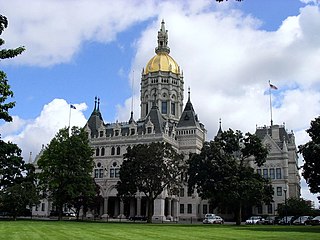
The Connecticut State Capitol is located north of Capitol Avenue and south of Bushnell Park in Hartford, the capital of Connecticut. The building houses the Connecticut General Assembly; the upper house, the State Senate, and lower house, the House of Representatives, as well as the office of the Governor of the State of Connecticut. The Connecticut Supreme Court occupies a building across Capitol Avenue.
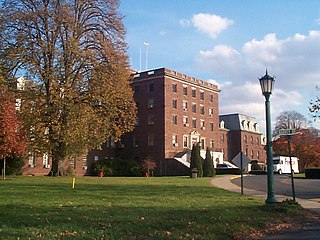
Connecticut Valley Hospital in Middletown, Connecticut, is a public hospital operated by the state of Connecticut to treat people with mental illness. It was historically known as Connecticut General Hospital for the Insane. It is a 100-acre (40 ha) historic district that was listed on the National Register of Historic Places in 1985.
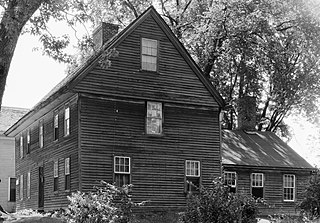
The Buttolph–Williams House is a historic house museum at 249 Broad Street in Wethersfield, Connecticut. Built in 1711, it is one of the oldest surviving houses in the town. It is owned by Connecticut Landmarks, a historic preservation organization, and is open for regular tours between May and October. it was designated a National Historic Landmark in 1968 for its significance as an extremely well-preserved example of early colonial architecture.
Edward Tuckerman Potter was an American architect best known for designing the 1871 Mark Twain House in Hartford, Connecticut. With his half-brother William Appleton Potter, he also designed Nott Memorial Hall (1858–79) at his alma mater, Union College, Schenectady, New York. Both the Mark Twain House and Nott Memorial Hall are National Historic Landmarks.
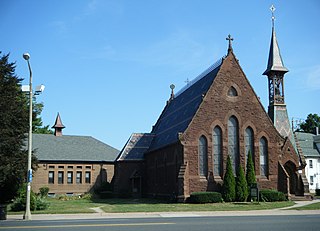
St. John's Episcopal Church is a historic church building at 1160 Main Street in East Hartford, Connecticut. It was designed by Edward T. Potter and was built in 1867, and is a prominent local example of High Gothic Revival executed in stone. Its congregation, begun as an Episcopal mission in 1854, has recently been merged into the St. John's Episcopal Church in Vernon. The building was listed on the National Register of Historic Places in 1983.

The Fyler–Hotchkiss Estate, also known as the Hotchkiss-Fyler House Museum, is a historic house museum at 192 Main Street in Torrington, Connecticut. Operated by the Torrington Historical Society, its main house is a well-preserved and distinctive example of Chateauesque Victorian architecture. It is also significant for its association with Orsamus Fyler, a prominent local politician and businessman. The property was listed on the National Register of Historic Places in 2009.

The Sarah Whitman Hooker House is a historic house at 1237 New Britain Avenue in West Hartford, Connecticut. Built about 1720, it is believed to be the oldest standing house in the town. It was listed on the National Register of Historic Places on November 1, 1979.

The Whitman House is a historic house at 208 North Main Street in West Hartford, Connecticut. Built about 1764, it is one of the town's few surviving 18th-century buildings. It was listed on the National Register of Historic Places on September 10, 1986.

The Whiting Homestead is a historic house at 291 North Main Street in West Hartford, Connecticut. Built about 1790, it is a fine example of late colonial architecture, with many original interior features. The house was listed on the National Register of Historic Places on August 3, 1987.
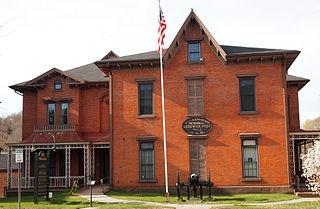
The William A. Buckingham House, also known as Buckingham Memorial Hall, is a historic house a fraternal hall at 307 Main Street in Norwich, Connecticut. It was built in 1847 by William A. Buckingham, whose later political career included terms as mayor of Norwich and Governor of Connecticut. Since 1898, it has housed a variety of veterans' and other service organizations, as well as government offices. The house was listed on the National Register of Historic Places on April 29, 1982.
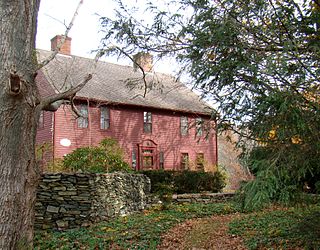
The Lathrop-Mathewson-Ross House is a historic house on Ross Hill Road in Lisbon, Connecticut. The house was built in 1761, and is a well-preserved example of Georgian residential architecture with an extensive documentary trail. It was added to the National Register of Historic Places on April 15, 1982.

The Butler-McCook Homestead is a historic house museum at 396 Main Street in Hartford, Connecticut. Built in 1782, it is one of the city's few surviving 18th-century houses. It was listed on the National Register of Historic Places in 1971. It is now operated as the Butler-McCook House & Garden by Connecticut Landmarks.
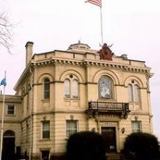
The B.P.O. Elks Lodge is a historic fraternal lodge building at 34 Prospect Street in Hartford, Connecticut. It is a Classical Revival architecture building designed by John J. Dwyer, and built in 1903 for the local chapter of the Benevolent and Protective Order of Elks. The building was listed on the National Register of Historic Places in 1984 for its architecture.

The Dudley House, also known as the Perry-Dudley House, is a historic house at 14 Front Street in Exeter, New Hampshire. Built about 1805, it is a prominent local example of Federal architecture, further notable for its occupation by two of the town's leading 19th-century doctors. The house was listed on the National Register of Historic Places in 1971. It now houses professional offices.

The Maj. John Gilman House is a historic house at 25 Cass Street in Exeter, New Hampshire, United States. Built in 1738, it is a well-preserved example of a Georgian gambrel-roof house, further notable for its association with the locally prominent Gilman family. It was listed on the National Register of Historic Places in 1988.

The City Hall-Monument District encompasses the city hall complex and central municipal park of New Britain, Connecticut. A prominent part of the city's downtown business district, the city hall is an architecturally distinguished former hotel, while the park includes a substantial Beaux Arts Civil War memorial. The district was listed on the National Register of Historic Places in 1973.

The Calvin Day House is a historic house at 105 Spring Street in Hartford, Connecticut. Built in 1852, it is the last survivor of a series of fine Italianate houses that lined a bluff overlooking Hartford's Union Station. It was listed on the National Register of Historic Places in 1978. It now houses a social service agency.

Marlborough House is a historic private residence at 226 Grove Street in Bristol, Connecticut. Built in 1929 for a local businessman, it is a prominent local example of Georgian Revival architecture. It was listed on the National Register of Historic Places in 1993.

Memorial Hall is a historic meeting hall at South Main and Elm Streets in Windsor Locks, Connecticut. Built in 1890 as a memorial to the town's American Civil War soldiers, it has served for most of its existence has a meeting place for veterans' organizations, from the Grand Army of the Republic to the American Legion. It is also one of the town's finest examples of Romanesque architecturer, and was listed on the National Register of Historic Places in 1987.

The Terry-Hayden House is a historic house on Middle Street in Bristol, Connecticut. Built in 1835 and enlarged in 1884, it is a well-preserved example of a Greek Revival house with a four-column temple portico. Now part of a professional office complex called Terry Commons, it was listed on the National Register of Historic Places in 1982.