Mobile Communications Business Group, Sony Corporation and in short, Sony Mobile is a multinational telecommunications company founded on October 1, 2001 as a joint venture between Sony Group Corporation and Ericsson, headquartered in Tokyo, Japan and wholly owned by Sony. It was originally incorporated as Sony Ericsson Mobile Communications, and headquartered in London, England, until Sony acquired Ericsson's share in the venture on February 16, 2012. On April 1, 2021, Sony integrated its electronics businesses including Sony Mobile into one company called Sony Corporation.
A mobile operating system is an operating system for mobile phones, tablets, smartwatches, 2-in-1 PCs, smart speakers, or other mobile devices. While computers such as typical laptops are 'mobile', the operating systems used on them are generally not considered mobile ones, as they were originally designed for desktop computers that historically did not have or need specific mobile features. This distinction is becoming blurred in some newer operating systems that are hybrids made for both uses.

MeeGo is a discontinued Linux distribution hosted by the Linux Foundation, using source code from the operating systems Moblin and Maemo. Primarily targeted at mobile devices and information appliances in the consumer electronics market, MeeGo was designed to act as an operating system for hardware platforms such as netbooks, entry-level desktops, nettops, tablet computers, mobile computing and communications devices, in-vehicle infotainment devices, SmartTV / ConnectedTV, IPTV-boxes, smart phones, and other embedded systems.

The Nokia N9 is a smartphone developed by Nokia, running on the Linux-based MeeGo mobile operating system. Announced in June 2011 and released in September, it was the first and only device from Nokia with MeeGo, partly because of the company's partnership with Microsoft announced that year. It was initially released in three colors: black, cyan and magenta, before a white version was announced at Nokia World 2011.

Jolla Oy is a Finnish technology company; vendor and developer of Sailfish OS. Headquartered in Tampere, Finland, Jolla has its own research and development offices in Helsinki, Tampere and Cyberport, Hong Kong. Jolla was founded in 2011 by former Nokia staff of the MeeGo project team to use the MeeGo opportunities and its "endless possibilities".

Sailfish OS is a Linux-based operating system based on free software, and open source projects such as Mer as well as including a closed source UI. The project is being developed by the Finnish company Jolla.

The Motorola Photon Q 4G LTE (XT897) is a smartphone manufactured by Motorola which runs on Sprint's 4G LTE network. The "Photon Q" has a 4.3-inch touchscreen and a 1.5 GHz dual-core processor. It runs the Android operating system and includes a built-in, sliding keyboard similar to the one on the Motorola Droid 4.

The Jolla smartphone is a smartphone produced by Jolla that runs the Sailfish OS, released on 27 November 2013 and manufactured in China.
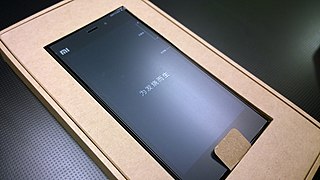
The Xiaomi Mi 3 is a high-end, premium Android smartphone produced by Xiaomi made in the Philippines.

The Jolla Tablet is a product that was the first tablet designed by Jolla running the company's Sailfish OS, a Linux-based OS built around the Mer software components.
Aqua Fish is a smartphone produced by Intex Technologies that runs the Linux based Sailfish OS 2.0 released in July 2016 costing about Rs 5,000, whose hardware specification is nearly identical to Jolla C, a limited-edition mobile phone released in May 2016 by Jolla geared toward Community and Developers, only with different cellular bands set. It is historically the first mobile device launched by OEM with Sailfish OS licensed from Jolla. The licensed OS allows to launch and use Android software simultaneously with native OS software. It is the first device in a strategy for establishing Sailfish OS as the common and official operating system for the BRICS countries. The device was on display for the first time during World Mobile Congress 2016 at Barcelona in Spain.

The Fairphone 2 is a touchscreen-based, dual-SIM smartphone, designed to be easily repaired by the user. It was the first modular smartphone available for purchase. It was first released in December 2015, and production ceased in 2018, and has since received both hardware improvements and major software updates. Initially shipped with Android 5, existing phones run Android 9.0 as of March 2021.
Turing Phone is a Sailfish OS and Android OS smartphone by Turing Robotic Industries (TRI) which provides end-to-end encryption for secure communications. The device uses decentralized authentication to encrypt any communications and comes with its master public key and unique private key pre-installed with the phone. When a device is communicating with another Turing Phone, the two devices can directly verify their identity, side-stepping the need to route it via a Key Distribution Center.
The PuzzlePhone was an uncompleted modular smartphone project by Circular Devices. The device's design was intended to allow its main parts, which would be specific modules, to be easily assembled and replaced by the user.
Jolla C is a limited-edition mobile phone by Jolla geared toward Community and Developers with Sailfish OS and no third-party applications installed by factory, so called "purest Sailfish OS". It is the first dual SIM device from Jolla, whose hardware specification is nearly identical to Aqua Fish released later on by Intex Technologies, only with different cellular bands set. It is compatible with Android apps.

Oysters ООО is a Russian company that designs and manufactures consumer electronics including the Sailfish OS smartphone Oysters SF.
The Sailfish watch is a wearable devices that connects to a Sailfish smartphone and can display and control more functions than only time. It is not a production model, but a proof of concept study aiming to show that Jolla can bring Sailfish to many different shapes and form factors. The goal is to get it done on the watch and prove that the OS is well designed for smaller form factors and easy to navigate.
The INOI R7 is a mobile phone employing the Sailfish OS. It is manufactured by Chinese company Tinno Mobile for Russian company INOI. It was presented at the Mobile World Congress in February 2017 in Barcelona. The OS is an open-source Linux and has the ability to serve additional closed source components to a particular device from third parties built into the OS special layers for personalization and marketing purposes. The genuine multitasking capability of the Sailfish OS allows it to run and employ multiple applications simultaneously, switching among them in real time. The number of apps running together is limited by the amount of free memory available on the device.
Accione is a low-cost hi-tech smartphone with Sailfish OS or Android from the Bolivian company Jala group developed in cooperation with Jolla. It is intended for Latin America customers, for the first time announced at Mobile World Congress on 27 February 2017 in Barcelona. The OS is open source Linux and have ability to serve additional closed source components from 3rd sides built-in the OS special layers for personalisation and marketing purposes by partner manufacturing a particular device. The real multitasking of Sailfish OS allows to run and use together many software applications, switching them in the fly in real time, without freezing them in background. Number of apps running together is not fixed by OS, but it is limited by amount of memory every next app requires to run and amount of free memory available at the device, until next app can't be launched.
The Youyota Tablet, 64bit device running Sailfish OS above 2.0 upon direct official license from Jolla, is successor and resurrected from oblivion incarnation of Jolla Tablet with the same original design and specifications, but 4500mA battery and versions with 32 or 64GB of built-in flash storage.


