Reversi

Last updated

Reversi
Othello Spielbrett.jpg
Othello, a modern variation of Reversi. A semi-transparent hand indicates a possible move by the player with the black pieces.
Years active1883;143 years ago (1883)
(or earlier)—present
Genres
Players2
Setup time< 10 seconds
Playing time1–60 minutes
ChanceNone
Age range8+
Skills Strategy, tactics, observation
SynonymsOthello

Reversi is a strategy board game for two players, played on an 8×8 uncheckered board. It was invented in 1883. Othello, a variant with a fixed initial setup of the board, was patented in 1971.

Contents

Basics

Two players compete, using 64 identical game pieces ("disks") that are light on one side and dark on the other. Each player chooses one color to use throughout the game. Players take turns placing one disk on an empty square, with their assigned color facing up. After a play is made, any disks of the opponent's color that lie in a straight line bounded by the one just played and another one in the current player's color are turned over. When all playable empty squares are filled, the player with more disks showing in their own color wins the game.

History

Othello was one of Nintendo's first arcade games, and it was later ported to a dedicated home game console in 1980. Nintendo-TV-Game-Computer.jpg
Othello was one of Nintendo's first arcade games, and it was later ported to a dedicated home game console in 1980.

Original version

Englishmen Lewis Waterman and John W. Mollett[ citation needed ] both claim to have invented the game of reversi in 1883, each denouncing the other as a fraud. The game gained considerable popularity in England at the end of the 19th century. [1] The game's first reliable mention is in the 21 August 1886 edition of The Saturday Review . Later mention includes an 1895 article in The New York Times , which describes reversi as "something like Go Bang, [...] played with 64 pieces." [2] In 1893, the German games publisher Ravensburger started producing the game as one of its first titles. Two 18th century continental European books dealing with a game that may or may not be reversi are mentioned on page fourteen of the Spring 1989 Othello Quarterly , and there has been speculation, so far without documentation, that the game has older origins.[ citation needed ]

A Japanese publication in 1907 titled World Games Rules Complete Collection (世界遊戯法大全) describes the board game reversi with the same rules as Othello where the first four pieces go in the center in a diagonal pattern and the player who cannot make a move simply passes. [3]

Othello

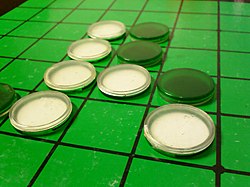
A modern plastic Othello set Othello (Reversi) board.jpg
A modern plastic Othello set

The modern version of the game—the most regularly used rule-set, and the one used in international tournaments—is marketed and recognized as Othello (オセロ, osero). It was patented in Japan in 1971 by Goro Hasegawa (legal name: Satoshi Hasegawa), then a 38-year-old salesman. [4] [5] Hasegawa initially explained that Othello was an improvement on reversi, [6] but from around 2000, he began to claim that he invented it in Mito regardless of reversi. [7] Hasegawa also claimed that the origin of reversi/Othello dates back 5,000 years. [8]

Hasegawa established the Japan Othello Association in March 1973, and held the first national Othello championship on 4 April 1973 in Japan. [9] The Japanese game company Tsukuda Original launched Othello in late April 1973 in Japan under Hasegawa's license, which led to an immediate commercial success. [10] [11] [12] [13] [14]

The name was selected by Hasegawa [14] as a reference to the Shakespearean play Othello, the Moor of Venice, referring to the conflict between the Moor Othello and Iago, and to the unfolding drama between Othello, who is black, and Desdemona, who is white. The green color of the board is inspired by the image of the general Othello, valiantly leading his battle in a green field. It can also be likened to a jealousy competition (jealousy being the central theme in Shakespeare's play, which popularized the term "green-eyed monster"), since players engulf the pieces of the opponent, thereby turning them to their possession. [15]

Othello was first launched in the U.S. in 1975 by Gabriel Industries and it also enjoyed commercial success there. Sales have reportedly exceeded $600 million. More than 40 million classic games have been sold in over 100 countries.

Hasegawa's How to play Othello (Osero No Uchikata) in Japan in 1974, was published in 1977 in an English translation entitled How to Win at Othello. [16]

Kabushiki Kaisha Othello, which was owned by Hasegawa, registered the trademark "OTHELLO" for board games in Japan; Tsukuda Original registered the trademark in the rest of the world. All intellectual property regarding Othello outside Japan is now owned by MegaHouse, the Japanese toy company that acquired Tsukuda Original's successor PalBox. [17]

Rules

Each of the disks' two sides corresponds to one player; they are referred to here as light and dark after the sides of Othello pieces, but any counters with distinctive faces are suitable. The game may for example be played with a chessboard and Scrabble pieces, with one player letters and the other backs.

The historical version of reversi starts with an empty board, and the first two moves made by each player are in the four central squares of the board. The players place their disks alternately with their colors facing up and no captures are made. A player may choose to not play both pieces on the same diagonal, different from the standard Othello opening. It is also possible to play variants of Reversi and Othello where the second player's second move may or must flip one of the opposite-colored disks (as variants closest to the normal games).

For the specific game of Othello, the game begins with four disks placed in a square in the middle of the grid, two facing light-side-up, two dark-side-up, so that the same-colored disks are on a diagonal. Convention has this such that the dark-side-up disks are to the north-east and south-west (from both players' perspectives), though this is only marginally consequential: where sequential openings' memorization is preferred, such players benefit from this. The dark player moves first.

abcdefgh
1 Reversi d44.svg Reversi d44.svg Reversi d44.svg Reversi d44.svg Reversi d44.svg Reversi d44.svg Reversi d44.svg Reversi d44.svg 1
2 Reversi d44.svg Reversi d44.svg Reversi d44.svg Reversi d44.svg Reversi d44.svg Reversi d44.svg Reversi d44.svg Reversi d44.svg 2
3 Reversi d44.svg Reversi d44.svg Reversi d44.svg Reversi d44.svg Reversi d44.svg Reversi d44.svg Reversi d44.svg Reversi d44.svg 3
4 Reversi d44.svg Reversi d44.svg Reversi d44.svg Reversi Od44.svg Reversi Xd44.svg Reversi d44.svg Reversi d44.svg Reversi d44.svg 4
5 Reversi d44.svg Reversi d44.svg Reversi d44.svg Reversi Xd44.svg Reversi Od44.svg Reversi d44.svg Reversi d44.svg Reversi d44.svg 5
6 Reversi d44.svg Reversi d44.svg Reversi d44.svg Reversi d44.svg Reversi d44.svg Reversi d44.svg Reversi d44.svg Reversi d44.svg 6
7 Reversi d44.svg Reversi d44.svg Reversi d44.svg Reversi d44.svg Reversi d44.svg Reversi d44.svg Reversi d44.svg Reversi d44.svg 7
8 Reversi d44.svg Reversi d44.svg Reversi d44.svg Reversi d44.svg Reversi d44.svg Reversi d44.svg Reversi d44.svg Reversi d44.svg 8
abcdefgh
Starting position

Dark must place a piece (dark-side-up) on the board and so that there exists at least one straight (horizontal, vertical, or diagonal) occupied line between the new piece and another dark piece, with one or more contiguous light pieces between them. For move one, dark has four options shown by translucently drawn pieces below:

abcdefgh
1 Reversi d44.svg Reversi d44.svg Reversi d44.svg Reversi d44.svg Reversi d44.svg Reversi d44.svg Reversi d44.svg Reversi d44.svg 1
2 Reversi d44.svg Reversi d44.svg Reversi d44.svg Reversi d44.svg Reversi d44.svg Reversi d44.svg Reversi d44.svg Reversi d44.svg 2
3 Reversi d44.svg Reversi d44.svg Reversi d44.svg Reversi xd44.svg Reversi d44.svg Reversi d44.svg Reversi d44.svg Reversi d44.svg 3
4 Reversi d44.svg Reversi d44.svg Reversi xd44.svg Reversi Od44.svg Reversi Xd44.svg Reversi d44.svg Reversi d44.svg Reversi d44.svg 4
5 Reversi d44.svg Reversi d44.svg Reversi d44.svg Reversi Xd44.svg Reversi Od44.svg Reversi xd44.svg Reversi d44.svg Reversi d44.svg 5
6 Reversi d44.svg Reversi d44.svg Reversi d44.svg Reversi d44.svg Reversi xd44.svg Reversi d44.svg Reversi d44.svg Reversi d44.svg 6
7 Reversi d44.svg Reversi d44.svg Reversi d44.svg Reversi d44.svg Reversi d44.svg Reversi d44.svg Reversi d44.svg Reversi d44.svg 7
8 Reversi d44.svg Reversi d44.svg Reversi d44.svg Reversi d44.svg Reversi d44.svg Reversi d44.svg Reversi d44.svg Reversi d44.svg 8
abcdefgh
Where dark may play

Play always alternates unless one player has no legal move, in which case they pass. After placing a dark disk, dark turns over (flips to dark, captures) the single disk (or chain of light disks) on the line between the new piece and an anchoring dark piece. Multiple chains of disks may be captured in a single move. No player can look back to the previous status of disks when playing moves. A valid move is one where at least one piece is reversed (flipped over).

If dark decided to put a piece in the topmost location (all choices are strategically equivalent at this time), one piece gets turned over, so that the board appears thus:

abcdefgh
1 Reversi d44.svg Reversi d44.svg Reversi d44.svg Reversi d44.svg Reversi d44.svg Reversi d44.svg Reversi d44.svg Reversi d44.svg 1
2 Reversi d44.svg Reversi d44.svg Reversi d44.svg Reversi d44.svg Reversi d44.svg Reversi d44.svg Reversi d44.svg Reversi d44.svg 2
3 Reversi d44.svg Reversi d44.svg Reversi d44.svg Reversi Xd44.svg Reversi d44.svg Reversi d44.svg Reversi d44.svg Reversi d44.svg 3
4 Reversi d44.svg Reversi d44.svg Reversi d44.svg Reversi Xd44.svg Reversi Xd44.svg Reversi d44.svg Reversi d44.svg Reversi d44.svg 4
5 Reversi d44.svg Reversi d44.svg Reversi d44.svg Reversi Xd44.svg Reversi Od44.svg Reversi d44.svg Reversi d44.svg Reversi d44.svg 5
6 Reversi d44.svg Reversi d44.svg Reversi d44.svg Reversi d44.svg Reversi d44.svg Reversi d44.svg Reversi d44.svg Reversi d44.svg 6
7 Reversi d44.svg Reversi d44.svg Reversi d44.svg Reversi d44.svg Reversi d44.svg Reversi d44.svg Reversi d44.svg Reversi d44.svg 7
8 Reversi d44.svg Reversi d44.svg Reversi d44.svg Reversi d44.svg Reversi d44.svg Reversi d44.svg Reversi d44.svg Reversi d44.svg 8
abcdefgh
After dark play

Now light plays. This player operates under the same rules, with the roles reversed: light lays down a light piece, causing a dark piece to flip. Possibilities at this time appear thus (indicated by transparent pieces):

abcdefgh
1 Reversi d44.svg Reversi d44.svg Reversi d44.svg Reversi d44.svg Reversi d44.svg Reversi d44.svg Reversi d44.svg Reversi d44.svg 1
2 Reversi d44.svg Reversi d44.svg Reversi d44.svg Reversi d44.svg Reversi d44.svg Reversi d44.svg Reversi d44.svg Reversi d44.svg 2
3 Reversi d44.svg Reversi d44.svg Reversi od44.svg Reversi Xd44.svg Reversi od44.svg Reversi d44.svg Reversi d44.svg Reversi d44.svg 3
4 Reversi d44.svg Reversi d44.svg Reversi d44.svg Reversi Xd44.svg Reversi Xd44.svg Reversi d44.svg Reversi d44.svg Reversi d44.svg 4
5 Reversi d44.svg Reversi d44.svg Reversi od44.svg Reversi Xd44.svg Reversi Od44.svg Reversi d44.svg Reversi d44.svg Reversi d44.svg 5
6 Reversi d44.svg Reversi d44.svg Reversi d44.svg Reversi d44.svg Reversi d44.svg Reversi d44.svg Reversi d44.svg Reversi d44.svg 6
7 Reversi d44.svg Reversi d44.svg Reversi d44.svg Reversi d44.svg Reversi d44.svg Reversi d44.svg Reversi d44.svg Reversi d44.svg 7
8 Reversi d44.svg Reversi d44.svg Reversi d44.svg Reversi d44.svg Reversi d44.svg Reversi d44.svg Reversi d44.svg Reversi d44.svg 8
abcdefgh
Where light may play

Light takes the bottom left option and reverses one piece:

abcdefgh
1 Reversi d44.svg Reversi d44.svg Reversi d44.svg Reversi d44.svg Reversi d44.svg Reversi d44.svg Reversi d44.svg Reversi d44.svg 1
2 Reversi d44.svg Reversi d44.svg Reversi d44.svg Reversi d44.svg Reversi d44.svg Reversi d44.svg Reversi d44.svg Reversi d44.svg 2
3 Reversi d44.svg Reversi d44.svg Reversi d44.svg Reversi Xd44.svg Reversi d44.svg Reversi d44.svg Reversi d44.svg Reversi d44.svg 3
4 Reversi d44.svg Reversi d44.svg Reversi d44.svg Reversi Xd44.svg Reversi Xd44.svg Reversi d44.svg Reversi d44.svg Reversi d44.svg 4
5 Reversi d44.svg Reversi d44.svg Reversi Od44.svg Reversi Od44.svg Reversi Od44.svg Reversi d44.svg Reversi d44.svg Reversi d44.svg 5
6 Reversi d44.svg Reversi d44.svg Reversi d44.svg Reversi d44.svg Reversi d44.svg Reversi d44.svg Reversi d44.svg Reversi d44.svg 6
7 Reversi d44.svg Reversi d44.svg Reversi d44.svg Reversi d44.svg Reversi d44.svg Reversi d44.svg Reversi d44.svg Reversi d44.svg 7
8 Reversi d44.svg Reversi d44.svg Reversi d44.svg Reversi d44.svg Reversi d44.svg Reversi d44.svg Reversi d44.svg Reversi d44.svg 8
abcdefgh
After light play

Players take alternate turns. If one player cannot make a valid move, play passes back to the other player. The game ends when the grid has filled up or if neither player can make a valid move.

Examples where the game ends before the grid is completely filled:

abcdefgh
1 Reversi Od44.svg Reversi Od44.svg Reversi Od44.svg Reversi Od44.svg Reversi Od44.svg Reversi Od44.svg Reversi Od44.svg Reversi Od44.svg 1
2 Reversi Od44.svg Reversi Od44.svg Reversi Od44.svg Reversi Od44.svg Reversi Od44.svg Reversi Od44.svg Reversi Od44.svg Reversi Od44.svg 2
3 Reversi Od44.svg Reversi Od44.svg Reversi Od44.svg Reversi Od44.svg Reversi Od44.svg Reversi Od44.svg Reversi Od44.svg Reversi Od44.svg 3
4 Reversi Od44.svg Reversi Od44.svg Reversi Od44.svg Reversi Od44.svg Reversi Od44.svg Reversi Od44.svg Reversi Od44.svg Reversi d44.svg 4
5 Reversi Od44.svg Reversi Od44.svg Reversi Od44.svg Reversi Od44.svg Reversi Od44.svg Reversi Od44.svg Reversi d44.svg Reversi d44.svg 5
6 Reversi Od44.svg Reversi Od44.svg Reversi Od44.svg Reversi Od44.svg Reversi Od44.svg Reversi Od44.svg Reversi d44.svg Reversi Xd44.svg 6
7 Reversi Od44.svg Reversi Od44.svg Reversi Od44.svg Reversi Od44.svg Reversi Od44.svg Reversi Od44.svg Reversi Od44.svg Reversi d44.svg 7
8 Reversi Od44.svg Reversi Od44.svg Reversi Od44.svg Reversi Od44.svg Reversi Od44.svg Reversi Od44.svg Reversi Od44.svg Reversi Od44.svg 8
abcdefgh
Vlasáková 1 – 63 Schotte (European Grand Prix Prague 2011)
abcdefgh
1 Reversi d44.svg Reversi Xd44.svg Reversi Xd44.svg Reversi Xd44.svg Reversi Xd44.svg Reversi Xd44.svg Reversi Xd44.svg Reversi Xd44.svg 1
2 Reversi d44.svg Reversi Od44.svg Reversi Od44.svg Reversi Od44.svg Reversi Od44.svg Reversi Od44.svg Reversi d44.svg Reversi Xd44.svg 2
3 Reversi Od44.svg Reversi Od44.svg Reversi Od44.svg Reversi Od44.svg Reversi Od44.svg Reversi Od44.svg Reversi Od44.svg Reversi Xd44.svg 3
4 Reversi Od44.svg Reversi Od44.svg Reversi Od44.svg Reversi Od44.svg Reversi Od44.svg Reversi Od44.svg Reversi Od44.svg Reversi Xd44.svg 4
5 Reversi Od44.svg Reversi Od44.svg Reversi Od44.svg Reversi Od44.svg Reversi Od44.svg Reversi Od44.svg Reversi Od44.svg Reversi Xd44.svg 5
6 Reversi Od44.svg Reversi Od44.svg Reversi Od44.svg Reversi Od44.svg Reversi Od44.svg Reversi Od44.svg Reversi Od44.svg Reversi Xd44.svg 6
7 Reversi Od44.svg Reversi Od44.svg Reversi Od44.svg Reversi Od44.svg Reversi Od44.svg Reversi Od44.svg Reversi Od44.svg Reversi Xd44.svg 7
8 Reversi d44.svg Reversi Od44.svg Reversi Od44.svg Reversi Od44.svg Reversi Od44.svg Reversi Od44.svg Reversi d44.svg Reversi d44.svg 8
abcdefgh
Vecchi 13 – 51 Nicolas (World Othello Championship 2017, Ghent)
abcdefgh
1 Reversi d44.svg Reversi d44.svg Reversi d44.svg Reversi d44.svg Reversi Od44.svg Reversi d44.svg Reversi d44.svg Reversi d44.svg 1
2 Reversi d44.svg Reversi d44.svg Reversi d44.svg Reversi d44.svg Reversi Od44.svg Reversi Od44.svg Reversi d44.svg Reversi d44.svg 2
3 Reversi Od44.svg Reversi Od44.svg Reversi Od44.svg Reversi Od44.svg Reversi Od44.svg Reversi Od44.svg Reversi Od44.svg Reversi Xd44.svg 3
4 Reversi d44.svg Reversi d44.svg Reversi Od44.svg Reversi Od44.svg Reversi Od44.svg Reversi Od44.svg Reversi d44.svg Reversi Xd44.svg 4
5 Reversi d44.svg Reversi d44.svg Reversi Od44.svg Reversi Od44.svg Reversi Od44.svg Reversi d44.svg Reversi d44.svg Reversi Xd44.svg 5
6 Reversi d44.svg Reversi d44.svg Reversi d44.svg Reversi d44.svg Reversi d44.svg Reversi d44.svg Reversi d44.svg Reversi d44.svg 6
7 Reversi d44.svg Reversi d44.svg Reversi d44.svg Reversi d44.svg Reversi d44.svg Reversi d44.svg Reversi d44.svg Reversi d44.svg 7
8 Reversi d44.svg Reversi d44.svg Reversi d44.svg Reversi d44.svg Reversi d44.svg Reversi d44.svg Reversi d44.svg Reversi d44.svg 8
abcdefgh
Hassan 3 – 61 Verstuyft J. (European Grand Prix Ghent 2017)

The player with the most pieces on the board at the end of the game wins. The game is scored by counting the number of discs in each player's color. If the game ended before the grid was completely filled, any empty squares are scored for the winner. [18] However, if one player defaults by running out of time, that player's opponent wins regardless of the board configuration. There are varying methods to determine the official score when a player defaults.

In common practice over the Internet, opponents agree upon a time-control of, typically, from one to thirty minutes per game per player. Standard time control in the World Championship is thirty minutes, and this or something close to it is common in over-the-board (as opposed to internet) tournament play generally. In time-defaulted games, where disk differential is used for tie-breaks in tournaments or for rating purposes, one common over-the-board procedure for the winner of defaulted contests to complete both sides' moves with the greater of the result thereby or one disk difference in the winner's favor being the recorded score. Games in which both players have the same number of disks their color at the end (almost always with a full-board 32–32 score) are not very common, but also not rare, and these are designated as 'ties' and scored as half of a win for each player in tournaments. The term 'draw' for such may also be heard, but is somewhat frowned upon.

What are generally referred to as transcript sheets are generally in use in tournament over-the-board play, with both players obligated to record their game's moves by placing the number of each move in an 8×8 grid. This both enables players to look up past games of note and tournament directors and players to resolve disputes (according to whatever specific rules are in place) where claims that an illegal move, flip or other anomaly are voiced. An alternative recording method not requiring a grid is also in use, where positions on a board are labeled left to right by letters a through h and top to bottom by digits 1 through 8. Note that the numbers run in the opposite direction to the chess standard, and that the perspective may be that of either player (with no fixed standard). This alternate notational scheme is used primarily in verbal discussions or where a linear representation is desirable in print, but may also be permissible as during-game transcription by either or both players.

Tournament over-the-board play has various ways of handling illegal moves and incorrect flips. For example, one procedure that has been used is to permit either player to make corrections going back some fixed number of moves.

Anti-Reversi

Anti-Reversi or Reversed Reversi is a variant of the game where the player wins who has fewer own-colored disks at the end of the game; draw is also a possible result. [19] To put a disk on the board, the same rules apply as in normal reversi.

Brightwell Quotient

Invented by the British mathematician and three times runner-up at the World Championship and five times British Champion Graham Brightwell, this is the tie-breaker that is now used in many tournaments including the W.O.C. If two players have the same number of points in the thirteen-round W.O.C. Swiss, the tie is resolved in favour of the player with the higher Brightwell Quotient.[ citation needed ]

The Brightwell Quotient (BQ) is calculated as follows: [20]

  1. A constant c is calculated. It is the integer nearest to (number of squares on the board) divided by (number of rounds in the tournament).
  2. If any of the player's opponents have withdrawn in the course of the tournament, or if a player has been paired against bye , ignore such games for the moment.
  3. Calculate the total number of disks scored by the player in all games not covered by step 2 and add c times the sum of points scored by all of the player's opponents, except those who have withdrawn.
  4. For each game against an opponent who has withdrawn, and each bye received, add half the number of squares on the board plus (c times the player's own tournament score) to the result calculated in step 3. The number resulting is the player's BQ.

Computer opponents and research

Good Othello computer programs play very strongly against human opponents. This is mostly due to difficulties in human look-ahead peculiar to Othello: The interchangeability of the disks and therefore apparent strategic meaninglessness (as opposed to chess pieces for example) makes an evaluation of different moves much harder. This can be demonstrated with blindfold games, as the memorization of the board demands much more dedication from the players than in blindfold chess.

The first tournament pitting Othello computer programs against human opponents took place in 1980. In it, then world champion Hiroshi Inoue, although he would go on to win the tournament, lost a game against the computer program The Moor. In 1997, the computer Othello program Logistello defeated the reigning human champion, Takeshi Murakami, six games to zero. [21]

Analysts have estimated the number of legal positions in Othello is at most 1028, and it has a game-tree complexity of approximately 1058. [22] Mathematically, Othello is solved up to 8x8 board. On 4×4 and 6×6 boards under perfect play, the second player wins. [23] On 8x8 board, the game results in draw under perfect play, according to an arXiv paper. [24] The first of these proofs is relatively trivial, the second dates to around 1990, and the last one was done in 2023. When generalizing the game to play on an n×n board, the problem of determining if the first player has a winning move in a given position is PSPACE-complete. [25]

World Othello Championship

The World Othello Championship (WOC), which started in 1977, was first organized by the Japan Othello Association. From 1978 until 2004, the World Othello Championship was organized by the Othello TD group and Anjar Co. In 2005, the World Othello Federation took over the responsibility for the WOC.

From 1977 to 1986, each country could send one player to participate in the WOC. From 1987, each country could send up to three players to participate. In 1987, the title WOC team championship started. In 2005, a female championship category was added to the WOC. From 2006, each World Othello Federation member could send a full team of up to four players. In 2016, a youth champion title was added to the WOC. [26] The WOC was cancelled in 2020 and 2021 due to the COVID-19 pandemic.

YearLocationWorld ChampionTeamRunner-upFemale ChampionYouth Champion
1977Tokyo Flag of Japan.svg Hiroshi InoueN/A Flag of Norway.svg Thomas HeibergN/AN/A
1978New York City Flag of Japan.svg Hidenori MaruokaN/A Flag of the United States.svg Carol JacobsN/AN/A
1979 Rome Flag of Japan.svg Hiroshi InoueN/A Flag of the United States.svg Jonathan CerfN/AN/A
1980London Flag of the United States.svg Jonathan CerfN/A Flag of Japan.svg Takuya MimuraN/AN/A
1981 Brussels Flag of Japan.svg Hidenori MaruokaN/A Flag of the United States.svg Brian RoseN/AN/A
1982 Stockholm Flag of Japan.svg Kunihiko TanidaN/A Flag of the United States.svg David ShamanN/AN/A
1983Paris Flag of Japan.svg Ken'Ichi IshiiN/A Flag of the United Kingdom.svg Imre Leader N/AN/A
1984 Melbourne Flag of France.svg Paul RalleN/A Flag of Japan.svg Ryoichi TaniguchiN/AN/A
1985 Athens Flag of Japan.svg Masaki TakizawaN/A Flag of Italy.svg Paolo GhirardatoN/AN/A
1986Tokyo Flag of Japan.svg Hideshi TamenoriN/A Flag of France.svg Paul RalleN/AN/A
1987 Milan Flag of Japan.svg Ken'Ichi Ishii Flag of the United States.svg United States Flag of France.svg Paul RalleN/AN/A
1988Paris Flag of Japan.svg Hideshi Tamenori Flag of the United Kingdom.svg United Kingdom Flag of the United Kingdom.svg Graham Brightwell N/AN/A
1989 Warsaw Flag of Japan.svg Hideshi Tamenori Flag of the United Kingdom.svg United Kingdom Flag of the United Kingdom.svg Graham BrightwellN/AN/A
1990 Stockholm Flag of Japan.svg Hideshi Tamenori Flag of France.svg France Flag of France.svg Didier PiauN/AN/A
1991New York City Flag of Japan.svg Shigeru Kaneda Flag of the United States.svg United States Flag of France.svg Paul RalleN/AN/A
1992 Barcelona Flag of France.svg Marc Tastet Flag of the United Kingdom.svg United Kingdom Flag of the United Kingdom.svg David ShamanN/AN/A
1993London Flag of the United States.svg David Shaman Flag of the United States.svg United States Flag of France.svg Emmanuel CaspardN/AN/A
1994Paris Flag of Japan.svg Masaki Takizawa Flag of France.svg France Flag of Denmark.svg Karsten FeldborgN/AN/A
1995 Melbourne Flag of Japan.svg Hideshi Tamenori Flag of the United States.svg United States Flag of the United States.svg David ShamanN/AN/A
1996Tokyo Flag of Japan.svg Takeshi Murakami Flag of the United Kingdom.svg United Kingdom Flag of France.svg Stéphane NicoletN/AN/A
1997 Athens Flag of Japan.svg Makoto Suekuni Flag of the United Kingdom.svg United Kingdom Flag of the United Kingdom.svg Graham BrightwellN/AN/A
1998 Barcelona Flag of Japan.svg Takeshi Murakami Flag of France.svg France Flag of France.svg Emmanuel CaspardN/AN/A
1999 Milan Flag of the Netherlands.svg David Shaman Flag of Japan.svg Japan Flag of Japan.svg Tetsuya NakajimaN/AN/A
2000 Copenhagen Flag of Japan.svg Takeshi Murakami Flag of the United States.svg United States Flag of the United States.svg Brian RoseN/AN/A
2001New York City Flag of the United States.svg Brian Rose Flag of the United States.svg United States Flag of the United States.svg Raphael SchreiberN/AN/A
2002 Amsterdam Flag of the Netherlands.svg David Shaman Flag of the United States.svg United States Flag of the United States.svg Ben SeeleyN/AN/A
2003 Stockholm Flag of the United States.svg Ben Seeley Flag of Japan.svg Japan Flag of Japan.svg Makoto SuekuniN/AN/A
2004London Flag of the United States.svg Ben Seeley Flag of the United States.svg United States Flag of Japan.svg Makoto SuekuniN/AN/A
2005 Reykjavík Flag of Japan.svg Hideshi Tamenori Flag of Japan.svg Japan Flag of South Korea.svg Kwangwook Lee Flag of Japan.svg Hisako KinoshitaN/A
2006 Mito Flag of Japan.svg Hideshi Tamenori Flag of Japan.svg Japan Flag of Singapore.svg Makoto Suekuni [27] Flag of Japan.svg Toshimi TsujiN/A
2007 Athens Flag of Japan.svg Kenta Tominaga Flag of Japan.svg Japan Flag of France.svg Stéphane Nicolet Flag of Japan.svg Yukiko TatsumiN/A
2008 Oslo Flag of Italy.svg Michele Borassi Flag of Japan.svg Japan Flag of Japan.svg Tamaki Miyaoka Flag of Germany.svg Liya YeN/A
2009 Ghent Flag of Japan.svg Yusuke Takanashi Flag of Japan.svg Japan Flag of Germany.svg Matthias Berg Flag of Japan.svg Mei UrashimaN/A
2010 Rome Flag of Japan.svg Yusuke Takanashi Flag of Japan.svg Japan Flag of Italy.svg Michele Borassi Flag of the Netherlands.svg Jiska HelmesN/A
2011 Newark Flag of Japan.svg Hiroki Nobukawa Flag of Japan.svg Japan Flag of Thailand.svg Piyanat Aunchulee Flag of the United States.svg Jian CaiN/A
2012 Leeuwarden Flag of Japan.svg Yusuke Takanashi Flag of Japan.svg Japan Flag of Japan.svg Kazuki Okamoto Flag of Sweden.svg Veronica StenbergN/A
2013 Stockholm Flag of Japan.svg Kazuki Okamoto Flag of Japan.svg Japan Flag of Thailand.svg Piyanat Aunchulee Flag of Finland.svg Katie WuN/A
2014 Bangkok Flag of Japan.svg Makoto Suekuni Flag of Japan.svg Japan Flag of the United States.svg Ben Seeley Flag of Australia (converted).svg Joanna WilliamN/A
2015 Cambridge Flag of Japan.svg Yusuke Takanashi Flag of Japan.svg Japan Flag of Japan.svg Makoto Suekuni Flag of the United States.svg Yoko Sano RoseN/A
2016 Mito Flag of Thailand.svg Piyanat Aunchulee Flag of Japan.svg Japan Flag of the People's Republic of China.svg Yan Song Flag of the People's Republic of China.svg Zhen Dong Flag of Japan.svg Masaki Wada
2017 Ghent Flag of Japan.svg Yusuke Takanashi Flag of Japan.svg Japan Flag of Japan.svg Akihiro Takahashi Flag of Japan.svg Misa Sugawara Flag of Japan.svg Akihiro Takahashi
2018 Prague Flag of Japan.svg Keisuke Fukuchi Flag of Japan.svg Japan Flag of Thailand.svg Piyanat Aunchulee Flag of Japan.svg Misa Sugawara Flag of Japan.svg Keisuke Fukuchi
2019Tokyo Flag of Japan.svg Akihiro Takahashi Flag of Japan.svg Japan Flag of Japan.svg Yusuke Takanashi Flag of Australia (converted).svg Joanna William Flag of Japan.svg Akihiro Takahashi
2020Cancelled
2021Cancelled
2022 [28] Paris Flag of Japan.svg Kento Urano Flag of Japan.svg Japan Flag of Switzerland (Pantone).svg Arthur Juigner Flag of Finland.svg Katie Pihlajapuro Flag of Japan.svg Fuyumi Okudaira
2023 [29] Rome Flag of Japan.svg Yasushi Nagano Flag of Japan.svg Japan Flag of Thailand.svg Rujipas Aunchulee  Flag of Japan.svg Hisako Kinoshita  Flag of Japan.svg Osuke Kawazoe
2024 [30] Hangzhou Flag of Japan.svg Seiya Kurita Flag of Japan.svg Japan Flag of Japan.svg Yusuke Takanashi  Flag of Japan.svg Hisako Kinoshita  Flag of Japan.svg Yo Tomita

Reception

Games magazine included Othello in their "Top 100 Games of 1980", noting that it was "Based on the Victorian game of reversi" and had achieved "remarkable success in this country for an abstract game of strategy". [31]

Games magazine included Othello, Tournament Set in their "Top 100 Games of 1981", noting that by that time "Othello has become so popular that Gabriel now markets a computer version and a players' association publishes a quarterly magazine". [32]

Games magazine included Othello in their "Top 100 Games of 1982", noting that "Although the goal is to finish with the most pieces of your color up, the best strategy, paradoxically, is usually to limit your opponent's options by flipping over as few of his discs as possible during the first two-thirds of the game." [33]

Reviews

See also

References

  1. "Brief history of Othello". Othello Museum. Beppi.it. Archived from the original on 16 May 2009. Retrieved 4 January 2015.
  2. "Fine New Games and Toys; Now Ready for Distribution by the Agents of Santa Claus. In the Modern Wonderland – Millions Spent for the Amusement and Instruction of Children – Minds Active and Hands Busy All the Time". The New York Times . 1 December 1895. Retrieved 4 January 2015.
  3. 松浦, 政泰 (December 1907). "裏返へし(レヴアルシー)Reversi". Complete World Game Law (in Japanese). Hakubunkan. pp. 187–189. doi:10.11501/860315.
  4. See Japan Utility Patent Application numbers S46-001435 (JP,1971-001435) and number S47-135869 (JP,1972-135869), available via https://www.j-platpat.inpit.go.jp/web/all/top/BTmTopEnglishPage
  5. "Modern Living: Japanese Othello". Time. 11 November 1976. Retrieved 28 May 2016.
  6. Hasegawa, Goro (December 1973). "A generation of making popular "Othello" games". Gendai (in Japanese). 7 (12). Kodansha: 147–151. doi:10.11501/3367321.
  7. Hasegawa, Goro (December 2005). The Tale of One Hundreds of Othello - Famous players who decorated the history of Othello (in Japanese). Kawade Shobō Shinsha. ISBN   9784309906553.
  8. Hasegawa, Goro (1981). How to Othello (in Japanese). p. 136.
  9. The Nihon Keizai Shimbun. Page 24, 20 March 1973
  10. "140 years of history" . Retrieved 4 January 2015.
  11. Pages 147–151 of The December issue of GENDAI, published by Kodansha on 1 December 1973. Viewed at National Diet Library of Japan
  12. Pages 110–113 August 25 issue of Yomiuri Weekly, published by Yomiuri Shimbun on 25 August 1973. Viewed at National Diet Library of Japan
  13. Page 23 of Vol.77, No.1811 of JITSUGYO NO NIHON published by Jitsugyo no Nihon Sha, Ltd. on 1 March 1974. Viewed at National Diet Library of Japan
  14. 1 2 Pages 276–281 December issue of The Ushio published by Ushio Publishing Co., Ltd., on 1 December 1974. Viewed at National Diet Library of Japan
  15. "Japanese Othello". Time. 22 November 1976. Archived from the original on 3 November 2007.
  16. Hasegawa, Goro (1977). HOW TO WIN AT OTHELLO . U.S.: A Harvest / HBJ Book. ISBN   978-0156422154.
  17. "MegaHouse and Co. Pal box signed a transfer agreement part of the business (translated by Google translation)". Archived from the original on 23 September 2015. Retrieved 11 September 2015.
  18. "World Othello Championships Rules" (PDF). World Othello Federation. 2019. Retrieved 4 December 2024.
  19. About Anti-Reversi https://samsoft.org.uk/reversi/strategy.htm on 14 August 2024
  20. "Britishothello.org.uk" (PDF). Archived from the original (PDF) on 18 February 2019.
  21. Buro, Michael (2003). "The Evolution of Strong Othello Programs". Entertainment Computing. IFIP Advances in Information and Communication Technology. Vol. 112. pp. 81–88. doi:10.1007/978-0-387-35660-0_10. ISBN   978-1-4757-5153-6.
  22. Allis, Victor (1994). Searching for Solutions in Games and Artificial Intelligence (PDF). PhD Thesis, University of Limburg, Maastricht, The Netherlands. ISBN   90-900748-8-0. Archived (PDF) from the original on 7 March 2005.
  23. "Amenor". Archived from the original on 29 October 2013.
  24. Takizawa, Hiroki (2023). "Othello is Solved". arXiv: 2310.19387 [cs.AI].
  25. Iwata, S.; Kasai, T. (1994). "The Othello game on an n*n board is PSPACE-complete". Theor. Comput. Sci. 123 (2): 329–340. doi:10.1016/0304-3975(94)90131-7.
  26. "World Othello Championship :: World Othello Federation". worldothello.org. Retrieved 21 June 2021.
  27. "2006.htm".
  28. "World Othello".
  29. "World Othello".
  30. "World Othello".
  31. "Top 100 Games of 1980". Games . No. 20. November–December 1980. p. 53.
  32. "Top 100 Games of 1981". Games . No. 26. November–December 1981. p. 52.
  33. Schmittberger, R. Wayne, ed. (November 1982). "The Top 100 Games 1982". Games . No. 33. p. 46.
  34. "GAMES Magazine #1". September 1977.
  35. "Jeux & stratégie 06". December 1980.
  36. Lowder, James (18 February 2024). Family games : The 100 best. Green Ronin. ISBN   978-1-934547-21-2.