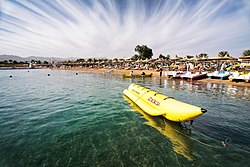
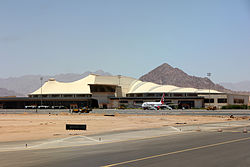
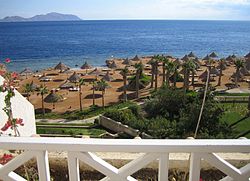
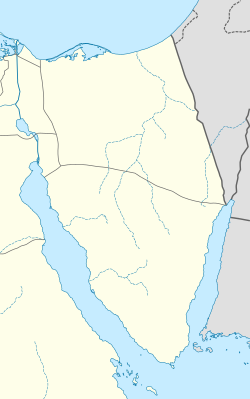
Sharm El Sheikh,[a] alternatively rendered Sharm el-Sheikh or Charm el Sheikh, is an Egyptian city located on the southern tip of the Sinai Peninsula, in South Sinai Governorate, on the coastal strip along the Red Sea in Asia.[2] Its population is approximately 77,000 as of 2017[update].[3] Sharm El Sheikh is the administrative hub of Egypt's South Sinai Governorate, which includes the smaller coastal towns of Dahab and Nuweiba as well as the mountainous interior, St. Catherine and Mount Sinai.
The city was historically a fishing town and military base, and was developed into a commercial and tourist-centric city afterwards.[4] The Egyptian government continued and expanded the development, promoting Sharm El Sheikh as a major international resort city. Today, Sharm El Sheikh and its holiday resorts is a significant centre for tourism in Egypt, while also attracting many international conferences, diplomatic meetings and also concerts and clubbing.[5][6]
Downtown Sharm El Sheikh has the major concentrations of international banks in the city and is home to several large national companies.[7] The city is home to major hospitals and health facilities, including Sharm International Hospital, the city's largest hospital and others engaged in health-related care and research.[8][9] Sharm El Sheikh port is the city's seaport, which lies on the coast of the Red Sea, and the nearest airport is the city's Sharm El Sheikh International Airport. The Sharm El Sheikh metropolitan area is one of the most visited cities in Egypt, attracting over 10 million visitors in 2024.[10][11]
Name
The English name of Sharm El Sheikh is a borrowing of the Egyptian Arabicشرم الشيخ, šarm aš-šayḵ and, as such, does not have a fixed romanisation. There are documented uses of alternate spellings such as Sharm el Sheikh and Sharm el-Sheikh, sometimes within the same news article.[12]
Sharm El Sheikh is sometimes referred to as the "City of Peace" (مدينة السلام, madinet es-salām), referring to the large number of international peace conferences that have been held there.[13]
Amongst Egyptians and also many visitors, the name of the city is commonly shortened to "Sharm" (Egyptian Arabic:[ʃɑɾm]), which is its common name in Egyptian Arabic.
Geography and history
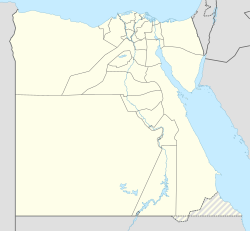
Sharm el Sheikh and the Strait of Tiran in the 1840 Kiepert map of the Sinai Peninsula. The town of Shurm is shown just north of two bays: Sharm El Sheikh and Sharm El Miya (Arabic: شرم المية). This area forms the southern tip of the modern city.Sharm El Sheikh is located on the Egyptian Red Sea coast, at the southern tip of the Sinai Peninsula
Sharm El Sheikh is on a promontory overlooking the Straits of Tiran at the mouth of the Gulf of Aqaba. Its strategic importance led to its transformation from a fishing village into a major port and naval base for the Egyptian Navy. It was conquered by Israel during the Suez Crisis of 1956 and returned to Egypt in 1957. A United Nations peacekeeping force was stationed there until 1967 when it was ordered to leave by Egyptian President Gamal Abdel Nasser, a fact that precipitated the Six-Day War during which it was reoccupied by Israel. Sharm El Sheikh remained under Israeli control from 1967 until the Sinai Peninsula was returned back to Egypt in 1982, after the Egypt–Israel peace treaty of 1979 that was signed in Washington, D.C.[14][15] During that time, an Israeli settlement named Ofira was built in the area.[16] In 1968, Israel opened an air force military base there, where Egypt later built the Sharm el-Sheikh International Airport on the same location that included an enormous $420m investment by the Egyptian Holding Company for Airports and Air Navigation, a major project that helped put the city on global map.[17][18] Unlike Sinai's other well-known settlement, Yamit, Ofira was not demolished after Israel ceded control of Sinai to Egypt following the Camp David Accords, but was returned intact and is today a thriving tourist town and home to local Egyptian residents.[19]
Egypt's former president Hosni Mubarak designated Sharm El Sheikh as The City of Peace in 1982 and the Egyptian government began a policy of encouraging massive development of the city. Egyptian businessmen and investors, along with global investors contributed to building several mega projects, including mosques and churches. The city is now an international tourist destination, and environmental zoning laws limit the height of buildings to avoid obscuring the natural beauty of the surroundings. In 2022, Sharm El-Sheikh along with another Egyptian city, Hurghada, were both chosen by Trip advisor as the world's top 25 tourist destinations.[20]
A hierarchical planning approach was adopted for the Gulf of Aqaba, whereby the area's components were evaluated and subdivided into zones, cities and centers. In accordance with this approach, the Gulf of Aqaba zone was subdivided into four cities: Taba, Nuweiba, Dahab and Sharm El Sheikh. Sharm El Sheikh city has been subdivided into five homogeneous centers, namely Nabq, Ras Nusrani, Naama Bay, Umm Sid and Sharm El Maya.
Sharm El Sheikh city, with Naama Bay, Hay el Nour, Hadaba, Rowaysat, Montazah and Shark's Bay[wd] form a metropolitan area.
The site off the shore gun emplacements at Ras Nasrani opposite Tiran Island is now a diving area.[21][22][23]
In 2005, the resort was hit by the Sharm El Sheikh terrorist attacks, which were carried out by an extremist Islamist organisation targeting Egypt's tourist industry. Eighty-eight people were killed, the majority of them Egyptians, and over 200 were wounded by the attack, making it the second deadliest terrorist attack in the country's history.
The city has played host to a number of important Middle Eastern peace conferences, including the 4 September 1999 agreement to establish Palestinian self-rule over the Gaza Strip. A second summit was held at Sharm on 17 October 2000 following the outbreak of the second Palestinian intifada, but it failed to end the violence. A summit was held in the city on 3 August 2005 on developments in the Arab world, such as the situation in the Arab–Israeli conflict. Again in 2007, an important ministerial meeting took place in Sharm, where dignitaries discussed Iraqi reconstruction.[24]
The World Economic Forum on the Middle East was hosted by Sharm El Sheikh in 2006[25] and 2008.[26] Amidst the 2011 Egyptian protests, then-president Mubarak reportedly went to Sharm El Sheikh and resigned there on 11 February 2011.[27] The 2014 World Economic Forum in Sharm El Sheikh heralded a new initiative for desert cities urban development in Egypt.[28]
John Kerry, Sam Cho, and others at COP27, Sharm-El-Sheikh, Egypt (2022).
In November 2022, the United Nations Climate Change Conference (COP27) was held in Sharm El Sheikh.[29] This conference led to the first loss and damage fund being created.[30]
The city experiences a subtropical arid climate, classified by the Köppen–Geiger system as hot desert (BWh).[32] Temperatures are just short of a tropical climate. Typical temperatures range from 18 to 23°C (64 to 73°F) in January and 33 to 37°C (91 to 99°F) in August. The temperature of the Red Sea in this region ranges from 21 to 28°C (70 to 82°F) over the course of the year.[33]
Marsa Alam, Kosseir and Sharm El Sheikh have the warmest winter night temperatures of cities and resorts in Egypt.
The highest recorded temperature was 46°C (115°F) on 3 June 2013, and the lowest recorded temperature was 5°C (41°F) on 23 February 2000.[34]
Sharm El Sheikh's major industry is foreign and domestic tourism, owing to its landscape, year-round dry climate with long hot summers and warm winters and its long beaches. Its waters are clear and calm for most of the year and have become popular for various water sports, particularly recreational scuba diving and snorkelling.[41][42] There is an opportunity for scientific tourism in the city due to the diversity of marine life, as it contains 250 different types of coral reefs and 1000 types of fish.[43][44]
These natural resources, together with its proximity to tourist markets in Europe, have stimulated rapid growth in tourism in the region. The number of resorts has increased from three in 1982 to ninety-one in 2000. Guest nights also increased in that period from sixteen thousand to 5.1 million. International hotel companies that currently operate in the city include Accor (Mövenpick, Novotel, Rixos), Deutsche Hospitality (Steigenberger), Four Seasons, Hilton (DoubleTree), Marriott (Renaissance, Sheraton), and Rotana, with categories of three to five stars. In 2007, the first aqua park hotel resort opened in the area. The four-star Aqua Blu Sharm Resort was built on the Ras Om El Seid, with an area of 133,905 square metres (1,441,340ft2).
Sharm is also home to a congress center, located along Peace Road, where international political and economic meetings have been held, including peace conferences, ministerial meetings, world bank meetings, and Arab League meetings. The Ras Muhammad National Park, at the southernmost tip of the peninsula, has been designated a national park, protecting the area's wildlife, natural landscape, shoreline and coral reef. There are a number of international hotels and restaurants in the centre of Sharm El Sheikh, in the area known as Naama Bay, with golf courses and other leisure facilities further up the coast.
As of 2012, nationals from the EU and the US do not require a visa for travel to Sharm El Sheikh if the visit is for fourteen days or less, although those travelling outside the Sinai area may still require a visa, which is purchasable for a small fee on arrival.[47] Visitors are often ushered into a queue to buy a visa after entering the airport upon landing.
Infrastructure and services
The city of Sharm El Sheikh boasts significant infrastructure and services, heavily focused on ecotourism, sustainability, and tourism support, with major upgrades in renewable energy, specifically solar energy, sustainable transport, such as electric buses, bike lanes, advanced water desalination plants, and an integrated waste management system.[48][49] Those projects aim to be Egypt's first ICLEI City with a "Green Sharm" platform for eco-tourism and environmental innovation.[50][51] The main services in the city revolve around tourism, health and communication, supported by significant investments in water security, resource sustainability and vital and environmentally friendly infrastructure.[52][53]
Solar energy projects, with hotels adopting rooftop solar panels for energy efficiency.[54] Multiple water desalination plants also produce fresh water for commercial and residential needs. Introduction of electric buses and bike-sharing systems.[55] Also, the city includes 145 km of dedicated cycling lanes to promote low-carbon mobility. Integrated solid waste management system.[56]
Major road development projects boosting infrastructure in the city, including the 342-km tunnel road, connects the city to other major areas such as the Martyr Ahmed Hamdi Tunnel, improving traffic flow and accessibility across South Sinai.[61] Internal road efficiency has also been a focus, including the development of a ring road and dedicated cycling lanes to promote low-carbon mobility.[62]
Sharm El Sheikh has become a popular location for scuba diving as a result of its underwater scenery and warm waters.[63][64] Other beach activities include snorkeling, wind surfing, kite-surfing, para-sailing, boating, and canoeing and stand up paddle boarding.[65][66]
Ras Muhammad National Park is located at the southernmost tip of the Sinai Peninsula where the waters of the Red Sea and Gulf of Suez meet, producing strong currents and providing a habitat for diverse marine life.
The Straits of Tiran are located at the mouth of the Gulf of Aqaba and in a major shipping lane. There are four reefs there, each named after one of the British cartographers who first mapped them: Gordan, Thomas, Woodhouse and Jackson. In summer months, hammerhead sharks swim in schools near the reefs.[67] The Sharm El Sheikh Hyperbaric Medical Center was founded in 1993 by the Egyptian Ministry of Tourism with a grant from USAID, to assist with diving-related medical conditions.[68]
Two reefs popular with divers are Shark Reef, a vertical wall descending to over 800 metres (2,600ft), and Yolanda Reef, the site of the wreck of the Yolanda.[69] Jackfish Alley is alarmed drift dive known for its caves and potential sightings of large pelagic fish such as jackfish and tuna.[70][71] Other sites such as Naama Bay, Shark's Bay, and Ras Um Sid have house reefs, shallow waters, and coral formations, many accessible directly from the beach.[72][73]
Culture
Music and performing arts
Sharm El Sheikh is considered major hub for electronic, Egyptian house, and live performance music, centered around its world-class beach clubs and vibrant plazas.[74] The city attracts a large number of musicians, singers, actors, dancers, and orchestral players. The city has numerous orchestras, symphonies, and performing art conservatories.[75][76] Besides the Sharm El Sheikh Theater, other venues include Space Sharm, La Dolce Vita Club, Bus Stop Club, Taj Mahal Club, Hard Rock Cafe Sharm el Sheikh, SOHO Square Sharm El Sheikh and Farsha Cafe.[77][78]
The city’s first museum of antiquities, featuring artifacts that highlight the evolution of Egyptian civilization and Sinai’s cultural legacy. The museum highlights the city and its archaeological and historical significance, showcasing 7,000 artifacts spanning from Ancient Egypt to Modern Egypt.[79][80] It features seven exhibition halls, theater, cinema, conference hall, lounges, shops, bazaars, children's and family library, desalination plant, and a seawater treatment plant for irrigating the museum's grounds. Additional facilities include generator rooms and storage for artifacts.[81][82]
Bedouin Heritage
While a modern city, the bedouin culture of the Sinai Peninsula is a core part of the local identity of the city. Many visitors participate in "Bedouin Nights," which include traditional buffet dinners under the stars, Tanura dancing, folk music, and fire shows.[83][84] Local markets feature Bedouin-style embroidery, handmade carpets, and traditional jewelry. Old Market (Sharm El Maya) is the heart of traditional life in the city.[85][86]
Holidays and festivals
Sharm El Sheikh celebrates a mix of Islamic, Coptic Christian, and national holidays, featuring vibrant festivals like the Eid holidays such as Eid al-Fitr, Eid al-Adha, religious observances like Coptic Christmas on January 7th and Mawlid al-Nabi, and national days such as Revolution Day on January 25th and Egyptian Armed Forces Day on October 6th, alongside cultural events such as Sham El-Nessim and unique spectacles offering diverse cultural experiences year-round. The city also celebrates April 25th as national day for the Sinai Peninsula.[87]Ramadan is the holy month of fasting, observed with special meals and community focus.[88][89]
Religious landmarks
El-Mostafa MosqueThe Heavenly Cathedral
Mosques
El-Sahaba Mosque, is located in the Old Market, a masterpiece of contemporary Islamic architecture with towering 76-meter minarets. El-Mostafa Mosque is one of the most famous mosques in the city as well. Inaugurated in 2007, the mosque covers an area of 27,000 square meters, has a height of 12 meters, its minarets reach 71 meters, and its dome is 31 meters high.[90]
Cathedrals
Known for its ceiling frescoes and intricate religious art,[91] the church of the Blessed Virgin Mary and St. Mina is the primary church in the city of Sharm El Sheikh dedicated to the Virgin Mary is the Church of the Blessed Virgin Mary and St. Mina. There is also the St. Mary Catholic Church in the city.[92]
Infrastructure
Healthcare
Sharm El Sheikh has a well-developed, primarily private healthcare system with several quality hospitals, clinics, and pharmacies that cater to both residents and tourists. Many facilities offer multilingual staff.[93]
King Salman International University, has one of its three smart campuses in Sharm El Sheikh. The campus hosts faculties such as Al-Alsun and applied languages, tourism and hospitality, art and design, and architecture.[96]
K-12 Schools
The city has several public, international and private schools catering to various curricula, which are often the preferred choice for residents and expatriates.[97][98]
International schools include L'Ecole Française de Sharm el Sheikh, Sharm International British School, St. Joseph's International School, and Sharm El Sheikh College: offers national education programs.
Other schools include Sharm Prime School, Geel October School, Sharm College, El Fayrouz Language School, Sharm British School, and the Sheikh Official Language School.[99][100]
The city is served by Sharm El Sheikh International Airport, the third largest airport in Egypt, and one of the busiest airports in the Middle East. Sharm el-Sheikh International Airport has two main passenger terminals, with the larger terminal, handling most international flights, and the other terminal, which is primarily used for domestic flights.[101][102]
Port
Sharm El Sheikh Port belongs to the General Authority for Red Sea Ports. It is located on the Red Sea coast at the southernmost point of the Sinai Peninsula, at the meeting point of the Gulfs of Suez and Aqaba, at the head of the southern triangle represented by the Sinai Peninsula, 156 nautical miles from the port of Suez, 380 km south of the city of Suez, and 490 km from Cairo. Sharm's marina also has been redeveloped for private yachts and sailing boats, with a passenger terminal for cruise ships.[103]
Bus system
The bus system is highly simple and can be easy to an outsider. The Sharm El Sheikh city management has established a system of Green buses. These buses are electric and environmentally friendly. The city also uses buses with specific routes and destinations, generally written on their windshields and most hotels own their own buses. The city has also frequent coach services to Cairo leaving from the Delta Sharm bus station.[104][105]
Roads
A road in Sharm
Sharm El Sheikh is connected to the rest of Egypt to the west by the Suez-Sharm El Sheikh road, extending to Cairo, a distance of over 500 km. This route passes through the Ahmed Hamdi Tunnel under the Suez Canal. To the east, the city is connected by the 240 km Sharm El Sheikh-Taba road, which is also a single-lane road. Lampposts on El Salaam Street use solar power. Taxis and buses are numbered for safety.[106][107]
↑The Jewish Agency's Digest of Press and Events Jewish Agency for Israel - 1956 Egyptian Blockade. "The point on the south-eastern coast of Sinai directly facing Tiran is known as Ras Nasrani."
↑"Sharm El Sheikh Airport Normals 1991–2020". World Meteorological Organization Climatological Standard Normals (1991–2020). National Oceanic and Atmospheric Administration. Archived from the original on 2 October 2023. Retrieved 2 October 2023.
↑IT Department - RSPA - it@rspa.gov.eg. "ميناء شرم الشيخ". www.rspa.gov.eg (in Arabic). Archived from the original on 20 June 2019. Retrieved 13 December 2025.
This page is based on this Wikipedia article Text is available under the CC BY-SA 4.0 license; additional terms may apply. Images, videos and audio are available under their respective licenses.


 Egypt
Egypt South Sinai