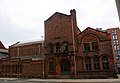
| Southern Railway Viaduct and Colonnade | |
|---|---|
| Southern Railway Viaduct in 2014 | |
| General information | |
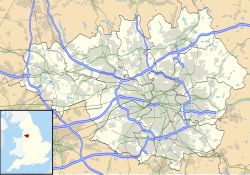
| Location | New Bailey St, Salford, Greater Manchester, England |
| Coordinates | 53°28′59″N2°15′16″W / 53.48292°N 2.25446°W |
| Year built | 1844 |
Listed Building – Grade II* | |
| Official name | Southern Railway Viaduct and Colonnade |
| Designated | 18 January 1980 |
| Reference no. | 1386162 |
The Southern Railway Viaduct and Colonnade is a Grade II* listed structure on New Bailey Street in Ordsall, a suburb within Salford, Greater Manchester, England. It forms part of the historic railway infrastructure near Salford Central railway station and is notable for its distinctive cast-iron architecture and ornamental detailing.
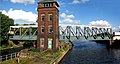
The viaduct was constructed in 1844 for the Liverpool and Manchester Railway, one of the pioneering railway companies of the early Victorian era. The design was overseen by Sir John Hawkshaw, [1] a prominent civil engineer known for his work on major railway projects during the period of rapid railway expansion often referred to as "Railway Mania". [2]
The structure was built to carry railway lines over New Bailey Street, connecting routes into Manchester. It is one of three adjacent bridges at Salford Central, each built by different companies, reflecting the competitive nature of early railway development. The Southern Viaduct is the southernmost of these bridges, with the others constructed for the Lancashire and Yorkshire Railway and later additions for the Manchester, Bolton and Bury Railway. [3]
On 18 January 1980, Southern Railway Viaduct and Colonnade was designated a Grade II* listed building. [4]
The viaduct is distinguished by its cast-iron columns supporting I-section girders and a cast-iron parapet. The columns feature Egyptian lotus flower capitals, a decorative motif popular in mid-19th-century industrial design. [5] The parapet is largely plain but becomes highly ornamented over New Bailey Street, where it is divided by fluted pilasters with acanthus capitals and an enriched frieze. This combination of structural engineering and decorative detailing exemplifies Victorian railway architecture's blend of utility and ornamentation. [4]