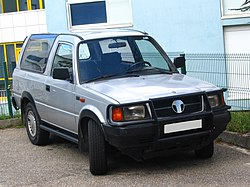
Tata Motors was founded in 1945, as a locomotive manufacturer. Tata Motors entered the passenger vehicle market in 1991 with the launch of the Tata Sierra, a multi utility vehicle. This was followed by the launch of the Tata Estate in 1992 (a stationwagon based on the existing TataMobile light commercial vehicle) and the Tata Sumo in 1994, India's first sports utility vehicle.
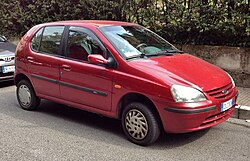
Tata launched the Indica in 1998, the first fully indigenous Indian passenger car. Although initially criticised by auto-analysts, its fuel economy, engine and an aggressive marketing strategy made it one of the best selling cars in the history of the Indian automobile industry. A newer version of the car, named Indica V2, was introduced later. Tata Motors also exported the car to South Africa.[5]
In 1999, Tata Motors entered talks to sell its struggling passenger car business, and Ford emerged as a potential buyer. However, after meeting Ford chairperson Bill Ford in Detroit, Ratan Tata decided not to sell the business.[6][7]
Later in 2008, during the Great Recession, Ford verged on bankruptcy. Tata offered to buy their Jaguar Land Rover (JLR) for $2.3 billion. Bill Ford reportedly thanked Tata by saying "You are doing us a big favour by buying JLR."[6][7][8][9][10][11]
Tata Nano
In January 2008, Tata Motors launched Tata Nano, the least expensive production car in the world at about ₹120,000 (US$3,000).[12] The city car was unveiled during the Auto Expo 2008 exhibition in Pragati Maidan, New Delhi.[13]
Tata faced controversy over developing the Nano, as environmentalists like Anumita Roychoudhury of the Centre for Science and Environment in Delhi[14] and Rajendra K. Pachauri,[15] the chairperson of the Intergovernmental Panel on Climate Change (IPCC), raised concerns over the launch of such a low-priced car which could lead to mass motorization in India, leading to an increase in pollution and accelerate climate change.[16][17] Tata had set up a factory in Sanand, Gujarat, and the first Nanos were rolled out in the summer of 2009.[18]
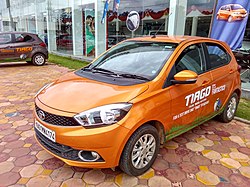
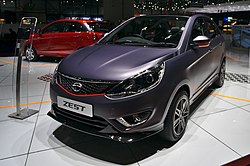
At the 12th Auto Expo in February 2014, Tata Motors unveiled The Bolt, a hatchback and The Zest, a compact sedan.[19]
In 2015, Tata Motors Cars entered the Southeast Asian market by expanding into Vietnam and the Philippines.[20]
Tata Motors Passenger Vehicles makes products in the compact, midsize car, and utility vehicle segments.[25] The company's manufacturing plants in India are in Pune (Maharashtra) and Sanand (Gujarat). Tata's dealership, sales, service, and spare parts network comprise over 3,500 touchpoints.[25] Tata Motors has more than 250 dealerships in more than 195 cities across 27 states and four Union Territories of India.[26] It has the third-largest sales and service network after Maruti Suzuki and Hyundai.
Tata also has franchisee/joint venture assembly operations in Kenya, Bangladesh, Ukraine, Russia, and Senegal.[27] Tata has dealerships in 26 countries across 4 continents.[28] Tata is present in many countries, it has managed to create a large consumer base in the Indian subcontinent, namely India, Bangladesh, Bhutan, Sri Lanka and Nepal. Tata is also present in Italy,[29] Spain,[30] Poland,[31] Romania,[32] Turkey,[33] Chile,[34] South Africa,[35] Oman, Kuwait, Qatar, Saudi Arabia, United Arab Emirates, Bahrain, Iraq, Syria and Australia.
Jaguar Land Rover PLC is a premium British automaker headquartered in Whitley, Coventry, United Kingdom, and has been a wholly owned subsidiary of Tata Motors since June 2008, when it was acquired from Ford Motor Company of USA.[36] Its principal activity is the development, manufacture and sale of Jaguar luxury and sports cars and Land Rover premium four-wheel-drive vehicles.
JD Power, of the US, rates Land Rover and Jaguar as the two worst brands for initial quality. [37] The Jaguar F-Pace made Consumer Reports February 2019 list of the 10 Least Reliable Cars. The editors cited "electronics, drive system, power equipment, noises and leaks" as problematic aspects.[38]
The Jaguar Land Rover subsidiary was struggling by 2019 and Tata Motors wrote down its investment in JLR by $3.9 billion. Much of the financial problem was due to a 50% drop in sales in China during 2019, although the situation was improving. Still, Tata was open to considering a partnership with another company according to a statement in mid-October, as long as the partnership agreement would allow Tata to maintain control of the business. The company ruled out the possibility of a sale of JLR to another entity.[39]
In July 2023, Tata announced its plans to invest £4 billion to build an electric car battery factory in the UK, which will be one of the largest of its kind in Europe.[40][41][42] The factory will be the company's first battery production facility outside India.[42] Located in Bridgwater, Somerset, the factory will supply Jaguar Land Rover's future battery electric models, including the Range Rover, Defender, Discovery and Jaguar brands, with the potential to also supply other car manufacturers.[43] Production at the new facility is due to start in 2026.
Electric vehicles
Tata Passenger Electric Mobility is a subsidiary which produces electric cars under the brand name Tata Motors.[1]
Tata Motors unveiled electric versions of the Tata Indica passenger car powered by TM4 electric motors and inverters,[44] and running on lithium batteries.
Tata EVision concept (2018)
In 2008 Tata Motors' UK subsidiary, Tata Motors European Technical Centre, bought a 50.3% holding in electric vehicle technology firm Miljøbil Grenland/Innovasjon of Norway for US$1.93 million, and planned to launch the electric Indica hatchback in Europe the following year.[45][46][47]
In December 2019, Tata Motors unveiled the Nexon EV, an SUV with a 30.2 kWh lithium-ion battery and a consistent range of 312km on a single charge. It is also equipped with fast charging technology, which can charge the vehicle from 0% - 80% in 60 minutes.[48]
The British engineering and design services company Incat International, which specialises in engineering and design services and product lifecycle management in the automotive, aerospace, and engineering sectors, is a wholly owned subsidiary of TTL. It was acquired by TTL in August 2005 for ₹4 billion.
In 2017, TAL, a subsidiary of Tata Motors, manufactured India's first industrial articulated robot for micro, small, and medium enterprises.[43]
Fiat-Tata
Fiat-Tata is an India-based joint venture between Tata and Fiat (Stellantis) which produces Jeep and Tata branded passenger cars, as well as engines and transmissions. Tata Motors has gained access to Fiat's diesel engine and transmission technology through the joint venture.[49]
The two companies formerly also had a distribution joint venture through which Fiat products were sold in India through joint Tata-Fiat dealerships. This distribution arrangement was ended in March 2013; Stellantis cars have since been distributed in India by Fiat Automobiles India Limited, a wholly owned subsidiary of Stellantis.[50][51]
Tata Motors Design Tech Centre
Tata Motors Design Tech Centre, formerly known as Tata Motors European Technical Centre, is an automotive design, engineering, and research company based at WMG, University of Warwick on the campus of the University of Warwick in England. It was established in 2005.[52]
In September 2013, it was announced that a new National Automotive Innovation Campus would be built at WMG at Warwick's main campus at a cost of £100 million.[53][54] The initiative will be a partnership between Tata Motors, the university, and Jaguar Land Rover, with £30 million in funding coming from Tata Motors.[55]
This page is based on this Wikipedia article Text is available under the CC BY-SA 4.0 license; additional terms may apply. Images, videos and audio are available under their respective licenses.


 ₹371,531 crore (US$44 billion) (2025)
 ₹19,394 crore (US$2.3 billion) (2025)