50 Cassiopeiae

Last updated
50 Cassiopeiae
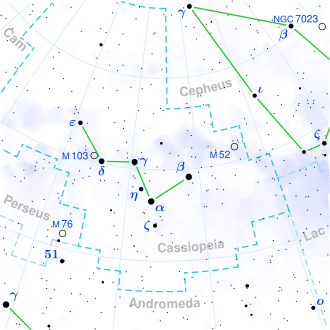
Cassiopeia constellation map.svg
Red circle.svg
Location of 50 Cassiopeiae (circled in red)
Observation data
Epoch J2000       Equinox J2000
Constellation Cassiopeia [1]
Right ascension 02h 03m 26.10206s [2]
Declination +72° 25 16.6376 [2]
Apparent magnitude  (V)+3.95 [1]
Characteristics
Evolutionary stage main sequence [3]
Spectral type A2 V [3]
B−V color index −0.002±0.007 [1]
Astrometry
Radial velocity (Rv)−18.2±0.9 [4] km/s
Proper motion (μ)RA: −43.57 [5] mas/yr
Dec.: +22.30 [5] mas/yr
Parallax (π)20.76±0.14  mas [5]
Distance 157 ± 1  ly
(48.2 ± 0.3  pc)
Absolute magnitude  (MV)0.54 [1]
Details
Mass 2.56±0.03 [3]   M
Radius 2.5 [6]   R
Luminosity 63.8+3.5
−6.4
[3]   L
Temperature 9,376+240
−235
[3]   K
Metallicity [Fe/H]+0.18±0.28 [7]   dex
Rotational velocity (v sin i)91 [3]  km/s
Other designations
Gang, 50 Cas, BD+71°117, FK5 70, GC 2445, HD 12216, HIP 9598, HR 580, SAO 4560, NGC 771 [8]
Database references
SIMBAD data

50 Cassiopeiae, also named Gang, [9] is a white star in the northern constellation of Cassiopeia. In the past, it had been misidentified as a suspected nebula, and given the number NGC 771. [10] The star is visible to the naked eye, having an apparent visual magnitude of +3.95. [1] Based upon an annual parallax shift of 20.76  mas , it is located 157  light years away. It is moving closer, having a heliocentric radial velocity of −18 km/s, [4] and will approach to within 82 ly in 1.879 million years. [1]
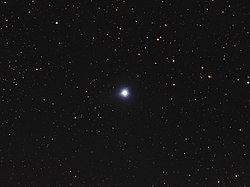
50 Cassiopeiae in optical light 50 Cassiopeiae.jpg
50 Cassiopeiae in optical light
A light curve for 50 Cassiopeiae, plotted from TESS data 50CasLightCurve.png
A light curve for 50 Cassiopeiae, plotted from TESS data

It is an A-type main-sequence star with a stellar classification of A2 V. [3] It is a suspected variable star with a very small amplitude. [12] 50 Cas has an estimated 2.56 times the mass of the Sun, [3] and about 2.5 times the Sun's radius. [6] It is radiating 64 times the Sun's luminosity from its photosphere at an effective temperature of around 9,376 K. [3]

The star was the brightest star in the occasionally used 1775 to 19th century constellation Custos Messium, typically drawn as a depiction of Charles Messier standing on top of the giraffe (Camelopardalis), between Cepheus and Cassiopeia. [13]

In Chinese astronomy, this star is part of the asterism Gàng (, "Shaft"), itself part of Huá Gài (華蓋 "Canopy of the Emperor"). The IAU Working Group on Star Names approved the name Gang for this star on 25 December 2025, and it is now so entered in the IAU Catalog of Star Names. The name Huagai was adopted for ι Cassiopeiae, and Custos (after Custos Messium) for BE Camelopardalis. [9]

References

  1. 1 2 3 4 5 6 Anderson, E.; Francis, C (2012), "XHIP: An extended hipparcos compilation", Astronomy Letters, 38 (5): 331, arXiv: 1108.4971 , Bibcode:2012AstL...38..331A, doi:10.1134/S1063773712050015, S2CID   119257644.
  2. 1 2 Brown, A. G. A.; et al. (Gaia collaboration) (August 2018). "Gaia Data Release 2: Summary of the contents and survey properties". Astronomy & Astrophysics . 616. A1. arXiv: 1804.09365 . Bibcode: 2018A&A...616A...1G . doi: 10.1051/0004-6361/201833051 .
  3. 1 2 3 4 5 6 7 8 9 Zorec, J.; Royer, F. (2012), "Rotational velocities of A-type stars. IV. Evolution of rotational velocities", Astronomy & Astrophysics, 537: A120, arXiv: 1201.2052 , Bibcode:2012A&A...537A.120Z, doi:10.1051/0004-6361/201117691, S2CID   55586789.
  4. 1 2 de Bruijne, J. H. J.; Eilers, A.-C. (October 2012), "Radial velocities for the HIPPARCOS-Gaia Hundred-Thousand-Proper-Motion project", Astronomy & Astrophysics, 546: 14, arXiv: 1208.3048 , Bibcode:2012A&A...546A..61D, doi:10.1051/0004-6361/201219219, S2CID   59451347, A61.
  5. 1 2 3 Van Leeuwen, F. (2007). "Validation of the new Hipparcos reduction". Astronomy and Astrophysics. 474 (2): 653–664. arXiv: 0708.1752 . Bibcode:2007A&A...474..653V. doi:10.1051/0004-6361:20078357. S2CID   18759600.
  6. 1 2 Pasinetti Fracassini, L. E.; et al. (February 2001), "Catalogue of Apparent Diameters and Absolute Radii of Stars (CADARS) - Third edition - Comments and statistics", Astronomy and Astrophysics, 367 (2): 521–524, arXiv: astro-ph/0012289 , Bibcode:2001A&A...367..521P, doi:10.1051/0004-6361:20000451, S2CID   425754.
  7. Gáspár, András; et al. (August 2016), "The Correlation between Metallicity and Debris Disk Mass", The Astrophysical Journal, 826 (2): 14, arXiv: 1604.07403 , Bibcode:2016ApJ...826..171G, doi: 10.3847/0004-637X/826/2/171 , S2CID   119241004, 171.
  8. "50 Cas". SIMBAD . Centre de données astronomiques de Strasbourg . Retrieved 2018-06-25.
  9. 1 2 "IAU Catalog of Star Names" . Retrieved 28 December 2025.
  10. Wolfgang Steinicke (19 August 2010). Observing and Cataloguing Nebulae and Star Clusters: From Herschel to Dreyer's New General Catalogue. Cambridge University Press. ISBN   978-1-139-49010-8.
  11. MAST: Barbara A. Mikulski Archive for Space Telescopes, Space Telescope Science Institute, retrieved 8 December 2021.
  12. Koen, Chris; Eyer, Laurent (2002). "New periodic variables from the Hipparcos epoch photometry". Monthly Notices of the Royal Astronomical Society. 331 (1): 45–59. arXiv: astro-ph/0112194 . Bibcode:2002MNRAS.331...45K. doi: 10.1046/j.1365-8711.2002.05150.x . S2CID   10505995.
  13. Ian Ridpath's Star Tales - Custos Messium