| Chalishevia Temporal range: Ladinian ~ | |
|---|---|
 | |
| Diagram showing the known skull remains of the holotype individual | |
 | |
| Chalishevia | |
Scientific classification  | |
| Kingdom: | Animalia |
| Phylum: | Chordata |
| Class: | Reptilia |
| Clade: | Archosauriformes |
| Family: | † Erythrosuchidae |
| Genus: | † Chalishevia Ochev, 1980 |
| Species | |
| |

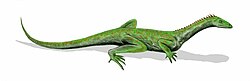
Chalishevia is an extinct genus of erythrosuchid archosauriform (quadrupedal, large-headed terrestrial carnivore) from the Ladinian Bukobay Formation of Russia (Orenburg Oblast), likely making it the youngest known erythrosuchid in the geological time scale. [1] [2] Though it is only known from some fragmentary cranial material, the skull is estimated to be around 80 centimeters long, making it one of the largest erythrosuchids known. [1]

What is known of its anatomy is very similar to that of Shansisuchus (likely indicating a close phylogenetic relationship), [3] [1] sharing a large additional fenestra in the skull behind the nostrils, between the premaxilla and maxilla bones, and roofed by the nasal. This fenestra has been described as the "accessory antorbital fenestra" or "sub-narial fenestra".
Besides the holotype, two bone fragments of the same part of the skull from two other different individuals have been described, one being noticeably smaller than the holotype (possibly a juvenile animal).
Several vertebrae and a jaw bone are also known near the region, but due to lack of overlap between the preserved bones of the holotype, these have been referred to Erythrosuchidae indet.