Marcianosuchus

Last updated

Marcianosuchus
Temporal range: Middle Triassic, Anisian (Aegean substage)
Marcianosuchus angustifrons (holotype, SMNS 91318).jpg
Holotype specimen
Scientific classification OOjs UI icon edit-ltr.svg
Kingdom: Animalia
Phylum: Chordata
Class: Reptilia
Clade: Eucrocopoda
Genus: Marcianosuchus
Sues, Spiekman & Schoch, 2024
Species:
M. angustifrons
Binomial name
Marcianosuchus angustifrons
Sues, Spiekman & Schoch, 2024

Marcianosuchus is an extinct genus of eucrocopodan archosauriform from the Middle Triassic Plattensandstein Formation of Germany. The genus contains a single species, Marcianosuchus angustifrons, known from a partial disarticulated skeleton. Marcianosuchus represents the first non-archosaurian archosauriform named from Central Europe.

Contents

Discovery and naming

Germany adm location map.svg
Red pog.svg
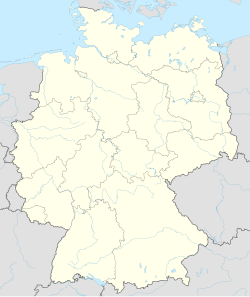
Marcianosuchus type locality at the Kössig quarry in Germany

The Marcianosuchus holotype specimen, SMNS 91318, was discovered in 1972 by Rupert Wild in talus deposits of the retired Kössig quarry, representing outcrops of the Plattensandstein Formation [nb 1] (Buntsandstein Group) near Ebhausen in Calw district of Baden-Württemberg, Germany. The specimen consists of an associated, generally disarticulated, skeleton of a single individual. Known material includes several bones of the skull and lower jaws, teeth, pectoral and pelvic girdles, humeri, femora, an incomplete tibia and probable fibula, assorted autopodial bones, cervical, dorsal, and caudal vertebrae, associated osteoderms, ribs, and gastralia. [2]

In 2024, Sues, Spiekman & Schoch described Marcianosuchus angustifrons as a new genus and species of archosauriforms based on these fossil remains. The generic name, Marcianosuchus, combines a reference to the Black Forest near the type locality (its Latin name, used by historian Ammianus Marcellinus in the 4th century, is "Marciana silva", meaning "border forest") with the Greek σοῦχος ("suchus"), after Sobek, the crocodile-headed ancient Egyptian deity. The specific name, angustifrons, combines the Latin words "angustus", meaning "narrow", and "frons", meaning "forehead", after the holotype skull's narrow frontal region. [2]

Marcianosuchus is the only non-archosaurian archosauriform currently known from Germany's Buntsandstein Group and Central Europe as a whole. [2]

Description

Life restoration of the similar Euparkeria Euparkeria capensis.png
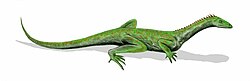
Life restoration of the similar Euparkeria

Marcianosuchus was a fairly small archosauriform. The holotype individual was likely not fully mature when it died, so would have been able to grow larger. Its femur was close to 115 millimetres (4.5 in), similar to the 127 millimetres (5.0 in) femur of the euparkeriid " Turfanosuchus " shageduensis. The longest known femur of Euparkeria is only 65.5 millimetres (2.58 in) long. [2]

Marcianosuchus has a body plan very similar to the similarly aged Euparkeria from South Africa. With the euparkeriid-like Dorosuchus from Russia, Marcianosuchus presents a generally skeletal morphology comparable to the archosaur plesiomorphic condition. [2]

Several generally rectangular osteoderms were found in association with the other skeletal elements of Marcianosuchus. These were interpreted as likely forming a paired row along the midline of the back, as in euparkeriids. [2]

Classification

In their phylogenetic analysis, Sues, Spiekman & Schoch (2024) recovered Marcianosuchus as a basal member of the archosauriform clade Eucrocopoda, in a polytomy with Dorosuchus outside of the Euparkeriidae. Their results are displayed in the cladogram below: [2]

Eucrocopoda

Palaeoenvironment

Marcianosuchus is known from the Plattensandstein Formation of Germany, which dates to the Anisian age of the beginning of the mid-Triassic period. Other reptile fossils from the formation include those of Sclerosaurus (a procolophonid), Amotosaurus (a tanystropheid), undescribed juvenile rhynchosaurians, and the indeterminate, dubiuous diapsids Seemannia and Crenelosaurus . [1]

References

  1. 1 2 Sues, Hans-Dieter; Schoch, Rainer R. (2025-12-04). "Synopsis of the Triassic reptiles from Germany". Fossil Record. 28 (2): 411–483. doi: 10.3897/fr.28.164405 . ISSN   2193-0074.
  2. 1 2 3 4 5 6 7 Sues, Hans-Dieter; Spiekman, Stephan N. F.; Schoch, Rainer R. (2024). "Osteology and phylogenetic relationships of a new archosauriform reptile from the Middle Triassic (Anisian) of Germany". Journal of Vertebrate Paleontology . 43 (6). e2357326. doi:10.1080/02724634.2024.2357326.

Notes

  1. Sues et al. (2024) described Marcianosuchus as deriving from the Röt Formation, although Sues & Schoch (2025) instead assign it to the Plattensandstein Formation in a review of Triassic German reptiles. [1]