Related Research Articles

The Amalik Bay Archeological District is a geographic area with a significant number of archaeological sites in Alaska. It is located on the Pacific coast of Katmai National Park and Preserve, in the mainland portion of Kodiak Island Borough, Alaska.

This is a list of the National Register of Historic Places listings in Aleutians West Census Area, Alaska.

This is a list of the National Register of Historic Places listings in Anchorage, Alaska.

This is a list of the National Register of Historic Places listings in Denali Borough, Alaska.

This is a list of the National Register of Historic Places listings in Kenai Peninsula Borough, Alaska.
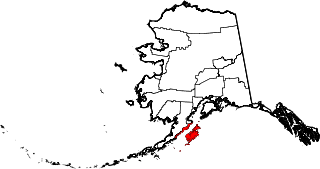
This is a list of the National Register of Historic Places listings in Kodiak Island Borough, Alaska.

This is a list of the National Register of Historic Places listings in Lake and Peninsula Borough, Alaska.
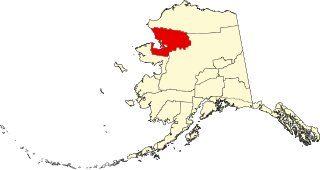
This is a list of the National Register of Historic Places listings in Northwest Arctic Borough, Alaska.

This is a list of the National Register of Historic Places listings in Matanuska-Susitna Borough, Alaska.

This is a list of the National Register of Historic Places listings in North Slope Borough, Alaska.

Kijik is a ghost town in Lake and Peninsula Borough, Alaska, United States. An Athabascan village that was established on the shores of Lake Clark in the Alaska Range, its population was recorded at 91 in the 1880 United States Census and declined thereafter, falling to approximately 25 individuals by 1904. Today, the village has been abandoned. The ghost town is located within the bounds of Lake Clark National Park and Preserve.

The DIL-161 Site is a prehistoric archeological site in Katmai National Park and Preserve. Located on the banks of the Alagnak River, the site was first identified in 1997 by National Park Service personnel, and its extents were mapped in 2004. The site is that of a village that was occupied between about 300 BCE and 800 CE. More than 40 cabin sites, which are little more than house pits, have been identified.
The Port Moller Hot Springs Village Site is a prehistoric archeological site on the Alaska Peninsula. It is located on the shores of Moller Bay, an indentation on the peninsula with extensive tidal flats. Until historical times the area was a border region between the Aleut people and the Inuit people. The site is notable for the presence of a sulphurous hot spring, which provides drinkable water. The 50-acre (20 ha) site contains the remains of a native village and extensive refuse middens. The site was first excavated in 1928.
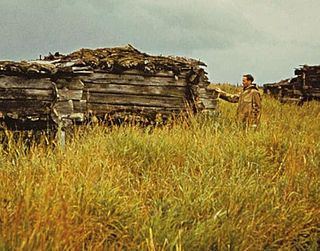
The Old Savonoski Site is the former site of a native village in Lake and Peninsula Borough, Alaska, that was buried by ash in the June 1912 eruption of the Novarupta Volcano. The site is located near the confluence of the Savonoski and Ukak Rivers, and is within the bounds of the Katmai National Park and Preserve. The site was visited by archaeologists in 1953, who identified a number of surviving elements, including fifteen barabaras, or semi-subterranean dwellings.
The Middle Bay Brick Kiln is a historical archaeological site on Kodiak Island, Alaska. Located on an eroding bluff face on Middle Bay, the site contains the remains of a brickmaking facility established by the Russian American Company, probably in the early 19th century. The remains include a 4-by-4-metre Roman-style kiln, with a series of arches that supported the kiln floor and provided a space for the fire. At the time of the site's first major excavation in 1979, elements of at least one arch were in danger of being undermined by the eroding bluff face, and were removed for potential reconstruction by the Kodiak Historical Society. Other notable finds at the site include hand cut nails and a brick with Russian writing on it.
The Kaguyak Village Site, designated 49 Afg 4, is a historic and prehistoric archaeological site on the Pacific coast of the Alaska Peninsula in Katmai National Park and Preserve. It is the site of an Alaska Native village which was abandoned after the eruption of Novarupta in 1912. The historic elements of the site include the remains of a Russian Orthodox church and cemetery, as well as a number of frame house remnants and foundations.

The Kukak Village Site is a prehistoric and historic archaeological site, located on the shore of Kukak Bay, on the south coast of the Alaska Peninsula in Katmai National Park and Preserve. The area was documented to be occupied in the early 20th century, and was abandoned after the 1912 volcanic eruption of Novarupta. The Kukak Bay area is also of prehistoric significance, with researchers identifying 89 depressions as likely sites of subterranean houses, and a refuse midden.
The Moose River Site is a prehistoric archaeological site in Kenai Peninsula Borough, Alaska. Located near the confluence of the Kenai and Moose Rivers near Sterling, it is apparently a camp or village site that was used as a fishing camp about 1500 years ago. The site includes seven house pits and three food cache pits.
Atanik is a prehistoric and historic Native Alaskan community site on coast of the Chukchi Sea in North Slope Borough, Alaska. A Native village was documented to be at the site in 1838, and the area may have evidence of much earlier habitation. Archaeological features of interest include the ruins of sod houses, ice cellars, a cemetery, and evidence of whaling-related activity. The site is also believed to have been a point from which inland hunting expeditions were launched.
The Savonoski River Archeological District encompasses a complex of prehistoric and historic archaeological sites on the Savonoski River near the mouth of the Grosvenor River in Katmai National Park and Preserve, located on the Alaska Peninsula of southwestern Alaska. At least two sites, designated 49-MK-3 and 49-MK-4 by state archaeologists, were identified when the site was listed in 1978. In 2003, the district was enlarge to include a third site, XMK-53. This area is believed to be the site of one of a group of Native Alaskan settlements referred to in Russian records as "Severnovsk". Excavations of a known prehistoric site in 1964 uncovered additional evidence of a post-contact settlement.
References
- ↑ Federal and state laws and practices restrict general public access to information regarding the specific location of this resource. In some cases, this is to protect archeological sites from vandalism, while in other cases it is restricted at the request of the owner. See: Knoerl, John; Miller, Diane; Shrimpton, Rebecca H. (1990), Guidelines for Restricting Information about Historic and Prehistoric Resources, National Register Bulletin, National Park Service, U.S. Department of the Interior, OCLC 20706997 .
- 1 2 "National Register Information System". National Register of Historic Places . National Park Service. July 9, 2010.
- ↑ Shinkwin, Anne D (1974). "Dakah De'nin's Village: An Early Historic Atna Site". Arctic Anthropology (Volume 11): 54–64. JSTOR 40315801.
 | Boroughs |  | |
Census areas | |||
There are no sites listed on the National Register of Historic Places in Kusilvak Census Area. | |||
| Topics | |
|---|---|
| Lists by state |
|
| Lists by insular areas | |
| Lists by associated state | |
| Other areas | |
| Related | |


 | This article about a location in the Copper River Census Area, Alaska is a stub. You can help Wikipedia by expanding it. |