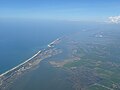
Huế,[a] formerly Thừa Thiên Huế province,[b] is a municipality in central Vietnam, located approximately at the center of the country, and an educational, medical, and cultural hub. It borders Quảng Trị to the north, Đà Nẵng to the south, the Laos provinces of Salavan and Sekong to the west and the South China Sea to the east. As one of the country's six direct-controlled municipalities, Huế falls under the administration of the central government. It has 128km of coastline, 22,000 ha of lagoons and over 200,000 ha of forest. The city is located in the middle of the North Central and South Central regions (including the South Central Coast and Central Highlands), and is transitional in geology, climate, administrative division, and local culture.
Huế was historically part of Thuận Hóa, a territory ceded by Champa to Đại Việt in 1306 as a wedding dowry. Huế (then known as Phú Xuân) became the provincial capital in 1687, the capital of Đàng Trong from 1738 to 1775, and the capital of Vietnam under the Nguyễn dynasty from 1802 to 1945. The city served as the Imperial Citadel and administrative capital of the Nguyễn dynasty, and later also functioned as capital of the protectorate of Annam during the colonial French Indochina period.
Huế is a tourist destination with UNESCO-designated complex of imperial palaces, tombs and temples. Alongside its moat and stone walls, the complex encompasses the Imperial City of Huế, with palaces and shrines; the Forbidden Purple City, once the emperor's home; a replica of the Royal Theater; and temples and monuments on the city's outskirts.[4]
Etymology
Regarding the place name, according to some information:[5]
It is possible that Emperor Lê Thánh Tông of the Lê dynasty was the first to mention the place name Huế in Thập giới cô hồn quốc ngữ văn, a literature written in Chữ Nôm. In the literature, there is a line: “Hương kỳ nam, vảy đồi mồi, búi an tức, bì hồ tiêu, thau Lào, thóc Huế, thuyền tám tầm chở đã vạy then [Sandalwood incense, tortoiseshell scales, An Tức cloth, pepper hides, Lao bronze, Huế rice, an eight-fathom boat with a worn rudder].”
Older historical documents, with the exception of Quốc Triều Chính Biên Toát Yếu, used the name Phú Xuân, Kinh Đô, or simply Kinh, rather than the name Huế, when referring to Huế.
Việt Nam sử lược by Trần Trọng Kim was the first Vietnamese history book written in Chữ Quốc Ngữ. In addition to traditional historical sources, Trần Trọng Kim utilized Western historical sources, and the name Huế appeared.
In the memoir of Pierre Poivre, a French merchant who visited Phú Xuân (Huế) in 1749, the name Huế in the form of Hué appeared on occasions.
In 1787, Le Floch de la Carrière drew a map of the Đàng Trong coast for the French Navy, in which the map of Huế was depicted, and the name Huế was recorded as the French would later write it: Hué.[6]
In a letter written in Saigon on July 15, 1789, by Oliver de Puynamel to Létodal in Macau, the name Hué was mentioned twice when discussing the situation there.[7]
The oldest ruins in Huế belong to the Kingdom of Lâm Ấp, dating back to the 4th century AD. The ruins of its capital, the ancient city of Kandarpapura (lit. 'the city where Śiva burnt Kama'), is later located in Long Tho Hill, three kilometers to the west of the city. Kandarpapura might have only been established during the reign of Kandarpadharma (r. 629–640) and it was named after the king, certainly it may be not the name of the capital of former Lâm Ấp kingdom. Another Champa ruin in the vicinity, the ancient city of Hoa Chau is dated back to the 9th century.[8]
In 1306, the King of Champa, Che Man offered Vietnam two Cham prefectures, Ô and Lý, in exchange for marriage with a Vietnamese (Trần dynasty) princess named Huyền Trân.[9] The Vietnamese King Trần Anh Tông accepted this offer.[9] He took and renamed Ô and Lý prefectures to Thuận prefecture and Hóa prefecture, respectively, the two being sometimes referred collectively to as Thuận Hóa region.[9][10]
Map of Thua Thien province in 1909Map of Huế citadel in 1885
In 1592, the Mạc dynasty was forced to flee to Cao Bằng province and the Lê emperors were enthroned as de jure Vietnamese rulers under the leadership of Nguyễn Kim, the leader of Lê dynasty loyalists. Later, Kim was poisoned by a Mạc dynasty general which paved the way for his son-in-law, Trịnh Kiểm, to take over the leadership. Kim's eldest son, Nguyen Uông, was also assassinated in order to secure Trịnh Kiểm's authority.[11]Nguyễn Hoàng, another son of Nguyễn Kim, feared a fate like Nguyễn Uông's so he pretended to have a mental illness. He asked his sister Ngoc Bao, who was a wife of Trịnh Kiểm, to entreat Trịnh Kiểm to let Nguyễn Hoàng govern Thuận Hóa, the furthest south region of Vietnam at that time.[12]
Because Mạc dynasty loyalists were revolting in Thuận Hóa, and Trịnh Kiểm was busy fighting the Mạc dynasty's forces in northern Vietnam during this time, Ngoc Bao's request was approved, and Nguyễn Hoàng went south.[12] After Hoàng pacified Thuận Hóa, he and his heir Nguyễn Phúc Nguyên secretly made this region loyal to the Nguyễn family; then they rose against the Trịnh lords.[13][14] Vietnam erupted into a new civil war between two de facto ruling families: the clan of the Nguyễn lords and the clan of the Trịnh lords.[15]
Drawing of Huế citadel in the Nguyễn dynasty in the 20th century.
Tây Sơn rebellions broke out in 1771 and occupied an area from Quy Nhon to Bình Thuận province, thereby weakening the authority and power of the Nguyễn lords.[16] While the war between Tây Sơn rebellion and Nguyễn lord was being fought, the Trịnh lords sent south an army and captured Phú Xuân in 1775.[17] After the capture of Phú Xuân, the Trịnh lords' general Hoàng Ngũ Phúc made a tactical alliance with Tây Sơn and withdrew almost all troops to Tonkin and left some troops in Phú Xuân.[18] In 1786, Tây Sơn rebellion defeated the Trịnh garrison and occupied Phú Xuân.[19] Under the reign of the emperor Quang Trung, Phú Xuân became the Tây Sơn dynasty capital.[20]
Hue City in 1875
In 1802, Nguyen Ánh, a successor of the Nguyễn lords, recaptured Phú Xuân and unified the country. Nguyễn Ánh rebuilt the citadel entirely and made it the Imperial City capital of all of Vietnam.[21] Nguyễn Phúc Ánh (later Emperor Gia Long) succeeded in establishing his control over the whole of Vietnam, thereby making Huế the national capital.[22]
The second emperor of the Nguyễn dynasty to rule from Huế, reigning from his birthday on 14 February 1820 until his death, on 20 January 1841 was Minh Mạng. He was a younger son of Emperor Gia Long, whose eldest son, Crown Prince Cảnh, had died in 1801. Minh Mạng was known for his opposition to French involvement in Vietnam, and for his rigid Confucianorthodoxy.[23]
While Bảo Đại was proclaimed "Head of the State of Vietnam" with the help of the returning French colonialists in 1949, his new capital was Saigon, in the south.[26]
The city underwent fighting during the Vietnam War, as it was the second-most northerly province of the South Vietnam, close to the North Vietnamese border (DMZ) at the 17th parallel. 2,893 U.S. soldiers died in Huế, more than in any other Vietnamese province.[27]
After the war's conclusion in 1975, some of the historic features of Huế were neglected because they were seen by the victorious communist regime and some other Vietnamese as "relics from the feudal regime"; the Communist Party of Vietnam (then Workers' Party of Vietnam) doctrine described the Nguyễn dynasty as "feudal" and "reactionary". With the adoption of liberalizing reforms, these hostile policies have been abandoned. Some of the city's historic areas and buildings are undergoing restoration, including the full reconstruction of Kien Trung Palace in 2024, and the city is developing into a tourism and transportation hub for central Vietnam.[28]
The Perfume River passes through the center of the city. The city also accommodates the Tam Giang–Cau Hai lagoon, the largest lagoon in Southeast Asia, which is 68 kilometres (42mi) long with a surface area of 220 square kilometres (85sqmi). It is divided into four zones: mountainous areas, hills, plains, and lagoons separated from the sea by sandbanks. The city has a coastline of 128 kilometres (80mi). The mountains, located along the western and southwestern borders, cover more than half of the province’s total area, with elevations ranging from 500 metres (1,600ft) to 1,480 metres (4,860ft). The hills, which lie between the mountains and the plains, account for about one-third of the territory and range in height from 20 metres (66ft) to 200 metres (660ft), with occasional peaks rising to 400 metres (1,300ft). The plains occupy roughly one-tenth of the surface area, reaching elevations of up to 20 metres (66ft) above sea level. The lagoons, located between the hills, represent the remaining 5% of the city’s area.[31]
Bạch Mã National Park is a protected area in the city of Huế. The area covers 220 square kilometres (85 sq mi) and is divided into three zones: a strictly protected core area, an administrative area, and a buffer zone.
Huế’s climate mostly resembles the rest of central Vietnam, characterized as tropical monsoon, while because of the topography and altitude, climatic types occur which can be the same as found in temperate latitudes (A Lưới and Bạch Mã). In the plains and hills, the average annual temperature is 25°C (77°F), while in the mountains it is lower, at around 21°C (70°F) (Statistical Yearbook 2004).[32]
The cool season extends from November to March, accompanied by northeasterly winds. January records the lowest average monthly temperature, 20°C (68°F), though temperatures in the plains can drop to 12°C (54°F). Relative humidity in this season ranges from 85% to 95%. From April to September, the climate becomes warmer, with average monthly temperatures reaching 29°C (84°F) in July and extremes of up to 41°C (106°F). The relative humidity may occasionally decrease to around 50%.[32]
The annual precipitation in the city is 3,200 millimetres (130in), while there are variations. Depending on the year, the annual average may be 2,500 millimetres (98in) to 3,500 millimetres (140in) in the plains and 3,000 millimetres (120in) to 4,500 millimetres (180in) in the mountains. In some years the rainfall may be higher and reach more than 5,000 millimetres (200in) in the mountains.[31] The rainy season is from September to December—about 70% of the precipitation occurring in those months. Rainfall may occur in bursts which can cause flooding and erosion, with social, economic and environmental consequences. The historic floods of November 1999 led to 600 deaths and affected 600,000 homes.[32][33]
A region known as the "Green Corridor" is home to species. New species of snake, butterfly, and orchid have been found there in 2005 and 2006, as stated by Chris Dickinson of the World Wide Fund for Nature (WWF) on 26 September 2007.[37][38] The scientists discovered 11 new species of plants and animals, including a snake, two butterflies and five leafless orchid varieties. The new snake species is a white-lipped keelback (Hebius leucomystax). The new butterfly species are a skipper from the genusZela, and the other from Satyrinae. The new plant species also include one in the genus Aspidistra, and a poisonous Arum perennial.[39]
Administrative divisions
Huế is subdivided into 40 commune-level subdivisions:[40]
The average population of the province is 1,143,572; which consist of approximately 567,253 males and 576,319 females. The rural population is approximately 587,516 while the urban population is 556,056 (2015).[41]
Culture
Clothing
Festival in Huế
The design of the áo dài, a Vietnamese national costume, developed from the costumes worn by civilians in Đàng Trong in the 18th century after the costume reform of lord Nguyễn Phúc Khoát. A court historian of the time described the rules of dress as follows:
Thường phục thì đàn ông, đàn bà dùng áo cổ đứng ngắn tay, cửa ống tay rộng hoặc hẹp tùy tiện. Áo thì hai bên nách trở xuống phải khâu kín liền, không được xẻ mở. Duy đàn ông không muốn mặc áo cổ tròn ống tay hẹp cho tiện khi làm việc thì được phép.
Outside court, men and women wear gowns with straight collars and short sleeves. The sleeves are large or small depending on the weather. There are seams on both sides running down from the sleeve, so the gown is not open anywhere. Men may wear a round collar and a short sleeve for more convenience.
This outfit evolved into the áo ngũ thân, a type of five-part costume most popular in Vietnam in the 19th and 20th centuries. Inspired by Paris fashions, Nguyễn Cát Tường and other artists associated with Hanoi University redesigned the ngũ thân to create the áo dài in the 1920s and 1930s.[42] While the áo dài and nón lá are seen by some as a symbol of Vietnam as a whole, the combination is seen by Vietnamese as being particularly evocative of Huế. Violet-coloured áo dài are especially common in Huế, the color having a special connection to the city's heritage as a former capital.[43][44]
The cuisine of Huế forms the heart of Central Vietnamese cuisine, while one of the differences is the prominence of vegetarianism in the city. All-vegetarian restaurants are scattered in corners of the city to serve the locals who have a tradition of eating a vegetarian meal twice a month, as part of their Buddhist beliefs. Nam Châu Hội Quán is a traditional dining hall. Huế dishes are known for their relatively small serving size with refined presentation, a vestige of its royal cuisine. Huế cuisine is notable for often being very spicy.[45]
Huế cuisine has luxurious and popular rustic dishes. It consists of distinctive dishes from small and delicate creations, originally made to please the appetites of Nguyen feudal lords, emperors, and their hundreds of concubines and wives.[46]
Among Buddhist sites in the surrounding midland area of Huế is Chùa Phổ Lại, which hosts religious, cultural, and community activities.[47]
In 1963, Thích Quảng Đức drove from Huế to Saigon to protest anti-Buddhist policies of the South Vietnamese government, setting himself on fire on a Saigon street.[48]
Thích Nhất Hạnh, a Zen master who originated from Huế and lived for years in exile including France and the United States, returned to his home town in October 2018 and resided there at the Tu Hieu pagoda until his death in 2022.[49]
Chùa Phổ Lại in Phong Thái Ward, Huế City, Vietnam
Forbidden Purple City of Huế, once the emperor's home
Roughly along the Perfume River from Huế lie monuments, including the tombs of some emperors, including Minh Mạng, Khải Định, and Tự Đức. The Thiên Mụ Temple is the largest pagoda in Huế and the official symbol of the city.[51]
Imperial City of Huế, containing palaces and shrinesSaigon Morin Hotel, the oldest hotel in Huế on Lê Lợi Street, opened in the 20th century
In the first 11 months of 2012, Huế received 2.4 million visitors, an increase of 24.6% from the same period of 2011. 803,000 of those 2.4 million visitors were foreign guests, an increase of 25.7%. While tourism plays a role in the city's socioeconomic development, it has impacts on environment and natural resource base.[52] For example, services associated with tourism, such as travel, the development of infrastructure and its operation, and the production and consumption of goods, are energy-intensive.[53] Research by the Climate and Development Knowledge Network has identified traditional 'garden houses' as having the potential to increase tourist traffic and revenue. Apart from the environmental, economic and cultural benefits provided by garden houses, their promotion could pave the way for other low carbon development initiatives.[54]
Economy
The retail sales of goods and services (trade, hotel, restaurant, tourism) in the province is 10,960.6 billion đồng, or 0.9% of national GDP. This is compared with 12.7% for Hanoi and 23.5% for Ho Chi Minh City (2009).[55] The province has more than 120km of coastline, which provides for a seafood industry that produces over 40,000 tonnes per year, consisting of over 500 species of fish.[56]
There are more than 100 mines for minerals and non-mineral resources with the majority consisting of limestone, granite and kaolin.[57]
Huế is home to historical buildings, mostly a legacy from its time as a capital of the Nguyễn dynasty (1802–1945), including the Imperial Citadel, the Flag Tower, the Royal Palace, and the Royal Tombs. Huế's Forbidden Purple City was once reserved solely for the royal family's use; it was damaged during the Vietnam War. Outside the city is the religious site known as Nam Giao Hill ("Heaven's Altar"). Huế Brewery Ltd is located on the Perfume River. The Brewery is a joint state-private partnership founded in 1990, with an initial investment of US$2.4 million and a capacity of 3 million liters per year, which has since grown to a capacity of 100 million liters per year in 2007.[58]
The municipality is home to Huế University (e.g.: Huế Economic University, Huế University of Medicine and Pharmacy, Huế Pedagogical University, Huế Forestry and Agriculture University, Huế University of Sciences, Huế University of Arts, Huế Conservatory of Music and Huế College of Foreign Languages). As of 2009, the city had 190 schools, 1302 classrooms, 2184 teachers and 36,200 pupils.[59]
Phu Bai International Airport, the province's sole airport, is situated 15km south of Huế; it ranks fourth in passenger numbers among Vietnam's airports. While a new terminal was completed in 2023 to receive international flights, Phu Bai still only has direct flights to domestic destinations; the first international routes to Kunming, Taipei and Seoul are planned to be inaugurated in 2025.[61]
↑Woodside, Alexander (1988). Vietnam and the Chinese model: a comparative study of Vietnamese and Chinese government in the first half of the nineteenth century. Harvard University Asia Center. p. 127. ISBN978-0-674-93721-5.
↑Stearns, Peter N.; Langer, William Leonard (2001). The Encyclopedia of world history: ancient, medieval, and modern, chronologically arranged. Houghton Mifflin Harcourt. p. 1036.
↑"Population and Employment". Monthly Statistical Information. General Statistics Office of Vietnam. Archived from the original on 13 November 2011. Retrieved 16 November 2011.
↑Phương Linh (5 October 2025). "Chốn về bình yên giữa miền trung du Huế"[A peaceful retreat in Hue's midland region]. Báo Thế giới và Việt Nam[The World & Vietnam Report] (in Vietnamese). Press and Information Department, Ministry of Foreign Affairs (Vietnam). Archived from the original on 5 October 2025. Retrieved 8 February 2026.
↑Advancing green growth in the tourism sector: The case of Hue, Vietnam Archived 14 July 2014 at the Wayback Machine , Kyoko Kusakabe, Pujan Shrestha, S. Kumar and Khanh Linh Nguyen, the Asian Institute of Technology, Chiang Mai Municipality and the Hue Centre for International Cooperation, 2014
↑"Potentials and perspective". About Thừa Thiên Huế Province. Thừa Thiên Huế Portal. Archived from the original on 31 March 2012. Retrieved 16 November 2011.
Fleming, Tom (2021). "Huế". Việt Nam(PDF) (Report). Cultural Cities Profile East Asia. Hà Nội: British Council Vietnam. pp.52–79. Archived(PDF) from the original on 28 April 2024. Retrieved 19 April 2025.
This page is based on this Wikipedia article Text is available under the CC BY-SA 4.0 license; additional terms may apply. Images, videos and audio are available under their respective licenses.



 Vietnam
  0.704 [3]