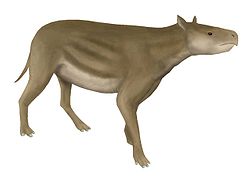
Telmatherium

Last updated

Telmatherium
Temporal range: Eocene, 53.5–48.5  Ma
O
S
D
C
P
T
J
K
Pg
N
Telmatherium AMNH.jpg
T. validus skull, American Museum of Natural History
Scientific classification OOjs UI icon edit-ltr.svg
Kingdom: Animalia
Phylum: Chordata
Class: Mammalia
Order: Perissodactyla
Family: Brontotheriidae
Genus: Telmatherium
Marsh, 1872
Species
  • T. validus (O.C Marsh, 1872)
Synonyms

Genus synonymy

  • Manteoceras
  • Telmatotherium
  • Leurocephalus

Species synonymy

  • Telmatherium validum
  • Telmatotherium validum
  • Telmatherium foris
  • Telmatherium cultridens

Telmatherium is a genus of a North American brontothere. It lived during the Eocene epoch. [1]

Contents

Description

Musculature of Telmatherium by Charles R. Knight (then known as Manteoceras) Skull of Telmatherium.png
Musculature of Telmatherium by Charles R. Knight (then known as Manteoceras)

Known from mostly cranial material, Telmatherium is a medium-sized hornless brontothere, with a notable post-canine diastema and sub-caniniform upper incisors. The first premolar is relatively simple, and there is a small diastema between the second and third lower premolars. [2] Molar size of Telmatherium has been compared to Palaeosyops . [3] A great amount of variance has been found in specimens of Telmatherium via isotopic analysis, especially so compared to other brontotheres such as Palaeosyops. [4] The zyogmatic arch is less developed than other brontothere genera, and the nasals are described as compressed and laterally decurved. [5] The unique nasal morphology of Telmatherium has been suggested to indicate the genus is ancestral to the later horned brontotheres, though others believe there is no direct ancestral relationship between the two. [2]

Classification

Described as T. validus in 1872 by paleontologist Othniel Charles Marsh, Telmatherium has had a convoluted classification history. The genera Manteoceras, Telmatotherium and Leurocephalus have all been synonymized with Telmatherium, [6] and one species of Telmatherium, T. validus, is considered valid. While T. validum ocassionally appears in literature, it is likely a typographical error originating from Henry Fairfield Osborn. [7]

Paleoecology

Telmatherium and Dolichorhinus by Charles R. Knight Manteoceras and Dolichorhinus by Charles R. Knight.jpg
Telmatherium and Dolichorhinus by Charles R. Knight

Telmatherium is known from the Green River Formation, a lacustrine depositional site. Telmatherium lived alongside various rodents, gruiform birds and testudines. [8] [9]

References

  1. Mader, Bryn J. (2009). "The Cranial Anatomy of Metarhinus (Mammalia, Perissodactyla, Brontotheriidae)" . Journal of Vertebrate Paleontology. 29 (4): 1300–1305. Bibcode:2009JVPal..29.1300M. doi:10.1671/039.029.0429. ISSN   0272-4634. JSTOR   20627138.
  2. 1 2 "Species Taxonomy, Phylogeny, and Biogeography of the Brontotheriidae (Mammalia: Perissodactyla)". Bulletin of the American Museum of Natural History . doi:10.1206/0003-0090(2008)501[1:STPABO]2.0.CO;2.full.
  3. Hanneman, Debbie (2025-01-01). "BRIDGERIAN AND UINTAN (EOCENE) MAMMALS FROM SAGE CREEK AREA OF SOUTHWEST MONTANA". Paludicola 15(2):47–82 June 2025.
  4. Michalski, John (2024-08-01). "Tales in the Teeth: Using Isotopic Analysis to Understand the Paleoecology and Social Behavior of Brontotheres of the Intermountain Basins During the Middle Eocene". All Graduate Reports and Creative Projects, Fall 2023 to Present.
  5. Marsh, Othniel Charles (1872-08-01). "Preliminary description of new Tertiary mammals". American Journal of Science. s3-4 (20). doi:10.2475/ajs.s3-4.20.122.
  6. Earle, Charles (1892). A Memoir Upon the Genus Palæosyops Leidy, and Its Allies. Academy of Natural Sciences of Philadelphia.
  7. Osborn, Henry Fairfield; Peterson, Olof August. "Fossil mammals of the Uinta Basin : expedition of 1894. Bulletin of the AMNH ; v. 7, article 2". Biodiversity Heritage Library. Retrieved 2026-01-12.
  8. Marsh, Othniel Charles (1871-07-01). "Notice of some new fossil mammals from the Tertiary formation". American Journal of Science. s3-2 (7). doi:10.2475/ajs.s3-2.7.35.
  9. "Green River Formation - Vertebrates". ucmp.berkeley.edu. Retrieved 2026-01-12.