Anzac Parade, Canberra

Last updated

Anzac Parade

ANZAC Parade from the Australian War Memorial, Canberra ACT.jpg
Looking down Anzac Parade from the Australian War Memorial
Anzac Parade, Canberra
General information
TypeRoad
Length1.1 km (0.7 mi) [1]
Former
route number
Australian Capital Territory Tourist Drive 3.svg ACT Tourist Route 3
Major junctions
Northeast end Limestone Avenue
Fairbairn Avenue
Campbell, Australian Capital Territory
  Constitution Avenue
Southwest end Parkes Way
Lake Burley Griffin
Location(s)
Major suburbs Campbell, Reid

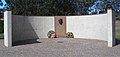
Anzac Parade is a major arterial road and thoroughfare in the Australian capital city of Canberra, connecting the Australian War Memorial with Constitution Avenue, Parkes Way and Lake Burley Griffin. It is used for ceremonial occasions, such as Anzac Day services, and is the site of many military memorials.

Contents

Named in honour of the Australian and New Zealand Army Corps (ANZAC) of World War I, Anzac Parade joins Gallipoli Reach of Lake Burley Griffin in the south and the Australian War Memorial to the north. As the main axis between Parliament House and Mount Ainslie, it bisects Constitution Avenue, which forms one side of the Parliamentary Triangle between Civic and Russell Hill.

The Parade is flanked by Victorian blue gum eucalyptus trees on gently sloping banks either side of the three-lane, one-way roads centred by a wide parade ground topped with granulated rock (similar to scoria), with planted boxes of a low bush called Hebe. The eucalypts are Australian; and the hebe comes from New Zealand. The Parade is also flanked by the streets of Anzac Park West and Anzac Park East on either side of Anzac Park.

On Anzac Day (25 April) and other ceremonial occasions, the Parade and adjoining streets may be blocked off to provide a parade route for formed groups of armed services personnel and veterans to proceed either along the central parade ground or the flanking roads. Removable concrete kerbs to facilitate marching along the central parade route are at the cross streets of Parkes Way, Constitution Avenue, Currong Street/Blamey Crescent, and Limestone Avenue/Fairbairn Avenue.

Memorial interpretation

Anzac Parade – Memorials (north to south)
Australian War Memorial AS AWM 2.jpg
Australian War Memorial
Limestone Avenue (roundabout) Fairbairn Avenue
Hellenic/Greek AS Hellenic 1.jpg
Hellenic/Greek
Parade
Kemal Ataturk /Turkey AS Kemal Ataturk 1.jpg
Kemal Atatürk /Turkey
space for memorialspace for memorial
Australian Army AS Army 1.jpg
Australian Army
Australian Navy AS Navy 1.jpg
Australian Navy
Korean War AS Korea 1.jpg
Korean War
Service Nurses AS Nurses 1.jpg
Service Nurses
Vietnam Forces Vietnam Forces National Memorial-Close look.jpg
Vietnam Forces
Air Force AS Air Force 2.jpg
Air Force
Mounted Mounted Memorial, Canberra-Close view.jpg
Mounted
Rats of Tobruk AS Rats1.jpg
Rats of Tobruk
Boer War Boer War Memorial, Canberra-Close view.jpg
Boer War
Peacekeeping Peacekeekers Memorial Canberra view 01.jpg
Peacekeeping
Australia 'basket' New Zealand Memorial-West side.jpg
Australia 'basket'
New Zealand 'basket' New Zealand Memorial-East side.jpg
New Zealand 'basket'
Constitution Avenue
Anzac Park West offices Anzac Park West.jpg
Anzac Park West offices
Anzac Park East offices Anzac Park East.jpg
Anzac Park East offices
Parkes Way (fountain) Parkes Way
Service road / parking area
(Space for Memorial) Rond Terrace
Emergency Services NESM-west face.jpg
Emergency Services
Lake Burley Griffin

In the manner of interpretation of museum displays, the memorials are accompanied by several forms of signage to assist the passer-by. Each memorial has various plaques or foundation stones that were laid at the time of unveiling. Additionally, interpretative signage in a common format has been provided by the Government of Australia adjacent to each memorial that gives succinct information about the nature and/or the site of the people or group or events leading to the establishment of the memorial.

Situation and history

Anzac Parade is situated on the main axis between Parliament House and Mount Ainslie. It bisects Constitution Avenue, which forms one side of the Parliamentary Triangle between Civic and Russell Hill.

Anzac Parade, positioned on Canberra's Land Axis Inner-canberra-triangle MJC01.png
Anzac Parade, positioned on Canberra's Land Axis

The Parade separates the residential suburbs of Campbell and Reid. The naming is significant:

Anzac Parade in 1964 AnzacParadeCanberra1964.jpg
Anzac Parade in 1964

At the corner of Anzac Parade and Constitution Avenue is the historic St John the Baptist Anglican Church, consecrated by the Bishop of Australia, William Broughton, on 12 March 1845, some 80 years before the site of the national capital was decided. Fortuitously, the alignment of the church was such that it seems to have been designed to fit the alignment of the adjoining roads, ordained in the plans by Walter Burley Griffin.

Lighting

The original lighting was designed to be a symbolic "honour guard" and was opened by then Prime Minister, Robert Menzies, on Anzac Day 25 April 1965. The street lighting was updated and officially opened on 26 March 2001 by then Prime Minister of Australia, John Howard. The design is intended to be efficient, and to reduce energy consumption and thus air pollution while also reducing skyglow/light pollution.

Heritage listing

On Anzac Day 25 April 2006 Federal Environment and Heritage Minister Ian Campbell announced that Anzac Parade along with the Australian War Memorial would be added to the National Heritage List.

See also

Flag of Australia.svg Australiaportal Australia road sign W5-29.svg Australian Roadsportal

References

  1. "Anzac Parade, Canberra" (Map). Google Maps . 14 May 2018.
Template:Attached KML/Anzac Parade, Canberra
KML is from Wikidata