| Golden silk orb-weaver | |
|---|---|
| Nephila clavipes | |
| Scientific classification | |
| Kingdom: | Animalia |
| Phylum: | Arthropoda |
| Subphylum: | Chelicerata |
| Class: | Arachnida |
| Order: | Araneae |
| Infraorder: | Araneomorphae |
| Family: | Araneidae |
| Subfamily: | Nephilinae |
| Genus: | Nephila Leach, 1815 [1] |
| Type species | |
| Aranea pilipes (Fabricius, 1793) [1] | |
| Species | |
See text. | |
| Diversity [1] | |
| 23 species | |
The golden silk orb-weavers (Nephila) are a genus of araneomorph spiders noted for the impressive webs they weave. Nephila consists of numerous species found in warmer regions around the world. They are also commonly called golden orb-weavers, giant wood spiders, or banana spiders.
A genus is a taxonomic rank used in the biological classification of living and fossil organisms, as well as viruses, in biology. In the hierarchy of biological classification, genus comes above species and below family. In binomial nomenclature, the genus name forms the first part of the binomial species name for each species within the genus.
Spiders are air-breathing arthropods that have eight legs and chelicerae with fangs able to inject venom. They are the largest order of arachnids and rank seventh in total species diversity among all orders of organisms. Spiders are found worldwide on every continent except for Antarctica, and have become established in nearly every habitat with the exceptions of air and sea colonization. As of July 2019, at least 48,200 spider species, and 120 families have been recorded by taxonomists. However, there has been dissension within the scientific community as to how all these families should be classified, as evidenced by the over 20 different classifications that have been proposed since 1900.
The genus name Nephila is derived from Ancient Greek, meaning "fond of spinning", [2] from the words νεῖν (nein) = to spin (related to nema νήμα "thread") + φίλος (philos) = "love".
The ancient Greek language includes the forms of Greek used in Ancient Greece and the ancient world from around the 9th century BCE to the 6th century CE. It is often roughly divided into the Archaic period, Classical period, and Hellenistic period. It is antedated in the second millennium BCE by Mycenaean Greek and succeeded by Medieval Greek.
Nephila spiders vary from reddish to greenish yellow in color with distinctive whiteness on the cephalothorax and the beginning of the abdomen. Like many species of the superfamily Araneoidea, most of them have striped legs specialized for weaving (where their tips point inward, rather than outward as is the case with many wandering spiders). Their contrast of dark brown/black and green/yellow allows warning and repelling of potential predators to which their venom might be of little danger.
The cephalothorax, also called prosoma in some groups, is a tagma of various arthropods, comprising the head and the thorax fused together, as distinct from the abdomen behind. The word cephalothorax is derived from the Greek words for head and thorax. This fusion of the head and thorax is seen in chelicerates and crustaceans; in other groups, such as the Hexapoda, the head remains free of the thorax. In horseshoe crabs and many crustaceans, a hard shell called the carapace covers the cephalothorax.
Araneoidea is a taxon of araneomorph spiders, termed "araneoids", treated as a superfamily. As with many such groups, its circumscription has varied; in particular some families at one time moved to the Palpimanoidea have more recently been restored to Araneoidea. A 2014 treatment includes 18 families, with the araneoids making up about 26% of the total number of known spider species; a 2016 treatment includes essentially the same taxa, but now divided into 17 families.
Golden orb-weavers reach sizes of 4.8–5.1 cm (1.5–2 in) in females, not including legspan, with males being usually two-thirds smaller (less than 2.5 cm, 1 in). The largest specimen ever recorded was a 6.9-cm (2.7-in) female N. plumipes (which is now debated to have been a new yet undocumented subspecies) from Queensland, Australia, that was able to catch and feed on a small finch. In 2012, a large individual was photographed killing and consuming a 0.5-m-long brown tree snake in Freshwater, Queensland. [3] [4] Species from Taiwan have been known to reach over 130 mm (5.1 in), legspan included, in mountainous country. [5] In 2014, a study discovered that golden orb-weavers living in urban areas, particularly areas of a high socioeconomic status, grew larger and carried more eggs than those in their native habitats. A number of possible explanations were suggested, such as increased food supplies due to artificial light or lack of predators and parasites. [6]
Nephila plumipes is a species of spider found in Australia, Indonesia and some Pacific Islands, which exhibits extreme sexual dimorphism. It is sometimes called the tiger spider due to its markings which look similar to a tiger. This species has historically been confused with Nephila clavipes, with the main distinguishing visual difference being significantly smaller black hair tufts on the legs. As with other spiders from the genus Nephila, they have a distinctive golden web.
The true finches are small to medium-sized passerine birds in the family Fringillidae. Finches have stout conical bills adapted for eating seeds and often have colourful plumage. They occupy a great range of habitats where they are usually resident and do not migrate. They have a worldwide distribution except for Australia and the polar regions. The family includes species known as siskins, canaries, redpolls, serins, grosbeaks and euphonias.
The brown tree snake is an arboreal rear-fanged colubrid snake native to eastern and northern coastal Australia, eastern Indonesia, Papua New Guinea, and a large number of islands in northwestern Melanesia. This snake is infamous for being an invasive species responsible for extirpating the majority of the native bird population in Guam. It is also one of the very few colubrids found in Australia, where elapids are more common.
As of August 2019 [update] it contains eleven species and one subspecies: [7]
Embrik Strand was an entomologist and arachnologist who classified many insect and spider species including the greenbottle blue tarantula.
The Comoros, officially the Union of the Comoros, is an island country in the Indian Ocean located at the northern end of the Mozambique Channel off the eastern coast of Africa between northeastern Mozambique, the French region of Mayotte, and northwestern Madagascar. The capital and largest city in Comoros is Moroni. The religion of the majority of the population is Sunni Islam.
Mayotte is an overseas department and region of France officially named the Department of Mayotte. It consists of a main island, Grande-Terre, a smaller island, Petite-Terre, and several islets around these two. Mayotte is part of the Comoros archipelago, located in the northern Mozambique Channel in the Indian Ocean off the coast of Southeast Africa, between northwestern Madagascar and northeastern Mozambique. The department status of Mayotte is recent and the region remains, by a significant margin, the poorest in France. Mayotte is nevertheless much more prosperous than the other countries of the Mozambique Channel, making it a major destination for illegal immigration.
Golden silk orb-weavers are widespread in warmer regions throughout the world, with species in Australia, Asia, Africa (including Madagascar), and the Americas. One species, N. clavipes , occurs in the United States of America, where it ranges throughout the coastal southeast and inland, from North Carolina to Texas. Spiderlings can be carried by the wind over long distances, and each year, a small number of golden orb web spiders are found in New Zealand (where they are not endemic) after having been blown across the Tasman Sea; the spiders usually end up in the North Island. [8]
Whilst the geographic distribution of Nephila is large, many habitat similarities are seen between these locations. A warm and reasonably wet climate is generally preferred, as these are some of the environmental cues that induce spiderling hatching. [9] Locally, spiders look for relatively dense vegetation where webs can be set up in areas that insects will regularly fly through. Urban environments are also attractive due to the large prey concentrations and lower levels of predation. [10]
Nephila spiders produce large asymmetric orb webs up to 1.5 m (5 ft) in diameter. The hub of the web is in the upper section, while most of the sticky capture strands are found in the lower web. [11] Nephila species remain in their webs permanently, so have a higher predation risk. A barrier web structure on either side of the main web helps mitigate this risk. [12] The golden silk orb-weaver is named for the yellow color of the spider silk used to construct these webs.
Yellow threads of their web shine like gold in sunlight. Carotenoids are the main contributors to this yellow color, but xanthurenic acid, two quinones, and an unknown compound may also aid in the color. [13] Experimental evidence suggests that the silk's color may serve a dual purpose: sunlit webs ensnare bees that are attracted to the bright yellow strands, whereas in shady spots, the yellow blends in with background foliage to act as a camouflage. The spider is able to adjust pigment intensity relative to background light levels and color; the range of spectral reflectance is specifically adapted to insect vision.
The webs of most Nephila spiders are complex, with a fine-meshed orb suspended in a maze of non-sticky barrier webs. As with many weavers of sticky spirals, the orb is renewed regularly if not daily, apparently because the stickiness of the orb declines with age. When weather is good (and no rain has damaged the orb web), subadults and adults often rebuild only a portion of the web. The spider removes and consumes the portion to be replaced, builds new radial elements, then spins the new spirals. This partial orb renewal is distinct from other orb-weaving spiders that usually replace the entire orb web. The web of Nephila antipodiana contains ant-repellent chemicals to protect the web. [14]
Typically, the golden orb-weaver first weaves a nonsticky spiral [15] with space for two to 20 more spirals in between (the density of sticky spiral strands decreases with increasing spider size). When she has completed the coarse weaving, she returns and fills in the gaps. Whereas most orb-weaving spiders remove the nonsticky spiral when spinning the sticky spiral, Nephila spiders leave it. This produces a "manuscript paper" effect when the orb is seen in the sun: groups of sticky spirals reflecting light with "gaps" where the nonsticky spiral does not reflect the light.
The circular-orb portion of a mature N. clavipes web can be more than 1 m (3 ft) across, with support strands extending perhaps several more meters away. In relation to the ground, the webs of adults may be woven from eye-level upwards high into the tree canopy. The orb web is usually truncated by a top horizontal support strand, giving it an incomplete look.
Adjacent to one face of the main orb, a rather extensive and haphazard-looking network of guard-strands may be suspended a few cm distant across a free space. This network is often decorated with a lumpy string or two of plant detritus and insect carcasses clumped with silk. This "barrier web" may function as a kind of early-warning system for incoming prey or against spider-hunting predators, or as a shield against windblown leaves; it may also be remnants of the owner's previous web. At least one reference explains the suspended debris-chain as a cue for birds to avoid blundering into and destroying the web.
Stabilimenta among N. clavipes are sometimes seen in the webs of immatures nearing molt, hence the names "molting webs" or "skeleton webs" (webs with radial strands but no spiral elements).
The golden silk orb-weaver targets many different organisms as prey, ranging from small flies and beetles to larger cicadas and locusts. As a result of their strong web structure, small birds and bats can also become trapped and fed upon. Whilst most of the captured prey is relatively small compared to Nephila, the majority of biomass consumed comes from larger, rarer prey. Prey larger than 66% of the captor's size accounts for just 16.5% of prey captured, but 85% of prey consumed, indicating the spider is selective in its feeding habits. [16]
Throughout the maturation process, spiders exhibit different feeding behaviours relative to their web type. Originally after birth, the spiderlings inhabit a communal web and eat dead siblings and dead prey, but do not attack any live organisms. After they move to individual webs, the spiderlings begin to attack small live prey. As they increase in size, they become more ambitious in their prey capture attempts through larger and stronger webs and greater attack confidence. [17]
Spiders are notified that potential prey has been caught in the web through vibrations along strands, and these can be followed to the prey location on the web and be used to estimate prey size. [10] Due to the large variety in prey, Nephila species have different attack techniques dependent on prey size. Small prey such as flies are captured alive, then removed from the web and wrapped in silk. This occurs with smaller prey because they do not present a threat to the spider when alive. Prey that is seen as potentially threatening is bitten to be subdued before wrapping. Medium-sized prey receive bites that are sustained until prey is immobilised and then is covered in silk. Finally, the largest captured prey receives the bite-and-back-off treatment, where a single, lunging bite is made before the spider withdraws and waits for the venom to take effect before wrapping. This lunging bite is often repeated to speed up the process of immobilisation. [18]
Nephila species also create caches of food for storage, which can be found above the hub of the web and contain up to 15 prey items. These items are arranged in a line vertically and are wrapped in silk to reduce dehydration. Caches are created and grow when prey is readily available and more biomass is available for consumption than is required by the spider. The purpose of caches is to have a backup food source when prey is scarce and occasionally to provide bait to attract more prey to the web. [19] Nephila species may also respond to food shortages by moving their webs, but this is a response to longer periods of prey scarcity than cache creation. [20] Web moving is seen as a result of environmental change, whereas caches occur from environmental fluctuation.
Nephila spiders display large sexual dimorphism in size, with females being greatly larger than males, sometimes up to 10 times the size. [21] Debate exists as to whether this is a result of male dwarfism or female gigantism.[ citation needed ] Smaller males may be selected for due to the presence of competition for mating. Smaller males are quicker and more nimble, allowing them to be able to catch the females more easily, as well as to escape when threatened. Larger males may have to wait for the female to come close due to their slower speed. [22] Larger females may have been selected for as a result of males using mating plugs upon copulation. Larger individuals reduce the success of these plugs, allowing for multiple mating and reducing the risk of genital mutilation. [23] Gigantism in females is also associated with fecundity, as larger individuals can produce more eggs and therefore increase reproductive success. [24]
When males are fully mature, they leave their webs to search for a suitable female, often using web characteristics to identify potential mates. Females are most likely to mate directly after their final molt at the beginning of adulthood and later in adulthood when they are feeding. [25] Often, multiple males attempt to court the same female, thus competition for territory on the web occurs, but is rarely physical, as smaller males surrender area to larger ones. When males approach females, they are often feeding, allowing the males to get closer without an aggressive response and also meaning the female is not moving. On approach, the male makes himself known by tapping on a web strand to ensure the female is amenable before proceeding to mate. When met with aggression, males stop approaching and remain in the same location until the female relaxes or they retreat. Females engage in multiple mating, but no benefit to the offspring occurs as a result of this; however, the energy cost of repelling a male is higher than that of allowing him to copulate. [26] As a result of this, sperm competition occurs through males altering the duration and frequency of mating, with longer mating being proportional to a greater likelihood of success. Sexual cannibalism is uncommon in Nephila as a result of male mating behaviours. By copulating when females are immobile after molting or inactive due to feeding, the males increase their chances of survival. Males also approach from the side of the web opposite the female, increasing the odds of a successful approach. [27] Sexual cannibalism does still occur, but generally is more common with larger males, and from older females.
Females produce an egg sac in the surrounding environs of the web to protect their eggs. The eggs are deposited on a silk platform, then are covered in loose silk to form a sac, which is firmly attached to surrounding vegetation so that it is hidden from the view of predators. These sacs can contain from 300 to 3000 eggs, depending on mating success and particular species. [20] Once hatched, the spiderlings inhabit a communal web to begin their lives.
Nephila spiders change their body positioning relative to the sun to maintain internal temperatures at an optimal level. As ambient temperatures increase, the spiders position themselves so the abdomen shades the cephalothorax from the sun. Spiders may also hang from their hind legs as a result of the heat due to a loss of hydrostatic pressure. Conversely, as temperatures cool down, the spiders position themselves perpendicular to the sun to retain as much heat energy as possible. When ambient temperatures reach extreme highs (above 40°C), they may leave their webs and seek shade in the surrounding environment. [28]
Predation of Nephila species is relatively uncommon; when it does occur, the main group affected are the juvenile individuals. The major predators are birds, but wasps and damselflies also prey upon smaller juveniles. To combat this, females aggregate their webs to form a large complex, discouraging aerial predators for fear of entanglement. [29]
N. clavipes (and many other Nephila species) are frequently parasitized by Argyrodes , a genus of very small black-and-silver spiders that are kleptoparasitic. As many as a few dozen may infest a single Nephila web to feed from the host spider's captured prey. The frequent rebuilding or abandoning of webs by Nephila may be a tactic for controlling Argyrodes. Spiny orb-weaver spiders of the genus Gasteracantha also inhabit the webs of Nephila as kleptoparasites.
Egg sacs generally remain free from both predation and parasitism, often due to the close proximity of the mother and how well it is hidden. Moth larvae of genus Anatrachyntis have been known to prey on Nephila eggs, but this is the only well known and researched case. [30]
Nephila spiderlings leave the egg sac as a result of environmental cues, often warmer and wetter conditions in spring. They then live on a communal web, eating dead siblings and web debris for around a week before dispersing to make individual webs. [31]
Young spiders do not generally build yellow-colored silk, and the young themselves can be easily mistaken for young orchard spiders ( Leucauge ) in general color and shape (both genera sport silver stripes or patches on their abdomens, described in some references as a form of heat control). The best distinction between Leucauge and Nephila juveniles is web structure: Leucauge species tend to build horizontal orbs that form a perfect circle, whereas Nephila species build vertical, elliptical orbs that are incomplete (missing the portion of the orb over the hub, the center where the spider sits). The latter seem to prefer more open habitat such as second-growth scrub or forest edges. Fences or building overhangs often do just as nicely.
In addition, young spiders demonstrate vibrational motion when approached by a predator. [32] They oscillate around 40 Hz when the web is plucked—thought to be a response to a potential predator. If a predator persists in an attack, the spider either runs to a web-support strand and thus to nearby vegetation, bails out of the web on a silk line that remains connected to the web, or jumps from the web after inducing oscillations in the web that aid the jump.
Once they are juvenile, Nephila spiders inhabit their individual webs, then begin their growth by the molting process. The time between molts is called an instar and seven to 12 of these can occur depending on food availability. Ecdysis, the shedding of the exoskeleton, occurs through the formation of a soft exoskeleton inside the current one. Once the old exoskeleton is shed, the new, larger one begins to harden. Ecdysis occurs when the spider's mass becomes too great for the current exoskeleton to support. [33] Male spiders seek out females for copulation and live on their webs. When mating season arrives, both males and females stop molting and remain the same size for the remainder of their lives.
The venom of the golden silk orb-weaver is effective in action on prey, but has not been reported to be of any notable consequence for humans if accidentally bitten. In the literature, Nephila is one of several genera where the venom "must be considered as more or less ineffectual in human beings". [34] That said, the potentially large size of several members of the genus means that they possesses relatively strong chelicerae, so any bite can cause some mechanical damage, but only of short-term localised effect for humans. However, active components of the venom in some Nephila have been shown to be insecticidal, [35] most notably containing some specific blockers of glutamate receptors (i.e. glutaminergic neurotransmission) in other arthropods, such as NSTX-3 JSTX-3 and Nephilatoxins (NPTX-1˜12),. [36] [37] However, further studies of the venom components are needed to better understand pathways associated with any toxicity.
Nephila do not seem to form either beneficial or harmful relationships with humans. Females often construct their webs using human structures as a base for support strands due to their stability. Individuals are often found in urban and suburban environments due to the protection from predation and greater prey availability. [38] As they weave their webs in bushes and near flowers, they might present a nuisance for gardeners or flower pickers. Some nests near fruits may repel or destroy known pests, such as Tephritid fruit flies, without the need to use insecticides. Spiders may bite humans if provoked but more often flee if confronted.
There have been several efforts in the past to produce garments from Nephila silk although none commercially viable. [40] These include two bed hangings that were shown at the 1900 Paris Exhibition. [41] In 2004 a textile designer, Simon Peers, and an entrepreneur, Nicholas Godley managed in three years work and using 1.2 million Golden silk orb-weavers (collected in the wild and released some 30 minutes later after they produced the silk) to produce a shawl that was as exhibited at the American Museum of Natural History in 2009. [42] [43] By 2012 they managed to produce a second, bigger garment, a cape, that, together with the shawl, were exhibited at the Victoria and Albert Museum in London. [44]
Another possible use of Nephila silk lies in tissue engineering. A study from the Medizinische Hochschule Hannover reports that processed Nephila silk is an excellent scaffold material thanks to its biocompatibility, mechanical strengths, and its property to promote cell adhesion and proliferation. [45] In particular, the silk acts as a suitable guiding material for peripheral nerve regrowth. [46]
Fishermen on the coasts of the Indo-Pacific ocean remove Nephila webs and form them into a ball, which is thrown into the water. There it unfolds and is used to catch bait fish. [40]
The genus Argiope includes rather large spiders that often have a strikingly coloured abdomen. These spiders are distributed throughout the world. Most countries in tropical or temperate climates host one or more species that are similar in appearance. The etymology of Argiope is from a Latin word argentum meaning silver. The carapace of Argiope species is typically covered in silvery hairs.
Orb-weaver spiders or araneids are members of the spider family Araneidae. They are the most common group of builders of spiral wheel-shaped webs often found in gardens, fields and forests. "Orb" can in English mean "circular", hence the English name of the group. Araneids have eight similar eyes, hairy or spiny legs, and no stridulating organs.
The spider species Araneus diadematus is commonly called the European garden spider, diadem spider, orangie, cross spider and crowned orb weaver. It is sometimes called the pumpkin spider, although this name is also used for a different species, Araneus marmoreus. It is an orb-weaver spider found in Europe and North America.
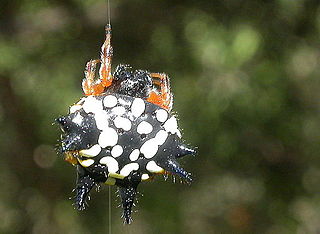
Austracantha is a genus of spider with a single species, Austracantha minax, commonly known as the jewel spider or the Christmas spider. It is a member of the family Araneidae and is endemic to Australia. They are relatively small spiders, reaching a maximum total body length of only around 12 mm (0.47 in) for females, and 5 mm (0.20 in) for males. Their abdomen has six distinctive projections ("spines") that makes them easy to identify. They are predominantly a shiny black, with variable white, yellow, and orange patterns. Melanistic forms also occur during autumn. They are facultatively gregarious, and can be found in large aggregations of overlapping orb webs. They feed on small flying insects that get entangled in their webs. They are harmless to humans, though the webs can be a nuisance for bushwalkers. They are most abundant during the summer months.
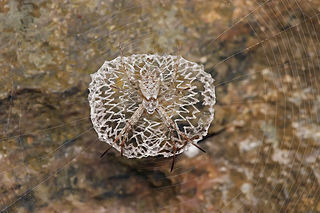
A web decoration or stabilimentum is a conspicuous silk structure included in the webs of some species of orb-web spider. Its function is a subject of debate.
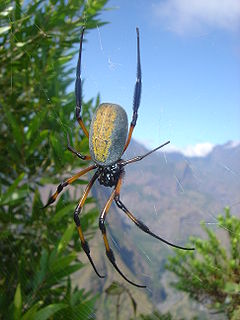
Nephila inaurata, commonly known as the red-legged golden orb-weaver spider or red-legged nephila, is a species of golden orb-weaver spider. It is native to southern and East Africa, besides several islands of the western Indian Ocean.
Nephila clavata, also known as the Jorō spider, is a member of the golden orb-web spider genus. The spider can be found throughout Japan except Hokkaidō, in Korea, Taiwan, China, and more recently, Northeast Georgia in North America. Due to the large size as well as the bright, unique colors of the female Nephila, the spider is well-favored in Japan.
Nephila clavipes is the only species of golden orb-web spider indigenous to continental North and South America. In the United States, it is commonly known as the "banana spider".
Argiope keyserlingi is a common species of orb-web spider found on the east coast of Australia, from central New South Wales to northern Queensland. It is very similar in appearance to the closely related north Queensland species, Argiope aetherea. A. keyserlingi is commonly found in large populations in suburban parks and gardens, particularly amongst the leaves of Lomandra longifolia. Like many species of orb-web spider, A. keyserlingi shows considerable sexual size dimorphism, with the females being many times larger than the males. Mature females can be seen during the summer months and it is not uncommon to see multiple males on the web of one female.
The spider species Argiope aurantia is commonly known as the yellow garden spider, black and yellow garden spider, golden garden spider, writing spider, zigzag spider, hay spider,corn spider, or McKinley spider. It is common to the contiguous United States, Hawaii, southern Canada, Mexico, and Central America. It has distinctive yellow and black markings on the abdomen and a mostly white cephalothorax. Its scientific Latin name translates to "gilded silver-face". Males range from 5–9 mm (0.20–0.35 in); females range from 19–28 mm (0.75–1.10 in). These spiders may bite if disturbed or harassed, but the venom is harmless to non-allergic humans, roughly equivalent to a bumblebee sting in intensity.
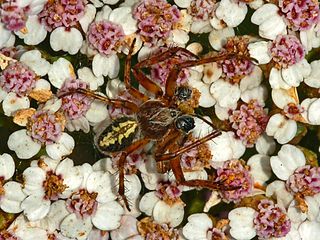
Aculepeira ceropegia, the oak spider, is an orb-weaving spider species belonging to the family Araneidae.
Spider behavior refers to the range of behaviors and activities performed by spiders. Spiders are air-breathing arthropods that have eight legs and chelicerae with fangs that inject venom. They are the largest order of arachnids and rank seventh in total species diversity among all other groups of organisms which is reflected in their large diversity of behavior.
Nephila pilipes is a species of golden orb-web spider. It can be found in Japan, China, Vietnam, Cambodia, Taiwan, Malaysia, Singapore, Myanmar, Indonesia, Thailand, Laos, Philippines, Sri Lanka, India, Nepal, Papua New Guinea, and Australia. It is commonly found in primary and secondary forests and gardens. Females are large and grow to a body size of 30–50 mm, with males growing to 5–6 mm. It is the largest of the orb-weaving spiders apart from the recently discovered Nephila komaci, and one of the biggest spiders in the world.
Nephilengys is a genus of tropical spiders of the family Araneidae, consisting of two currently described species. The genus Nephilingis has been split off from this genus. Both genera have been called hermit spiders from the habit staying in their retreats during the day; the name eunuch spiders has been used for Nephilengys alone. Males may sever parts of their palpal bulbs after copulation.
Metepeira labyrinthea, the labyrinth orbweaver, an American dollar coin sized spider, with thin legs and a round, bulbous abdomen; it is a member of the Araneidae family, of genus Metepeira. The female’s length is 5.3 mm, its carapace 2.3 mm, abdomen 3.3 mm, and extended legs 18.4 mm. The carapace is brown or gray, and the abdomen is dark with a white pattern. The legs alternate pale brown and dark brown, and the sternum is dark brown with a longitudinal yellow mark. The male spider is three-quarters of the female’s length, or slightly larger, with a darker carapace and with greater contrast between dark and light areas of the legs. Metepeira are easily distinguished from other Araneidae by their light eye region, white median line on the sternum, relative length of the leg segments, small male palpus, weakly sclerotized epigyne and the special composite web.
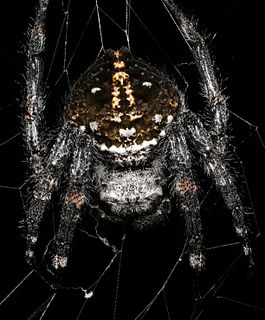
Darwin's bark spider is an orb-weaver spider that produces the largest known orb webs, ranging from 900 to 28,000 square centimetres, with bridge lines spanning up to 25 metres (82 ft). The spider was discovered in Madagascar in the Andasibe-Mantadia National Park in 2009. Its silk is the toughest biological material ever studied, over ten times tougher than a similarly-sized piece of Kevlar. The species was named in honour of the naturalist Charles Darwin, with the description being prepared precisely 150 years after the publication of The Origin of Species, on 24 November 2009.
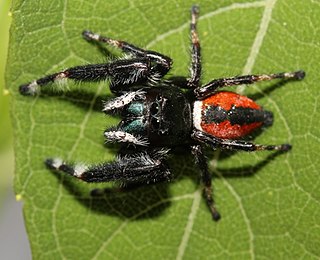
Phidippus clarus is a species of jumping spider found in old fields throughout eastern North America. It often waits upside down near the top of a plant, which may be useful for detecting prey, and then quickly jumps down before the prey can escape. The spider is one of 60 species in the genus Phidippus, and one of about 5,000 in the Salticidae, a family that accounts for about 10% of all spider species. P. clarus is a predator, mostly taking insects, other spiders, and other terrestrial arthropods.
Cyrtophora moluccensis is a tent-web spider in the orb-weaver family. It is commonly known as the tent spider or dome-web spider, and is native to India, Japan, Indonesia, Papua New Guinea, Australia, Fiji, and Tonga. It is often found in disturbed or open habitats from coasts to forest and mountainous interiors.
Tetragnatha montana, commonly known as the silver stretch spider, is a species of long-jawed orb weaver from the family Tetragnathidae that has a Palearctic distribution. It preys mostly on flies and mosquitoes. The name silver stretch spider refers to its shiny metallic colour and its habit of extending its legs into a stick like shape.
|deadurl= (help)1900 Paris Exhibition
Simon Peers, a textile designer, and Nicholas Godley, an entrepreneur,
| Wikispecies has information related to Nephila |
| Wikimedia Commons has media related to Nephila . |