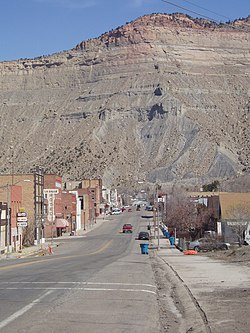
Spring City is a city in Sanpete County, Utah, United States. The population was 988 at the 2010 census.

The Heber Valley Railroad (HVRX) is a heritage railroad based in Heber City, Utah. It operates passenger excursion trains along a line between Heber City and Vivian Park, which is located in Provo Canyon. The HVRX carries over 110,000 passengers a year.

The Deer Creek Dam and Reservoir hydroelectric facilities are on the Provo River in western Wasatch County, Utah, United States, about 16 miles (26 km) northeast of Provo. The dam is a zoned earthfill structure 235 feet (72 m) high with a crest length of 1,304 ft (397 m). The dam contains 2,810,000 cubic yards of material and forms a reservoir of 152,570 acre-foot (188,190,000 m3) capacity. Construction began in May 1938 and was completed in 1941. The reservoir supplies water for agricultural, municipal, and industrial use. Recreational activities on and around the reservoir include boating, fishing, camping, swimming and water skiing.

The William Aiken House and Associated Railroad Structures make up a National Historic Landmark District in Charleston, South Carolina, that contains structures of South Carolina Canal and Railroad Company and the home of the company's founder, William Aiken. These structures make up one of the largest collection of surviving pre-Civil War railroad depot facilities in the United States. The district was declared a National Historic Landmark in 1963.

East Greenwich Historic District is a historic district encompassing the historic commercial and civic heart of East Greenwich, Rhode Island, United States. The district bounded on the east by Greenwich Cove, an inlet on Narrangansett Bay, on the south by London and Spring Streets, on the west roughly by Park Street, and on the north by Division Street. The district extends westward on Division Street as far Dark Entry Brook, and the district properties on its north side now lie in the city of Warwick. East Greenwich was settled in 1677 with its town center growing in the district, with a rural farm landscape to the west. The area's road network had begun to take shape by the mid-18th century, and the town center was industrialized in the 19th century.

The H. H. Richardson Historic District of North Easton is a National Historic Landmark District in the village of North Easton in Easton, Massachusetts. It consists of five buildings designed by noted 19th-century architect Henry Hobson Richardson, and The Rockery, a war memorial designed by Frederick Law Olmsted. It was declared a National Historic Landmark in 1987.
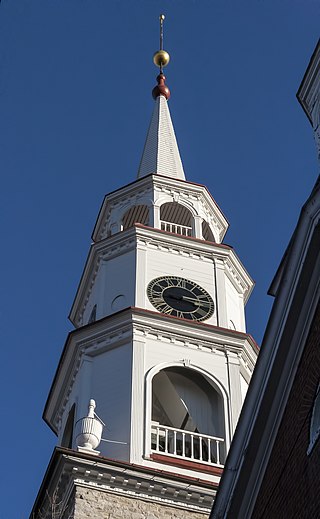
The Frederick Historic District is a national historic district in Frederick, Maryland. The district encompasses the core of the city and contains a variety of residential, commercial, ecclesiastical, and industrial buildings dating from the late 18th century to 1941. Notable are larger detached dwellings in the Queen Anne and American Foursquare architectural styles of the late 19th and early 20th centuries The churches reflect high style architecture ranging from Gothic and Greek Revival to Richardsonian Romanesque and Colonial Revival. The east side of the district includes the industrial buildings.
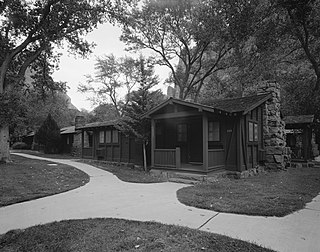
The Zion Lodge Historic District surrounds the rustic lodge originally designed by Gilbert Stanley Underwood in Zion National Park. The lodge served as the center of a group of cabins, employee dormitories and support buildings which are included in the district. A swimming pool and bathhouse were demolished in 1976. The district was expanded in 1986 to include an Underwood-designed former photography studio and additional cabins.

The Beaver County Courthouse is a historic building in Beaver, Utah, United States, that is listed on the National Register of Historic Places (NRHP).

Lowertown Historic District is a national historic district located at Lockport in Niagara County, New York. The district is predominantly residential in nature, with some commercial structures and warehouses. The most elegant homes are along Market Street, east of Chapel Street, facing the Erie Canal. Notable structures in this district include the Western Block Company Warehouse, a 2+1⁄2-story stone structure built before 1855; Lockport Bank Building built in 1829, and located at 315-319 Market Street; Washington Hunt House, built in 1831 and home to New York Governor Washington Hunt, and located at 363 Market Street; the former Christ Episcopal Church at 425 Market Street; and the Vine Street School, an Italianate style one-room school built in 1864.

The historical buildings and structures of Zion National Park represent a variety of buildings, interpretive structures, signs and infrastructure associated with the National Park Service's operations in Zion National Park, Utah. Structures vary in size and scale from the Zion Lodge to road culverts and curbs, nearly all of which were designed using native materials and regional construction techniques in an adapted version of the National Park Service Rustic style. A number of the larger structures were designed by Gilbert Stanley Underwood, while many of the smaller structures were designed or coordinated with the National Park Service Branch of Plans and Designs. The bulk of the historic structures date to the 1920s and 1930s. Most of the structures of the 1930s were built using Civilian Conservation Corps labor.

The Skaneateles Historic District is a 17 acres (6.9 ha) historic district in the village of Skaneateles, New York that dates back to 1796, includes one building from the 20th century, but is otherwise composed of 19th-century residences and commercial buildings. It includes 59 contributing buildings and one contributing site – Thayer Park along Skaneateles Lake, – as well as five non-contributing structures. The district runs along both sides of East Genesee Street from Jordan Street to Onondaga Street, and includes the core of Skaneateles' historic downtown area, which was rebuilt in 1836 after being almost totally destroyed by fire in 1835. Also included are properties on Jordan Street up to the intersection of Fennell Street, and the stone mill property on Fennell Street.

Old Homer Village Historic District is a national historic district located at Homer in Cortland County, New York. The district includes the historic core of the village of Homer centered on the village green. It includes a mix of residential, commercial, civic, and religious structures. Residences are primarily 2-story frame structures and commercial structures are 2- and 3-story structures constructed of brick. Included within the district is the Homer Town Hall (1908), the 3+1⁄2-story Jebediah Barber building (1863), 3-story Brockway Block (1887–1888), and residences dating to the 1810s. Also located within the district boundaries is the U.S. Post Office.

Hillsborough Historic District is a national historic district located at Hillsborough, Orange County, North Carolina. The district encompasses 529 contributing buildings, 9 contributing sites, 13 contributing structures, and 2 contributing objects in the central business district and surrounding residential sections of Hillsborough. The district includes buildings dating to the late-18th and early-20th century and includes notable examples of Federal, Greek Revival, and Italianate style architecture. Located in the district are the separately listed Burwell School, Eagle Lodge, Hazel-Nash House, Heartsease, Montrose, Nash Law Office, Nash-Hooper House, Old Orange County Courthouse, Poplar Hill, Ruffin-Roulhac House, Sans Souci, and St. Matthew's Episcopal Church and Churchyard. Other notable buildings include Seven Hearths, the Presbyterian Church (1815-1816), Methodist Church (1859-1860), First Baptist Church (1862-1870), Twin Chimneys, and the Berry Brick House.

Alderson Historic District is a national historic district located at Alderson, Greenbrier County and Monroe County, West Virginia. The district encompasses 196 contributing buildings and three contributing sites located in the commercial district and surrounding residential section. They are predominantly 19th and early 20th century frame detached residences and masonry commercial buildings including notable examples of the Federal, Greek Revival, and Queen Anne styles. Notable buildings include the Woodson Mohler Grocery building, Johnson and Gwinn warehouse, Greenbrier Mill, First National Bank building, Alderson's Store, Chesapeake and Ohio depot, U.S. Post Office, and the City Hall (1939). The Alderson Ferry Site is for the ferry established 1789. Located in the district is the separately listed Alderson Bridge.

Mount Union Historic District is a national historic district located at Mount Union in Huntingdon County, Pennsylvania. The district includes 58 contributing buildings, 3 contributing sites, and 1 contributing structure in the central business district and surrounding residential areas of Mount Union. Notable buildings include the Federal-style John Shaver House (1818), Shapiro Theater (1915), T.A. Appleby Store and House, Kenmar Hotel, Penn Central National Bank (1916), Peduzzi's and the Weller Building (1913-1914), Pennsylvania Railroad Freight Depot (1914), St. Luke's Evangelical Lutheran Church (1904-1905), First United Methodist Church (1925-1926), St. Catherine of Siena Roman Catholic Church (1912-1913), Mount Union Elementary School (1923-1924), and U.S. Post Office (1936). The contributing sites include the I.O.O.F. community cemetery, founded in 1872, and the former Victoria Park. Located in the district and listed separately is the Harbison-Walker Refractories Company complex.

The Fairfield District School is a historic schoolhouse in Fairfield, Utah, United States, that is listed on the National Register of Historic Places (NRHP) and is part of the Camp Floyd State Park Museum.

The David Keith Mansion and Carriage House, at 529 East South Temple Street in Salt Lake City, Utah, United States, was built during 1898–1900. It was designed by architect Frederick Albert Hale. Keith lived in the home until 1916 when it was sold, and died in 1918. Among other activities, Keith financed and published The Salt Lake Tribune.
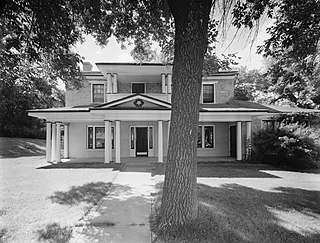
The Hampton's Ford Stage Stop and Barn is a historic district in northeastern Box Elder, Utah, United States, that is listed on the National Register of Historic Places.

The Panguitch Historic District is a historic district that comprises the center of Panguitch, Utah, United States, that is listed on the National Register of Historic Places. It included 379 contributing buildings and two contributing objects.