Publication history
Introduction
Indeed little is know of the Dark Angels during that time. The Chapter's early history was removed from all Imperial records following the Horus Heresy and the banishment of the nine "treacher-legions" to the Eye of Terror.
— History of the Raven Wing [10]
The first reference to the Horus Heresy was a brief mention in a history of the Raven Wing company of the Dark Angels chapter of Space Marines, published in White Dwarf 96 (December 1987). [10] It was again mentioned with slight expansion in the 1988 rules supplement Chapter Approved: Book of the Astronomicon. [11] The nature of the Horus Heresy was fleshed out later that year in another supplement, the first volume of the rulebook Realm of Chaos , subtitled "Slaves to Darkness". [12]
The concept was also elaborated in the rulebook for Adeptus Titanicus (1988), the first Games Workshop Epic -branded tabletop miniatures wargame. [13] Epic-scale-miniature games may involve campaign- or theater‑level play that employs large forces, and provides for a correspondingly wider-scale background. This campaign setting included the establishment of the Horus Heresy as an important canon-based element.
Space Marine [1st Edition]
Finally in 1989 the Epic-series wargame Space Marine was introduced. Designed and developed by veteran Games Workshop associates Jervis Johnson and Graeme Davis, the game used model design and sculpting by Games Workshop division Citadel Miniatures. [14] Subtitled "Epic Battles in the Age of Heresy", it was the first Games Workshop product to directly involve the Horus Heresy concept, which was its sole campaign setting; by providing a justification for intra-Imperial warfare, the publisher was spared the effort and cost of different armies in the basic game boxes. [15] The boxed game contained army and scenery miniatures, accessories, and guides, while the rulebook included a multipage "Background" section, and annotated the rules with related storytext. [lower-alpha 2]
Expansion and continuity
In the years following its introduction as background for other products and as campaign setting for Space Marine, the Horus Heresy came into its own as a project; the transition mainly took place early in the 21st century. The concept was refined and further defined with expansions in areas such as art, gaming, literature, and multimedia. The continuing additions are set in the Heresy period of the universe, c. 30000 ("M31"), as opposed to the c. 41st millennium ("M41") era of most Warhammer 40,000 material. The additions may be released as stand-alone products or as parts of Horus Heresy series.
A significant development was the September 2012 initial release of the Horus Heresy miniatures wargame expansion. This in effect repositioned the concept as a foreground element within the main Warhammer 40,000 gaming system, thereby extending the related universe's active setting to the Horus Heresy era. In February 2013 the first Heresy-specific event, the 2-day Horus Heresy Weekender, was announced.
In addition to regular edition products, releases include special editions such as anniversary editions, collector's editions, web exclusives, and bundle offers. [16] However some components, including the majority of pre-Horus Heresy book series products or works, may be out of print, discontinued, or obsolete, and generally hard to find as of 2013 [update] .
Additions to the Heresy storyline are not necessarily in chronological sequence, and the overall narrative across all areas is nonlinear; [17] it may include events presented from different perspectives, and gaps that may presumably be filled in the future.
The expansions provide new or additional detail about the Horus Heresy, and their scope covers the entire Warhammer 40,000 universe c. M31; in some cases the newer material has led to continuity conflicts with older canon and other material. Overall, the information provided in the book series is generally assumed to be authoritative and superseding the older material. [18] Among other authoritative sources are the Horus Heresy wargame environment (especially the associated rulebooks), and other expansions. [lower-alpha 3]
"The Horus Heresy" is marketed as a sub-brand by Games Workshop, the Black Library (a Games Workshop publishing division), and Forge World, a modelling subsidiary. The associated product lines and related logos, places, names, devices and other components are copyrighted or trademarked. [lower-alpha 4] Games Workshop and affiliates have also released products that though not branded or classified as Horus Heresy items, are directly related to the fictional conflict or to specific facets of it. [19]
Art
Illustrations and images from a variety of artists, about the conflict and the related background, have been published in art books. The book series cover art has been separately released, as A2-size posters and in other formats. [20]
Art book series
This series consists of four "Horus Heresy: Visions" volumes, published between May 2004 and July 2006. They contain original art as well as images derived from the Horus Heresy card game. The volumes also collect edited, previously published Heresy-related magazine articles, and select rulebook information; in addition, original annotations, information, and short stories. The text, along with the art, greatly expanded the Heresy material. The series outlines the entire Heresy history, while providing additional background on it and the wider Warhammer 40,000 universe. The work was the result of contributions by numerous associates and staff of Games Workshop and its subsidiaries; select contributors are listed.
- Visions of War – Allan Merrett (writer), John Blanche (conceptual art), Matt Ralphs (editor) – May 2004 [21]
- Visions of Darkness – Allan Merrett (writer), John Blanche (conceptual art). Includes short story by Graham McNeill – December 2004 [22]
- Visions of Treachery – Allan Merrett (writer), John Blanche (conceptual art). Includes short story by Graham McNeill – July 2005 [23]
- Visions of Death – Allan Merrett (writer), John Blanche (conceptual art) – July 2006 [24]
Posters (selections)
- The Outcast Dead (cover art) – Neil Roberts. Cover art poster of Book 17 in the book series – November 2011 [25]
- The Primarchs (cover art) – Neil Roberts. Cover art poster of Book 20 in the book series – May 2012 [26]
- The Scripts: Volume 1 (cover art) – Neil Roberts. Cover art poster of the first book in the Horus Heresy scriptbook series – March 2013 [27]
Special editions (selections)
- Collected Visions: Iconic images of the Imperium, Betrayal and War – Omnibus edition of the four volumes of the Art book series. Nick Kyme and Matt Ralphs (editors) – June 2007 [28]
- Horus Heresy Poster Bundle #1 – Neil Roberts, Philip Sibbering. The cover art posters of the first three titles of the book series. One of several poster bundles offered, it had been discontinued as of 2013 – October 2006 [29]
Events
As of April 2013 [update] the following had been officially announced:
- The Horus Heresy Weekender – Black Library and Forge World (organizers). Two-day limited-attendance event to be held in Nottingham. Horus Heresy creators and associates present seminars, workshops, demonstrations, exclusive products etc. – May 2013 [30] [ needs update ]
Gaming
The war has been the focus of board and card games; they provided additional relevant information. The Horus Heresy miniatures wargame, which brought the concept to the gaming foreground, was introduced in 2012.
Board games
- Horus Heresy[1st version] – Designed by Jervis Johnson, this wargame centers on the Heresy's endgame, the "Battle for Earth" – 1993 [31]
- The companion mini board game Warmaster, a free promotion, was simultaneously offered through a Games Workshop publication; [lower-alpha 5] it was also designed by Jervis Johnson – 1993 [32]
- Horus Heresy[2nd version] – Designed by John Goodenough and Jeff Tidball, this is a reworking of the 1993 original, subtitled "The Legendary Battle for Holy Terra". Released by Games Workshop licensee Fantasy Flight Games – 2010 [33]
Card games
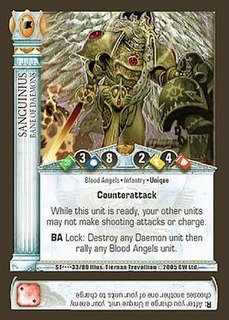
- Horus Heresy – Collectible card game designed by Ryan Miller and Luke Peterschmidt. It was introduced in 2003 by Games Workshop affiliate Sabertooth Games, whose art department illustrated the cards. The game was expanded (2003–05) with the release of several booster packs and other products, and covered major battles of the Heresy campaign. The detailed card illustrations, which were reproduced in the Art book series and elsewhere, provided comprehensive imagery of the Heresy, while the accompanying text and rulesets included new information. The game was discontinued in 2008.
- Base Set – Starter pack, includes separate Loyalist and Traitor decks, "story cards" that describe the background, original rulesets, and other components. The setting may be one of two significant early battles of the Heresy – 2003 [34]
Miniatures games
- Horus Heresy – Stand-alone expansion for the main Warhammer 40,000 gaming system, produced by Games Workshop modelling subsidiary Forge World. The expansion consists of a series of wargaming supplements including rulebooks, miniatures, and accessories; the first installment was introduced during UK Games Day 2012. This series is reputedly developed in coordination with the book series, includes new material and information about the Horus Heresy and the overall Warhammer 40,000 background, and is an authoritative source for both. [35]
- Betrayal – First installment of the Horus Heresy expansion, and the first volume of the Horus Heresy Rulebook Series. This supplement is centered on the culling of Loyalists from the Traitor ranks (see § Conflict and resolution), an operation that culminated at the Battle of Isstvan III. Ruleset and background text by Alan Bligh; models by Simon Egan and Forge World artists and designers – September 2012 [36]
- Massacre – second installment of the Horus Heresy expansion, and the second volume of the Horus Heresy Rulebook Series. This supplement is centered on the drop site massacre Ruleset and background text by Alan Bligh; models by Simon Egan and Forge World artists and designers – September 2012 [36]
- Extermination – fourth installment of the Horus Heresy expansion. This supplement is centered around the aftermath of the drop site massacre.
- Conquest – fifth installment of the Horus Heresy expansion. This supplement is centered around traitor invasion of the northern Imperium.
- Retribution – sixth installment of the Horus Heresy expansion. This supplement is centered around the shattered legions (survivors of the dropsite massacres) and blackshields (renegades from loyalist and traitor legions) and deals with the shadow wars.
- Inferno – seventh installment of the Horus Heresy expansion. This supplement is centered around the burning of Prospero and focuses on the forces of the Thousand sons, Space Wolves and Custodes and Silent sisterhood.
- Malevolence – eighth installment of the Horus Heresy expansion. This supplement is centered around the battle of Signus prime and involves the blood angels and the daemons of the ruinstorm. Also contains rules for the White Scars and Custodes.
Literature
Literature directly related to the Horus Heresy consists of works in several formats and media, created by various authors; the majority are published by the Black Library, a Games Workshop imprint. As of April 2013 [update] it included magazine articles, novels, novellas, and short stories. [37] [lower-alpha 6] In the 2010s, some Heresy-branded literature appeared in other-language special editions before release in English. [lower-alpha 7] [lower-alpha 8]
Spoiler Free Reading/listening order
The graphic below shows the reading order to avoid spoiler and compiles almost all literature work of Horus Heresy.

Book series
The Black Library started publishing the Horus Heresy book series in 2006, a derived brand that consists of titles with stories by a variety of authors. They provide detailed, multifaceted descriptions of the Heresy; the entire Warhammer 40,000 universe (c. 31000) is represented and taken advantage of. As of October 2013 [update] the series consisted of 27 volumes, including full-length novels and novel-length compilations of novellas or short stories; the publisher had been adding several books per year since the start of the series' publication.
An opening scene-setting trilogy (Books 1–3) features the Luna Wolves Space Marine Legion, and portrays the fall of their Primarch (the Warmaster Horus) and the beginning of the Heresy. The series narrative was subsequently expanded to include the actions of other Legions and of various organisations and individuals. In the timeline of the Heresy, by Book 24 [update] (originally published December 2012) this series was at about the half-way mark of Horus' campaign.
Most titles are published in multiple media and formats: as mass-market and trade paperbacks, in hardcover "premium" edition, as regular or "enhanced" e-books, and as abridged or unabridged audiobooks and e‑audiobooks. [37] A number of stories have appeared in other official publications, sometimes before the release of the relevant book series titles; compilation stories have also been pre- or re‑published in stand-alone editions. [lower-alpha 9]
Magazine articles
Horus Heresy-related articles that appeared originally or solely in publisher-affiliated magazines.
- "The Emperor and Horus" – William (Bill) King. Story article originally in the Games Workshop magazine White Dwarf . This and the following articles by King were reproduced, re-edited, or sourced in the Art books (series) – November 1990 [40]
- "The Assault on Earth" and "Aboard Horus' Battle Barge" – William King. Two story articles published in White Dwarf issue 161 (UK edition) upon release of the first version of the Horus Heresy board game. They provide details and background related to the game's setting, the campaign's deciding battle – May 1993 [41]
- "Assault on Holy Terra" – William King. Another story article in White Dwarf, that expands the articles listed above – April 2002 [42]
- "Iron Within" – Rob Sanders. Short story in Hammer and Bolter, a downloadable magazine (e‑magazine) published by the Black Library between 2010 and 2012 – February 2011 [43]
- "The Lion" – Gav Thorpe. Novella serialized in Hammer and Bolter. In 3 parts – February to April 2012 [44]
- "The Horus Heresy" – Cover story of White Dwarf issue 394. Informational article with description of the Horus Heresy concept and product line, and details about the related Horus Heresy miniatures wargame expansion; it concentrates on Betrayal, the expansion's first installment. Includes interviews with Forge World game designer Alan Bligh and artist Simon Egan, and double-sided poster insert of Betrayal artwork – October 2012 [45]
Novellas
Horus Heresy novellas that were not originally included in the Horus Heresy book series compilations; the following were first released in special or limited editions. [lower-alpha 7]
- Promethean Sun – Nick Kyme. Subtitled "Into the fires of war". [lower-alpha 10] Specially priced "Collectors Edition" novella in 3,000 copies only, hardcover. Initially offered as a "web exclusive", the general-availability release is expected in 2013 [47] [ needs update ] – May 2011 [48]
- Aurelian – Aaron Dembski‑Bowden. Subtitled "The Eye stares back", this novella is part of a story arc along with The First Heretic, Book 14 of the book series. Originally offered as another of the publisher's web exclusives, it was simultaneously released in two "Collectors Edition" versions (Silver and Gold) – October 2011 [49]
- Brotherhood of the Storm – Chris Wraight. Subtitled "The Khan rides to war". Signed, time-limited web exclusive print on demand "Collectors Edition", available 21–28 September 2012 only – September 2012 [50]
- Corax: Soulforge – Gav Thorpe. Subtitled "Victory is vengeance". A time-limited, print on demand collector's edition novella, with expanded artwork and other material. Available 5–12 April 2013 only – April 2013 [51]
Short stories
Horus Heresy short stories that were not originally included in the Horus Heresy book series compilations; several were first released or included in special or limited editions.
- "The Kaban Project" – Graham McNeill. Originally in the Art books (series) volume Visions of Darkness – December 2004 [52]
- "The Battle of Prospero" – Graham McNeill. Originally in the Art books (series) volume Visions of Treachery – July 2005 [53]
- "The Dark King" – Graham McNeill. Included in a limited edition Horus Heresy chapbook for Games Day 2007 – October 2007 [54]
- "The Lightning Tower" – Dan Abnett. Included in the aforementioned chapbook compilation – October 2007 [54]
- "Death of a Silversmith" – Graham McNeill. Included in the limited edition compilation Games Day Anthology 2011, edited by Nick Kyme – September 2011 [55]
- "Army of One" – Rob Sanders. A story in "e‑short" (short e‑book) format, one of several such works released in celebration of the Black Library's 15‑year publishing history – April 2012 [56]
- "Kryptos" – Graham McNeill. Subtitled "The voice of Chaos". An "e‑short" release – June 2012 [57]
- "Distant Echoes of Old Night" – Rob Sanders. Included in the limited edition compilation Games Day Anthology 2012/13 – September 2012 [58]
- "Lost Sons" – James Swallow. Included in the first volume of the two‑volume limited edition compilation Black Library Weekender – November 2012 [59]
- "The Divine Word" – Gav Thorpe. Included in the second volume of the two‑volume limited edition compilation Black Library Weekender – November 2012 [60]
- "Dark Heart" – Anthony Reynolds. E‑short. The story was republished in the Mark of Calth compilation, Book 25 of the book series – January 2013 [61]
- "The Gates of Terra" – Nick Kyme. Another e‑short, this one first appeared in a 2012 French language limited edition chapbook [lower-alpha 8] – March 2013 [62]
- "Lord of the Red Sands" – Aaron Dembski‑Bowden. A 1500-word story originally available in the e‑book-format collection Angron – March 2013 [63]
Special editions (selections)
- Horus Rising – Dan Abnett. "5th anniversary edition" of Book 1 in the Horus Heresy book series – April 2011 [64]
- Limited Edition Horus Heresy Audio Boxset – Dan Abnett, Ben Counter, Graham McNeill. CD-audio compilation of the opening trilogy in the book series, narrated by Martyn Ellis. Includes an "exclusive bonus CD" with the short story "Little Horus" by Abnett, also read by Ellis; this "audio short" was originally published in Book 16, Age of Darkness – November 2011 [65]
- Xmas 2011 Horus Heresy eBundle – Book series authors. The first 17 Horus Heresy book series titles in an e‑book edition bundle, one of several bundle editions offered (bundle was retired 2012) – November 2011 [66]
- Angel Exterminatus – Graham McNeil. "Premium Hardback Edition" of Book 23 in the book series, the first title published in this format, with additional material and artwork. Offered exclusively through the publisher and affiliates – October 2012 [67]
- Angron – Aaron Dembski‑Bowden, Matthew Farrer. Character-based mini-compilation of short stories released in e‑book format. The collection's spotlight is on Angron, doomed Primarch of the "World Eaters" Legion of Space Marines. It contains Farrer's "After De'shea", a short story previously published in the book series title Tales of Heresy (Book 10). Additionally, two stories by Dembski‑Bowden: the prose adaptation of the audio drama Butcher's Nails , and "Lord of the Red Sands", an original short – March 2013 [68]
Multimedia
As of March 2013 [update] this category included audio dramas of various durations, and published collections of their scripts.
Audio dramas
Below are original audio dramas, and also dramatisations of stories previously published in text media. Released in disc or audio file format, their durations range from over one hour to over two hours. They employ a number of scriptwriters, narrators, voice actors, and directors. Audio production is provided by specialist UK companies Big Finish Productions or Heavy Entertainment (which is also involved in audiobook editions of the Horus Heresy book series). Select contributors listed below.
- The Dark King and The Lightning Tower – Scripted by Graham McNeill and Dan Abnett respectively, Danny Webb performs both; audio drama versions of the chapbook originals – June 2008 [69]
- Raven’s Flight – Gav Thorpe (scriptwriter), Toby Longworth (performer). Prequel to Deliverance Lost, Book 18 in the book series – February 2010 [70]
- Butcher's Nails – Aaron Dembski‑Bowden (scriptwriter), Sean Barrett and others (performers) – May 2012 [71]
- The Sigillite – Chris Wraight (scriptwriter), Toby Longworth, Ramon Tikaram and Tim Treloar (performers) – March 2013 [72]
- Honour to the Dead – Gav Thorpe (scriptwriter), Gareth Armstrong, Jane Collingwood, Jonathan Keeble and Luke Thompson (performers). Adapted from a novella by Thorpe, originally published in German. [lower-alpha 7] – May 2013 [73]
- Wolf Hunts - Scripted by Graham McNeil, this was released in May 2013 in a limited edition sleeve.
- Prince of Crows
- Crimson Fists
Drama "shorts"
The following audio dramas range in duration from under ten minutes to about half an hour, and are released in downloadable MP3 file format only.
- "Grey Angel" – John French (scriptwriter), John Banks, Toby Longworth and Ramon Tikaram (performers). A Garro series short – August 2012 [74]
- "Burden of Duty" – James Swallow (scriptwriter), John Banks, Toby Longworth and Ramon Tikaram (performers). Another Garro short – October 2012 [75]
- "Warmaster" – John French (scriptwriter), Ramon Tikaram (performer). In a nine‑minute audio drama, Horus lays out his plans for the remainder of the Heresy campaign. One of Black Library's "Advent Calendar" special releases for the 2012 holiday season, this was the "Advent Day Seven" installment – December 2012 [76]
- "Strike and Fade" – Guy Haley (scriptwriter), Toby Longworth (performer). Another ten‑minute audio drama, the "Advent Day Fourteen" entry in Black Library's "Advent Calendar 2012" releases – December 2012 [77]
- "Veritas Ferrum" – David Annandale (scriptwriter), Toby Longworth, Ramon Tikaram and Tim Treloar (performers). "Advent [2012] Day Twenty Four" e‑audio short – December 2012 [78]
Garro series
Audio drama‑only series based on Horus Heresy character Nathaniel Garro. The series is a sequel to The Flight of the Eisenstein, Book 4 in the book series.
- Oath of Moment – James Swallow (scriptwriter), Toby Longworth (performer) – December 2010 [79]
- Legion of One – James Swallow (scriptwriter), Toby Longworth (performer) – April 2011 [80]
- Sword of Truth – James Swallow (scriptwriter), John Banks, Toby Longworth and Ramon Tikaram (performers) – November 2012 [81]
- Burden of Duty/Grey Angel – John French and James Swallow (scriptwriters); John Banks, Toby Longworth and Ramon Tikaram (performers). Compilation reissue of two Garro Series audio shorts (listed above) – April 2013 [82]
Scriptbook series
Series of books containing the complete production scripts of Horus Heresy audio dramas, including soundtrack direction and character notes.