You can help expand this article with text translated from the corresponding article in German. (November 2025)Click [show] for important translation instructions.
Machine translation, like DeepL or Google Translate, is a useful starting point for translations, but translators must revise errors as necessary and confirm that the translation is accurate, rather than simply copy-pasting machine-translated text into the English Wikipedia.
Do not translate text that appears unreliable or low-quality. If possible, verify the text with references provided in the foreign-language article.
You must provide copyright attribution in the edit summary accompanying your translation by providing an interlanguage link to the source of your translation. A model attribution edit summary is Content in this edit is translated from the existing German Wikipedia article at [[:de:Weg-Malve]]; see its history for attribution.
You may also add the template {{Translated|de|Weg-Malve}} to the talk page.
Malva neglecta is a species of plant of the family Malvaceae, native to most of the Old World except sub-Saharan Africa. It is an annual growing to 0.6m (2ft). It is known as common mallow in the United States and also as buttonweed, cheeseplant, cheeseweed, dwarf mallow, and roundleaf mallow.[2] This plant is often consumed as a food, with its leaves, stalks and seed all being considered edible.[3][4][5] This is especially true of the seeds, which contain 21% protein and 15.2% fat.[6]
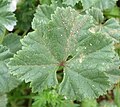
Dwarf mallow is a prostrate, downy, herbaceous plant, growing to approximately 60cm (24in). The leaves are alternate with long, strongly channeled petioles, up to 12cm (4.7in), and narrowly triangular stipules. It is a broadleaf winter annual that also persists through a biennial or perennial life cycle if environmental conditions are favorable.[7][8] Each leaf is reniform or with 5–7 shallow lobes, the basal leaves are 3–7cm (1.2–2.8in). It grows a tough taproot.[9] The flowers are single-stalked and occur in clusters of 2–5 in the leaf axils. The flower stalks are shorter than the leaf stalks, with the leaves partially obscuring the flowers. The fruits are schizocarps, which split into 10–12 mericarps (nutlets) and are smooth and hairy.[10][11]
Malva neglecta exibits six age states: seedlings, juveniles, immatures, virginals, young generatives, and middle-aged generatives. Seedling leaf blades are pubescent below and along the edge. Juvenile plants have a solitary shoot and rounded leaves with wavy toothed edges. Immature plants show kidney-shaped leaves with jagged edges. Virginile plants present rosettes of 3-5 rounded heart-shaped leaves. Young generative plants develop solitary white or light pink flowers. Branching of the generative shoot is observed in Middle-aged plants.[13] While young leaves and stems are green, mature leaves and lower stems vary from green to purple in color.[14]
Ecology
Acyrthosiphon Malvae
Although the ecology is more complex, in the Thames valley, Acyrthosiphon Malvae (informally Aphis Malvae) is the common aphid found feeding on common mallow.[15]
A common traditionally used medicinal plant, used for catarrh, enteritis, sore throat, hoarse voice, and as an expectorant.[21] A lab study has shown that the plant is good for stomach ulcers[22]
Seeds
The seeds can be eaten raw or cooked and have a nutty flavor.[19] Mature seeds can be cooked like rice or grains.[23] In the past, seeds were ground into flour in times of need.[24]
Root
The root can be ground and used as a meringue substitute[25] by boiling in water, simmering until thickened, and then whisked like egg whites.[26]
Leaves
Leaves are useful in salads, can be eaten raw, and contain Vitamin C, significant protein and mineral content.[27] In culinary applications, it is cooked similar to spinach, or used for thickening soups, as the leaves release a thickening agent similar to okra which is also in the mallow family. In Morocco leaves are known as Bakola or Khobiza, braised as a side dish (called salad, but cooked) or used as a sauce over couscous.[28] In Jewish and Egyptian cooking, leaves are made into a stew called Mulukhiyah.
Botanical gallery
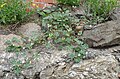
Plant spreads along ground, leaves not large, leaves fairly uniform size (Antalya)
Spreading on rocks, similarly (Edinburgh)
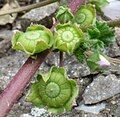
Flowers, fruits and leaves
Flowers, fruits and leaves, closer
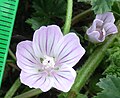
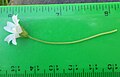
Flowers can be pink with bold veins or may be pale
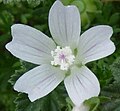
Paler form, hairs (visible) in centre at petal stalks
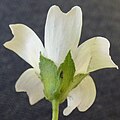
Flower much larger than calyx, green calyx with 5 broad parts, epicalyx at base formed of 3 narrow strips
Flowers may have long to very long stalks
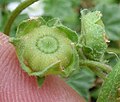
Fruits
Fruits
Fruiting undersides, showing epicalyx of 3 narrow strips
Flowers and fruits from side showing the features above, stalks reasonably long
Hairs a mixture of stellate (star-like) and simple
Hairs a mixture of stellate (star-like) and simple
↑Batsatsashvili, K.; Mehdiyeva, N.; Fayvush, G.; Kikvidze, Z.; Khutsishvili, M.; Maisaia, I.; Sikharulidze, S.; Tchelidze, D.; Alizade, V.; Aleksanyan, A.; Paniagua-Zambrana, N. Y. (2017). "Malva neglecta Wallr.; Malva sylvestris L.". In Bussmann, R. W. (ed.). Ethnobotany of the Caucasus(PDF). Cham: Springer International Publishing. doi:10.1007/978-3-319-49412-8_115. Retrieved 24 January 2026.
↑Stace, C.A. (2019). New Flora of the British Isles. Suffolk. ISBN978-1-5272-2630-2.{{cite book}}: CS1 maint: location missing publisher (link)
↑Rose, Francis (2006). The Wild Flower Key. London: Frederick Warne. ISBN978-0-7232-5175-0.
↑Ketevan Batsatsashvili; Naiba P. Mehdiyeva; George Fayvush; Zaal Kikvidze; Manana Khutsishvili; Inesa Maisaia (2017). "Malva neglecta Wallr. Malva sylvestris L. Malvaceae". In Bussmann, R (ed.). Ethnobotany of the Caucasus(PDF). Springer. pp.395–403. doi:10.1007/978-3-319-49412-8_115. Retrieved 29 January 2026.
This page is based on this Wikipedia article Text is available under the CC BY-SA 4.0 license; additional terms may apply. Images, videos and audio are available under their respective licenses.