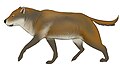
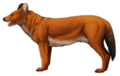
Protocyon was a hypercarnivore, suggested by its dental adaptations. Like many other large canids, it was most likely a pack hunter. It hunted the medium-sized grazers and browsers, and bite marks on fossils suggest that it may have hunted Glyptotherium.[1] The find of a molar tooth found in Santa Vitória do Palmar in Brazil suggests a weight of between 25 and 37 kilograms (55 and 82 pounds) for this particular specimen,[2]:219 modest in size compared to other canids including the dire wolf. However, despite its size, isotopic analysis shows a dietary overlap with Smilodon populator, which implies it competed with the sabertooth cat for the same prey.[3]
Taxonomy
Protocyon was named by Giebel in 1855 and assigned to Canidae by Carroll in 1988.[4]:634 The genus definitively contains P. troglodytes (with its junior synonym P. orcesi) and P. scagliarum. Some researchers propose that the species Theriodictis tarijensis falls under the genus Protocyon.[5][6] In 2022, Ruiz-Ramoni, Wang & Rincón named a new species from the Late Pliocene-Early Pleistocene strata, P. orocualensis.[7]
Canid fossil material from the Hoyo Negro pit in the Sac Actun cave system (Mexico), initially identified as remains of a coyote, was reinterpreted as remains of P. troglodytes by Schubert et al. (2019), indicating that this taxon was also present in the southern part of North America.[11]:2 The youngest known specimen of P. troglodytes is dated to 20,288-21,139 calibratedBP.[12]
↑Bocherens, Hervé; Cotte, Martin; Bonini, Ricardo; Scian, Daniel; Straccia, Pablo; Soibelzon, Leopoldo; Prevosti, Francisco J. (1 May 2016). "Paleobiology of sabretooth cat Smilodon populator in the Pampean Region (Buenos Aires Province, Argentina) around the Last Glacial Maximum: Insights from carbon and nitrogen stable isotopes in bone collagen". Palaeogeography, Palaeoclimatology, Palaeoecology. 449: 463–474. Bibcode:2016PPP...449..463B. doi:10.1016/j.palaeo.2016.02.017. hdl:11336/43965.
↑Prevosti, F.J.; Schubert, B.W. (2013). "First taxon date and stable isotopes (δ13C, δ15N) for the large hypercarnivorous South American canid Protocyon troglodytes (Canidae, Carnivora)". Quaternary International. 305: 67–73. doi:10.1016/j.quaint.2012.07.003.
This page is based on this Wikipedia article Text is available under the CC BY-SA 4.0 license; additional terms may apply. Images, videos and audio are available under their respective licenses.