This article may be expanded with text translated from the corresponding article in Korean. (March 2018)Click [show] for important translation instructions.
|
| Provisional People’s Committee for North Korea | ||||||||||||
| 북조선인민위원회 Pukchosǒn Inmin Wiwŏnhoe | ||||||||||||
| ||||||||||||
| Anthem Aegukka 애국가 "Patriotic Song" | ||||||||||||
Location of the northern portion of the Korean Peninsula. | ||||||||||||
| Capital | Pyongyang | |||||||||||
| Languages | Korean | |||||||||||
| Religion | Cheondoism, Shamanism a | |||||||||||
| Government | Unitary Marxist–Leninist provisional government | |||||||||||
| Chairman b | ||||||||||||
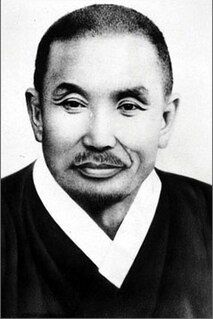
| • | 1946–1948 | Kim Tu-bong | ||||||||||
| Chairman c | ||||||||||||
| • | 1946–1948 | Kim Il-sung | ||||||||||
| Legislature | People's Assembly [2] | |||||||||||
| Historical era | Cold War | |||||||||||
| • | Formation | 8 February 1946 | ||||||||||
| • | North Korean parliamentary election | 25 August 1948 | ||||||||||
| • | Democratic People's Republic of Korea proclaimed | 9 September 1948 | ||||||||||
| Currency | Korean yen [3] (1946–1947) North Korean won (1947–1948) | |||||||||||
| ||||||||||||
| Today part of | ||||||||||||
| ^a See Religion in North Korea. ^b As "Chairman of the Central Committee". ^c As "Chairman of the Provisional People's Committee". | ||||||||||||
| Provisional People's Committee for North Korea | |
| Chosŏn'gŭl | 북조선인민위원회 |
|---|---|
| Hancha | 北朝鮮人民委員會 |
| Revised Romanization | Bukjoseon Inmin Wiwonhoe |
| McCune–Reischauer | Pukchosǒn Inmin Wiwŏnhoe |
Part of a series on the | ||||||||||||||||||||||||||||||||||||
|---|---|---|---|---|---|---|---|---|---|---|---|---|---|---|---|---|---|---|---|---|---|---|---|---|---|---|---|---|---|---|---|---|---|---|---|---|
| History of North Korea | ||||||||||||||||||||||||||||||||||||
| ||||||||||||||||||||||||||||||||||||
The Provisional People’s Committee for North Korea, [4] colloquially known as Soviet Korea, was the official name of the provisional government governing the northern portion of the Korean Peninsula following its post-World War II partition by the United States and the Soviet Union after the defeat of the Empire of Japan in 1945.
A provisional government, also called an interim government or transitional government, is an emergency governmental authority set up to manage a political transition generally in the cases of new nations or following the collapse of the previous governing administration. Provisional governments are generally appointed, and frequently arise, either during or after civil or foreign wars.
The Korean Peninsula is located in East Asia. It extends southwards for about 1,100 km (680 mi) from continental Asia into the Pacific Ocean and is surrounded by the Sea of Japan to the east and the Yellow Sea to the west, the Korea Strait connecting the two bodies of water.
World War II, also known as the Second World War, was a global war that lasted from 1939 to 1945. The vast majority of the world's countries—including all the great powers—eventually formed two opposing military alliances: the Allies and the Axis. A state of total war emerged, directly involving more than 100 million people from over 30 countries. The major participants threw their entire economic, industrial, and scientific capabilities behind the war effort, blurring the distinction between civilian and military resources. World War II was the deadliest conflict in human history, marked by 50 to 85 million fatalities, most of whom were civilians in the Soviet Union and China. It included massacres, the genocide of the Holocaust, strategic bombing, premeditated death from starvation and disease, and the only use of nuclear weapons in war.
Soviet forces had seized and occupied the northern portion of Korea from the Japanese during World War II, while the Americans had seized and occupied the southern portion from the Japanese. In the north, a pro-Soviet, ideologically communist government was established, officially succeeding a quasi-government composed of five provinces in 1946. The government was largely modeled after the Soviet Union. It co-existed alongside with the Soviet Civil Administration.
In political and social sciences, communism is the philosophical, social, political, and economic ideology and movement whose ultimate goal is the establishment of the communist society, which is a socioeconomic order structured upon the common ownership of the means of production and the absence of social classes, money, and the state.
The Soviet Civil Administration (SCA) functioned as the occupying government of northern Korea from October 3, 1945 until the founding of the Democratic People's Republic of Korea in 1948 although it governed concurrently after the setup of the Provisional People's Committee for North Korea in 1946. It was the administrative structure that the Soviet Union used to govern what would become North Korea following the division of Korea. Terentii Shtykov was the main proponent of setting up a centralized structure to coordinate Korean People's Committees. The setup was officially recommended by General Ivan Chistyakov and headed by General Andrei Romanenko in 1945 and General Nikolai Lebedev in 1946.
In February 1946, the provisional government was formed under Kim Il-sung, who had spent the last years of the war training with Soviet troops in Manchuria. Conflicts and power struggles rose up at the top levels of government in Pyongyang as different aspirants maneuvered to gain positions of power in the new government. At the local levels, people's committees openly attacked collaborators with Japan and some landlords, confiscating much of their land and possessions. As a consequence many collaborators and others disappeared or were assassinated. It was out in the provinces and by working with these same people's committees that the eventual leader of North Korea, Kim Il-sung, was able to build a grassroots support system that would lift him to power over his political rivals who had stayed in Pyongyang. Throughout August, Koreans organized throughout the country into people committees branches for the "Committee for the Preparation of Korean Independence" (CPKI, 건국준비위원회, 建國準備委員會). The Soviet Army allowed these committees to continue to function since they were friendly to the Soviet Union, but still established the Soviet Civil Administration to begin to centralize the independent committees. Further provisional committees were set up across the country putting Communists into key positions.
Kim Il-sung was the first leader of North Korea which he ruled from the country's establishment in 1948 until his death in 1994. He held the posts of Premier from 1948 to 1972 and President from 1972 to 1994. He was also the leader of the Workers' Party of Korea (WPK) from 1949 to 1994. Coming to power after the end of Japanese rule in 1945, he authorized the invasion of South Korea in 1950, triggering an intervention in defense of South Korea by the United Nations led by the United States. Following the military stalemate in the Korean War, a ceasefire was signed on 27 July 1953. He was the third longest-serving non-royal head of state/government in the 20th century, in office for more than 45 years.
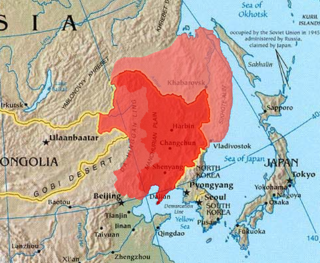
Manchuria is a name first used in the 17th century by Japanese people to refer to a large geographic region in Northeast Asia. Depending on the context, Manchuria can either refer to a region that falls entirely within the People's Republic of China or a larger region divided between China and Russia. "Manchuria" is widely used outside China to denote the geographical and historical region. This region is the traditional homeland of several groups, including the Koreans, Xianbei, Khitan, and Jurchen peoples, who built several states within the area historically.
The People's Committees were a species of largely local self-government which appeared throughout Korea immediately following the conclusion of the Second World War. These committees existed in their original form from August 1945 to early 1946.
In March 1946, the land reform was instituted, as the land from Japanese and collaborator land owners was divided and handed over to poor farmers. Kim Il-sung initiated a sweeping land reform program in 1946. Organizing the many poor civilians and agricultural laborers under the people's committees, a nationwide mass campaign broke the control of the old landed classes. Landlords were allowed to keep only the same amount of land as poor civilians who had once rented their land, thereby making for a far more equal distribution of land. The North Korean land reform was achieved in a less violent way than that of the People's Republic of China or Vietnam. Official American sources stated, "From all accounts, the former village leaders were eliminated as a political force without resort to bloodshed, but extreme care was taken to preclude their return to power." [5] This was very popular with the farmers but caused many collaborators and former landowners to flee to the U.S.-controlled South, where some of them obtained positions in the new South Korean government. According to the U.S. military government, 400,000 northern Koreans went south as "refugees". [6]
Chinilpa is a Korean word that denotes Koreans who collaborated with Imperial Japan during its colonial reign over Korea from 1910–1945, or shortly before then, around the time of the Korean Empire. Today, the term is often used derogatorily against Japanophilic Koreans. They are sometimes called national traitors as they supported the colonial government instead of the national government. Their actions included killing independence movement or nation building leaders of the Korean nation, criminalizing the use of Korean language and literature, and taking of resources and property in Korea.
Land reform in North Vietnam can be understood as an agrarian reform in northern Vietnam throughout different periods, but in many cases it only refers to the one within the regime of Democratic Republic of Vietnam (DRV) in the 1950s. Land reform in North Vietnam is one of the most important economic and political programs launched by Viet Minh government during the years 1953-1956.
The United States Army Military Government in Korea (USAMGIK) was the official ruling body of the southern half of the Korean Peninsula from September 8, 1945 to August 15, 1948.
Key industries were nationalized. The economic situation was nearly as difficult in the North as it was in the South, as the Japanese had concentrated agriculture in the south and heavy industry in the north.
The Democratic People's Republic of Korea was proclaimed on September 9, 1948, effectively dissolving the provisional government. Soviet forces departed from North Korea in 1948.
The history of North Korea began at the end of World War II in 1945. The surrender of Japan led to the division of Korea at the 38th parallel, with the Soviet Union occupying the north, and the United States occupying the south. The Soviet Union and the United States failed to agree on a way to unify the country, and in 1948 they established two separate governments – the Soviet-aligned Democratic People's Republic of Korea and the Western-aligned Republic of Korea – each claiming to be the legitimate government of all of Korea.
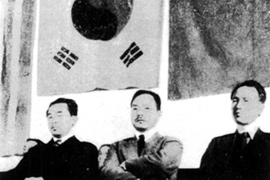
The flag of North Korea, also known as the Ramhongsaek Konghwagukgi, consists of a central red panel, bordered both above and below by a narrow white stripe and a broad blue stripe. The central red panel bears a five-pointed red star within a white circle near the hoist. This flag is banned from public use in South Korea due to its association with the ruling regime although some exceptions for the usage of the flag exist.
The Division of Korea began at the end of World War II in 1945. With the defeat of Japan, the Soviet Union occupied the north of Korea, and the United States occupied the south, with the boundary between their zones being the 38th parallel.
The People's Republic of Korea (PRK) was a short-lived provisional government that was organized at the time of the surrender of the Empire of Japan at the end of World War II. It was proclaimed on September 12, 1945, as Korea was being divided into two occupation zones, with the Soviet Union occupying the north, and the United States occupying the south. Based on a network of people's committees, it presented a program of radical social change. In the south, the US military government outlawed the PRK on December 12, 1945, while in the north, the Soviet authorities co-opted the committees into the structure of the emerging Democratic People's Republic of Korea.
Cho Man-sik was a nationalist activist in Korea's independence movement. He became involved in the power struggle that enveloped North Korea in the months following the Japanese surrender after World War II. Originally Cho was supported by the Soviet Union for the eventual rule of North Korea. However, due to his opposition to trusteeship, Cho lost Soviet support and was forced from power by the Soviet-backed communists in the north. Placed under house arrest in January 1946, he later disappeared into the North Korean prison system, where he is generally believed to have been executed soon after the start of the Korean War.
The Workers' Party of North Korea was a communist party in North Korea from 1946 to 1949 and was a predecessor of the current Workers' Party of Korea. It was founded at a congress on 28–30 August 1946, by the merger of the North Korean Branch Bureau of the Communist Party of Korea and the New People's Party of Korea. Kim Tu-bong, the leader of the New People's Party, was elected Chairman of the party. Vice Chairmen of the party were Chu Yong-ha and Kim Il-sung. At the time of establishment, the party is believed to have had about 366 000 members organized in around 12,000 party cells.

The Communist Party of Korea was a communist party in Korea. It was founded during a secret meeting in Seoul in 1925. The Governor-General of Korea had banned communist parties under the Peace Preservation Law, so the party had to operate in a clandestine manner. The leaders of the party were Kim Yong-bom and Pak Hon-yong.
The Communist movement in Korea emerged as a political movement in the early 20th century. Although the movement had a minor role in pre-war politics, the division between the communist North Korea and the anti-communist South Korea came to dominate Korean political life in the post-World War II era. North Korea, officially the Democratic People's Republic of Korea, continues to be a Juche socialist state under the rule of the Workers' Party of Korea. In South Korea, communism remains illegal through the National Security Law. Due to end of economic aid from Soviet Union after its dissolution in 1991 and impractical ideological application of Stalinist policies in North Korea over years of economic slowdown in 1980s and receding during 1990s, North Korea replaced Communism with Juche ideology in its 1992 and 1998 constitutional revisions for the personality cult of Kim's family dictatorship and opening of North Korean market economy reform, though it still retains a command economy with complete state control of industry and agriculture with collectivized farms and state-funded education and healthcare.
The Workers' Party of Korea (WPK) is the founding and ruling political party of North Korea. It is the largest party represented in the Supreme People's Assembly and coexists de jure with two other legal parties making up the Democratic Front for the Reunification of the Fatherland. However, these minor parties are completely subservient to the WPK, and must accept the WPK's "leading role" as a condition of their existence.
The People’s Committee of North Korea was a provisional government governing the northern portion of the Korean Peninsula from 1947 until 1948.
The Central Committee of the Workers' Party of Korea is the highest party body between WPK national meetings. According to WPK rules, the Central Committee is elected by the party congress and the party conference can be conferred the right to renew its membership composition. In practice, the Central Committee has the ability to dismiss and appoint new members without consulting with the wider party at its own plenary sessions.
The History of the Workers' Party of Korea (WPK) encompasses the period from 1949 onwards.
The 1st Congress of the Workers' Party of North Korea (WPNK) was held in Pyongyang, North Korea, from 28–30 August 1946, and established the WPNK. The congress is the highest organ of the party, and is stipulated to be held every four years. A total of 801 delegates represented the party's 336,399 members. The 1st Central Committee, elected by the congress, elected Kim Tu-bong as WPNK Chairman, Kim Il-sung and Chu Yong-ha as deputy chairmen.
The 2nd Congress of the Workers' Party of North Korea (WPNK) was held in Pyongyang, North Korea, from 27–30 March 1948. The congress is the highest organ of the party, and is stipulated to be held every four years. 999 delegates represented the party's 750,000 members. The 2nd Central Committee, elected by the congress, reelected Kim Tu-bong as WPNK Chairman, and Kim Il-sung and Chu Yong-ha as deputy chairmen.
Terentii Fomich Shtykov was effectively the first supreme leader of North Korea, as the de facto head of its 1945-1948 military occupation and the first Soviet Ambassador to North Korea from 1948 until 1950. Shtykov's support for Kim Il-sung was crucial in Kim's rise to power, and the two persuaded Stalin to allow the Korean War to begin in June 1950.
The Sinuiju incident of November 23, 1945 was an uprising of students and Christian leaders in the port city of Sinuiju in North Pyŏngan Province of what is known today as the Democratic People's Republic of Korea (DPRK), or North Korea. It marked the peak of social resistance against the communist regime in the formative period of North Korea, during the Soviet occupation from 1945 to 1948.
The Socialist Women's Union of Korea is a mass organization for women in North Korea. Founded in 1945 as the North Korea Democratic Women's League, it is the oldest and one of the most important mass organizations in the country. The Union has committees on every level of administrative divisions of North Korea, from ri (village) all the way up to provinces.
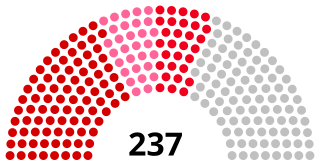
The People's Assembly of North Korea (Chosŏn'gŭl: 북조선인민회의) was the unicameral legislature of the People's Committee of North Korea. It consisted of 237 deputies elected during a meeting of the provincial, city and county people's committees, political parties and social organizations of North Korea held from 17-20 February 1947.