Related Research Articles
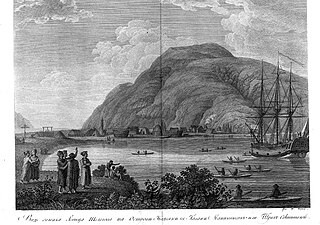
Three Saints Bay is a 9 Mile -long inlet on the southeast side of Kodiak Island, Alaska, north of Sitkalidak Strait. It is 97 km (60 mi) southwest of Kodiak. The Three Saints Bay Site is an archaeological site, the location of the first Russian settlement in Alaska, Three Saints Harbor. The settlement was founded in 1784 by Grigory Shelikhov. The main settlement was moved in 1792 to Pavlovskaya Gavan, now known as the city of Kodiak. The Three Saints Bay Site was declared a National Historic Landmark by the United States in 1978.

The Amalik Bay Archeological District is a geographic area with a significant number of archaeological sites in Alaska. It is located on the Pacific coast of Katmai National Park and Preserve, in the mainland portion of Kodiak Island Borough, Alaska.
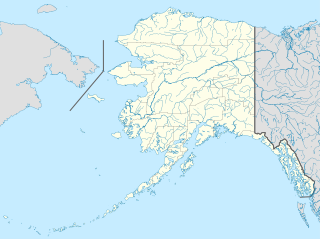
Fort Durham, also known as Fort Taku, Taku, Taco, and Tacouw, is an archaeological site near Taku Harbor, Alaska, within the limits of Juneau City and Borough and Tongass National Forest. It was one of three Hudson's Bay Company (HBC) posts set up in Russian America. The Fort Durham Site was declared a U.S. National Historic Landmark in 1978.

Fort Abercrombie State Historical Park, also known as the Fort Abercrombie State Historic Site, is an Alaska state park on Kodiak Island, Alaska. It includes 182 acres (74 ha) of land at the end of Miller Point, located on the eastern shore of Kodiak Island northeast of the city of Kodiak. The park, established in 1969, is noted for its historical World War II fortifications and its scenery, which includes bluffs overlooking the ocean, spruce forests, and meadows. The site was named in honor of the early Alaska explorer and United States Army officer Lt. Col. William R. Abercrombie. The fortifications, whose surviving elements include gun emplacements, underground magazines, and foundational remnants of buildings, were built in 1941 and abandoned after the war ended, having seen no action.

Woody Island is located in Chiniak Bay, 2.6 miles (4.2 km) east of Kodiak, Alaska. It was originally settled by the native Alutiiq people who called themselves Tangirnarmiut, "the people of Tangirnaq." They inhabited and used Woody Island for thousands of years. The Russians established an agricultural colony on Woody Island in 1792. It was officially designated Wood Island in 1894 by the US Post Office and was the primary coastal settlement for commerce and trade for many years. The first road in Alaska was built on Woody Island. Aside from the Aleut presence, the island has gone through four periods of occupation by non-natives, and is largely unoccupied today. The island is approximately 2.8 miles long from north to south and 1.8 miles wide and 13 miles in circumference.

This is a list of the National Register of Historic Places listings in Kenai Peninsula Borough, Alaska.
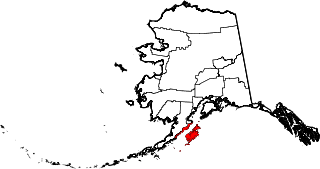
This is a list of the National Register of Historic Places listings in Kodiak Island Borough, Alaska.

The Ascension of Our Lord Chapel is a historic Russian Orthodox chapel in Karluk, Alaska. Now it is under Diocese of Alaska of the Orthodox Church in America

The Holy Resurrection Church is a historic Russian Orthodox church located at the corner of Mission Road and Kashevaroff Avenue in Kodiak, Alaska. Now it is under Diocese of Alaska of the Orthodox Church in America

The Protection of the Theotokos Chapel is a historic Russian Orthodox chapel on Kodiak Island, Alaska, along E Street at Akhiok, Alaska. Now it is under Diocese of Alaska of the Orthodox Church in America
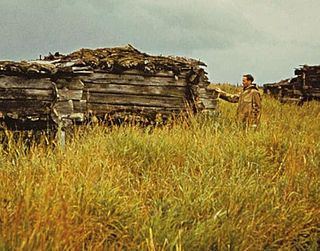
The Old Savonoski Site is the former site of a native village in Lake and Peninsula Borough, Alaska, that was buried by ash in the June 1912 eruption of the Novarupta Volcano. The site is located near the confluence of the Savonoski and Ukak Rivers, and is within the bounds of the Katmai National Park and Preserve. The site was visited by archaeologists in 1953, who identified a number of surviving elements, including fifteen barabaras, or semi-subterranean dwellings.
The Kad'yak, also known as Kadyak and Kadiak, was a wooden-hulled sailing merchant ship belonging to the Russian-American Company. Purchased by the company in 1851, she was used to transport personnel and supplies among its settlements in Russian Alaska, and to transport trade goods to San Francisco. On April 2, 1860, she struck a rock near the port of Kodiak, Alaska while carrying a load of ice and trade goods destined for San Francisco, and sank near Spruce Island after drifting for three days.
The American Cemetery, also known as the Old City Cemetery, is a historic cemetery on Upper Mill Bay Road in Kodiak, Alaska. It is a small parcel of land near the intersection with Wilson Avenue, about one third of an acre, now completely surrounded by buildings. It was established in 1868 by the United States Army, not long after occupying the formerly Russian community after the Alaska Purchase, and is the second-oldest cemetery in the city. The cemetery was used by the military and later the community until 1940. At least seven soldiers, including five from the original occupation of Fort Kodiak, are known to be buried here.
The Middle Bay Brick Kiln is a historical archaeological site on Kodiak Island, Alaska. Located on an eroding bluff face on Middle Bay, the site contains the remains of a brickmaking facility established by the Russian American Company, probably in the early 19th century. The remains include a 4-by-4-metre Roman-style kiln, with a series of arches that supported the kiln floor and provided a space for the fire. At the time of the site's first major excavation in 1979, elements of at least one arch were in danger of being undermined by the eroding bluff face, and were removed for potential reconstruction by the Kodiak Historical Society. Other notable finds at the site include hand cut nails and a brick with Russian writing on it.
The Kaguyak Village Site, designated 49 Afg 4, is a historic and prehistoric archaeological site on the Pacific coast of the Alaska Peninsula in Katmai National Park and Preserve. It is the site of an Alaska Native village which was abandoned after the eruption of Novarupta in 1912. The historic elements of the site include the remains of a Russian Orthodox church and cemetery, as well as a number of frame house remnants and foundations.
Takli Island is an island off the southern coast of the Alaska Peninsula in the Shelikof Strait of southwestern Alaska. It is located at the mouth of Amalik Bay, off the mainland portion of Kodiak Island Borough, in Katmai National Park and Preserve. The area was first archaeologically investigated in the 1960s, when the prehistory of the area was little known, and the island's sites are type sites for a series of archaeological cultures.

The Kukak Village Site is a prehistoric and historic archaeological site, located on the shore of Kukak Bay, on the south coast of the Alaska Peninsula in Katmai National Park and Preserve. The area was documented to be occupied in the early 20th century, and was abandoned after the 1912 volcanic eruption of Novarupta. The Kukak Bay area is also of prehistoric significance, with researchers identifying 89 depressions as likely sites of subterranean houses, and a refuse midden.
KOD-171 is a prehistoric and historic archaeological site in the vicinity of Larsen Bay, a city on the north side of Kodiak Island in southern Alaska. The site was discovered by Smithsonian Institution archaeologist Aleš Hrdlička and described in 1944 as containing both historical Russian artifacts as well as prehistoric Kachemak Bay tradition artifacts. A 1978 survey team reported the site to include 22 house pits and an eroding shell midden. The site, listed on the National Register of Historic Places in 1981, is subject to erosion and vandalism by pot hunters.
Cape Alitak is a finger of land on the south side of Kodiak Island, the major island of the Kodiak Archipelago of southern Alaska. The cape is an extension of Tanner Head, from which it is separated by Rodman Reach, a saltwater lagoon. The cape is bounded on the east by Alitak Bay, on the west by the southern end of Shelikof Strait, and on the south by Sitkinak Strait, which separates Kodiak Island from the Trinity Islands. The cape has long been known its remarkable collection of prehistoric petroglyphs, which include a wide variety of shapes, some of animals and humans, and others of apparently abstract geometric figures. The cape was surveyed in detail in 2011 by archaeologists from the Alutiiq Museum in Kodiak, at which time thirteen different petroglyph locations were identified, along with evidence of prehistoric habitation of the area. The petroglyph site were listed on the National Register of Historic Places in 2013.
The Savonoski River Archeological District encompasses a complex of prehistoric and historic archaeological sites on the Savonoski River near the mouth of the Grosvenor River in Katmai National Park and Preserve, located on the Alaska Peninsula of southwestern Alaska. At least two sites, designated 49-MK-3 and 49-MK-4 by state archaeologists, were identified when the site was listed in 1978. In 2003, the district was enlarge to include a third site, XMK-53. This area is believed to be the site of one of a group of Native Alaskan settlements referred to in Russian records as "Severnovsk". Excavations of a known prehistoric site in 1964 uncovered additional evidence of a post-contact settlement.
References
- ↑ Federal and state laws and practices restrict general public access to information regarding the specific location of this resource. In some cases, this is to protect archeological sites from vandalism, while in other cases it is restricted at the request of the owner. See: Knoerl, John; Miller, Diane; Shrimpton, Rebecca H. (1990), Guidelines for Restricting Information about Historic and Prehistoric Resources, National Register Bulletin, National Park Service, U.S. Department of the Interior, OCLC 20706997 .
- 1 2 "National Register Information System". National Register of Historic Places . National Park Service. July 9, 2010.
- ↑ "Kodiak Region Comprehensive Economic Development Strategy" (PDF). May 2012. Retrieved 2015-01-05.
 | Boroughs |  | |
Census areas | |||
There are no sites listed on the National Register of Historic Places in Kusilvak Census Area. | |||
| Topics | |
|---|---|
| Lists by state |
|
| Lists by insular areas | |
| Lists by associated state | |
| Other areas | |
| Related | |

