The 2025 UEFA European Under-21 Championship (also known as UEFA Under-21 Euro 2025) was the 25th edition of the UEFA European Under-21 Championship (28th edition if the Under-23 era is also included), the biennial international youth football championship organised by UEFA for the men's under-21 national teams of Europe. A total of 16 teams will play in the final tournament. Players born on or after 1 January 2002 are eligible to participate.
The tournament took place from 11 to 28 June 2025 and was hosted by Slovakia, who beat Belgium and Croatia in the bidding process.[2] This is the Slovak's second time hosting after hosting the 2000 UEFA European Under-21 Championship. It was the first 16-team tournament which was hosted in a single country.[3][4] This was Slovakia's biggest football tournament they ever held.[5]
16 teams took part for the third time since 2021. Qualification took place between March 2023 and November 2024. Georgia and Slovenia qualified on merit for the first time after previously co-hosting the 2023 and 2021 editions respectively.
UEFA deemed the tournament a success, with records being broken.[6] A record amount of sponsors were part of the tournament.[6] Overall, a record 120 million people watched the tournament.[4] However, the Slovak Football Association didn't get a profit after hosting the event.[7] The president of Slovakia, Peter Pellegrini also stated the event was a big success as he said it was a great advertisement of the country.[8]
Host selection
In July 2021, UEFA opened the bidding process.[9] The following countries applied:
Belgium – Slovak media reported that Belgium was also a candidate for the hosting rights.[10]
Croatia – Slovak media had stated that Croatia was a rival for Slovakia.[11]
Slovakia – On 1 December 2021, the Slovak Football Association submitted a candidacy for the tournament. Slovak federation president, Ján Kováčik, stated that they had the infrastructure for the event and it was the logical step for the country in its organisation of football tournaments as they cannot host anything bigger.[11][12][13] The Slovak federation contemplated if they should bid for 3 months before they decided to proceed with the application.[10] In autumn 2022, the Slovak federation met with UEFA president, Aleksander Čeferin, and reiterated to him that their bid was serious.[14][15]
Organisers expect 50,000 people from across Europe to attend the event.[19]
Preparations
2023
On 20 July 2023, members of the federation, alongside representatives of the host cities, had their first official meeting on organizing the European Under-21 Football Championship.[20]
In October 2023, UEFA officials came to Slovakia to further inspect their venues and were satisfied with them. At the same time, the Slovak federation proposed that the tournament is held from 18 June to 5 July.[21][22]
2024
In February 2024, the Slovak sports support fund gave 2.5 million Euros for the organisation of the championship.[23]
In April 2024, UEFA had their second venue inspection visit, where is was confirmed that the Slovak Philharmonic in Bratislava will host the draw on 3 December 2024.[24]
On 9 June 2024, a meeting between the organizers and representatives of the Žilina city council took place.[25]
In August 2024, the secretary general of the Slovak Football Association, Peter Palenčík, expressed satisfaction with the preparations and stated that they were in the final phase of preparations; while also clarifying that a UEFA delegation will come for their third visit in September 2024.[26][27]
In late September 2024, UEFA inspected the stadiums in Košice, Trenčín and Žilina. They would later inspect the other five stadiums in early October 2024.[28]
On 16 October 2024, Ján Kováčik stated that his ambition is to have 300,000 spectators and 100 million people watch on televisions across the world.[29]
On 17 December 2024, Chinese car manufacturer, BYD became a sponsor for the tournament.[32]
Between 3 and 15 December 2025, a trophy tour was organised throughout the eight host cities.[33]
2025
In February and March 2025, UEFA delegates had their fourth and final inspection visit.[34][35]
Between 27 and 29 March 2025, an event at the Nivy Station in Bratislava took place. Activities included taking a picture of the trophy and getting autographs by Slovakian international footballers.[36]
On 22 April 2025, Czech betting company, Fortuna, was brought in as a sponsor.[37]
During April 2025, to recruit volunteers for the tournament, an volunteer roadshow was organised throughout every host city.[38][39]
On 28 May 2025, the championship's marketing director, Lukáš Donoval, stated that the preparations were almost finished for the competition and that this was one of the most logistically demanding tournaments the country has hosted.[40]
During the tournament
Bus sign for 2025 UEFA European Under-21 Championship in Bratislava.
2025 UEFA European Under-21 Championship bus in Bratislava.
Transport sign for 2025 UEFA European Under-21 Championship in Bratislava.
Due to traffic restrictions on matchdays in Žilina, public authorities increased the public transport services in the city.[41][42] Similar provisions were put in place in Bratislava as well.[43]
Czech fans briefly criticised the organisation after the failure of the championship organizers to provide shuttle transport after their match vs England in Dunajská Streda.[44][45]
On 16 June 2025, Ján Kováčik stated he had received positive feedback about the start of the tournament.[46]
Due to already having a training session at the National Football Stadium in Bratislava earlier in the tournament, Romania had to train at FK Rača's (a team who play in the third tier) training facilities before their last game against Slovakia.[47]
During the tournament, 54 sustainability-focused activities took place.[4]
On 22 October 2024, the pre-sale ticket phase for Slovak fans who registered for tickets was opened. The pre-sale phase was opened to non-registered fans a week later on 29 October.[50] Hours into the pre-sale, 12,513 tickets had already been sold.[51] The pre-sale ticket sales reportedly exceeded UEFA's expectations.[30]
On 4 December 2024, tickets were put on sale for fans outside of Slovakia.[30]
A very limited amount of tickets were put on sale in Prešov at the beginning of the ticketing process, due to the contractor being forced to change the markings of some sections and seats, meaning it would have been unknown how many tickets would be on sale per section.[52]
On 21 May 2025, the final wave of tickets were released.[56]
Two weeks before the tournament, the organising committee stated that 235,000 tickets were sold.[57]
As of 6 June 2025, 250,000 tickets were purchased.[58] That figure broke the record for most tickets sold before the tournament.[59][60]
As of 11 June 2025, 254,000 tickets were sold.[61][62]
On 24 June 2025, 1,000 new tickets for the final were made available.[63]
The most tickets bought from a foreign country was from Czech Republic, followed by Finland, Germany, Romania and England. The organisers hoped for a 80% occupancy rate at the stadiums.[64] In total, 358,393 tickets were made available.[65] 250,492 total spectators were at the matches. SFZ marketing director, Lukáš Donoval, reported that 292,331 tickets were sold, an 82.5% occupancy rate.[65]
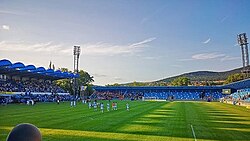
Nitra Stadium before England vs Slovenia match at 2025 UEFA European Under-21 Championship.Advertising board in Nitra.Event venue advertising panel in Slovak
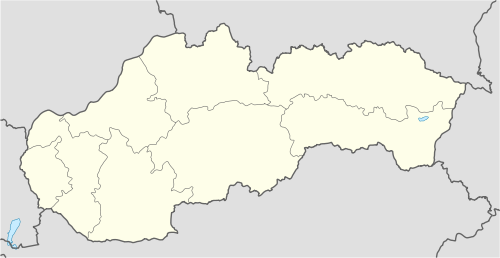
Slovakia's eight proposed venues during the bidding process were used for the tournament.[67][68] The eight stadiums were spread across seven of the eight Slovak regions, with the exception of Banská Bystrica Region. Trnava Region was the only region to have multiple host cities, Trnava and Dunajská Streda. The average capacity of the stadiums was 12,500.[61][69] Six venues used for the competition were deemed category 4, with only Nitra and Prešov's stadiums being classified as category 3.[67]
Seven stadiums were already built before the competition was given to Slovakia, with Prešov's being the only stadium being constructed during the tournament's preparations. Ján Kováčik had stated the if Prešov's stadium wasn't built in time, they had back-up options.[14]
The implementation of natural grass pitches in Trenčín and Žilina was also done before the tournament.[26][14]Košice's stadium was also upgraded during the tournament's preparations and was completed on 30 April 2024. Košice's upgrades include the installation of an LED screen, camera system and other accessories, plus an additional 6,719 seats were also added, bringing the final capacity to 12,555.[70] 17 training areas were available for the championship, including one for referees.[28]
Despite being already built and meeting requirements, concerns were brought up about the Štadión pod Zoborom (later renamed the Nitra Stadium for the tournament) in Nitra due to lack the lack of experience the stadium had hosting big events.[24][71]Mária Berdisová, director of the organizing committee proclaimed that in terms of infrastructure readiness, Bratislava was the best prepared and Nitra was the least prepared, as the latter had the most adjustments that needed to be made for the tournament.[35]
The neighbouring Czechs who visited the country during the tournament were astonished with the quality of the Slovak's stadiums.[72][73]
Construction of Prešov's stadium
The Tatran Arena in Prešov was the only venue that was completely under construction during the preparations of the championship. It was the most contentious point of the preparations as concerns were raised numerous times that the venue would not be built in time. Before Slovakia received the hosting rights, the city of Prešov had previously signed a memorandum of cooperation with the Slovak Football Association about hosting games.[74] By May 2023, construction on the stadium had still not started, signaling more doubts about the venue's readiness. Although, the building of the venue was included in Slovakia's list of sports infrastructure of national importance a month before.[75] The stadium finally started to be built on 27 June 2023.[20] In October 2023, the Slovak federation stated their confidence that the stadium will be built on schedule.[22] On 13 December 2023, the company, tasked with creating the stadium, reversed their decision to terminate their contract and continued to build the stadium.[76] By April 2024, the situation calmed down significantly as the construction was going according to plan.[77] In November 2024, a problem aroused when a criminal report was filed a month before surrounding the stadium and its ongoing construction.[78] However, the problem was quickly fixed after the city and the construction company agreed on a date for the completion of the construction part of the works on the arena.[79] In March 2025, the stadium was nearing its completion and was already handed over to the authorities in Prešov.[34][80] In April 2025, the venue was finally complete. On 3 May 2025, the official opening of the stadium was done. The stadium was inaugurated with a match between the retired Tatran Prešov internationals and Slovakia internationals.[81][82][83][53]
Fan zones were organised at every host city. In Trnava, the fan zone was at the station SNP near the city center. In Žilina, you could find the city's fan zone at the Hlinkov station. The other six fan zones, in Bratislava, Dunajská Streda, Košice, Nitra, Prešov and Trenčín, were next to the stadium.[119]
Qualification
2025 UEFA European Under-21 Championship − Map of qualified countries
In the qualification group stage, 52 teams were drawn into nine groups: seven groups of six teams and two groups of five teams. The draw for the qualifying group stage was held on 2 February 2023 in Nyon at 08:00 CET.[120] The qualifying group stage took place from 24 March 2023 to 15 October 2024. Each group was played in home-and-away round-robin format. The nine group winners and the three best runners-up (not counting results against the sixth-placed team) qualified directly for the final tournament, while the remaining six runners-up advanced to the play-offs.
In the play-offs, the six teams were drawn into three ties to play home-and-away two-legged matches to determine the last three qualified teams. The play-off draw took place on 17 October 2024 in Nyon.[4] The qualifying group stage took place from 24 March 2023 to 15 October 2024, while the play-offs were held between the 15 to 19 November 2024.
Of the qualified teams, 11 were present at the previous edition. Georgia and Slovenia qualified on merit for the first time after previously co-hosting the 2023 and 2021 editions respectively.[121][122]Finland had the longest absence, with their last appearance being in 2009.[123] Hosts Slovakia came back after their last appearance in 2017. Poland returns, with the last time the Poles qualified being in 2019. Denmark qualified after missing out in 2023.
Of the absentees, Croatia couldn't make it after losing on penalties to Georgia in the play-offs, ending their three successive tournament qualification streak. Switzerland failed to qualify after making two consecutive appearances. Belgium, Israel and Norway all failed to qualify after their sporadic appearances in 2023.
According to the UEFA coefficient rankings as of February 2025, the highest ranked team to not qualify was Switzerland, ranked 11th. Excluding the hosts Slovakia, ranked 23rd, the lowest ranked team to qualify was Finland, placed 20th.[124]
Qualified teams
The following teams qualified for the final tournament.
Note: All appearance statistics include only U-21 era (since 1978).
The draw was held at 19:00 CET on 3 December 2024 at the Slovak Philharmonic in Bratislava, Slovakia.[125][4][126][127] Slovak presenter, Vera Wisterová, hosted the draw.[128] The guests were former Slovak footballers, Juraj Kucka and Vratislav Greško, whom are both ambassadors for the tournament and assisted with the draw. Before the draw started, hosts Slovakia were pre-allocated into position A1 in Group A. The draw started with, in order, pots 1, 2, 3 and 4 being drawn, with each team selected then allocated into the first available group alphabetically. The position for the team within the group would then be drawn (for the purpose of the schedule).
Seeding
The seeding was based off the UEFA men's U-21 national team coefficient rankings as of November 2024.[129][130]
On 8 March 2025, the 12 refereeing teams were announced for the tournament, including a Venezuelan team selected as part of a co-operation agreement between the UEFA and CONMEBOL.[131] Originally, an English refereeing team including referee John Brooks alongside assistants, Simon Bennett and Daniel Robatan was selected. However, due to an injury to John Brooks, they had to be withdrawn and a Lithuanian referee team replaced them.
Players born on or after 1 January 2002 are eligible to participate.[132] Each national team had to submit a squad of 23 players, three of whom had to be goalkeepers. If a player was injured or ill severely enough to prevent his participation in the tournament before his team's first match, he could be replaced by another player.[132]
Group stage
The schedule was unveiled on 16 October 2024.[50] The detailed schedule with the qualified teams involved was confirmed shortly after the draw.[133] The group winners and runners-up advanced to the knockout stage, which began with the quarter-finals.[134]
The singer Tina performed at the opening ceremony, accompanied by 32 dancers. A further 100 performers helped complete the opening choreography. The program was directed by dancer and choreographer Miňo Kereš.[128]
Tiebreakers
The ranking of teams in the group stage was determined as follows:
Goals scored in head-to-head matches among tied teams;
If more than two teams were tied, and after applying all head-to-head criteria above, a subset of teams were still tied, all head-to-head criteria above were reapplied exclusively to this subset of teams;
Goal difference in all group matches;
Goals scored in all group matches;
Penalty shoot-out if only two teams had the same number of points, and they met in the last round of the group and were tied after applying all criteria above (not used if more than two teams had the same number of points, or if their rankings were not relevant for qualification for the next stage);
Disciplinary points
Yellow card: −1 point;
Indirect red card (second yellow card): −3 points;
A player is automatically suspended for the next match for the following offences:
Receiving a red card (red card suspensions may be extended for serious offences)
Receiving two yellow cards in two matches; yellow cards expire after the completion of the quarter-finals (yellow card suspensions are not carried forward to any other future international matches)
The following suspensions were served during the tournament:
This page is based on this Wikipedia article Text is available under the CC BY-SA 4.0 license; additional terms may apply. Images, videos and audio are available under their respective licenses.

 England (4th title)
 Germany