Acadian borders

Last updated

The borders of Acadia have changed repeatedly throughout its history. More often than not, they were ignored, poorly defined, or confused with other boundaries. Acadia officially ceased to exist as a political entity in 1763. [1] Nevertheless, the Acadian people endured, and their territory continued to evolve, influencing—and still influencing—the definition of Acadia. This territory is partly associated with the Acadian diaspora. [2] Some of Acadia’s former boundaries persist or have shaped modern borders, notably portions of the Canada–United States border. [3] Uncertainties surrounding these historical borders continue to have consequences, including contributing to the Aroostook War. [4]

Contents

Evolution of Acadia’s borders

Origins

Several Indigenous peoples successively occupied the territory that would become Acadia. The most recent before European contact were the Maliseet, Mi'kmaq, and Abenaki, whose cultures developed from the 6th century CE onward. [5] Martins Point is generally regarded as the boundary between Maliseet and Mi'kmaq territory, while Lepreau Point marked the divide between the Maliseet and the Passamaquoddy. [6] Portages connected these territories, and the peoples belonged to the Wabanaki Confederacy. [7] In any case, these boundaries were fluid because the territories were not permanently occupied; the economy was based on hunting and fishing. [6]

Indigenous boundaries had little or no impact on subsequent European borders. [6] However, the distribution of Indigenous nations was frequently shown on maps, and tribal names were sometimes used in place of territorial ones. [8]

Early European exploration

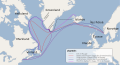
The Vikings reached North America around the year 1000 and named three regions—Helluland, Markland, and Vinland—whose exact locations and extents remain unknown. [9] In any event, none of their boundaries survived their departure. [10]

Several largely unsubstantiated theories exist about early pre-Columbian exploration and settlement of Acadia, including voyages by the Irish saint Saint Brendan around 530, the Welsh prince Madog around 1170, Malians in the 12th–13th centuries, the Knights Templar in the 14th century, the Zeno brothers around 1390, and the Chinese admiral Zheng He in 1421. [11] Phantom islands and imaginary places such as Drogeo and Norumbega are associated with these voyages. Norumbega appeared on maps until the early 17th century; its last mention came in 1613 when Pierre Biard wrote that the St. Croix River flowed through it. [8]

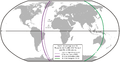
In any case, Christopher Columbus reached the Americas in 1492. The papal bull Inter caetera (1493) granted Spain all lands west and south of a line 100 leagues (418 km (260 mi)) west of the Azores and Cape Verde. [9] The Treaty of Tordesillas (1494) moved the line to 370 leagues (1,770 km (1,100 mi)) west of Cape Verde. [9] In both cases, the future Acadia fell within the Spanish sphere, but the demarcation was ignored by other European powers, including Spain and Portugal, and soon fell into disuse. [10]

Many explorers visited the region in the 15th and early 16th centuries, including John Cabot for England in 1497 and João Álvares Fagundes for Portugal around 1520. [10] Fagundes explored and named several areas, including Newfoundland, present-day Nova Scotia, and Saint Pierre and Miquelon; he may have claimed them for Portugal, though this is unlikely. [12] Early explorers initially mistook the land for Asia but soon realized they had found a new continent and sought a passage to Asia. [9] Maps of the period often used flags to denote possession, but boundaries remained vague. [9] Exploration did not necessarily confer legal possession but formed the basis for future claims. [9] European fishermen were already familiar with the coasts. [10]

French Acadia (1604–1713)

French Acadia refers to the period from its founding in 1604 until its final conquest by Britain in 1713. It was not always called Acadia during this time, nor was it continuously under French sovereignty. [13]

Official status within the Kingdom of France

New France is sometimes considered to comprise only the Canada colony or to include Acadia as well. [14] In practice, however, Acadia remained distinct, with its own governor. [14] Orders were supposed to pass through the Governor General of New France, but the French court sometimes dealt directly with Acadia’s governor. [14] Relations between Acadia and Canada were often tense, characteristic of two separate colonies; even Placentia (Plaisance) refused cooperation. [15]

A spirit of independence animated both Acadia and Canada. [16] The Abenaki lived around the Penobscot River, forming a buffer zone between Acadia and New England. [15]

Recognition

Spanish and Portuguese presence prevented England and France from colonizing south of the 30th parallel north. [17] The English focused around the 37th parallel and the French around the 45th, though the French were slow to establish settlements. [17]

The name “Acadia” was probably first used in 1524 by Giovanni da Verrazzano, exploring for France, to describe the Delmarva Peninsula; only in the 17th century did it refer to a region roughly corresponding to the modern Maritime provinces. [17]

France sent Jacques Cartier in 1534 before formally claiming the territory. [9] Humphrey Gilbert took possession of Newfoundland (northeast of Acadia) for England in 1583, based on Cabot’s voyage. [9] The Colony of Virginia was chartered the same year without defined limits. [9] France then considered Acadia to include the Gulf of St. Lawrence coast extending southwest to an undetermined boundary with Virginia. [9]

In 1603, Henry IV of France, citing Verrazzano’s exploration, granted Pierre Dugua, Sieur de Mons a fur-trade monopoly and instructed him to found a colony between the 40th and 46th parallels—intended to run from Cape Cod to Cape Breton Island but actually bisecting the island. [9] This ignored English explorations in Maine in 1602–1603. [9] It was likely the first use of parallels as boundaries in Canadian history. [18]
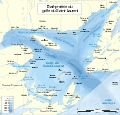
Early settlement attempts

Aymar de Chaste received the New France trade monopoly in 1603 and sent François Gravé du Pont and Samuel de Champlain, but no settlement was founded. [19]

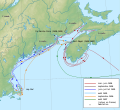
Acadia was founded in 1604 by Pierre Dugua de Mons on Sainte-Croix Island, now in Maine near the northern shore of the Bay of Fundy. [17] An earlier colony on Sable Island (1598–1603) had failed. [19] Acadia became one of the first regions in North America to be accurately mapped, by Champlain in 1604. [20] The Sainte-Croix settlement failed, and Port-Royal was established in 1605 on the southern shore of the Bay of Fundy. [21]
Beginning of hostilities

Borders (green) of the Plymouth Council for New England. Wpdms virginia company plymouth council.png
Borders (green) of the Plymouth Council for New England.

From the outset, England coveted Acadia’s strategic position and repeatedly attacked it. [22] Most English attacks aimed to push Acadia’s border eastward to the Kennebec River and then the Penobscot River. [23] The French mainly tried to disrupt Boston. [23] The French founded no permanent settlements west of the St. Croix River. [24] Most attacks failed or were abandoned due to poor organization or weather. [23] Governors frequently moved the capital and received little military or financial support, contributing to instability. [25]

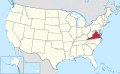
In 1606, the Virginia Company received a charter from James I for Virginia between the 34th and 45th parallels, ignoring Acadia’s boundaries. [18] The English founded the short-lived Popham Colony in Maine in 1607. [26] When the French settled Mount Desert Island in 1613, the English destroyed it and captured Port-Royal, basing their claim on Cabot’s voyage. [27]

In 1620, James I replaced the Virginia Company with the Plymouth Council for New England, granting land from the Atlantic to the Pacific between the 40th and 48th parallels—encompassing Acadia and the nascent Canada colony. [28] The modern 49th parallel border is coincidental. [8]

Nova Scotia for the first time (1621–1632)

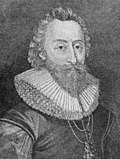
From 1613, Scotland claimed a colony called Nova Scotia, roughly covering French Acadia east of the St. Croix River and a line drawn due north. [18] In 1621, James VI and I granted it to his favorite Sir William Alexander. [18] Part of the present Canada–US border derives from this grant. [8] It was the first North American territory delimited by precise, identifiable geographical features. [18]

Later in 1621, the Plymouth Council granted Alexander the “territory of Sagadahock” between the St. Croix and Kennebec rivers. [29] In 1622, John Mason and Ferdinando Gorges received land between the Kennebec and Merrimack, named the Province of Maine; it was split in 1629 into Maine and New Hampshire. [30]

In 1627, the Company of One Hundred Associates received a monopoly over New France, defined as stretching from Newfoundland to the Great Lakes, the Arctic Circle to Florida—thus including Acadia and English possessions. [18] War broke out that year between France and England. The Treaty of Saint-Germain-en-Laye (1632) partially ended it and returned Acadia to France. [18]

The Nova Scotia grant was reconfirmed in 1625 and 1633. [8] The colony was divided into New Alexandria (north) and New Caledonia (south) across the Isthmus of Chignecto and Bay of Fundy—resembling modern New Brunswick and Nova Scotia without direct connection. [8] Scottish settlers arrived in 1629 at Cape Breton and Port-Royal. [18]

Meanwhile, Canada was briefly granted to Alexander in 1628; the grant lapsed after 1632. [8] Charles de Saint-Étienne de La Tour received a baronetcy in 1630 from Cape Fourchu (near Yarmouth) to Mirliguèche (near Lunenburg), implying this was the sole “Acadia”. [31]
British Acadia (1713–1763)

British Acadia describes the region of Acadia under British control from 1713 to 1763. [32]

Treaty of Utrecht and its interpretation (1713)

The Treaty of Utrecht. The Treaty of Utrecht.jpg
The Treaty of Utrecht.

The British conquest of Acadia was formalized by the Treaty of Utrecht in 1713. [33]

The Most Christian King shall restore to the Queen of Great Britain, on the day of the exchange of the ratifications of this present Treaty of Peace, letters and authentic acts, which shall serve as evidence of the cession, in perpetuity, to the Queen and to the Crown of Great Britain, of the island of Saint Christopher, which shall henceforth be possessed alone by British subjects; of Nova Scotia, or Acadia, in its entirety, according to its ancient limits, as also of the town of Port Royal, now called Annapolis Royal; and generally of all that depends on the said lands and islands of the said country, with the sovereignty [...]. [33]

In practice, France retained Île Royale and Île Saint-Jean, along with other holdings such as Anticosti Island and fishing rights on the French Shore of Newfoundland. [note 1] [18] The treaty equated Acadia with Nova Scotia, despite France's longstanding claim that the colony extended to the Kennebec River or at least the Penobscot River. [34] From the perspective of Massachusetts, the treaty restored the territory of Sagadahock and Nova Scotia, while Nova Scotia's new governor viewed the colony as encompassing all of former Acadia with its western boundary at the St. George River. [34] Great Britain regarded Acadia (and thus Nova Scotia) as extending north to the St. Lawrence River. [34] France, however, limited Acadia (and Nova Scotia) to the southern portion of the peninsula, [34] arguing that it was not the pre-1710 Acadia but a different one "according to its ancient limits." [35] These divergent views of Acadia were reflected in maps produced by both powers. [34] The British did not immediately occupy the continental portion of the territory after the treaty's signing, implying continued French sovereignty there. [34]

The French began claiming the continental portion around 1720. [35] In 1751, they built Fort Beauséjour on the north bank of the Missaguash River, while the British constructed Fort Lawrence on the south bank, effectively recognizing the French position de facto; this marked the third time the Isthmus of Chignecto served as a boundary. [34]

Despite boundary uncertainties, the English granted the township of Harrington along the Saint John River in 1732, though the grant was soon forgotten. [36]

Treaty of Aix-la-Chapelle and boundary commission (1748–1755)

In 1748, the Treaty of Aix-la-Chapelle (1748) effected no changes to the respective positions. [34] The treaty provided for a bilateral commission in 1750 to delimit Acadia's boundaries, which yielded no results and was dissolved. Nonetheless, the commission's conferences and published volumes preserved many lost or rare documents. [37]

The boundary between Massachusetts and Nova Scotia remained practically undefined; Massachusetts proposed several solutions to Nova Scotia, which deferred the matter to the Crown. [34] In 1762, the two colonies agreed not to grant lands in the undefined area until the boundary was clarified. [34]

A bilateral commission was also established to delimit the boundary at the Isthmus of Chignecto, but it too failed. [38] The Acadians were deported between 1755 and 1763, but one-third had returned by the end of the 18th century. [39] The English forced returning Acadians to settle in small, dispersed groups; most former Acadian lands were granted to English settlers. [39]

Expulsion of the Acadians (1755–1763)

Partition of Acadia

In 1763, France ceded its North American possessions to Great Britain via the Treaty of Paris (1763), which was unambiguous and ended disputes over Acadia's boundaries. [40] The only territory France gained was Saint Pierre and Miquelon, intended as a refuge for its fishermen. [note 2] [18] [41]
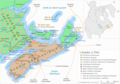
The St. Croix River and a line due north formed Nova Scotia's new boundary—the same as that of William Alexander's Nova Scotia in 1621. [34] The territory of Sagadahock thus defaulted to Massachusetts possession. [34]

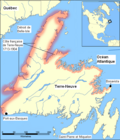
All internal French-era boundaries in Acadia were dissolved. [36] Newfoundland was granted all coastline from the Saguenay River in the west to Hudson Strait in the north, including islands such as Anticosti and the Magdalen Islands. [18] Île Royale and Île Saint-Jean were annexed to Nova Scotia; Governor Montague Wilmot's commission defined their boundaries. [18] By expanding Nova Scotia, the British aimed to consolidate their presence and assert authority over continental Acadian territories claimed since the Treaty of Utrecht. [18]

The Province of Quebec, replacing Canada, was created later in 1763. [18] Its southern boundary ran along the 45th parallel north, then north along the highlands (the Appalachian Mountains) dividing the St. Lawrence River watershed from that of the Atlantic Ocean, and finally east along the north shore of the Chaleur Bay to Cap des Rosiers. [18] This deprived Quebec of the Gaspé Peninsula. [note 3] [42] The Quebec Act of 1774 confirmed this boundary but granted other lands, including those ceded to Newfoundland in 1763. [43] Unrest in the Thirteen Colonies prompted British expansion of Quebec's territory, but this decision contributed to the American Revolution. [43] The texts overlooked that the "highlands" do not approach Chaleur Bay in this manner and ignored the Restigouche River, which flows into the bay rather than the St. Lawrence or Atlantic, leaving part of the boundary undefined. [40] Contemporary maps depicted the Restigouche farther north and shorter than in reality, explaining the confusion. [40] Most cartographers resolved this by drawing a straight line east from the highlands to the Restigouche's mouth, while Des Barres' more accurate map diverted the boundary around the river's source and then followed the shortest path to Chaleur Bay. [40] In any case, Quebec's southern boundary automatically became the northern boundary of Massachusetts and Nova Scotia. [42]

Massachusetts continued claiming the territory of Sagadahock (lands east to the St. Croix River), while Nova Scotia claimed lands west to the Penobscot River as heir to Acadia. [42] However, the Treaty of Paris and Quebec Act transferred northern Sagadahock to Quebec. [42] Governor Wilmot's 1763 commission held that Nova Scotia's western boundary ran from Cape Sable through the Bay of Fundy to the St. Croix's mouth, then due north to Quebec's southern boundary. [42] This created a "north angle," frequently mentioned thereafter. [42] Notably, the commission stated Nova Scotia once extended to the Penobscot, a phrasing that avoided finality amid ongoing boundary disputes. [42]

Nova Scotia had been divided into counties in 1759, with all territory north of Kings County, Nova Scotia—including present-day New Brunswick—falling within Cumberland County, Nova Scotia. [36] The Saint John River valley was separated from Cumberland in 1765 to form Sunbury County. [36] A boundary between the counties was established in 1770. [36] Sunbury's western boundary was described as running due north from the St. Croix's source to the Saint John River, then to Quebec's southern boundary. [36] This overlapped part of present-day Maine, as reaching Quebec from the Saint John required veering far west near the Chaudière River's source. [36]

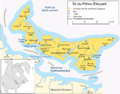
Île Saint-Jean was nearly depopulated in 1758 during the Expulsion of the Acadians before being surveyed in 1764 and granted to various English lords in 1767. [43] At their request, the island was separated from Nova Scotia in 1769 and renamed Prince Edward Island in 1798. [43] New Brunswick was separated from Nova Scotia in 1784. [44] Île Royale, renamed Cape Breton Island, became a separate province in 1784 but was rejoined to Nova Scotia in 1820. [45]

Summary

Acadia

Name [18] DurationSovereigntyOrigin
Acadia1604–1620 (1632 for the French)Royal Standard of the King of France.svg Kingdom of France (1328–1792)Explorations of Giovanni da Verrazzano (1524)
New England1620–1621Flag of England.svg Kingdom of England Grant of the Plymouth Council for New England
Nova Scotia1621–1632Flag of Scotland (1542-2003, navy blue).svg Kingdom of Scotland Grant to William Alexander
Acadia1632–1654 (1664 for the French)Royal Standard of the King of France.svg Kingdom of France (1328–1792) Treaty of Saint-Germain-en-Laye (1632)
Nova Scotia1654–1667Flag of The Commonwealth.svg Commonwealth of England, Flag of England.svg Kingdom of England Invasion by Robert Sedgwick, Treaty of Westminster (1654)
Acadia1667–1674Royal Standard of the King of France.svg Kingdom of France (1328–1792) Treaty of Breda (1667)
New Holland1674–1678Statenvlag.svg Dutch Republic Invasion by Jurriaen Aernoutsz
Acadia1678–1691Royal Standard of the King of France.svg Kingdom of France (1328–1792) Treaty of Nijmegen
Massachusetts1691–1696Flag of England.svg Kingdom of England Invasion by William Phips
Nova Scotia1696–1697Flag of England.svg Kingdom of England Separation from Massachusetts
Acadia1697–1713 (1763 according to France)Royal Standard of the King of France.svg Kingdom of France (1328–1792) Treaty of Ryswick
Nova Scotia1713–presentUnion flag 1606 (Kings Colors).svg Kingdom of Great Britain Treaty of Utrecht

Territory of Sagadahock

Name [34] DurationSovereigntyOrigin
Territory of Sagadahock1664–1667Flag of England.svg Kingdom of England Grant by Charles II to the Duke of York
Acadia1667–1674Royal Standard of the King of France.svg Kingdom of France (1328–1792) Treaty of Breda (1667)
Territory of Sagadahock1674–1678Flag of England.svg Kingdom of England Restoration of grant to the Duke of York
Acadia1678–1691Royal Standard of the King of France.svg Kingdom of France (1328–1792) Treaty of Nijmegen
Massachusetts1690–1691Flag of England.svg Kingdom of England Invasion by William Phips
Nova Scotia1691–1696Flag of England.svg Kingdom of England Separation from Massachusetts
Acadia1696–1713Royal Standard of the King of France.svg Kingdom of France (1328–1792) Treaty of Ryswick
Territory of Sagadahock1713–1763Flag of England.svg Kingdom of England Treaty of Utrecht
Massachusetts1763–presentFlag of England.svg Kingdom of England Treaty of Paris (1763)

Partition of Acadia

NameDurationSovereigntyOriginPortion
Île Royale1713–1763Royal Standard of the King of France.svg Kingdom of France (1328–1792) Treaty of Utrecht Gulf of St. Lawrence islands
Flag of Canada (Pantone).svg Nova ScotiaSince 1713Flag of the United Kingdom.svg United Kingdom then Flag of Canada (Pantone).svg Canada Treaty of Utrecht Peninsular portion and later Île Royale/Cape Breton Island
Territory of Sagadahock1713–1763Flag of the United Kingdom.svg United Kingdom Treaty of Utrecht Portion west of St. Croix River
Flag of the United States.svg Massachusetts1763–1820Flag of the United Kingdom.svg United Kingdom then Flag of the United States.svg United States Treaty of Paris (1763) Territory of Sagadahock
Flag of Canada (Pantone).svg Prince Edward IslandSince 1769Flag of the United Kingdom.svg United Kingdom then Flag of Canada (Pantone).svg Canada Former Île Saint-Jean
Province of Quebec 1774–1791Flag of the United Kingdom.svg United Kingdom Quebec Act Gaspé, Magdalen Islands, north of Sagadahock territory
Flag of Canada (Pantone).svg New BrunswickSince 1784Flag of the United Kingdom.svg United Kingdom then Flag of Canada (Pantone).svg Canada Continental portion east of St. Croix River and south of Chaleur Bay
Cape Breton Island1784–1820Flag of the United Kingdom.svg United Kingdom Former Île Royale
Lower Canada 1791–1841Flag of the United Kingdom.svg United Kingdom Constitutional Act 1791 Gaspé, Magdalen Islands, north of Sagadahock territory
Flag of the United States.svg MaineSince 1820Flag of the United States.svg United States Missouri Compromise Territory of Sagadahock
Flag of Canada (Pantone).svg Canada (Province of Canada)1841–1867Flag of the United Kingdom.svg United Kingdom Act of Union 1840 Gaspé, Magdalen Islands, north of Sagadahock territory
Flag of Canada (Pantone).svg QuebecSince 1867Flag of Canada (Pantone).svg Canada British North America Acts Gaspé, Magdalen Islands, north of Sagadahock territory

Distribution of the Acadian population

The distribution of the Acadian population has not always been tied to borders but has influenced their definition. [46]

French Acadia

Many colonization projects had to be canceled or delayed, due in part to shortages of supplies and funds; even observers, until the early 18th century, spoke of Acadia as a place to be colonized. [47] The colonization of Acadia truly began under the impetus of Isaac de Razilly in 1632. [48] Settlement started at Port-Royal and expanded to Beaubassin in 1671, the Mines in 1682, and subsequently to Pisiquid and the Trois-Rivières. [48] The rest of the territory remained sparsely populated. [48]

British Acadia

In 1755, the governor of Nova Scotia, Charles Lawrence, captured Fort Beauséjour from the French and began the Expulsion of the Acadians. [49] Until 1763, the territories adjacent to Nova Scotia were annexed, and Acadians were deported to New England. [50] Many others managed to flee to Canada, Île Saint-Jean (present-day Prince Edward Island), or hide among the Indigenous peoples. [50] Several colonies refused these prisoners, who were then deported to England or returned to Nova Scotia. [51] Île Saint-Jean was nearly depopulated in 1758. Two-thirds were deported to France, while others sought refuge at Ristigouche or Quebec. [52] Refugees in England were expatriated to France in 1763. [53] Some Acadians sought refuge in Saint Pierre and Miquelon but were almost all deported in 1778. [43]

Since 1763

After the Expulsion of the Acadians, Acadia transitioned from a defined territory to a set of communities with fluid borders. [54]

After the signing of the Treaty of Paris (1763) in 1763, Acadians moved to the West Indies, France, Louisiana, and Quebec, but mostly to Nova Scotia. [55] About 12,000 New England Planters had already settled in former Acadian villages, and the law prohibited Acadians from forming large communities. [55] They could settle on reserved lands among Anglophones or found new villages in remote corners of former Acadia, such as Cape Breton Island, Prince Edward Island, or the territory that became New Brunswick in 1784—which most did. [55] Among all the former core Acadian villages, only Pobomcoup, the left bank of the Trois-Rivières, [55] and Beaubassin (though the latter hosted few Acadians) were not reserved for Anglophones. Exiles gradually settled in Halifax and along the Strait of Canso, then from 1767 in Baie-Saint-Marie, Tusket, and Pobomcoup, and from 1780 in Chéticamp and Margaree. [55]

Nearly two-thirds of the Acadians in France went to Louisiana in 1785. [56] Their descendants are now called Cajuns. [57]

A group of Acadians from Saint-Malo settled in the Falkland Islands in 1764. Most left the archipelago in the following years, but it seems some families left descendants on these islands as well as in Montevideo, Uruguay. [58]

From 1785, the Madawaska region saw the arrival of Acadians who had to leave the lower Saint John River valley to the United Empire Loyalists. [52] By the end of the 18th century, 36% of Acadians were settled in the Maritime provinces, and their return from exile continued until the 1820s. [55] Until the second half of the 20th century, Maritime settlements expanded along the coasts and into the hinterland. [52] Several factors contributed to population movements, but the most consistent was religious presence. Thus, the construction of a chapel or the establishment of a priest generally meant a community was permanently settled. [59] During this period, the arrival of numerous British immigrants accentuated the minority status of Acadians. [60]

In the 19th century, French fishing families and residents of Saint Pierre and Miquelon settled on the French Shore of Newfoundland, particularly in the Port au Port Peninsula, despite the prohibition of permanent settlements. [61] They were joined by Acadian farmers. [61] The Francophone population then underwent massive cultural assimilation. France lost its fishing rights in 1904. [61]

In the second half of the 20th century, Acadian communities formed in Alberta and the Labrador. [62] They consist mainly of workers attracted by well-paid jobs in the primary sector. [62] This exodus threatens the survival of some Maritime communities. [62]

Indigenous territories

Map of Acadia and its neighboring cultural areas with Mi'kmaq reserves. Provinces maritimes nations.png
Map of Acadia and its neighboring cultural areas with Mi'kmaq reserves.

During the French regime, France did not recognize Maliseet and Mi'kmaq sovereignty over their territories but ensured they were respected in their use of them. [63] For their part, the Indigenous peoples considered the lands merely lent to the French and Acadians. [63] Although the arrival of Europeans changed Indigenous habits and many died from European diseases, relations were generally cordial, with each population occupying its own territory. [63] Métissage was common but denigrated at the end of the French regime; Acadians married to Indigenous women were more interested in their wife's culture, whereas the stated goal of métissage—promoted by the government—was to assimilate the Indigenous peoples. [64]

The Maliseet and Mi'kmaq still exist and own lands—Indian reserves—some of which are enclaved in Acadia. Some reserves have seen their territory reduced over the years, sometimes illegally. This is one reason several communities seek to reclaim larger territories. [65]

Anglophone population and immigrants

The immigrant population had little real impact on the definition of Acadia's territory. [66]

Influence of Acadia's borders to the present day

Uncertainties regarding Acadia's borders continue to influence the present and have led to several border conflicts between Canada and the United States, as well as between provinces and states. [3]

International border

American Revolutionary War and Treaty of Paris (1783)

The first page of the Treaty of Paris. Treaty of Paris 1783 - first page (hi-res).jpg
The first page of the Treaty of Paris.
The Mitchell Map. Mitchell Map-06full2.jpg
The Mitchell Map.

A provisional treaty was signed in 1782 between the United States and Great Britain. [67] It determined the border with Nova Scotia as beginning at the mouth of the St. Croix River in the Bay of Fundy, ascending its course to its source, and then following a due north line to the northwest angle in the "highlands," [68] essentially the same border given to Nova Scotia by Great Britain in 1763. [42] The commissioners relied on the Mitchell Map of 1755, considered the best of its time. [68] The Treaty of Paris (1783) of 1783 ended the American Revolutionary War and reiterated essentially the same border. [67] From that moment, the northern U.S. border became a source of discord with the United Kingdom and then Canada, persisting to the present day. [67]

Search for the St. Croix River

The St. Croix River at its mouth. StCroixRiver23.jpg
The St. Croix River at its mouth.

The exact location of the St. Croix River was quickly forgotten. The first known topographic description was made in April 1764 by Massachusetts governor Francis Bernard to John Mitchell, tasked with surveying Passamaquoddy Bay and determining the river's exact location. [69] Bernard referred to a waterway then called the Scoodic River, which proved to be the sought-after St. Croix. [69] In June 1764, Mitchell noted in his journal that Indigenous peoples considered the Magaguadavic River the St. Croix; he produced a map whose original has not survived. [69] The Pownall map of 1776 was the first printed map illustrating this theory. [69] Mitchell seems to have misinterpreted Cyprian Southack's 1715 plan, which identified the Magaguadavic as the St. Croix and named the Scoodic the Passamaquoddy River—an error repeated in his report and map. [69] In 1765, Charles Morris was sent on an expedition to Passamaquoddy Bay. [69] He identified the Cobscook River as the St. Croix and Treat Island as Dochet's Island but named the Scoodic as such and left the Magaguadavic unnamed; the wooded true Dochet's Island led him to mistake Treat Island's ruins for the French habitation. [69] According to William Francis Ganong, Morris's main error stemmed from his desire to push Nova Scotia's border as far west as possible. [69] In 1765, Governor Bernard, based on Mitchell's research and Samuel de Champlain's writings, sent a letter to Nova Scotia Governor Wilmot associating the Digdeguash River with the St. Croix; his error likely arose from consulting Champlain's 1632 edition, which had fewer and less accurate maps. [69] In 1772, Thomas Wright produced a detailed regional map identifying the Scoodic as the Great St. Croix River and the Magaguadavic as the Little; in 1797, he testified under oath that he relied on local usage. [69]

Contradictory testimonies emerged at the time. Indigenous peoples supported the Magaguadavic as the St. Croix, a view shared by some local English settlers, while others claimed Indigenous peoples were coerced into this theory, some English said the name was recent, and others maintained the Scoodic and Magaguadavic were once the Great and Little St. Croix Rivers. [69] In 1765, other Indigenous peoples told Morris they once called the Cobscook the St. Croix. [69]

In 1794, Article V of the Jay Treaty provided for a bilateral commission to determine the St. Croix's location. [70] On 25, the three commissioners recognized the Scoodiac and St. Croix as the same waterway; a monument was erected at its source. [70]

War of 1812 and Treaty of Ghent (1814)

Signing of the Treaty of Ghent. Signing of Treaty of Ghent (1812).jpg
Signing of the Treaty of Ghent.

The Treaty of Ghent, signed in 1814, ended the War of 1812 and was intended to resolve uncertainties from the Treaty of Paris. [71]

Aroostook War and Webster–Ashburton Treaty

Border uncertainties leading to the Aroostook War. Webster-Ashburton treaty map-fr.svg
Border uncertainties leading to the Aroostook War.

The ambiguities in the 1783 Treaty of Paris led to escalating tensions over the Maine–New Brunswick border, culminating in the Aroostook War (1838–1839), a bloodless conflict involving militia mobilizations but no combat. [4] The dispute centered on timber-rich lands, with both sides claiming the area based on differing interpretations of the "highlands" and the St. Croix's source. [4] The Webster–Ashburton Treaty of 1842 resolved it, awarding most of the disputed territory to Maine while preserving a British route from Halifax to Quebec, and establishing the modern border. [71]

Other treaties and conflicts

The Canada-U.S. border in 1941. Mountie and Trooper 1941.jpg
The Canada–U.S. border in 1941.

Canadian sovereignty over Campobello Island was recognized by a convention in 1817. [72] The 1908 treaty between the United States and the United Kingdom established a commission to maintain the border. [73] It stipulated that all previously recognized borders were fixed, ignoring potential geological changes. [73] The 1910 treaty clarified the border in Passamaquoddy Bay, a line from a point between Treat Island and Campobello Island generally south to the middle of the Grand Manan Channel; Pope's Folly Island and the lighthouse between Woodward Point and Cranberry Point were left to the United States. [73] The 1925 treaty shifted the Grand Manan Channel endpoint by 2,383 m (7,818 ft), gaining 9 acres (3.6 ha) for Canada. [74]

The proposed Eastport oil port in Maine created a Canada–U.S. conflict at the turn of the 21st century. [75]

Border between Quebec and New Brunswick

Topographic map of New Brunswick illustrating modern borders. New Brunswick general map-fr.svg
Topographic map of New Brunswick illustrating modern borders.

The border was fixed in 1851 by a British act [76] and demarcated between 1853 and 1855; it was the first interprovincial border to undergo this process. [77] However, Restigouche River islands are considered part of New Brunswick, but some have disappeared or emerged over time, making this segment uncertain. [76] The easternmost part depends on the status of the Gulf of Saint Lawrence. [76]

The border originates from the 1763 division of the Province of Quebec, following the highlands dividing the St. Lawrence and Atlantic watersheds to Chaleur Bay. [78] Disputes arose in the 19th century over timber and land, leading to arbitration in 1851 under the King of the Netherlands, though the award was partially rejected. [79] Modern issues include resource management and environmental concerns, but the border is stable. [76]

Border between New Brunswick and Nova Scotia

The border between New Brunswick and Nova Scotia was unofficially recognized by Isthmus of Chignecto residents as early as 1800. [77] Its exact demarcation was difficult because the Missaguash River's source is in a marshy area, but a line was finally demarcated in 1856. [77]

The border follows the Missaguash River from its mouth at Chignecto Bay to a point near Baie Verte, then east to the Petitcodiac River, and north along that river to its source, before proceeding due north. [80] It stems from the 1784 separation of New Brunswick from Nova Scotia and was formalized to resolve logging disputes. [81] No major modern disputes exist. [82]

Border between Quebec and Prince Edward Island

The border between Quebec and Prince Edward Island is maritime, defined by the Gulf of St. Lawrence. It was established through 1964 and 1972 interprovincial agreements on sea borders, using equidistant lines from the shores. [83] Quebec recognizes these as binding, confirmed by commissions in 1966 and 1991. [84] No significant disputes have arisen, though it could be relevant in Quebec independence scenarios. [85]

Border between Quebec and Nova Scotia

The border between Quebec and Nova Scotia is also maritime in the Gulf of St. Lawrence, similarly defined by the 1964 and 1972 agreements using equidistant principles. [83] It follows from the 1763 boundaries, with Nova Scotia's northern limit along the 47th parallel in parts of the gulf. [78] Quebec upholds these agreements, with no active disputes. [85]

Interpretations of Acadian boundaries since 1763

The relationship between Acadians and their territory has long been complex. According to historian Julien Massicotte, the traumatic events of Acadian history—particularly the Deportation of 1755–1763—led many Acadians to identify more strongly with culture, language, and religion than with a fixed geographic space. [86] Scholars such as Massicotte, Nicolas Landry, Nicole Lang, and Elsa Guerry emphasise that territory remains a central, yet constantly redefined, issue in Acadian identity. [87] [88]

For many Atlantic-Canadian Acadians, the existence of “Acadia” is taken as self-evident, even in the absence of official political recognition. [89] Poet Pierre Perrault famously described Acadian geography as a “geography of the soul”, [86] while geographer Cécyle Trépanier has argued that the very ambiguity of the term Acadia sustains its mythic power. [90]

Historical development

Historical awareness of a distinct Acadian identity emerged at different moments according to scholars: Naomi Griffiths places its origins before the Deportation, while Joseph Yvon Thériault  [ fr ] dates it to the 1880s. [86] Regardless, the mid-19th century witnessed a demographic boom and the creation of Acadian institutions during the period known as the Acadian Renaissance. [54] This renaissance partly defined itself against French-Canadian nationalism, emphasising language, culture, and Catholicism over territorial claims. [54]

Two 19th-century historians profoundly shaped early conceptions. François-Edme Rameau de Saint-Père viewed Acadia as wherever Acadians lived, seeing diaspora communities as potential seeds of a new nation. [54] Pascal Poirier stressed blood ties, describing Acadians as a distinct “race”. [54] Massive late-19th-century emigration to the United States reinforced a non-territorial vision, exemplified by the founding of the Société l'Assomption in Massachusetts in 1903. [54]

From the 1920s to the 1950s, a tragic narrative dominated, portraying Acadians as martyrs defined by the Deportation and faith. [91] Historians such as Émile Lauvrière, Antoine Bernard, and Robert Rumilly popularised this “tragic Acadia”, which coexisted with a more concrete regional vision focused on post-Deportation settlements. [91]

The Antigonish Movement and the establishment of social-science education in Memramcook in 1939 gradually shifted perceptions toward contemporary socio-economic realities. [92]

In 1987, New Brunswick geographer Adrien Bérubé proposed four contemporary conceptions of Acadia: historical, diasporic, operational, and prospective. [93] During the 1990s, Cécyle Trépanier conducted hundreds of interviews and concluded that none of Bérubé’s categories fully matched popular perceptions. [94]

Bérubé’s four conceptions

Bérubé linked each conception to distinct ideologies, symbols, and uses of the Acadian flag and name. [95]

Historical Acadia

The territory that disappeared irrevocably in 1713 or 1763. Some, including historian Michel Roy and scholar Léon Thériault, consider any post-1763 reference to Acadia paradoxical or an act of faith. [96]

Countries and regions with Acadian diaspora communities Acadie genealogique.svg
Countries and regions with Acadian diaspora communities

Diasporic (genealogical) Acadia

Encompasses all descendants of the deported Acadians worldwide (estimated at over three million by genealogist Stephen A. White). [93] Being Acadian is a matter of “blood” or ancestry. Bérubé described it as an “interior homeland” or “moral state” existing in the hearts of “Acadian cousins”. [93] The Acadian flag functions here as a kinship symbol, similar to Scottish tartans. [95]

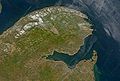
Regions with significant francophone populations in Atlantic Canada Acadie 2012.png
Regions with significant francophone populations in Atlantic Canada

Operational Acadia

Defines Acadian identity primarily through French language and culture. All francophones in the Maritime provinces are often implicitly considered Acadian. This conception facilitates statistical study using census data. [93] The term “Acadia des Maritimes” (Maritime Acadia) is frequently used synonymously, though Trépanier has called it conceptually “empty of meaning” while acknowledging its rhetorical usefulness. [90] Inclusion of Newfoundland and Labrador remains debated, though the broader label “Acadia de l’Atlantique” has gained currency. [97]

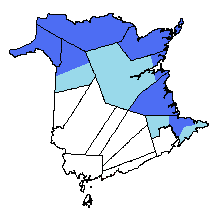
Approximate map of a proposed Acadian province in northern and eastern New Brunswick Acadie prospective.png
Approximate map of a proposed Acadian province in northern and eastern New Brunswick

Prospective (New) Acadia

Focuses on francophone areas of New Brunswick, where Acadian identity can be acquired through voluntary participation in a French-speaking community, regardless of ancestry. The Acadian flag is often displayed alone as a political statement. It represents a project for official recognition, potentially as a new province or through enhanced autonomy. [93]

Trépanier’s interviews revealed further nuances:

Cartography of Acadia

Pre-1763

Bellin's 1757 map of Acadia and neighboring regions Carte de l' Accadie et Pais Voisins 1757.jpg
Bellin’s 1757 map of Acadia and neighboring regions

Historical boundaries of Acadia were contested between France and Britain long before 1763, with no universally accepted limits. [98]

Post-1763

The absence of an official map is sometimes cited as proof that Acadia does not exist, yet numerous maps have been produced, especially during the identity debates of the 1980s. [99]

Bérubé identified four cartographic approaches:

Many maps are either over-inclusive or under-inclusive because of assimilation, varying local identities, and lack of official status. [102]

Official recognition

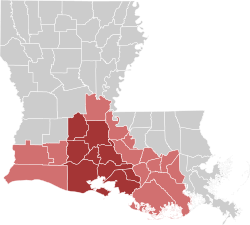
Officially recognized Acadiana region in Louisiana Acadiana Louisiana region map.svg
Officially recognized Acadiana region in Louisiana

Louisiana’s 22-parish Acadiana region was officially designated in 1971. [103] Newfoundland and Labrador’s francophone community gained provincial recognition in 1992. [103]

In Canada, section 16.1 of the Canadian Charter of Rights and Freedoms (1993) acknowledges New Brunswick’s French linguistic community without delimiting territory. Prime Minister Stephen Harper recognized Acadia’s existence but declined to grant it “nation” status comparable to Quebec (2006). [104]

Future of Acadian boundaries

Possible scenarios include maintaining the status quo, progressive duality within existing provinces, creation of an Acadian province, or union/annexation with Quebec. Support for annexation or independence has historically been low (25% in 1964, 7% at the 1979 convention). [105] Maritime union is occasionally proposed but generally seen as benefiting anglophones more than Acadians. [106]

See also

Notes and references

Notes

  1. These latter two territories were not originally part of Acadia but became associated with it later. The French had held the colony of Placentia in Newfoundland since 1660.
  2. Saint Pierre and Miquelon was not originally part of Acadia but became associated with it later.
  3. The exact definition of Canada, like that of Acadia, was uncertain. Strategic considerations prompted the British to reduce the colony's size.

References

  1. Griffiths (2005 , p. 425)
  2. Brasseaux (1987 , p. 1–10)
  3. 1 2 Van Zandt (1976 , p. 12)
  4. 1 2 3 Carroll (2001 , p. 197–220)
  5. Reid, John G. (2008). Essays on Northeastern North America, Seventeenth and Eighteenth Centuries. University of Toronto Press. pp. 23–25. ISBN   978-0-8020-9137-6.
  6. 1 2 3 Nicholson 1979 , pp. 8–9
  7. Prins, Harald E.L. (1996). The Mi'kmaq: Resistance, Accommodation, and Cultural Survival. Wadsworth. pp. 135–137. ISBN   978-0-15-501407-7.
  8. 1 2 3 4 5 6 7 Ganong 1901 , pp. 164–174
  9. 1 2 3 4 5 6 7 8 9 10 11 12 Ganong 1901 , pp. 155–160
  10. 1 2 3 4 Nicholson 1979 , pp. 9–12
  11. Quinn, David Beers (1977). North America from Earliest Discovery to First Settlements: The Norse Voyages to 1612. Harper & Row. pp. 115–130. ISBN   9780060134587.
  12. Williamson, James A. (1962). The Cabot Voyages and Bristol Discovery Under Henry VII. Hakluyt Society. pp. 237–240. ISBN   9780521010085.{{cite book}}: ISBN / Date incompatibility (help)
  13. Griffiths (2005 , p. 3–5)
  14. 1 2 3 Guerry, Basque & Couturier 2005 , p. 19
  15. 1 2 Guerry, Basque & Couturier 2005 , p. 21
  16. Guerry, Basque & Couturier 2005 , p. 22
  17. 1 2 3 4 Landry & Lang 2001 , pp. 13–16
  18. 1 2 3 4 5 6 7 8 9 10 11 12 13 14 15 16 Nicholson 1979 , pp. 12–22
  19. 1 2 Landry & Lang 2001 , pp. 17–24
  20. Daigle (1993 , p. 94)
  21. Griffiths (2005 , p. 21–35)
  22. Guerry, Basque & Couturier 2005 , p. 16
  23. 1 2 3 Guerry, Basque & Couturier 2005 , p. 18
  24. Van Zandt 1976 , pp. 55–60
  25. Landry & Lang 2001 , pp. 33–34
  26. Van Zandt 1976 , pp. 55–60
  27. Landry & Lang 2001 , p. 25
  28. Van Zandt 1976 , pp. 55–60
  29. Van Zandt 1976 , pp. 55–60
  30. Van Zandt 1976 , pp. 55–60
  31. Ganong 1901 , pp. 174–185
  32. Reid, John G. (1981). Acadia, Maine, and New Scotland: Marginal Colonies in the Seventeenth Century. University of Toronto Press. pp. 190–195. ISBN   978-0-8020-5507-1.
  33. 1 2 Plank, Geoffrey (2001). An Unsettled Conquest: The British Campaign Against the Peoples of Acadia. University of Pennsylvania Press. pp. 39–44. ISBN   9780812207101.
  34. 1 2 3 4 5 6 7 8 9 10 11 12 13 Ganong 1901 , pp. 153–154
  35. 1 2 Ganong 1901 , p. 197
  36. 1 2 3 4 5 6 7 Ganong 1901 , pp. 225–227
  37. Ganong 1901 , p. 198
  38. Daigle (1993 , p. 37)
  39. 1 2 Trépanier, Pierre (1996). "Les Acadiens du Québec" [The Acadians of Quebec]. Revue d'histoire de l'Amérique française (in French). 50 (1): 5–32. doi:10.7202/000440co (inactive 29 December 2025).{{cite journal}}: CS1 maint: DOI inactive as of December 2025 (link)
  40. 1 2 3 4 Ganong 1901 , pp. 220–222
  41. Plank (2001 , p. 149–160)
  42. 1 2 3 4 5 6 7 8 Ganong 1901 , pp. 223–225
  43. 1 2 3 4 5 Nicholson 1979 , pp. 22–27
  44. Landry & Lang 2001 , pp. 132–133
  45. Reid, John G. (1987). Six Crucial Decades: Times of Change in the History of the Maritimes. Nimbus Publishing. pp. 45–50. ISBN   978-0-920852-89-7.
  46. Griffiths (2005 , p. 3)
  47. Guerry, Basque & Couturier 2005 , p. 20
  48. 1 2 3 Landry & Lang 2001 , pp. 38–42
  49. Landry & Lang 2001 , p. 82
  50. 1 2 Landry & Lang 2001 , p. 89
  51. Landry & Lang 2001 , p. 92
  52. 1 2 3 Landry & Lang 2001 , p. 129
  53. Landry & Lang 2001 , p. 96
  54. 1 2 3 4 5 6 Massicotte, Pâquet & Savard 2007 , pp. 81–85
  55. 1 2 3 4 5 6 Landry & Lang 2001 , p. 128
  56. Landry & Lang 2001 , p. 97
  57. Brasseaux (1987 , p. 108)
  58. Leclerc, Jacques. "L'aménagement linguistique dans le monde - Îles Malouines" [Language Planning in the World - Falkland Islands]. Centre international de recherche sur le bilinguisme (in French). Archived from the original on June 11, 2013. Retrieved November 22, 2025.
  59. Arsenault, Samuel P. (1980). "La Géographie et les Acadiens" [The Geography and the Acadians]. In Daigle, Jean (ed.). L'Acadie des Maritimes[Acadia in the Maritimes] (in French). Moncton: Centre d'études acadiennes, Université de Moncton. p. 114. ISBN   2-921166-06-2.
  60. Landry & Lang 2001 , p. 127
  61. 1 2 3 Fédération des communautés francophones et acadienne du Canada (2009). Profil de la communauté francophone de Terre-Neuve-et-Labrador [Profile of the Francophone Community of Newfoundland and Labrador](PDF) (in French). Ottawa: La Fédération des communautés francophones et acadienne du Canada. p. 17. ISBN   978-2-922742-35-0. Archived (PDF) from the original on April 3, 2017. Retrieved November 22, 2025.
  62. 1 2 3 Daigle, Jean (1995). "L'historiographie et l'identité acadienne aux XIXe et XXe siècles" [Historiography and Acadian identity in the 19th and 20th centuries]. Identité et cultures nationales. L'Amérique française en mutation [Identity and national cultures. French America in transition] (in French). Les Presses de l’Université Laval. ISBN   2-7637-7424-5.
  63. 1 2 3 Landry & Lang 2001 , pp. 49–51
  64. Landry & Lang 2001 , pp. 51–52
  65. Paul, Daniel N. (2006). We Were Not the Savages: Collision between European and Native American Civilizations (3rd ed.). Fernwood. pp. 278–285. ISBN   978-1-55266-209-0.
  66. Griffiths (2005 , p. 428)
  67. 1 2 3 Van Zandt 1976 , pp. 14–16
  68. 1 2 Ganong 1901 , pp. 241–243
  69. 1 2 3 4 5 6 7 8 9 10 11 12 Ganong 1901 , pp. 228–239
  70. 1 2 Van Zandt 1976 , pp. 16–17
  71. 1 2 Van Zandt 1976 , pp. 17–20
  72. Moore (1898 , p. 125)
  73. 1 2 3 Van Zandt 1976 , p. 29
  74. Van Zandt 1976 , p. 32
  75. Toensing, Gale Courey (May 7, 2010). "Passamaquoddy group defeats LNG project on sacred ground". ICT. Retrieved November 22, 2025.
  76. 1 2 3 4 Dorion & Lacasse 2011 , pp. 120–122
  77. 1 2 3 Nicholson 1979 , pp. 153–161
  78. 1 2 Nicholson (1979 , p. 22–27)
  79. Moore (1898 , p. 112–115)
  80. Trueman, Stuart (1902). The Chignecto Isthmus and Its First Settlers. William Briggs. pp. 240–242. ISBN   978-0554000350.{{cite book}}: ISBN / Date incompatibility (help)
  81. Raymond, W.O. (1910). The River St. John: Its Physical Features, Legends and History. John A. McMillan. pp. 412–413.
  82. Nicholson (1979 , p. 153–161)
  83. 1 2 Office for Ocean Affairs and the Law of the Sea. "The Law of the Sea: Maritime Boundary Agreements (1970-1984)" (PDF). un.org. Archived (PDF) from the original on November 2, 2012. Retrieved November 22, 2025.
  84. Makovka, Aaron (2023). "Les limites territoriales et maritimes d'un Québec souverain" [The territorial and maritime boundaries of a sovereign Quebec]. Revue québécoise de droit international (in French). 8 (2): 309–323. doi:10.7202/1100895ar.
  85. 1 2 McDougall, John N. (1986). "The Maritime Boundaries of Quebec" (PDF). Canadian Public Policy. 12 (3): 467–476. doi:10.2307/3551222. JSTOR   3551222. Archived from the original (PDF) on March 23, 2022. Retrieved November 22, 2025.
  86. 1 2 3 Massicotte, Pâquet & Savard (2007 , p. 79–104)
  87. Landry, Nicolas; Lang, Nicole (2001). Histoire de l'Acadie [History of Acadia] (in French). Septentrion. ISBN   9782894481776.
  88. Guerry, Basque & Couturier (2005 , p. 15–24)
  89. Daigle (1993 , p. 141)
  90. 1 2 Trépanier, Cécyle (1996). "Le mythe de « l'Acadie des Maritimes »" [The myth of “Acadia in the Maritimes”]. Géographie et cultures (in French) (17): 121–134. Retrieved November 22, 2025.
  91. 1 2 Massicotte, Pâquet & Savard (2007 , p. 85–87)
  92. Massicotte, Pâquet & Savard (2007 , p. 87–92)
  93. 1 2 3 4 5 Bérubé (1987 , p. 202–208)
  94. 1 2 Trépanier, Cécyle (1994). "À la recherche de l'Acadie et des perceptions identitaires des Acadiens des Provinces maritimes du Canada" [In Search of Acadia and the Identity Perceptions of Acadians in Canada's Maritime Provinces]. Études canadiennes / Canadian Studies (in French). 37: 183–195.
  95. 1 2 Bérubé (1987 , p. 208–220)
  96. Daigle (1993 , p. 45)
  97. Massicotte, Pâquet & Savard (2007 , p. 98)
  98. Ganong (1901 , p. 139–232)
  99. 1 2 Bérubé (1987 , p. 201–202)
  100. Rayburn, Alan (1973). Acadia: The Origin of the Name and Its Geographical and Historical Utilization. Vol. 10. Cartographica. pp. 1–7. doi:10.3138/9616-83R9-8772-1G2J.
  101. LeBlanc, Raymond A. (1987). Du Grand Dérangement à la Déportation: la dislocation d'une ethnie, 1755-1761 [From the Great Upheaval to Deportation: The Dislocation of an Ethnic Group, 1755–1761] (in French). Chaire d’études acadiennes, Université de Moncton. ISBN   9781897214022.
  102. Bujold, Stéphan (2009). "L'Acadie? Quoi ça? Les Acadiens? Qui ça? Esquisse d'un territoire indéfini et d'un peuple éparpillé" [Acadia? What's that? The Acadians? Who are they? Sketch of an undefined territory and a scattered people](PDF). Cahiers de la Société historique acadienne (in French). 40 (2): 41–58.
  103. 1 2 Brasseaux, Carl A. (2011). Louisiana's Historic Cajun Country. Louisiana State University Press. p. 200. ISBN   9780807137239.
  104. "Nation' motion passes, but costs Harper". The Globe and Mail. November 28, 2006. Retrieved November 22, 2025.
  105. Hatfield, Richard (1988). Richard Hatfield: The Seventeen Year Saga. Formac. p. 130. ISBN   9780887801532.
  106. Hautecoeur, Jean-Paul (1975). L'Acadie du discours: pour une sociologie de la culture acadienne [Acadia in discourse: towards a sociology of Acadian culture] (in French). Presses de l’Université Laval. doi:10.7202/303495 (inactive 29 December 2025). ISSN   0035-2357.{{cite book}}: CS1 maint: DOI inactive as of December 2025 (link)

Bibliography