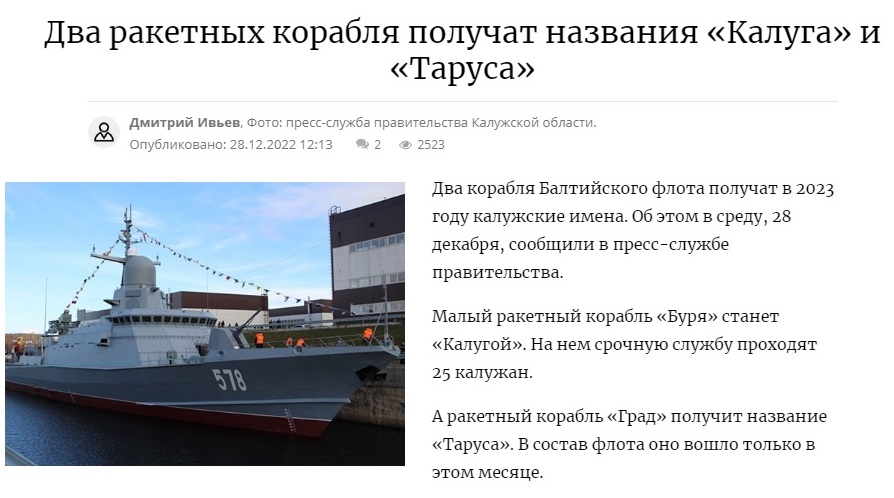
The Buyan-M class (Russian: Буян-М, lit.'Buyan-M'), Russian designation Project 21631 Buyan-M is a series of corvettes (small missile ships by Russian classification) in service with the Russian Navy. All ships of the class were designed by the Zelenodolsk Design Bureau and built by the JSC Zelenodolsk Shipyard in Tatarstan.
Construction began in 2010, and twelve ships were built in total. The lead ship, Grad Sviyazhsk, was commissioned in 2014 and the final ship, Stavropol, in 2025. Ships of the class serve in the Caspian Flotilla and the Baltic and Black Sea fleets, and have transferred between the respective seas via internal waterways. Buyan-M-class corvettes have participated in several deployments during Russia's intervention in the Syrian Civil War and the Russo-Ukrainian war, conducting cruise missile strikes in both conflicts. Several ships have reportedly been damaged during the war in Ukraine.
Characteristics
Structure
The Project 21631 ships are significantly larger than their predecessor, with a full-load displacement of 949 metric tons (934 long tons) compared to 560t (550LT). Ships of the class have a length of 74.1 meters (243ft) rather than 62m (203ft) on the original Buyan.[1][2][3] The Buyan-M-class corvettes also have a beam of 11m (36ft) and a draught of 2.6m (8ft 6in),[1] and a reported standard displacement of 850t (840LT).[4]
Due to their shallow draft and small dimensions, Buyan-M-class corvettes can operate in Russia's inland waterways.[2] The interconnected rivers and canals of Russia's inland waterway system provide routes between the Caspian, Baltic, White and Black seas.[5]
Zelenodolsk shipyard director Renat Mistakhov said in 2015 that the sixth ship (Vyshniy Volochyok) would receive Russian engines.[7] Instead, the next four ships[note 3] were each fitted with four CHD622V20 diesel engines produced by the Chinese company HND.[1][2][8][6]
Later, as part of Russia's drive to replace imported goods with domestic ones, and also because of reported unreliability of the Chinese engines, the final three ships[note 4] of the class received Russian-made 16D49[ru] diesel engines. The engines were made by Kolomna Locomotive Works. The final corvettes also feature gearboxes made by Zvezda[ru], and control systems supplied by NPO Avrora.[2][6]
The Buyan-M class has a reported maximum speed of 25 knots (46km/h; 29mph) and a range of 2,500nmi (4,600km; 2,900mi) at 12 knots (22km/h; 14mph).[1][3] They also have an endurance of ten days.[1][9]
Armament
Main armament
Whereas the original Buyan-class ships are fitted with an A-215 Gradmultiple rocket launcher,[10] Buyan-M units carry an eight-cell 3S-14vertical launching system.[1] The 3S-14 used on the Buyan-M class is intended to carry up to eight Kalibr or Onikscruise missiles. The 3M-14 variant of the Kalibr is used for land-attack, while the 3M-54 Kalibr and Oniks can be used for anti-ship missions, with the latter having supersonic capability.[11][12][3][2] Until its termination in 2019, the Intermediate-Range Nuclear Forces Treaty prohibited its parties from possessing ground-launched ballistic and cruise missiles with ranges of 500–5,500 kilometers (310–3,420mi), but did not restrict sea-launched missiles.[13] The deployment of Kalibr land-attack cruise missiles aboard river-capable Buyan-M corvettes therefore provided Russia with a long-range strike capability not subject to these restrictions.[5] Following a reported eight-missile Kalibr salvo by a Buyan-M-class corvette in 2022, Dmitry Litovkin of the Nezavisimoye Voyennoye Obozreniye argued that the launch demonstrated a Kalibr-carrying ship's capability to expend its entire missile load while remaining operational.[14]
Air defense and artillery
Buyan-M-class corvettes also carry two Gibka-R surface-to-air missile turrets.[15]Janes and USNI's Proceedings describe the turrets used on the Buyan-M class as the Komar.[16][3] According to RATEP[ru]—the Gibka-R's manufacturer—Komar was the name of the development program that led to production of the Gibka-R.[17] The Gibka-R systems on ships of the class are armed with short-range missiles of the Igla family.[1][18][16]
Published accounts of the Gibka-R/Komar system give several launcher configurations. Rosoboronexport describes the Komar as being able to carry four or eight "Igla-type" missiles.[18] Missilery says that the Komar can be fitted with one to four universal launch modules each carrying two Igla-type missiles.[19] The modules are identified by KBM as "Strelets", and the company confirms that they are used on Gibka-R (Komar) turrets.[20] Russianships.info specifies two six-round Gibka launchers for the Buyan-M class.[1]
Although it was rumored that the final ships of the class would receive Pantsir-M CIWS systems as seen on some Karakurt-class corvettes, they retained the existing armament.[2]
Sensors and countermeasures
Buyan-M-class corvettes carry a Pozitivair- and surface-search radar, as well as a MR-231 navigational radar.[1][3] They are also equipped with a MG-757 Anapa-M anti-saboteur sonar, a 3R-14N fire-control system for the Kalibr missiles, and a 5P-10-03 Laska fire-control system for the 100 mm gun. Countermeasures include the PK-10 Smely decoy system.[1]
Development and construction
The Buyan-M project was developed by the Zelenodolsk Design Bureau for the Russian Navy. Ships of the class were built by the JSC Zelenodolsk Shipyard in Tatarstan. The Buyan-M class is an updated missile-carrying variant of the earlier Buyan-class artillery ships.[21][3][2] These corvettes are intended to protect Russia's exclusive economic zone.[22]
Initial plans reported in 2010 called for 8-10 ships of the class to serve with the Caspian Flotilla and the Black Sea Fleet.[23][24] By 2015, the planned total comprised 9 ships, with 3 intended for the Caspian Flotilla and 6 for the Black Sea Fleet.[25][26] On 7 September 2016, the Russian Ministry of Defence contracted for three additional ships, bringing the planned total to 12.[27] Ultimately, all 12 ships of the class were built. The final three were assigned to the Baltic Fleet, which also received two ships—Serpukhov and Zeleny Dol—transferred from the Black Sea Fleet.[2][1]
Grad Sviyazhsk, the lead ship, was laid down on 27 August 2010.[28][29] Its acceptance act was signed in December 2013,[30] and its flag was raised on 27 July 2014.[31] The program continued up until 2025, when the final ship, Stavropol, was commissioned on 28 August.[32]
Russianships.info reports a ship of the Buyan-M-class planned to be built at the Almaz Shipbuilding Company, listing it as cancelled.[1]
Buyan-M-class corvettes, alongside other Russian Navy ships, fired Kalibrcruise missiles in several operations during Russian operations in Syria,[3] marking the first known combat usage of the Kalibr missile system.[14][33][34] The operations demonstrated the long-range land-attack capability available to relatively small Russian warships.[35][36] Buyan-M ships subsequently served on rotation in Russia's Mediterranean Sea Task Force, including deployments near the Syrian coast.[37][38]
October 2015
Russian Ministry of Defence footage of cruise-missile launches from the Caspian Sea, released in October 2015.[39]
On 7 October 2015, the Caspian Flotilla's Buyan-M-class corvettes Grad Sviyazhsk, Uglich, and Velikiy Ustyug participated in a missile strike against Syria along with the Gepard-classfrigateDagestan (the strike group's reported flagship). The four ships launched a total of 26 Kalibr missiles[note 5] at 11 targets in the Raqqa, Aleppo, and Idlibgovernorates of Syria. The missiles reportedly travelled approximately 1,500 kilometers (930 miles) across Iranian and Iraqi airspace to reach Syria.[33][41][40] According to the Russian Ministry of Defense, the missiles were launched overnight from the southwestern Caspian Sea.[34] According to accounts reported by Reuters, the targets included command posts, weapons and ammunition depots, fuel depots, bomb-making facilities, and training camps.[41]Russian Minister of DefenseSergei Shoigu claimed that all 11 targets had been destroyed, with no damage to civilian installations or civilian casualties. The missile strike occurred as Syrian government forces began a ground offensive that was supported by Russian airstrikes.[34][41]
This operation marked the first combat usage of Kalibr.[14][40] USNI described the operation as a demonstration of Russia's ability to conduct long-range naval land attacks while also noting the limitations of older Russian surface ships; ships of the Black Sea Fleet then operating much closer to Syria lacked equivalent land-attack capability.[36] BBC defense correspondent Jonathan Marcus said that Russia's rationale behind its choice of a naval cruise missile strike instead of an airstrike was unclear. He suggested that the strike may have been intended to demonstrate Russia's ability to conduct long-range naval strikes similar to those commonly carried out by the U.S. during overseas interventions.[34] Commander of NORTHCOMWilliam E. Gortney also said that Russia was messaging the U.S. and demonstrating its capability.[35]
On 8 October, reports—citing unnamed U.S. defense officials—alleged that four of the fired missiles had crashed in Iran before reaching Syria.[42][36] Russia denied the allegations, claiming that all 26 missiles had hit their targets. According to Iran's Fars News Agency, the Iranian defence ministry also rejected the reports, describing them as "psychological warfare". The Guardian reported that Pentagon and State Department officials declined to comment.[43] The Russian Ministry of Defense released videos purporting to show targets struck by the missiles, but the footage did not include time or location information.[36]
Footage published by the Russian Ministry of Defense showing ships of the strike group launching Kalibr missiles from the Caspian Sea
November 2015
On 20 November 2015, the same ships—Grad Sviyazhsk, Uglich, Velikiy Ustyug, and Dagestan—launched Kalibr cruise missiles from the Caspian Sea. The ships launched a total of 18 cruise missiles at seven targets in Syria, which, according to Sergei Shoigu, were in the same governorates as the previous strike (Raqqa, Aleppo, and Idlib). Caspian Flotilla deputy commander Captain 1st rank Sergei Yekimov stated that all 18 missiles had been successfully launched and that the results would be reported after assessment data was received. Shoigu stated that all seven targets were hit.[44][45][46][47]
2016
On 13 February 2016, the Black Sea Fleet announced that the Buyan-M-class ship Zeleny Dol had departed for the Mediterranean, armed with Kalibr missiles. RIA Novosti quoted a security source which identified Syria as the ship's destination and suggested that it could participate in Russia's military campaign there.[48] The Zeleny Dol and Serpukhov then fired a combined total of three Kalibr missiles from the eastern Mediterranean at Syria on 19 August.[49]
Russia's Ministry of Defense identified the targets as facilities belonging to Jabhat al-Nusra, which had renamed itself Jabhat Fatah Al-Sham. [50][49] The ministry stated that the targets included a command facility and a camp near Dar Ta Izzah.[51][52] The Associated Press reported the Russian MoD's claim that a mine-making facility and a weapons facility were also among the targets,[49] while other sources reported the ministry's description of a mortar-ammunition manufacturing plant and a warehouse.[52][53] The MoD claimed that the missiles' route was planned over unpopulated areas of Syria to avoid civilian casualties.[53] The ministry announced that all targets had been destroyed, and also released footage of the launches and purported target destruction, together with UAV footage presented as battle-damage assessment.[52][53][49]
After the missile launches, both corvettes returned to their homeport of Sevastopol.[54][55] Russia announced in October that Zeleny Dol and Serpukhov would return to the Mediterranean. Interfax subsequently reported that they would join Admiral Kuznetsov's group. However, the corvettes' northbound movements gave rise to suspicions that Zeleny Dol and Serpukhov were instead heading for the Baltic Sea. By 26 October, both corvettes had entered the Baltic Sea, and the presence was confirmed by ship spotters, NATO, and the Swedish military.[55][12] Russian media reported that they would join the Baltic Fleet,[12] and both corvettes transferred to the Baltic Fleet in October 2016.[4]
2018
In June 2018, Grad Sviyazhsk and Velikiy Ustyug sailed from the Caspian Sea to the Mediterranean through Russia's inland waterways and the Turkish Straits. According to the Eurasian Research Institute, the corvettes passed through the Bosphorus on the 16th and joined the Mediterranean task force on the 17th. During the deployment, Grad Sviyazhsk and Velikiy Ustyug operated with Russia's naval group near Tartus and participated in exercises near the Syrian Coast, including the joint Russian Navy and Aerospace Forces exercise in the Mediterranean in early September 2018. The exercise was announced for 1-8 September, a time of heightened Russian-Western tensions concerning Syria. According to the Southern Military District's account of the event, the ships practiced combat both independently and within a naval group, and conducted artillery firing against air and surface targets. The two corvettes returned to Astrakhan on 16 October 2018. The Southern Military District stated that the deployment was the two ships' first voyage from the Caspian to the Mediterranean, and that they had been away from their homeport for five months.[37][56][57]
Later rotations
Buyan-M-class corvettes continued to serve in the Mediterranean region, joining the permanent task force in rotations. According to Russian state reports, Orekhovo-Zuyevo served starting March 2019,[58] and Uglich and Velikiy Ustyug were in the Mediterranean until mid-October.[59][60]Orekhovo-Zuyevo was reportedly transiting the Turkish Straits to join the Mediterranean task force in April 2020.[61] In 2021, it was reported that Ingushetia had served in the Mediterranean for nearly four months before returning to Crimea.[62]Vyshny Volochyok reportedly began Mediterranean service in October 2021, and the Black Sea Fleet announced that Orekhovo-Zuyevo would replace it in January 2022.[63]Orekhovo-Zuyevo was listed as serving with the task force in February 2024.[64]
Buyan-M-class corvettes participated in the Russo-Ukrainian war as Kalibr cruise-missile carriers. In March 2022, a Buyan-M was reported to have launched all eight of its Kalibr missiles in succession.[14][65] Ukrainian forces also targeted Buyan-M corvettes during the war, including through sabotage and drone attacks. Several Buyan-M-class corvettes have reportedly been damaged during the war.[66][67][68][69]
Pre-2022
A Russian Ministry of Defense news outlet reported that Ingushetia was involved in exercises rehearsing the defense of Crimea in late October 2021. According to the reports, which were carried by the Jamestown Foundation, Ingushetia provided naval fire support alongside the cruiser Moskva, frigate Admiral Grigorovich and several missile boats. The exercise reportedly included suppression of simulated enemy coastal defenses and an amphibious assault supported by aircraft.[62]
Russian strike
Footage published by the Russian Ministry of Defense showing a Buyan-M of the Black Sea Fleet launching four missiles, reportedly Kalibrs
On 22 March 2022, a Buyan-M class corvette of the Black Sea Fleet reportedly fired all eight of its 3M-14 Kalibr missiles at Ukraine. Several videos were released at the time, which The Washington Post suggested were of the Buyan-M strike. Civilian footage showed at least four missiles being fired from the water near Sevastopol, a Russian MoD video shows four explosions above a ship, and a civilian video of eight flares with long trails in the sky appears to show the eight fired missiles. Although footage did not establish the missile type, Center for Strategic and International Studies deputy director Ian Williams said that he was "nearly positive" that the missiles shown in the videos were 3M-14 Kalibrs. According to the Russian MoD, the missiles hit their targets and destroyed a large Ukrainian weapons depot at Orzhev. U.S. officials could not confirm the use of the missiles, and Ukrainian officials did not corroborate the missile strike or the results.[14][65]
Incidents
2022-2024
In mid-June 2022, a photo emerged on an online forum showing a Buyan-M-class corvette being towed on the Volga River in a damaged state. Militarnyi said that the ship was likely the Velikiy Ustyug, even though the ship's name and hull number were painted over. The Militarnyi release claimed that the damage was caused by a Ukrainian attack, but also said that it is unknown how and when the ship was damaged. It suggested that the corvette was likely being taken to the Zelenodolsk Shipyard for repairs.[66][70]
The Security Service of Ukraine (SBU) and the Ukrainian Navy claimed to have attacked a Buyan-M-class corvette[note 6] near Sevastopol on 13 October 2023. The SBU said that the attack was carried out using a Sea Babyunmanned surface vehicle with "experimental weapons". The SBU stated that it had damaged the ship, but did not identify the specific ship or provide further details. Ukrainian officials also reported that a Sea Baby had damaged the Project 22160-classpatrol shipPavel Derzhavin.[71][72][73][74]
Ukrainian military intelligence released a video on 8 April 2024 in which they claimed to have started a fire onboard Serpukhov. The fire, however, reportedly occurred on 7 April. Serpukhov was in harbour at Baltiysk, Kaliningrad Oblast. Ukrainian military intelligence claimed that the fire destroyed "its communication and automation systems."[75] On 3 July 2024, the Defense Intelligence of Ukraine (HUR) revealed details of Operation "Rybalka" ("Fisherman"), which involved a former Russian sailor (reported callsign "Goga") setting fire to Serpukhov on 7 April. According to the HUR account, he also stole data "about the Baltic Fleet and the Russian military industry." The former sailor joined the Freedom of Russia Legion after defecting. HUR estimated Serpukhov would be out of action for six months. Ukraine claimed that the ship was targeted for its ability to fire Kalibr and Onyx missiles.[67][76]The Barents Observer reported that Serpukhov was active again in mid-2025.[77]
2025
On 7 August 2025 the Vyshniy Volochyok collided with the Turkish owned—and Panama-flagged—tanker Nazan in Temryuk Bay. According to purportedly leaked Russian naval report (published on the Russian Telegram channel VChK-OGPU), the corvette was ordered to return to port at 03:59 after reportedly detecting multiple Ukrainian drones. Vyshniy Volochyok struck the tanker at 04:05, as alleged by the account. The report described damages to the corvette's hull and internal structures, and photographs released alongside it also showed structural deformations. The Russian Navy classified the incident as a "ship control accident" and stated that the ship remained operational even after the collision.[78][79][80][81][68]
The HUR claimed to have struck a Buyan-M-class corvette in the Sea of Azov near Crimea on 28 August 2025. According to reports, the corvette was in Temryuk Bay and within range of launching Kalibr missiles at Ukrainian territory. HUR released footage of a drone attack on a Buyan-M's radar and main hull, allegedly showing the 28 August attack. HUR said that the corvette sustained significant damage from the attack. It claimed that the attack prevented a planned Kalibr strike and caused the corvette to withdraw from its "combat-duty area".[82][83][84][85]
On 4 October 2025, the Ukrainian Special Forces (SSO) reported that it had struck Grad on Lake Onega. The SSO said that the attack occurred at 04:31 local time, while Grad was sailing from the Baltic Sea to the Caspian Sea (far from Ukraine). It claimed a hit to the starboard side of the ship's power-plant compartment, but further assessments were unavailable at the time of the initial report.[69][86] A Russian Ministry of Defense report, (carried by PortNews in a 14 a May 2026 release) claimed that the Grad was active and had completed artillery firings in the Baltic Sea, not mentioning the recent attack.[87] A week later, on 27 May, Ukraine released a video of the strike. The video shows a fire amidships on the corvette as well as Russian sailors jumping overboard. In a release publishing the video, Militarnyi clarified that drones were used for the attack, and asserted that Grad was destroyed.[88]
2026
Ukrainian forces conducted a drone and missile strike on the Russian Port of Novorossiysk on 9 September 2026. Ukraine said it had struck a Buyan-M-class corvette, along with the Admiral Grigorovich-class frigates Admiral Essen and Admiral Makarov. The strike was reportedly the first instance of a Long Neptune (the missile used for the attack) missile being used to strike a ship. Satellite imagery provided by Exilenova+ showed damage to the Buyan-M as well as other ships.[89]
The SBU said that it and other Ukrainian defense forces struck the Naro-Fominsk with drones.[90] The attack occurred overnight into 11 November 2026, during a wider strike directed at Russia's Leningrad Oblast.[91] The attack reportedly took place near Gogland in the Gulf of Finland.[90] According to a Russian Telegram channel cited by The Insider, Naro-Fominsk subsequently headed toward Kronstadt under its own power; the extent of damage was unknown.[92] Finnish authorities confirmed that a Russian naval vessel had been struck in the Gulf of Finland.[93] Estonian Defence Minister Martin Herem said that the EDF observed an explosion aboard a Russian Baltic Fleet vessel at approximately 05:30, followed by smoke and the ship's departure toward Saint Petersburg. Herem also reported drone incursions into Estonian airspace during the wider operation and said that Estonia had not authorized its airspace to be used for military operations.[94] The attack was allegedly the first Ukrainian attack on a Russian warship at sea in the Baltic region.[95]
Ships
Hull numbers and yard numbers from Russianships.info.[1]
Active; reportedly damaged by sabotage in 2024 but participating in exercises in the Baltic as of 2025[77], reportedly having originally served in the Black Sea Fleet until 1 November 2016[1]
Active; reported struck by Ukrainian attack in October 2025; damage uncertain.[68] As of May 2026, Ukraine claims destroyed,[88] Russia claims active[87]
↑На «Великом Устюге» поднят Андреевский флаг[At the Zelenodolsk plant named after A.M. Gorky, the laying down of the third MRK of the Buyan type will take place]. vpk-news.ru (in Russian). 19 December 2014. Archived from the original on 24 December 2014. Retrieved 9 October 2015.
This page is based on this Wikipedia article Text is available under the CC BY-SA 4.0 license; additional terms may apply. Images, videos and audio are available under their respective licenses.

 Russian Navy