Chief Minister of Gujarat

Last updated

Chief Minister of Gujarat
Gujarat Mukhyamantri
Government Of Gujarat Seal In All Languages.svg
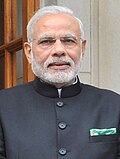
Chief Minister of Gujarat, Shri Bhupendra Patel (2).jpg
since 13 September 2021
Government of Gujarat
Style The Honourable
Status Head of Government
Member of
Residence Bungalow No. 26, Ministers’ Enclave, Sector-20, Gandhinagar
Appointer Governor of Gujarat
Term length 5 years subject to the confidence of the assembly
No term limits
Inaugural holder Jivraj Narayan Mehta
Formation1 May 1960
(65 years ago)
 (1960-05-01)
Deputy Deputy Chief Minister of Gujarat
Website http://cmogujarat.gov.in/

The Chief Minister of Gujarat is the head of government of the Indian state of Gujarat. As per the Constitution of India, the governor of Gujarat is the state's de jure head, but de facto executive authority rests with the chief minister, a template applicable to all other Indian states. Following elections to the Gujarat Legislative Assembly, the governor usually invites the political party (or a coalition of political parties) with a majority of assembly seats to form the government in the state. The governor appoints the chief minister, whose council of ministers is collectively responsible to the assembly. Given that they have the confidence of the assembly, the chief minister's term is for five years, renewable, and is subject to no term limits. [1]

Contents

The state of Gujarat was created on 1 May 1960, composed of the Gujarati-speaking districts of Bombay State. Jivraj Narayan Mehta of the Indian National Congress was the inaugural chief minister of the state. Narendra Modi of the Bharatiya Janata Party (BJP), whose term extended for more than 12 years from December 2002 to May 2014, has been the longest serving chief minister. He resigned to become the 14th prime minister of India, and was succeeded by Anandiben Patel, who was the state's first woman chief minister. The incumbent chief minister is Bhupendrabhai Patel of the BJP since 13 September 2021. [2]

Predecessors

Following the Indian Independence in 1947, the province of Bombay was established from the erstwhile Bombay Presidency. The Bombay State was created in 1950 following the adoption of the Constitution of India which included parts of Baroda, Western India and Gujarat States Agency (part of present-day Gujarat). [3] During the reorganisation of Indian states in 1956, the Saurashtra and Kutch States (part of present-day Gujarat) were added to Bombay State. [4]

Prime Minister of Kathiawar/Saurashtra (1948-50)

NoPortraitName Constituency Term of officeAssembly

(election)

Party
1 U. N. Dhebar.png U. N. Dhebar 15 February 194826 January 19501 year, 345 daysInterim Indian National Congress

Chief Minister of Saurashtra (1950-56)

NoPortraitName Constituency Term of officeAssembly

(election)

Party
1 U. N. Dhebar.png U. N. Dhebar 26 January 195019 December 19544 years, 327 daysInterim Indian National Congress
2nd

(1952 election)

2 Rasiklal Parikh 19 December 195431 October 19561 year, 317 days

Chief Minister of Bombay (1947-60)

Chief Ministers of Gujarat

The state of Gujarat was created on 1 May 1960, composed of the Gujarati-speaking districts of Bombay State following the Mahagujarat Movement. [5]

NoPortraitName Constituency Term of office Assembly

(election)

Party [a]
1 Jivraj Mehta.jpg Jivraj Mehta Amreli 1 May 19608 March 19623 years, 141 days1st
(1957 election)
Indian National Congress
8 March 196219 September 19632nd
(1962 election)
2 Balwantrai Mehta 2000 stamp of India (cropped).jpg Balwantrai Mehta Bhavnagar 19 September 196319 September 19652 years, 0 days
3 Hitendra Desai Lok Sabha photo.jpg Hitendra Desai Olpad 19 September 19653 April 19675 years, 236 days
3 April 196712 November 19693rd
(1967 election)
12 November 196913 May 1971 Indian National Congress (O)
Emblem of India.svg Vacant [b]
(President's rule)
N/A13 May 197117 March 1972309 daysDissolvedN/A
4 Ghanshyam Oza Lok Sabha photo.jpg Ghanshyam Oza Dahegam 17 March 197217 July 19731 year, 122 days4th
(1972 election)
Indian National Congress
5 Chimanbhai Patel Sankheda 17 July 19739 February 1974207 days
Emblem of India.svg Vacant [b]
(President's rule)
N/A9 February 197418 June 19751 year, 129 daysDissolvedN/A
6 Babubhai Patel Sabarmati 18 June 197512 March 1976268 days5th
(1975 election)
Indian National Congress (O)
Emblem of India.svg Vacant [b]
(President's rule)
N/A12 March 197624 December 1976287 daysN/A
7 Madhavsinh Solanki.jpg Madhav Singh Solanki Bhadran 24 December 197611 April 1977108 days Indian National Congress
(6) Babubhai Patel Sabarmati 11 April 197717 February 19802 years, 312 days Janata Party
Emblem of India.svg Vacant [b]
(President's rule)
N/A17 February 19807 June 1980111 daysN/A
(7) Madhavsinh Solanki.jpg Madhav Singh Solanki Bhadran 7 June 198010 March 19855 years, 29 days6th
(1980 election)
Indian National Congress
11 March 19856 July 19857th

(1985 election)

8 Amarsinh Chaudhary Lok Sabha photo.jpg Amarsinh Chaudhary Vyara 6 July 198510 December 19894 years, 157 days
(7) Madhavsinh Solanki.jpg Madhav Singh Solanki Bhadran 10 December 19894 March 199084 days
(5) Chimanbhai Patel Sankheda 4 March 199025 October 19903 years, 350 days8th
(1990 election)
Janata Dal
25 October 199017 February 1994 Indian National Congress
9 Chhabildas Mehta Mahuva 17 February 199414 March 19951 year, 25 days
10 Keshubhai Patel.jpg Keshubhai Patel Visavadar 14 March 199521 October 1995221 days9th
(1995 election)
Bharatiya Janata Party
11 Suresh Mehta Mandvi 21 October 199519 September 1996334 days
Emblem of India.svg Vacant [b]
(President's rule)
N/A19 September 199623 October 199634 daysN/A
12 Shankersinh Vaghela profile (cropped).jpg Shankersinh Vaghela Radhanpur 23 October 199627 October 19971 year, 4 days Rashtriya Janata Party
13 Dilip Parikh Dhandhuka 27 October 19974 March 1998128 days
(10) Keshubhai Patel.jpg Keshubhai Patel Visavadar 4 March 19987 October 20013 years, 217 days10th
(1998 election)
Bharatiya Janata Party
14 PM Modi Portrait(cropped).jpg Narendra Modi Rajkot West 7 October 200122 December 200212 years, 227 days
Maninagar 22 December 200222 December 200711th
(2002 election)
23 December 200720 December 201212th
(2007 election)
20 December 201222 May 201413th
(2012 election)
15 Anandiben Patel Ji.jpg Anandiben Patel Ghatlodia 22 May 20147 August 20162 years, 77 days
16 Vijay Rupani.jpg Vijay Rupani Rajkot West 7 August 201626 December 20175 years, 37 days
26 December 201713 September 2021 14th
(2017 election)
17 Bhupendra PAtel Sanskrit (cropped).jpg Bhupendrabhai Patel Ghatlodia 13 September 202112 December 20224 years, 113 days
12 December 2022Incumbent 15th
(2022 election)

Statistics

Fraction of time of holding CMO by party (as of September 2025)
  1. Bharatiya Janata Party (43.7%)
  2. Indian National Congress (40.1%)
  3. Janata Party (4.42%)
  4. Indian National Congress (O) (3.46%)
  5. Rashtriya Janata Party (2.11%)
  6. Janata Dal (1.00%)
  7. President's Rule (5.25%)

Timeline

Bhupendrabhai PatelVijay RupaniAnandiben PatelNarendra ModiDilip ParikhShankersinh VaghelaSuresh MehtaKeshubhai PatelChhabildas MehtaAmarsinh ChaudharyMadhav Singh SolankiBabubhai J. PatelChimanbhai PatelGhanshyam OzaHitendra Kanaiyalal DesaiBalwantrai MehtaJivraj Narayan MehtaChief Minister of Gujarat

Notes

  1. This column only names the chief minister's party. The state government he heads may be a complex coalition of several parties and independents; these are not listed here.
  2. 1 2 3 4 5 President's rule may be imposed when the "government in a state is not able to function as per the Constitution", which often happens because no party or coalition has a majority in the assembly. When President's rule is in force in a state, its council of ministers stands dissolved. The office of chief minister thus lies vacant, and the administration is taken over by the governor, who functions on behalf of the central government. At times, the legislative assembly also stands dissolved. [6]

Reference

  1. Durga Das Basu (1960). Introduction to the Constitution of India (20 ed.). LexisNexis Butterworths Wadhwa. pp. 241–245. ISBN   978-81-8038-559-9. Although the text talks about Indian state governments in general, it applies for the specific case of Gujarat as well.{{cite book}}: ISBN / Date incompatibility (help)
  2. "Gujarat chief minister Vijay Rupani submits resignation". The Times of India . 11 September 2016. Retrieved 11 September 2021.
  3. Desai, S. H. (1972). A critical study of the development of secondary education for girls in Gujarat its history and present day problems. Maharaja Sayajirao University of Baroda. pp. 411–420. hdl:10603/57937.
  4. "The States Reorganisation Act, 1956" (PDF). India Code. 31 August 1956. Archived from the original (PDF) on 24 May 2018.
  5. "Gujarat". Government of India . Retrieved 16 January 2008.
  6. "A dummy's guide to President's rule". Rediff.com. 15 March 2005.