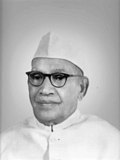
| Chief Minister of Kerala | |
|---|---|
| Kēraḷa Mukhyamantri | |
 | |
 | |
| Chief Minister's Office Government of Kerala | |
| Style | The Honourable (formal) Mr./Mrs. Chief Minister (informal) |
| Type | Leader of the Executive |
| Status | Head of government |
| Abbreviation | CMoKerala |
| Member of | |
| Reports to | |
| Residence | Cliff House, Thiruvananthapuram |
| Seat | State Secretariat, Thiruvananthapuram |
| Nominator | Members of the Kerala Legislative Assembly |
| Appointer | Governor of Kerala by convention, based on appointee's ability to command confidence in the Niyama Sabha |
| Term length | At the pleasure of the governor of Kerala [1]
|
| Constituting instrument | Article 164 of the Constitution of India |
| Precursor | Prime Minister of Travancore Prime Minister of Kingdom of Cochin Chief Minister of Madras Chief Minister of Travancore-Cochin |
| Formation | 5 April 1957 |
| First holder | E. M. S. Namboodiripad (1957–1959) |
| Deputy | Deputy Chief Minister of Kerala |
| Salary |
|
| Website | keralacm |

The Chief Minister of Kerala is the head of government of the Indian state of Kerala. As per the Constitution of India, the state's governor is the state's de jure head, and the de facto executive authority rests with the chief minister. Following elections to the Kerala Legislative Assembly, the governor usually invites the party (or coalition) with a majority of seats to form the government. The governor appoints the chief minister, whose council of ministers are collectively responsible to the assembly. Given that he has the confidence of the assembly, the chief minister's term is for five years and is subject to no term limits. [2] Usually, the chief minister also serves as leader of the house in the legislative assembly. [3]
Contents
- Predecessors
- Prime ministers of Travancore (1948–49)
- Prime ministers of Cochin (1947–49)
- Prime ministers of Travancore-Cochin (1949–50)
- Chief ministers of Travancore-Cochin (1950–56)
- List of chief ministers
- Statistics
- Timeline
- See also
- Notes
- References
- Further reading
- External links
Following India's independence from the British Raj in 1947, the states' monarchs of Travancore (Thiruvithāmkōr) and Cochin (Kochi) instituted a measure of representative government, headed by a prime minister and his council of ministers. On 1 July 1949, Travancore and Cochin were merged to form Travancore-Cochin state. The Malabar and Kasaragod region of South Canara, which together constitute more than half of present state of Kerala, had their representatives in the Madras Legislative Assembly. On 1 November 1956, the States Reorganisation Act redrew India's map along linguistic lines, and the present-day state of Kerala was born, consisting of Malayalam-speaking regions, by merging the Malabar, and Kasaragod districts with Travancore-Cochin. [4]
The first assembly election in Kerala was held in February–March 1957, and the first Kerala Legislative Assembly was formed on 5 April 1957. The assembly had 127 members including a nominated member. [4] E. M. S. Namboodiripad of the Communist Party of India, was the first chief minister, and his tenure was cut short by the imposition of President's rule. Since then, 12 people have served as the chief minister of Kerala. E. K. Nayanar held the office for 10 years and 353 days, and is the longest serving holder of the office. Karunakaran was sworn-in as the chief minister four times. A. K. Antony was the youngest to hold the office at age of 36 years, and V. S. Achuthanandan was the oldest to be sworn in at the age of 82 years. The state has come under President's rule seven times, with the last of them occurring in 1982. Since the 1980s, the office of the chief minister has generally alternated between the leaders of the Indian National Congress and of the Communist Party of India (Marxist).
Pinarayi Vijayan is the incumbent chief minister since 25 May 2016, and is the first chief minister from Kerala to be re-elected after completing a full term of 5 years.