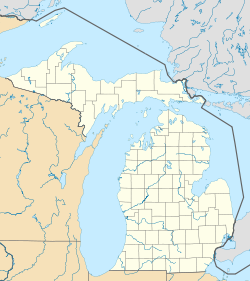
Dexter is administered separately from Dexter Township, which sits northwest of the city and includes the unincorporated communities of Dover and Hudson Mills.
History
The area that became Dexter was settled in 1824 by land speculator and lawyer Samuel W. Dexter, who purchased a tract of land at the confluence of Mill Creek and the Huron River.[6] Dexter was the village's first postmaster and became the first chief justice of Washtenaw County when it was formally organized in 1826. The settlement, originally known as the MillCreekSettlement, was officially platted in 1830 and renamed Dexter in honor of Dexter's father, Samuel Dexter, a former U.S. senator and cabinet member under President John Adams.[7]
In the early 1840s, Dexter built a Greek Revival-style residence northwest of the village known as Gordon Hall (named after Dexter's mother, Catherine Gordon Dexter), which has since become a prominent local landmark.[8] The property has been associated by historians with abolitionist activity and possible involvement with the Underground Railroad[9]. Gordon Hall was listed on the National Register of Historic Places in 1972.[10][11]
On March 20, 1966, the Dexter area was the site of a widely reported unidentified flying object sighting that received national media coverage.[12][13] Multiple residents and law enforcement officers reported sightings of unexplained lights near marshlands north of Dexter. Working as a U.S. Air Force consultant, astronomerJ. Allen Hynek attributed the sightings to atmospheric phenomena he described as "swamp gas". The explanation was met with plenty of skepticism and prompted then-CongressmanGerald R. Ford to call for a congressional investigation. The incident remains a notable episode in Dexter's modern history and reputation.
Tornado outside of Brass Creek
On March 15, 2012, an EF3 tornado struck Dexter and the surrounding area of Washtenaw County, producing wind speeds estimated at 135-140 mph and carving a path of damage over seven miles long.[14] More than 250 residences were affected, and the area faced losses of approximately $12 million. No fatalities or serious injuries were reported, but the event was the most destructive tornado to impact Washtenaw County in decades and prompted a federal disaster response.[15]
Dexter residents voted on November 4, 2014, to adopt a city charter under Michigan's Home Rule Act, ending the municipality's status as a village.[16] Officials cited increased administrative efficiency and the benefits of unified governance as primary motivations for the change, which was nearly a decade in the making.[17]
Geography
According to the U.S. Census Bureau, Dexter has a total area of 1.97 square miles (5.10km2), of which 1.94 square miles (5.02km2) is land and 0.03 square miles (0.08km2) (1.52%) is water.[1]
As of the 2020 census[21], the population of Dexter was 4,500. The population density was 2,284.3 inhabitants per square mile (882.0/km2). There were 1,864 housing units at an average density of 946.2 per square mile (365.3/km2). Dexter's racial makeup is 88.3% White, 0.6% African American, 2.7% Asian, 1.1% from other races, and 7.2% from two or more races. Hispanic or Latino people of any race make up 4.8% of the population. Dexter's population grew 10.6% from 2010 to 2020.
The median age in the city was 43.4 years, and the gender makeup was 49.8% male and 50.2% female. 28.2% of residents were under the age of 18; 7.7% were between the ages of 18 and 24; 15.2% were from 25 to 44; 27.2% were from 45 to 64; and 21.7% were 65 years of age or older.
Of the 1,840 households, 639 (34.7%) had children under the age of 18 living with them. 939 (51.0%) were married couples living together, 226 (12.3%) had a female householder with no husband present, 95 (5.2%) had a male householder with no wife present, and 580 (31.5%) were non-families. 27.1% of all households were made up of individuals, and 14.4% had someone living alone who was 65 years of age or older. The average household size was 2.46, and the average family size was 2.98.
As of the 2010 census[23], there were 4,067 people, 1,590 households, and 1,067 families residing in the city. The population density was 2,174.9 inhabitants per square mile (839.7/km2). There were 1,704 housing units at an average density of 911.2 per square mile (351.8/km2). The racial makeup of the city was 92.7% White, 1.1% African American, 0.4% Native American, 2.8% Asian, 0.8% from other races, and 2.2% from two or more races. Hispanic or Latino people of any race were 2.8% of the population. Dexter's population grew 62.9% from 2000 to 2010, the largest growth in the state during that period.[24]
The median age in the city was 36.2 years, and the gender makeup was 47.1% male and 52.9% female. 31% of residents were under the age of 18; 4.8% were between the ages of 18 and 24; 32.6% were from 25 to 44; 23.2% were from 45 to 64; and 8.6% were 65 years of age or older.
There were 1,590 households, of which 42.6% had children under the age of 18 living with them, 51.8% were married couples living together, 12.3% had a female householder with no husband present, 3.1% had a male householder with no wife present, and 32.9% were non-families. 28.2% of all households were made up of individuals, and 8.7% had someone living alone who was 65 years of age or older. The average household size was 2.56, and the average family size was 3.20.
2000 census
At the 2000 census,[2] there were 2,338 people, 1,013 households, and 641 families residing in the city. The population density was 1,236.7 inhabitants per square mile (477.5/km2). There were 1,106 housing units at an average density of 585.0 per square mile (225.9/km2). The racial makeup of the city was 96.58% White, 0.43% African American, 0.30% Native American, 1.03% Asian, 0.26% from other races, and 1.41% from two or more races. Hispanic or Latino people of any race were 0.98% of the population.
The median age in the city was 34 years, and the gender makeup was 48.7% male and 51.3% female. 26.4% of the population were under the age of 18, 6.6% from 18 to 24, 38.1% from 25 to 44, 19.0% from 45 to 64, and 9.8% were 65 years of age or older.
There were 1,013 households, of which 34.5% had children under the age of 18 living with them, 46.6% were married couples living together, 13.2% had a female householder with no husband present, and 36.7% were non-families. 32.3% of all households were made up of individuals, and 9.0% had someone living alone who was 65 years of age or older. The average household size was 2.31, and the average family size was 2.92.
The median household income was $50,510, and the median family income was $62,697. About 2.8% of families and 4.5% of the population were below the poverty line, including 6.3% of those under age 18 and 3.7% of those age 65 or over.
Government
Dexter operates under a council–manager form of government, with legislative authority held by an elected mayor and six elected council members (all nonpartisan) and day-to-day administration handled by a council-appointed city manager.[25]
Shawn Keough was elected as the city’s first mayor following Dexter’s incorporation as a city in 2014, after having served as village president since 2007.[26] Keough was reelected to a second four-year term in 2022.[27] As of 2026, Dexter's six city council members are Sanam Aldag, Wa-Louisa Hubbard, Pavlo Popov, Daniel Schlaff, Joseph Semifero, and Ray Tell. Two Dexter area students are appointed for one-year terms as student representatives to the council.[28][29] Justin Breyer has been the city manager since 2021.[30]
In addition to elected and administrative officials, Dexter maintains several appointed boards and commissions to assist with municipal governance and planning, including the Planning Commission, Downtown Development Authority, Parks and Recreation Commission, Tree Board, and Zoning Board of Appeals.[31] Fire and rescue services are contracted to the Dexter Area Fire Department, while law enforcement services are contracted to the Washtenaw County Sheriff’s Office.[32] The city operates municipal water and wastewater systems through its Department of Public Services.[33]
Transportation
The Western-Washtenaw Area Value Express (WAVE) Community Connector Bus[34] stops at several Dexter locations daily and on weekends. Its regular route travels between Chelsea and Ann Arbor, where it transfers to Ann Arbor Area Transportation Authority (TheRide) Bus #30.
Downtown Dexter's main thoroughfares were originally known as A, B, C, D, and E Streets. Today, these are known as Alpine, Broad, Central, Dover, and Edison Streets.[35] Residential areas in Dexter include the original settlements along Baker Road, Central Street, and Dexter-Ann Arbor Road, as well as newer subdivisions and condominiums. The city has 411 on-street public parking spaces and more than 300 spaces across six public parking lots, the largest of which (Main St.) has 175 spaces. Parking is free throughout the city.[36]
Dexter-Ann Arbor Road, the primary roadway between the two cities, was originally designated statehighway M-132 in 1931 as part of an early network of spur routes intended to improve regional connectivity. The route lost its state highway status and was returned to local control in 1960 after the expansion of the Interstate and freeway systems.[37] The Chicago-Montreal Highway, proposed by state officials in the 1930s to stretch from New Buffalo to Port Huron, was planned to pass through Dexter as part of a new diagonal trunkline route. With the exception of a few constructed bypasses, no work on the Chicago-Montreal Highway was ever completed.[38]
The city used to have a train depot, built around 1840 when the Central Railroad of Michigan from Detroit ended there, but no trains currently stop in Dexter. Today, the station is home to the Ann Arbor Model Railroad Club.[39]Amtrak's Wolverine service between Chicago and Pontiac travels through the city, with a stop in nearby Ann Arbor.[40][41]
Dexter is also served by several nearby private and charter schools, including Daycroft School, Emerson School, and Honey Creek Community School.[43][44][45] The Dexter Cooperative Nursery School is a non-profit community-run preschool.[46]
The Encore Musical Theatre Company was founded in 2008 by Broadway actor and Michigan native Dan Cooney, along with Anne and Paul Koch, at 3126 Broad Street.[48] The company operates as a nonprofit organization and stages professional musical theatre productions featuring a mix of Broadway performers and local talent. Encore is recognized by the Actors' Equity Association. In 2020, Encore purchased the historic Copeland Building at 7714 Ann Arbor Street from Dexter Community Schools as part of a long-term plan to establish a permanent performance venue in downtown Dexter.[49]
The Dexter Area Historical Society preserves the city's local history through exhibits, educational programming, and public events. The organization is involved in the stewardship of historic properties and supports community efforts to document and share Dexter’s historical and cultural heritage.[50]
The Dexter Summer Festival is an annual community festival held in downtown Dexter. Formerly called Dexter Daze, the event was rebranded in 2024. The two-day summer celebration features live music, food vendors, artisans from across Michigan, games, and family-friendly activities, and is one of the city’s largest recurring community events.[51][52]
The Dexter Cider Mill, established in 1886, claims to be the oldest continuously operating cider mill in the state. Located along the Huron River, it serves as a popular attraction for residents and visitors.[53][54]
Media
The Sun Times News, a weeklynewspaper covering Dexter, Chelsea, and other nearby cities in Washtenaw County, is the primary print newspaper dedicated to Dexter. The paper is delivered for free to over 30,000 residences and over 1,500 businesses in the area.[55] In 2025, the SunTimes was acquired by TrUiC (The Really Useful Information Company)[56], which assumed responsibility for the paper's business operations.[57]
The Dexter Leader was a weekly newspaper founded in 1869.[58] In 1995, it was absorbed by the ChelseaStandard[59] after Detroit-based Heritage Newspapers purchased both papers from Walter and Helen Leonard, a married couple who had owned and operated both papers since 1947.[60][61] The Standard and Leader were sold six years later, along with the Saline Reporter, Milan News-Leader,Manchester Enterprise, andYpsilanti Courier, after the death of Heritage owner and founder Heinz Prechter in 2001. The papers passed through bankruptcy and various stages of ownership, eventually merging into a single publication, WashtenawNow, under the ownership of Digital First Media, a newspaper publisher owned by hedge fund Alden Global Capital. WashtenawNow shut down in June 2015 after just 14 months of publication.[62][63][64]
Regional coverage of Dexter is also provided by The Ann Arbor News through MLive.com, which regularly reports on Dexter-area government, development, and community events. Other newspapers in the general Washtenaw County area, like the independently-owned ChelseaGuardian and SalinePost, cover regional topics affecting the Dexter community.
Dexter High School publishes The Squall, a student-run newspaper that primarily serves the school community but offers subscriptions to local residents.
Athletics
Monument Park
Dexter High School is home to a successful boys' cross country team. The team won five consecutive Michigan High School Athletic Association state championships from 2002 to 2006, tying the state record for most consecutive titles.[65] Other notable high school sports programs include football, field hockey, soccer, and water polo.[66]
Founded in 1978, the Dexter Ringers Horseshoe Club is a long-running competitive horseshoe league that plays its annual summer season at First Street Park on Edison Street in Dexter. The club welcomes participants from Dexter and surrounding communities and donates the proceeds from each season to charitable causes.[67]
The Dexter Baseball Club, which later became Dexter Little League (DLL)[68], was formed in 2003 and is the local youth baseball and softball organization serving the Dexter area. The DLL hosted the 8-10 boys' state baseball tournament in 2019.[69]
Since 2011, Dexter has been home to a vintage base ball team, the Union Base Ball Club of Dexter, which competes using 19th-century rules, uniforms, and equipment.[70]
This page is based on this Wikipedia article Text is available under the CC BY-SA 4.0 license; additional terms may apply. Images, videos and audio are available under their respective licenses.