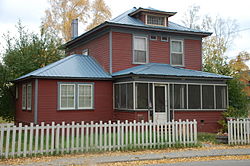
Fairbanks is a home rule city and the borough seat of the Fairbanks North Star Borough in the U.S. state of Alaska.

Chena was a former city in interior Alaska, located in the Fairbanks North Star Borough, Alaska, United States, near the confluence of the Chena and Tanana rivers. It incorporated in 1903 and was disincorporated in 1973. The area is now part of the outskirts of Fairbanks, within the CDP of Chena Ridge. Its heyday was in the first two decades of the 20th century, with a peak population of about 400 in 1907. By 1910 the population had fallen to 138.

The Tanana Valley Railroad (TVRR) was a 3 ft narrow gauge railroad that operated in the Tanana Valley of Alaska from 1905 to about 1917. A portion of the railroad later became part of the Alaska Railroad.

SS Nenana is a five-deck, western river, sternwheel paddleship. Two-hundred and thirty-seven feet in overall length, with a 42-foot beam, she was rated at 1,000 gross tons register. Nenana was built at Nenana, Alaska, and launched in May 1933. Marine architect W.C. Nickum of Seattle designed the sternwheeler, which was prefabricated in Seattle and put together at Nenana, Alaska, by Berg Shipbuilding Company. Nenana was built to serve as a packet. She could carry both passengers and freight. Nenana had accommodations for 48 passengers on her saloon deck. Up to 300 tons of freight, including two tons in cold storage, could be carried on her main deck. A Texas, topped by a pilothouse mounted forward in poolboat style, provided staterooms for a portion of the crew of 32. Nenana could push five or six barges on the Yukon River; but, because of sharp bends, only one on the Tanana River.

The Murie Ranch Historic District, also known as the STS Dude Ranch and Stella Woodbury Summer Home is an inholding in Grand Teton National Park near Moose, Wyoming. The district is chiefly significant for its association with the conservationists Olaus Murie, his wife Margaret (Mardy) Murie and scientist Adolph Murie and his wife Louise. Olaus and Adolph Murie were influential in the establishment of an ecological approach to wildlife management, while Mardy Murie was influential because of her huge conservation victories such as passing the Alaska National Interest Lands Conservation Act of 1980 and being awarded with the highest civilian honor, the Presidential Medal of Freedom, for her lifetime works in conservation. Olaus Murie was a prominent early field biologist in the U.S. Biological Survey and subsequent U.S. Fish and Wildlife Service before retiring and becoming the president of the Wilderness Society, He was a prominent advocate for the preservation of wild lands in America.

The history of Fairbanks, the second-largest city in Alaska, can be traced to the founding of a trading post by E.T. Barnette on the south bank of the Chena River on August 26, 1901. The area had seen human occupation since at least the last ice age, but a permanent settlement was not established at the site of Fairbanks until the start of the 20th century.

The Masonic Temple was a historic two-story wooden building at 809 1st Avenue, near the Chena River in Fairbanks, Alaska. It was built in 1906, expanded in 1908, and further altered in 1913 and 1916. Its architecture was "eclectic Renaissance Revival", a style that had been popular in the "lower 48" United States in the 1880s and 1890s. It was listed on the National Register of Historic Places in 1980.

The Immaculate Conception Church is a historic church and former cathedral at 115 N. Cushman Street in Fairbanks, Alaska, United States.
The Whitney Section House, also known as Whitney Station, is a historic railroad-related building in Wasilla, Alaska. It is a single-story wood-frame structure, which was built in 1917 by the Alaska Railroad. It originally stood at mile 119.1, about 4.8 miles (7.7 km) north of Anchorage Station, and was one of a series built by the railroad and located at roughly ten-mile intervals. The area where it stood was taken by the federal government for Elmendorf Air Force Base, and was rescued from demolition by the local chapter of the National Railroad Historical Society. It now stands on the grounds of the Alaska Museum of Transportation and Industry in Wasilla, and has seen a variety of uses.

The Chicken Historic District encompasses part of the historic mining district of Chicken, Alaska. It is located at milepost 66.5 on the north side of the Taylor Highway, and includes fifteen buildings built between 1908 and 1967. Most of these are single-story wood-frame structures, with either metal or board-and-batten siding, although there are also some log structures. Many of these buildings were erected by the Fairbanks Exploration Company, which ran the gold mining operations in the area. Notable buildings include the bunkhouse, a gabled log structure, and the Chicken Creek Roadhouse, built in 1906, which was originally two stories in height but was reduced to a single story in 1924. The district also includes a section of water pipeline built by the company to bring water to the area from Mosquito Creek, a distance of about 1 mile (1.6 km). The camp was used until the company ended mining operations in 1967.
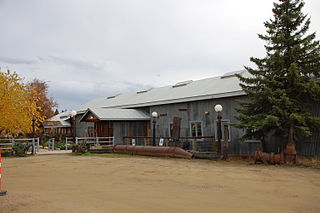
The Chena Pump House, also known just as the Pump House Restaurant, is a restaurant at 796 Chena Pump Road in Fairbanks, Alaska. The restaurant is located in the shell of a 1933 pumping station established by the Fairbanks Exploration Company, Alaska's largest gold mining operator at the time. The pump house was used to provide water to dredges operating on Cripple Creek in the Ester area. The building was abandoned by the company in 1958, and was enlarged and converted into a restaurant in 1978. It was listed on the National Register of Historic Places in 1982.
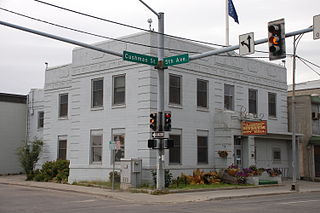
The Old City Hall, now the Fairbanks Distilling Company, is a historic civic building at 410 Cushman Street in Fairbanks, Alaska. It is a two-story Art Deco structure, built out of reinforced concrete in 1935 as a fireproof alternative to the city's previous city hall. The building is roughly T-shaped, with quoining patterns incised in the corners and bands of decoration on a parapet level. The building was originally built to house city offices as well as police and fire stations; the entrances to the fire equipment bays on Cushman Street have been filled in with wood framing and siding. The building was enlarged by extensions to the rear twice, once before 1950, and once after the 1967 floods. The city moved its offices to the adjacent Main School in 1994; the building then housed the Fairbanks Community Museum until it was acquired by Fairbanks Distilling Company in July 2014.

The Fairbanks Exploration Company was the major economic force in the growth of Fairbanks, Alaska during its gold rush years in the early 20th century. In the 1920s the company built a number of housing units for its workers. A cluster of at least eight of these is known to have survived on the east side of Illinois Street, of which four have retained historical integrity. Located at 505, 507, 521, and 523 Illinois Street, they are all similarly built Bungalow-style wood-frame buildings, 1+1⁄2 stories in height, with a hip roof and projecting hipped wings. The complex includes a five-stall garage which served all four houses, as well as two greenhouses. At the time of their listing on the National Register of Historic Places in 1997, this group of houses was being rehabilitated for use as a bed and breakfast inn.

The Fairbanks Exploration Company Machine Shop is a historic machine shop in Fairbanks, Alaska, United States. Located behind the Fairbanks Exploration Company administration building at 612 Illinois Street, it is a large single-story steel-frame structure, built in 1927 to serve the company's nearby gold mining operations. Its easternmost section is 16 feet (4.9 m) high, while that on the west is 20 feet (6.1 m) high, in order to accommodate belt-driven equipment and cranes. A tall double door at the center of the east facade is the main entrance. The front of the building housed large belt-driven lathes, while the center had a welding shop, drill presses, and a tool room. A blacksmithy in the back had a sand floor. The building was used by the F.E. Company between 1927 and 1964.

The Fairbanks Exploration Company Manager's House, also known as The White House and the Sisters' Convent, is a historic house at 757 Illinois Street in Fairbanks, Alaska. It is a three-story wood-frame structure, five bays wide, with a side gable roof, clapboard siding, and a post-and-beam foundation. An ell extends from the center of the rear. The house was built in 1935-36 by the Fairbanks Exploration Company to house its local vice president and general manager. It is the first Colonial Revival house built in Fairbanks, and is one of the state's finest examples of the style.

The Harding Railroad Car is a historically significant Pullman railroad passenger car located at Pioneer Park in Fairbanks, Alaska. Also called Denali, and designated with equipment number X-336 by the Alaska Railroad, the car was one of three used to carry a delegation that included President Warren G. Harding in 1923 to the Mears Memorial Bridge for a ceremony marking completion of the railroad between Fairbanks and Seward. The car was purchased by the Alaska Railroad in 1923 from the Great Northern Railroad, and was used in its service until 1945. At the urging of the Fairbanks "igloo" (chapter) of the Pioneers of Alaska, the car was restored in 1959–60 and given to the city of Fairbanks. It was placed in Alaskaland in 1967, created to mark the centennial of the Alaska Purchase. It was used for some years as the park's visitor center.

The Lacey Street Theatre building, now hosting the Fairbanks Ice Museum, is an Art Deco architectural showpiece theatre located at 500 Second Avenue in Fairbanks, Alaska. It was designed by noted theatre designer B. Marcus Priteca, and built in 1939 by C.W. Hufeisen for Austin E. "Cap" Lathrop. It was one of a chain of movie theaters built by Lathrop across Alaska, and was one of only two in Fairbanks into the 1960s. It closed in 1981, and was repurposed to house the museum in 1992.
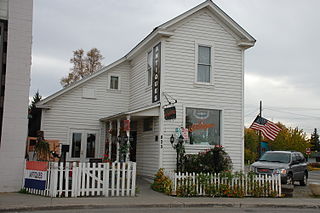
The Oddfellows House, also known as Oddfellows Hall, is a former fraternal clubhouse of Oddfellows at 825 1st Avenue in Fairbanks, Alaska. It is a wood-frame building with two sections, the front one a narrow two-story structure, the rear one a wider single-story structure. Each section has its own gable roof, although they do briefly align. The building was built in 1907 by Madame Renio, a fortune teller, and initially housed a clinic and residential space in the front and a bathhouse in the rear. The bathhouse business failed after its pipes froze in the winter of 1909–10, and the building was purchased by the local chapter of the International Order of Odd Fellows (IOOF). This fraternal organization converted the front space into a kitchen and bathroom, and the rear was converted into a large meeting hall. Under the IOOF's ownership the hall was used by a wide variety of civic and religious organizations, including its sister organization, the Golden North Rebekahs. The IOOF chapter was inactive between the late 1930s and 1945, but the Rebekahs continued to maintain the building, eventually taking ownership in 1967. The Rebekahs disbanded in 2007, and the space was briefly used as a museum; it now houses a retail establishment.

The Wickersham House is a historic house museum at Pioneer Park ("Alaskaland") in Fairbanks, Alaska. The single-story wood-frame house was built in 1904 for James Wickersham, one of the dominant political figures of early 20th-century Alaskan history. It was the first frame house built in Fairbanks, and the first to feature a wooden sidewalk, picket fence, and grass lawn. The house was the first designated state landmark, designated by Governor Walter J. Hickel in May 1966. The house was rescued from demolition by the Fairbanks chapter of the Pioneers of Alaska, and moved from its original site at First and Noble Streets to the newly formed Alaskaland park in 1967. It is now a museum operated by the Tanana-Yukon Historical Society.

The Rose Building was a historic commercial building in Fairbanks, Alaska. It was located on the west side of Illinois Street, north of the offices of the Fairbanks Daily News-Miner, and was a three-story log structure, capped by a steeply pitched gable roof. It is believed to have been built about 1912 in the mining community of Chena, and was moved to Fairbanks in 1925. It was named for Louis Rose, who purchased the building in 1938. It was, at the time of its demolition, the oldest commercial log building in the city, and was listed on the National Register of Historic Places in 1992. It was demolished in 1998 as part of the Illinois Street roadworks.