Gun laws in Honduras

Last updated

Gun laws in Honduras refers to the regulation of the commerce, ownership, possession and use of firearms by the citizens and residents of Honduras. [1] Hondurans have remained passive[ weasel words ][ clarification needed ] on the control of proliferation of firearms in the country. Escalation in crime and the use of firearms in the commission of crimes and homicides has brought political and public discourse to consider regulation of arms. [2]

Honduras republic in Central America

Honduras, officially the Republic of Honduras, is a country in Central America. In the past, it was sometimes referred to as "Spanish Honduras" to differentiate it from British Honduras, which later became modern-day Belize. The republic of Honduras is bordered to the west by Guatemala, to the southwest by El Salvador, to the southeast by Nicaragua, to the south by the Pacific Ocean at the Gulf of Fonseca, and to the north by the Gulf of Honduras, a large inlet of the Caribbean Sea.

Contents

Up until 1985, there was no official regulation of gun ownership and possession by private citizens although Title III, Chapter IV, Article 94 of the Honduran Constitution of 1965, replaced in 1982, stated No one may possess or carry weapons without the permission of the competent authority. The law shall regulate this provision; [3] while the Constitution of 1957 on Title II, Chapter IV said The inhabitants of the republic can own and carry weapons in accordance with the law. [4]

The current Constitution of Honduras, enacted in 1982, makes no direct mention of the 'right to keep and bear arms' and the role firearms should play as a constitutional right; however, Title V, Chapter X, Article 292 ...reserve[s] as exclusive power of the Armed Forces the manufacturing, import, distribution and sale of arms, ammunition and the like. [5] Other clauses in the Constitution regarding the right of citizens to life and personal safety have served as foundation to the legislation and regulation of individuals' right to possession and the use of firearms.

Constitution of Honduras

The Political Constitution of the Republic of Honduras was approved on 11 January 1982, published on 20 January 1982, amended by the National Congress of Honduras 26 times from 1984 to 2005, and 10 interpretations by Congress were made from 1982 to 2005. It is Honduras' twelfth constitution since independence in 1838. Previous charters were adopted in 1839, 1848, 1865, 1873, 1880, 1894, 1906, 1924, 1936, 1957 and 1965.

The right to keep and bear arms is the people's right to possess weapons (arms) for their own defense. Only a few countries currently recognize any right to keep and bear arms and protect it on a statutory level, and even fewer protect the right on a constitutional level.

A constitutional right can be a prerogative or a duty, a power or a restraint of power, recognized and established by a sovereign state or union of states. All constitutional rights are expressly stipulated and written in a consolidated national constitution, which is the supreme law of the land, meaning that any other laws which are in contradiction with it are considered unconstitutional and thus regarded as invalid. Usually any constitution defines the structure, functions, powers, and limits of the national government and the individual freedoms, rights, and obligations which will be protected and enforced when needed by the national authorities.

Until June 2007, openly carrying a firearm in public as well carrying a concealed weapon was permitted [6] but increased attention to deaths by firearm in the country led to further restrictions on the possession of firearms. Current law still makes the purchase, ownership, and possession of firearms legal and it describes the type of firearms permitted for civilian ownership. [7] The 2007 small arms survey shows 6 guns owned per 100 citizens in Honduras.
History

The legal control of the proliferation and of the illegal use of firearms is relatively new in Honduras. Prior to 1985, ownership or possession of a firearm by a private citizen was considered no more than the ownership and possession of any other piece of property. When a crime was committed using a firearm, other than regarding the weapon as evidence to the crime, its possession and use in the crime was not a crime by itself but the act committed, such as murder or robbery, was the violation to prosecute.

Murder Unlawful killing of a human with malice aforethought

Murder is the unlawful killing of another human without justification or valid excuse, especially the unlawful killing of another human being with malice aforethought. This state of mind may, depending upon the jurisdiction, distinguish murder from other forms of unlawful homicide, such as manslaughter. Manslaughter is a killing committed in the absence of malice, brought about by reasonable provocation, or diminished capacity. Involuntary manslaughter, where it is recognized, is a killing that lacks all but the most attenuated guilty intent, recklessness.

Robbery taking or attempting to take something of value by force or threat of force or by putting the victim in fear

Robbery is the crime of taking or attempting to take anything of value by force, threat of force, or by putting the victim in fear. According to common law, robbery is defined as taking the property of another, with the intent to permanently deprive the person of that property, by means of force or fear; that is, it is a larceny or theft accomplished by an assault. Precise definitions of the offence may vary between jurisdictions. Robbery is differentiated from other forms of theft by its inherently violent nature ; whereas many lesser forms of theft are punished as misdemeanors, robbery is always a felony in jurisdictions that distinguish between the two. Under English law, most forms of theft are triable either way, whereas robbery is triable only on indictment. The word "rob" came via French from Late Latin words of Germanic origin, from Common Germanic raub -- "theft".

In May 1985, when Honduras was transiting from military rule to a democracy, the Regulations for the Possession and Carrying of Weapons, Agreement Number 1029 was passed by the Legislative Power. By the mid 1990s, the administration of police forces was no longer part of the armed forces and therefore gun regulation became a civil task. In July 2000, the Act on the Control of Firearms, Ammunition, Explosives and Other Related Material was enacted, outlining the rights and limitations of citizens regarding weapons. Since then, several reforms to the Act have been passed in an effort to limit the use of firearms in violent crimes, including homicides.

Gun culture

Hondurans and the laws of Honduras have had an individual freedom centered view on firearms. [8] Guns are carried openly in the countryside as a demonstration of machismo and virility. [9] Citizens of Honduras and non-citizens who are legal residents of the country may own handguns, shotguns, or rifles under the types and calibers permitted by law. Firearms may be used for the purpose of hunting, competition, target practice, home protection, work protection, personal safety and any other hobby or recreational activity permitted by law. Because of rise in crime, gun ownership in the home, business establishment and while working (such as delivery drivers, taxi drivers, and truckers) has become common. [9] Anyone visiting a city in Honduras will immediately notice armed guards in virtually every establishment including restaurants, grocery stores, and everyday businesses. [10] "No Weapons Allowed" signs can be seen in certain places reminding patrons to leave their firearms at home when conducting business with them. Besides the common frisk when entering a building, some establishments have gone as far as installing metal detectors to make sure visitors are unarmed when entering. Rise in crime has brought some politicians to think the best way to protect citizens is from entirely banning firearms from civilians. [11] In 2009 there were 220,000 registered guns in private ownership in addition to an estimated 500,000 illegal guns. [9] There is an active black market for firearms. Though officially banned, AK-47 rifles can purchased for about $500. [9]

Machismo

Machismo (; Spanish: [maˈtʃizmo]; Portuguese: [maˈʃizmu] is the sense of being 'manly' and self-reliant, the concept associated with "a strong sense of masculine pride: an exaggerated masculinity." It is associated with "a man's responsibility to provide for, protect, and defend his family."

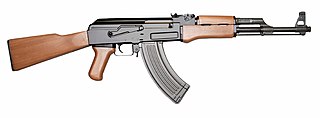
AK-47 1940s assault rifle of Soviet origin

The AK-47, officially known as the Avtomat Kalashnikova, is a gas-operated, 7.62×39mm assault rifle, developed in the Soviet Union by Mikhail Kalashnikov. It is the originating firearm of the Kalashnikov rifle family.

Gun violence

Crime has been endemic in Honduras for several years. [12] [13] The high level of violence and killings experienced in the last 20 years led public officials to formulate laws restricting and regulating firearms in the country. In 2008, Honduras held the second highest rate of homicides per 100,000 inhabitants with 78.6 percent of these committed by firearm. [14] As of 2012, Honduras holds the highest homicide rate in the world and San Pedro Sula holds the country's highest homicide rate with 137.5 murders per 100,000 inhabitants. Between 2005 and mid 2010, 79.38 percent of deaths were committed by firearm in the country. The UNDP estimates at least 800,000 guns in the country of which at least 650,000 are unregulated. [15] Authorities believe some 500,000 guns considered weapons of war are in the hands of civilians and criminals. [16] Most of the illegal guns in the country were acquired during the hostile years of the 1980s. The cost of a bullet in Honduras varies from one to eight lempiras (US$0.06 to 0.42). [17]

Constitutional rights

While the Constitution of Honduras make no explicit mention of citizens' right to weapons, it does include the following:

Article 61- The Constitution guarantees Hondurans and foreigners residents in the country the irrevocable right to life, personal safety, freedom, and equality before the law and [the right] to property.
Article 59- The human person is the supreme purpose of society and the State. All have an obligation to respect and protect it. The dignity of human beings is inviolable...
Article 274- The Armed Forces are subject to the provisions of its Constituent Law and other Laws and Regulations governing its operation... It will also cooperate with the institutions of public security, at the request of the Secretary of State in the Office of Security, to combat terrorism , arms trafficking and organized crime, as well as in the protection of the powers of the State and the Court of elections, to request, in its installation and operation.
Article 292- It is reserved as exclusive power of the Armed Forces the manufacturing, import, distribution and sale of arms and ammunition and similar articles.

These articles has been interpreted by the State as having the power to act through legislation to regulate the manufacture, import, distribution and sale of firearms, while recognizing ownership and possession of firearms for the citizens' legitimate defense. [18]

Licensing and legislation

Only citizens of Honduras and foreign citizens who are legal residents of Honduras may purchase, own, possess, or transport any handgun, shotgun, or rifle as permitted and defined under the Act on the Control of Firearms, Ammunition, Explosives and Other Related Materials. [7] [19] A license for every firearm must be obtained and renewed every four years. [20]

Current firearm and ammunition law

Current private ownership and possession of firearms is regulated under the Ley de Control de Armas de Fuego, Municiones, Explosivos y Otros Similares (Act on the Control of Firearms, Ammunition, Explosives and Other Related Material). [21]

In regard to the right to keep and bear arms, Title I, Chapter I, Article 4 of the Act on the Control of Firearms, Ammunition, Explosives and Other Related Material states:

It is recognized the right of ownership and possession of firearms to citizens and foreign residents who are in full joy of their civil rights and comply with the requirements established by this Law and its regulations.

In regard to what type of firearms are permitted, Title II, Chapter I, Article 7 states:

For the purpose of this law, it is considered permissible in accordance to current regulation, the following self-defense and recreational weapons:
  1. Handguns: Revolvers and semiautomatic handguns up to the point-forty five inches (.45) or eleven-point-five millimeter (11.5mm) caliber;
  2. Long guns: Rifles and bolt action or semiautomatic carbines up to point-three hundred and eight inches (.308); and
  3. Bolt action or semiautomatic shotguns of ten (10), twelve (12), sixteen (16), twenty (20)-gauge or point four hundred and ten (.410) caliber so as long as the barrel is greater than forty-six centimeters (46 cm) or eighteen (18) inches.

In regard to how many firearms a citizen may own, Title III, Chapter II, Article 27 (as reformed though Decreto 69-2007) states:

Every person in exercise of his or her rights as citizen can request a maximum of five (5) licenses to keep and carry up to five (5) firearms, presenting an application with the following:
  1. Form with personal information and address,
  2. Make, model, serial number, identification of modification of caliber, if any; as well as any other characteristics of the weapon,
  3. Proof of ballistic test,
  4. Payment of municipal matriculation, and
  5. Identification documents

In regard to where and when firearms may be carried, Article 27A was amended to the firearms control law and states:

The legal carry of a firearm by his owner, either apparent or openly, is only allowed in the spaces of private property such as homes, businesses, workshops, ranches, farms and similar only by their owners. It is also permitted to openly carry to employees performing duties of surveillance and security in public and private businesses, industrial, of service, agricultural, and private security, and strictly in the assigned places and time of employment, in compliance with the requirements of identification, use of uniforms, and other required by this or other law.

In regard to the transport of firearms, Article 27A, third paragraph, explains that firearms can be transported on the streets, in public spaces or areas, public transportation and private vehicles when:

...the weapon carried by his owner is kept or contained in a case or container that does that permit its immediate use... and,
...should be kept on the glove compartment or visible storage areas in the vehicle.

In regard to openly carrying firearms in public, Article 27A, fourth paragraph, states:

At no time is permitted to openly carry weapons on the streets, public areas, public transportation vehicles, public institutions or commercial establishments, [of] industrial, of service, recreational, and any other space where people gather, except under the circumstances described on the first paragraph.

In regard to bringing firearms to Honduras, Article 30 makes the possession of a firearm while in transit through Honduras illegal and requires visitors and tourists who will engage in hunting and shooting sport activities to register and request temporary import permits with the Ministry of Security prior to traveling to Honduras.

Automatic weapons

Under Article 8 of Title II, Chapter I of the Act on the Control of Firearms, Ammunition, Explosives and Other Related Materials, automatic weapons of any kind are forbidden in Honduras, as well as silencers and high-precision guns, such as sniper rifles.

Assault rifles

In response to the high level of crime and violence experienced in Honduras, in 2003, the government passed a law banning several types of military-issue "assault" rifles from private possession. Legislative Power Decree 101-2003 gave a 90-day grace period to surrender all weapons prohibited under Article 8, along with weapons described in the new law, without fear of criminal or civil prosecution and provided an incentive of 1,000 lempiras (US$52.92) per weapon surrendered.

This law pertains to weapons that found their way onto the black market from military channels; by definition, "assault" rifles are illegal in Honduras if they are capable of fully automatic fire or they fall under the make and model or caliber restricted under Article 2 of Decree 101-2003 which states:

...AK-47 rifle in all its versions. FN FAL and [Argentine] FAP 7.62mm, UZI sub machine gun, M-16 in all its versions, M60 machine gun. Sniper rifle 5.56mm in all its versions. IMI Galil rifle, Heckler & Koch G3 rifle, Beretta 5.56mm in all its versions. M21 for sharpshooters, homemade firearms, and other weapons of war the Secretary of State in the Office of Security and National Defense may consider as such. [22]

Possession of any weapon and ammunition as described above carries a sentence of eight to 10 years in prison and a fine of 5,000 to 10,000 lempiras (US$264.62-$529.24).

Decreto No. 69-2007

Increasing crime and violence and deaths by firearm has led the government to further restrict the ownership and possession of firearms by private citizens.

Under Decree Number 69-2007, signed into law on June 29, 2007, private citizens were restricted to register only up to five firearms and are no longer permitted to carry their firearms in public unless they are being transported and in the proper manner. [23]

Additionally, firearms cannot be carried on a motorcycle unless the bearer is a law enforcement officer.

National arms registry

In April 2002 the National Arms Register was created under the Act on the Control of Firearms, Ammunition, Explosives and Other Related Materials and it requires all citizens and legal residents to register their firearms with the Criminal Investigation Department of the Ministry of Security. [24]

Penal code regarding firearms

Sales and Ownership

La Armeria (the Armory) is the only outlet authorized to import and sell firearms in Honduras. It is run by the armed forces and it has 26 branches throughout all major cities in Honduras, serving civilians and law enforcement members with their firearms and ammunition needs. [27]

The following firearms are legal for civilian ownership: [7]

  1. Revolvers, all make and models, calibers .22, .32, .38, .357 and .44 Magnum,
  2. Semiautomatic handguns, all make and models, calibers .22, .25 ACP, .32 ACP, .380 ACP, 9x19mm, .40 S&W, 10mm, and .45 ACP.
  3. Rifles, of the hunting or tactical type, calibers .22, .30-30, .223, .243, .270, .stag 9 .30-06 and 8 millimeter,
  4. Shotguns, all make and models at least 46 cm or 18-inch barrel length, calibers 10, 12, 16, 20-gauge and .410 Bore,
  5. NOTE: Soviet Makarov firearms, regardless of caliber, are illegal in Honduras due to their high volume among criminals[ citation needed ]. These guns proliferated among the population after the Contra-Nicaraguan Revolution-era.

Purchase and ownership of firearms

In order to own and carry a firearm in Honduras, the following must be happen:

+People are advised against purchasing used firearms without the knowledge of who is the present owner, as the new bearer may become liable upon the discovery of any crimes the weapon may have been involved in when it goes through a ballistic test prior to being lawfully registered to the person requesting a license.

Taking firearms to Honduras

No one may bring firearms into Honduras, except for diplomats or individuals participating in shooting or hunting sport events who have obtained a temporary firearm importation permit from the Honduran Ministry of Security prior to their travel to Honduras. Firearms for personal safety or for purposes other than the aforementioned must be purchased locally through La Armería, the government-run firearm and ammunition supplier. [29]

Diplomats or individuals participating in shooting or hunting sport events must request a permit for the importation of firearms before attempting to travel to Honduras. [19] [30] Firearms that arrive without the requisite Honduran permit will be confiscated and the bearer will be prosecuted. [29]

Related Research Articles

Gun laws and policies regulate the manufacture, sale, transfer, possession, modification and use of small arms by civilians. Many countries have restrictive firearm policies, while a few have permissive ones. The only countries with permissive gun legislation are: Albania, Austria, Chad, Republic of Congo, Honduras, Micronesia, Namibia, Nigeria, Pakistan, Philippines, Senegal, South Africa, Switzerland, Tanzania, the United States, Yemen and Zambia, although several other countries like Canada and the Czech Republic, despite theoretically being restrictive, are shall-issue countries. Countries with a strong gun culture may afford civilians a right to keep and bear arms, and have more-liberal gun laws than neighboring jurisdictions. Countries which regulate access to firearms will typically restrict access to certain categories of firearms and then restrict the categories of persons who may be granted a license for access to such firearms. There may be separate licenses for hunting, sport shooting, self-defense, collecting, and concealed carry, with different sets of requirements, permissions, and responsibilities.

In the United Kingdom, access by the general public to firearms is tightly controlled by laws which are much more restrictive than the minimum rules required by the European Firearms Directive. It is less restrictive in Northern Ireland. There is some concern over the availability of illegal firearms.

Gun laws in Pakistan

Gun laws in Pakistan allow for the wide ownership of firearms there. Only tribal areas of the province of Khyber Pakhtunkhwa permits the ownership of heavy weaponry including the use of rocket-propelled grenades, short, medium, and long-range rockets, anti-aircraft guns, mortars, etc. These heavy weapons may be made in Pakistan.

Gun laws in Switzerland

Firearms legislation in Switzerland allows the free purchase of semi-automatic, but not fully automatic firearms by Swiss citizens and foreigners with permanent residence. Permits for concealed carrying in public are issued sparingly. The acquisition of fully automatic weapons, suppressors and target lasers likewise requires special permits issued by the cantonal firearms office. Use of hollow-point and soft-point ammunition is limited to hunting.

Gun politics and laws in Mexico covers the role firearms play as part of society within the limits of the United Mexican States. Current legislation sets the legality by which members of the armed forces, law enforcement and private citizens may acquire, own, possess and carry firearms; covering rights and limitations to individuals—including hunting and shooting sport participants, property and personal protection personnel such as bodyguards, security officers, private security, and extending to VIPs.

In Brazil, all firearms are required to be registered with the minimum age for gun ownership being 25. It is generally illegal to carry a gun outside a residence, and a special permit granting the right to do so is granted to certain groups, such as law enforcement officers. To legally own a gun, an owner must hold a gun license, which costs R$1000, and pay a fee every three years to register the gun, currently at R$85. Registration can be done online or in person with the Federal Police. Until 2008, unregistered guns could be legalized for free.

Concealed carry

Concealed carry, refers to the practice of carrying a handgun or other weapon in public in a concealed or hidden manner, either on one's person or in close proximity. While most law enforcement officers carry their handguns in a visible holster, some officers, such as plainclothes detectives or undercover agents, carry weapons in concealed holsters. In some countries and jurisdictions, civilians are legally permitted to carry concealed handguns; in some, this may be the only legal way for a civilian to carry a handgun.

Gun laws in the United States are found in a number of federal statutes. These laws regulate the manufacture, trade, possession, transfer, record keeping, transport, and destruction of firearms, ammunition, and firearms accessories. They are enforced by state agencies and the federal Bureau of Alcohol, Tobacco, Firearms and Explosives (ATF).

Gun laws in Norway incorporates the political and regulatory aspects of firearms usage in the country. Citizens are allowed to keep firearms. The acquisition and storage of guns is regulated by the state.

Gun legislation in Germany is regulated by the German Weapons Act which adheres to the European Firearms Directive, first enacted in 1972, and superseded by the law of 2003, in force as of 2016. This federal statute regulates the handling of knives, firearms and ammunition as well as acquisition, storage, commerce and maintenance of weapons. It also defines certain forbidden items, including nunchucks, switchblade knives and brass knuckles, and bans their possession and distribution.

Gun laws in California

Gun laws in California regulate the sale, possession, and use of firearms and ammunition in the state of California in the United States.

This is a list of laws concerning air guns by country.

Criminal possession of a weapon is the unlawful possession of a weapon by an individual.

Gun laws in Italy incorporates the political and regulatory aspects of firearms usage in the country within the framework of the European Firearms Directive. Different types of gun licenses can be obtained from the national police authorities. According to a 2007 study by The Small Arms Survey Project, the per capita gun ownership rate in Italy is around 12% with an estimated 7 million registered firearms in circulation.

Gun laws in Alabama regulate the sale, possession, and use of firearms and ammunition in the state of Alabama in the United States.

Gun laws in Maryland

Gun laws in Maryland regulate the sale, possession, and use of firearms and ammunition in the U.S. state of Maryland.

Gun laws in Pennsylvania

Gun laws in Pennsylvania regulate the sale, possession, and use of firearms and ammunition in the Commonwealth of Pennsylvania in the United States.

Gun laws in Tennessee

Gun laws in Tennessee regulate the sale, possession, and use of firearms and ammunition in the state of Tennessee in the United States.

Gun laws in Vermont

Gun laws in Vermont regulate the sale, possession, and use of firearms and ammunition in the U.S. state of Vermont.

Gun laws in West Virginia regulate the sale, possession, and use of firearms and ammunition in the U.S. state of West Virginia.

References

  1. Permanent Mission of Honduras to the United Nations (2004-04-28). "Gun laws in Honduras" (PDF). Retrieved 2011-11-21.
  2. Julieta Castellanos (2004-01-16). "Honduras:Violence by Numbers" (PDF). Political Database of America-Georgetown University. Retrieved 2011-06-20.
  3. Government of Honduras (2004-04-11). "Constitution of Honduras of 1965". Mario Secoff. Retrieved 2011-06-20.
  4. Government of Honduras (2004-04-11). "Constitution of Honduras of 1957". Mario Secoff. Retrieved 2011-06-20.
  5. Government of Honduras (2005-05-04). "Constitution of Honduras of 1982". Honduras.com. Retrieved 2011-06-21.
  6. [ not in citation given ]Melanie Wetzel (2009-12-19). "Don't go off half-cocked; know the gun laws". HondurasThisWeek. Retrieved 2011-06-21.
  7. "(Spanish) In Honduras they are permissive in the control of firearms". La Prensa. 2010-11-26. Retrieved 2011-06-21.
  8. 1 2 3 4 Clarín.com (2009-11-25). "(Spanish) Honduras, an armed country and with a high number of crimes" . Retrieved 2011-06-21.
  9. LaGringa (2007-02-18). "Guns everywhere". La Gringa's Blogicito. Retrieved 2011-06-21.
  10. El Heraldo de Honduras (2011-02-24). "(Spanish) Without security, Honduras is condemned to Chaos and Collapse" . Retrieved 2011-06-21.
  11. UNAH-Instituto Universitario de Democracia, Paz y Seguridad (2009-02-20). "(Spanish) Observatorio de la Violencia en Honduras". National Autonomous University of Honduras. Retrieved 2011-06-23.
  12. Agustín Lagos (2009-02-24). "(Spanish) Violence in Honduras out of control" (PDF). El Heraldo de Honduras. Retrieved 2011-06-23.
  13. Nanni Fontana (2009-08-03). "Violence in Honduras". NanniFontana.net. Retrieved 2011-06-22.
  14. El Heraldo (2010-10-25). "(Spanish) Homicide rate in Honduras eight times as high as the world average". América Economía. Archived from the original on 2011-09-28. Retrieved 2011-06-23.
  15. Caracol Radio (2001-05-01). "(Spanish) Arsenal headed to Colombia seized in Honduras" . Retrieved 2011-06-23.
  16. "(Spanish) Gun ownership will be regulated in Honduras". El Heraldo de Honduras. 2010-02-15. Retrieved 2011-06-23.
  17. Center Of Investigation and Promotion of Human Rights-CIPRODEH (2006-12-20). "Analysis of the Legislation of Control of Firearms and Ammunition in Honduras" (PDF). Retrieved 2011-06-21.
  18. 1 2 Embassy of Honduras (2007-04-15). "FAQ:What are the requirements to introduce and carry firearms in Honduras?" . Retrieved 2011-06-21.
  19. Godnick, William and Helena Vasquez (2012-01-29). "Honduras: Domestic Small Arms Control Laws". GunPolicy.org. Retrieved 2012-05-17.
  20. Honduran Congress (2000-06-19). "Honduran Congress Bill, Firearms, Ammunition and Explosives Law" (PDF). Retrieved 2011-11-20.
  21. Honduran National Congress (2003-08-28). "DECRETO No. 101-2003-" (PDF). CEDII. Retrieved 2011-06-21.
  22. Honduran National Congress (2007-08-27). "DECRETO No. 69-2007-" (PDF). CEDII. Retrieved 2011-06-21.
  23. Honduran National Congress (2004-04-28). "National Arms Registry". GunPolicy.org. Retrieved 2011-06-21.
  24. 1 2 3 4 5 6 7 Government of Honduras (2004-04-28). "Honduran Penal Code" (PDF). Honduran Secretary of State. Archived from the original (PDF) on 2011-09-30. Retrieved 2011-06-21.
  25. Honduras National Congress (October 2004). "DECRETO No. 101-2003" (PDF). Consultor Jurídico Digital de Honduras. Retrieved 2011-06-21.
  26. La Armeria Gun Store (2010-10-27). "La Armeria-Honduras". La America Website. Retrieved 2011-06-21.
  27. 1 2 El Heraldo Editor (2009-11-01). "Spanish: Reinicia census y registro de armas en Honduras". El Heraldo. Retrieved 2011-06-22.
  28. 1 2 U.S. Department of State (2012-01-30). "Travel information, Firearms section" . Retrieved 2012-05-17.
  29. Honduran Secretary of State (2007-04-05). "Spanish:What are the requirements to introduce and carry firearms in Honduras?". Honduran Secretary of Foreign Affairs. Retrieved 2011-06-22.