Indians in Korea include the migrant diaspora from India to Korea and their locally-born descendants. A majority of them live in Seoul and Busan, and smaller populations live in other parts of South Korea. The Indian population in North Korea is negligible, consisting of embassy staff and NGO members.
The Government of India's Ministry of External Affairs estimates the Overseas Indian population to be about 17,000 in South Korea, as of 2025. It is reported that 16 Indian citizens live in North Korea, although official data is hard to verify.[3] During the Coronavirus pandemic, India safely evacuated its embassy staff through a special Russia-bound train.[4]
History of Indian migration
Malananta: the 4th century Indian Buddhist monk in Korea
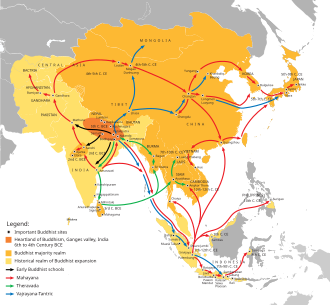
Buddhist expansion in Asia, from Buddhist heartland in northern India (dark orange) starting 5th century BCE, to Buddhist majority realm (orange), and historical extent of Buddhism influences (yellow). Mahāyāna (red arrow), Theravāda (green arrow), and Tantric-Vajrayāna (blue arrow). The overland and maritime "Silk Roads" were interlinked and complementary, forming what scholars have called the "great circle of Buddhism".
In the 14th century, the Buddhist monk of Nalanda, Dhyānabhadra, came to Korea during the Goryeo period. He played an important role in the development of Buddhism in Korea and upon his death, his relics were ordered by Gongmin of Goryeo to be brought to Korea where his followers built a stupa on top.[8]
While the Indian army did not militarily get involved in the Korean War, it sent a medical unit, the 60 Parachute Field Ambulance, which served in Korea for three and a half years (Nov 1950- May 1954), the longest single tenure by any military unit under the UN flag.
They were involved in providing medical cover alternately to the US Army/ROK forces and the Commonwealth Division under the UN Command as well as the local civilians, and earned the informal title, "The Maroon Angels."[citation needed]. The unit also looked after the North Korean POWs. The unit provided an ADS and a surgical team (7 officers and 5 other ranks) during Operation Tomahawk, an airborne operation launched on 21 March 1951 by the US Army's 187 Airborne Regimental Combat Team.
Towards the end of the Korean War in 1953, a reinforced brigade known as the Custodian Force of India was deployed for the repatriation of the prisoners of war and was deployed for almost two years (1953–54).
Postwar Korea
Economic Growth
After the Korean War, there remained only 1 Indian in South Korea, a United Nations Development Programme (UNDP) employee until 1966, when an Indian student came to study at Seoul National University. In the late 1960s, South Korea started exporting heavily, attracting some Indian diaspora with Sindhi traders from Hong Kong and Singapore. In the 1980s, professionals began immigrating to South Korea, and in the 1990s, South Korean universities admitted Indian students for classes and research.[9]
Current Status
Professional cooks
Most of professional cooks usually work at restaurants in Seoul, Busan, Daegu, and other cities. Some are hired by Korean owners of Indian restaurants and hotels, while others own their own restaurants.[9]
Cultural exchange
Technology has allowed for increased cultural exchange between India and Korea, leading to increased international engagement with Korean pop culture concerning both K-pop and K-dramas. Younger generations try to speak Korean and imitate Korean styles in India, especially in Manipur. The fascination with South Korea increases the interest of Indians in Korea who pursue paths like acting or the idol industry.[10]
Organizations and associations
With a burgeoning Indian community exceeding 10000, several representative organizations in South Korea have been established in South Korea. Some notable communities that are active include
Indian Students and Researchers in South Korea (ISRK) - representing close to 4000 researchers, post-docs, and university students, conduct various cultural activities to foster unity as well as to spread awareness.
"IndiansInKorea" (also known as IIK) - more than 5000 members and is an umbrella organization for Indians living in Korea, organizing events for significant holidays [11]
Indian Association of Korea - mainly comprises working professionals
Annapurna Indian Women's Club (formerly known as the Indian Women's Association) - helps with community and cultural exchanges among Indians living in South Korea[12]
Discrimination and racism
Indians in South Korea have reported experiencing various forms of racial discrimination in social, educational, and professional settings. Academic studies and media reports note that South Asian migrants, including Indians, often face negative stereotypes related to skin tone, socioeconomic status, and nationality. These attitudes can manifest in everyday interactions, such as reluctance from some Koreans to sit next to darker‑skinned foreigners on public transport or avoidance in social situations. Although many Indians describe positive experiences in the country, accounts of prejudice remain a recurring theme in surveys and interviews conducted among migrant communities.[13]
Several high-profile incidents have drawn public attention to discriminatory practices. In 2023, an Indian resident in Busan reported being denied entry to a nightclub that displayed a sign restricting access to Indian and Pakistani men, prompting widespread discussion on social media and coverage in Korean and international news outlets. Similar cases involving housing discrimination, workplace bias, and verbal harassment have been documented by migrant support organizations. These incidents have contributed to broader debates about xenophobia and the treatment of non‑white foreigners in South Korea.[14]
South Korea does not currently have a comprehensive anti‑discrimination law, despite repeated recommendations from international human rights bodies. Advocacy groups argue that the absence of such legislation limits legal recourse for victims of racial discrimination, including Indian nationals. Efforts to introduce an anti‑discrimination bill have faced political and social resistance, though public awareness of multicultural issues has gradually increased. As South Korea’s foreign population continues to grow, discussions about racism, migrant rights, and social integration remain central to the experiences of Indian residents in the country.
↑Kesavapany, K.; Mani, A.; Ramasamy, P., eds. (2008). Rising India and Indian communities in East Asia. Singapore: Institute of Southeast Asian Studies. ISBN978-981-230-868-9.
This page is based on this Wikipedia article Text is available under the CC BY-SA 4.0 license; additional terms may apply. Images, videos and audio are available under their respective licenses.