| Pica Temporal range: | |
|---|---|
| | |
| Eurasian magpie (P. pica) | |
| Scientific classification | |
| Kingdom: | Animalia |
| Phylum: | Chordata |
| Class: | Aves |
| Order: | Passeriformes |
| Family: | Corvidae |
| Subfamily: | Corvinae |
| Genus: | Pica Brisson, 1760 |
| Type species | |
| Corvus pica Linnaeus, 1758 | |
| Species | |
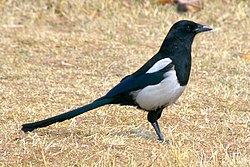
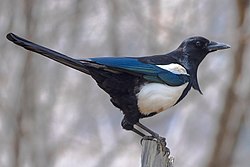
Pica is a genus of seven species of birds in the family Corvidae in both the New World and the Old. It is one of several corvid genera whose members are known as magpies. Pica have long tails and predominantly black and white plumage, with iridescent blue, green, purple and bronze colours on the wings and tail in good light. After Corvus, this genus is the second most widespread within the Corvidae family, being distributed across Eurasia, north Africa, and western North America. [1] Molecular phylogeny suggests that Pica is most closely related to nutcrackers ( Nucifraga ), jackdaws ( Coloeus ) and crows and ravens ( Corvus ). [2]
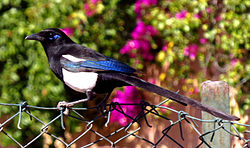
The genus Pica was introduced by the French zoologist Mathurin Jacques Brisson in 1760. [3] [4] He derived the name by tautonymy from the specific epithet of the Eurasian magpie Corvus pica which was introduced by Linnaeus in 1758. [4] [5] Pica is the Latin word for the Eurasian magpie. [6]
In 2018, a molecular phylogenetic study found that the Eurasian magpie consisted of multiple species including the Maghreb magpie, the Asir magpie, the black-rumped magpie and the oriental magpie. [7]
The genus contains seven living species; [8] species order follows AviList: [9]
| Common name | Scientific name and subspecies | Range | Size and ecology | IUCN status and estimated population |
|---|---|---|---|---|
| Maghreb magpie | Pica mauritanica Malherbe, 1845 | northwest Africa | Size: Habitat: Diet: | LC |
| Oriental magpie | Pica serica Gould, 1845 Two subspecies
| southeastern Russia and Myanmar to eastern China, Korea, Japan, Taiwan and northern Indochina | Size: Habitat: Diet: | LC |
| Black-rumped magpie | Pica bottanensis Delessert, 1840 | central Bhutan, west-central China | Size: Habitat: Diet: | NE |
| Asir magpie | Pica asirensis Bates, 1936 | Asir Region of Saudi Arabia | Size: Habitat: Diet: | EN |
| Eurasian magpie | Pica pica (Linnaeus, 1758) Six subspecies
| Europe and Asia | Size: Habitat: Diet: | LC |
| Black-billed magpie | Pica hudsonia (Sabine, 1823) | western half of North America | Size: Habitat: Diet: | LC |
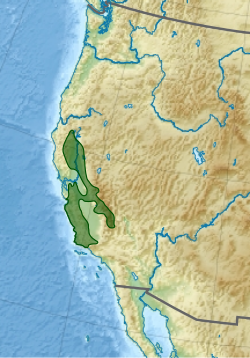
| Yellow-billed magpie | Pica nuttallii (Audubon, 1837) | California | Size: Habitat: Diet: | VU |
This phylogeny was concluded by Gang Song et al.'s 2018 study; it included all the taxa. [7]
| Pica |
| |||||||||||||||||||||||||||||||||||||||
A cladogram was established in A. P. Kryukov's 2025 study; note that it is only partial, with Asir and black-rumped magpies not included. [10]
| Pica |
| |||||||||||||||
Oriental magpie (P. serica) | ||||||||||||||||
Two prehistoric species of Pica are currently known: Pica mourerae , from fossils found in Pliocene–Pleistocene boundary strata on Mallorca, and Pica praepica , from Early Pleistocene strata of Bulgaria. [11] [12]
{{cite book}}: CS1 maint: publisher location (link)