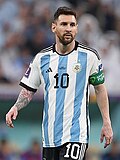
On the international stage, Messi made his debut with Argentina's senior national football team in 2005, and would represent the country in five FIFA World Cups, seven Copa Américas, and one Finalissima. Initially facing criticism for not winning major tournaments with the senior national team, Messi broke Argentina's 28-year international trophy drought by captaining the team to victory in the 2021 Copa América, the 2022 Finalissima, the 2022 FIFA World Cup, and the 2024 Copa América.
During the 2004–05 season, Lionel Messi was a guaranteed starter for the Barcelona B team, playing 17 games throughout the campaign and scoring six goals.[15][16] Since his debut in the friendly against Porto the previous November, he had not been called up to the first team again, but in October 2004, the senior players asked managerFrank Rijkaard to promote him.[15] Messi's usual position was left wing, but Ronaldinho already played this position. Rijkaard put Messi on the right flank, allowing him to cut into the centre of the pitch and shoot with his dominant left foot.[17][18]
Messi made his La Liga debut with Barcelona's senior team during the next match on 16 October, against Espanyol at Estadi Olímpic Lluís Companys in Montjuïc.[19] The 17-year-old Messi was at the time the youngest player to represent Barcelona in an official competition.[20] As a substitute player, he played in nine matches for the first team that season, including his debut in the UEFA Champions League.[16] He scored his first senior goal on 1 May 2005, becoming the youngest-ever scorer for the club at the time.[17][21] Barcelona won the league for the first time in six years.[22]
On 24 June 2005, his 18th birthday, Messi signed his first contract as a senior team player. It made him a Barcelona player until 2010, and contained a buyout clause of €150million.[24] Two months later, Messi made his first start for the club against Fabio Capello's Juventus in the Joan Gamper Trophy, Barcelona's pre-season competition.[23] Capello sought to take Messi to Juventus on loan, but Inter Milan offered to pay his €150million buyout clause and triple his salary.[25] According to then-president Joan Laporta, it was the only time the club faced a real risk of losing Messi, but he ultimately decided to stay.[26] On 16 September, his contract was updated for the second time in three months and extended to 2014.[24][27]
After scoring 8 goals in 25 games, including his first in the Champions League,[33][34] Messi's season ended prematurely on 7 March 2006, when he suffered a torn hamstring. Messi worked to regain fitness in time for the 2006 Champions League final, but he was eventually ruled out. He was so disappointed that he did not celebrate his team's 2–1 victory over Arsenal in Paris, which he later came to regret.[32][35]
While Barcelona began a gradual decline, the 19-year-old Messi established himself as one of the best players in the world during the 2006–07 season.[36][37] Already an idol to the club's supporters, he scored 17 goals in 36 games across all competitions.[37][38]In the league, his goal contribution increased towards the end of the season; 11 of his 14 goals came from the last 13 games.[38] On 10 March 2007, he scored his first hat-trick in a Clásico, the first player to do so in 12 years.[39] His growing importance to the club was reflected in a new contract, signed that month, which greatly increased his salary.[40]
Already frequently compared to compatriot Diego Maradona, Messi proved their similarity when he nearly replicated Maradona's two most famous goals in the span of seven weeks.[41] On 18 April, in a Copa del Rey match against Getafe, he ran 60 metres (66yd) with the ball, beating five defenders before scoring in a similar fashion to Maradona in his Goal of the Century.[42][43] A league match against Espanyol on 9 June saw Messi strike the ball with his hand in a fashion comparable to Maradona in his Hand of God goal.[44] In 2019, Messi's goal against Getafe was voted Barcelona's best goal ever in a poll of the club's fans.[45] As Messi continued his individual rise, Barcelona faltered; the team failed to reach the Copa del Rey final and was eliminated from La Liga competition by Real Madrid.[46][47]
After Ronaldinho lost form, Messi became Barcelona's new star player at 20 years old, receiving the nickname "Messiah" from the Spanish media.[a] Sports journalists voted him the third-best player of the year for the 2007 Ballon d'Or, while international managers and national team captains voted him second for the FIFA World Player of the Year award.[50][51] After suffering a torn hamstring on 15 December,[52] Messi returned to score twice in a 3–2 victory against Celtic in the last-16 round of the Champions League, becoming the competition's top scorer at that point with six goals.[53] Rijkaard had fielded him despite warnings from the medical staff, and on 4 March 2008 Messi was reinjured, leading captain Carles Puyol to criticise the Spanish media for pressuring Messi to play every match.[52] Barcelona was eliminated from the Champions League semi-finals by Manchester United and finished third in the league.[54]
After two unsuccessful seasons, Barcelona were in need of an overhaul, leading to the departure of Rijkaard and Ronaldinho.[citation needed] Upon Ronaldinho's departure, Messi was given the number 10 shirt.[30] He signed a new contract in July with an annual salary of €7.8million, becoming the club's highest-paid player.[55][56] Ahead of the new season, a major concern remained his frequent muscular injuries, which had left him sidelined for a total of eight months between 2006 and 2008. To combat the problem, the club implemented new training, nutrition, and lifestyle regimens, and assigned him a personal physiotherapist. As a result, Messi remained virtually injury-free during the next four years.[57][58] His performances in 2008 saw him again voted runner-up for the Ballon d'Or and the FIFA World Player of the Year award, both times behind Cristiano Ronaldo.[50][59]
During the 2008–09 season, he scored 38 goals in 51 games, contributing alongside Eto'o and Thierry Henry to a total of 100 goals in all competitions, a record at the time for the club.[60][61] During his first season under Barcelona's new manager Pep Guardiola, Messi played mainly as a false winger. On 2 May 2009, however, he played for the first time as a false nine, scoring twice in a 6–2 victory over Real Madrid.[62][63] Returning to the wing, he scored once and assisted a second goal as Barcelona defeated Athletic Bilbao 4–1 in the 2009 Copa del Rey final.[64] With 23 league goals from Messi that season, Barcelona became La Liga champions three days later and achieved its fifth double.[60][65]
Messi became the season's Champions Leaguetop scorer with nine goals, the youngest in the tournament's history.[66][62] He returned as a false nine during the 2009 Champions League final on 27 May in Rome against defending champions Manchester United, scoring the second goal in a 2–0 victory. Barcelona achieved the first treble in the history of Spanish football, an accomplishment that was reflected in a new contract which committed Messi to the club through 2016.[67] The contract had a buyout clause of €250million, and increased his salary to €12million.[55]
The new year started on a less positive note for Barcelona, as they were knocked out of the Copa del Rey in the round of 16.[71] Unsatisfied with his position on the right wing, Messi resumed playing as a false nine in early 2010. At that point, he effectively became the tactical focal point of Guardiola's team, and his goalscoring rate increased.[72][73] Messi finished the season as the top scorer in the Champions League for the second consecutive year.[74] He scored a total of 47 goals in all competitions that season, equalling Ronaldo's club record from the 1996–97 campaign.[75][76] As La Liga's top scorer with 34 goals (again tying Ronaldo's record), he helped Barcelona win a second consecutive La Liga trophy and earned his first European Golden Shoe.[76][77]
2010–2011: Fifth La Liga title, third Champions League, and second Ballon d'Or
Messi secured Barcelona's first trophy of the 2010–11 season, the Supercopa de España, by scoring a hat-trick in a 4–0 victory over Sevilla.[78] Assuming a playmaking role, he was instrumental in a 5–0 victory against Real Madrid on 29 November 2010.[79] He helped his team achieve 16 consecutive league victories, a record in Spanish football, concluding with another hat-trick against Atlético Madrid in a 3–0 win on 5 February 2011.[80][81] Messi's club performances in 2010 earned him the inaugural FIFA Ballon d'Or, an amalgamation of the Ballon d'Or and the FIFA World Player of the Year award, though his win was met with some criticism due to his lack of success with Argentina at the 2010 FIFA World Cup.[50][82]
During a semi-finals match of the Champions League, one of Messi's goals was described as one of the best ever in the competition.[83] In the Champions League final on 28 May, he gave a man-of-the-match performance by scoring the winning goal in Barcelona's 3–1 victory. He was the competition's top scorer for the third consecutive year, with 12 goals.[84][85] During the La Liga season, Messi had 31 goals and 18 assists as Barcelona won a third consecutive La Liga title.[86][87] He finished the overall season with 53 goals in all competitions, becoming Barcelona's all-time single-season top scorer and the first player in Spanish football history to reach 50 goals in a season.[86][88]
2011–2012: Record-breaking season, third Ballon d'Or, and Barcelona's all-time goalscorer
As Messi developed into a combination of a creator, scorer and assistant,[89] he scored an unprecedented 73 goals and provided 30 assists in all club competitions during the 2011–12 season.[b] In the Supercopa de España, Messi scored three times, overtaking Raúl as the competition's all-time top scorer with eight goals.[93][94] On 18 December, Messi scored twice in the 2011 FIFA Club World Cupfinal, a 4–0 victory over Santos. He earned the Golden Ball as the best player of the tournament, as he had done two years previously.[95] For his efforts in 2011, he again received the FIFA Ballon d'Or, becoming only the fourth player in history to win the award three times.[96] He also won the inaugural UEFA Best Player in Europe Award.[97] By then, Messi was already widely considered one of the best footballers in history, alongside players like Diego Maradona and Pelé.[98]
As Messi maintained his goalscoring form into the second half of the season, the year 2012 saw him break several longstanding records. In March, Messi became the top goalscorer in Barcelona's history with 234 goals, surpassing César Rodríguez.[99] On 3 April, he became the youngest player in history to score 50 goals in the Champions League.[100] Despite Messi's individual form, Barcelona's four-year cycle of success under Guardiola drew to an end.[101] Although Barcelona won the 2012 Copa del Rey final in May, the team lost to Real Madrid in La Liga and was eliminated in the Champions League semi-finals.[102][103] Messi finished the season as the league top scorer in Spain and Europe for a second time. He had scored a record 50 goals in La Liga, while his 73 goals in all competitions made him the single-season top scorer in the history of European club football.[104]
2012–2013: Record-breaking calendar year, fourth Ballon d'Or, and Messidependencia
Under manager Tito Vilanova, Messi helped Barcelona achieve its best-ever start to a La Liga season during the second half of 2012, amassing 55 points by the competition's midway point, a record in Spanish football.[105] In early December, he became Barcelona's all-time top scorer in La Liga, and he broke Gerd Müller's record of most goals scored in a calendar year.[106][107] At the close of the year, Messi had scored a record 91 goals in all competitions for Barcelona and Argentina.[108] Although FIFA did not acknowledge the achievement, Messi received the Guinness World Records title for most goals scored in a calendar year.[109][110] Messi again won the FIFA Ballon d'Or, becoming the first player to win the award four times.[108][111] Now in his ninth senior season with Barcelona, Messi signed a new contract which committed him to the club through 2018, while his salary rose to €13million.[112][113] He wore the captain's armband for the first time on 17 March.[114][115]
After four largely injury-free seasons, the muscular injuries that had previously plagued Messi reoccurred. He suffered a hamstring strain on 2 April, during a match against Paris Saint-Germain (PSG). In a subsequent match against PSG, Messi came off the bench in the second half and, within nine minutes, helped create Barcelona's game-tying goal. Defender Gerard Piqué explained that even if Messi is "half lame", his mere presence on the pitch motivates his teammates and improves their playing. The term Messidependencia emerged to refer to Barcelona's perceived tactical and psychological dependence on Messi.[116][117]
Messi continued to struggle with injury throughout 2013.[118] Further damage to his hamstring in May ended his goalscoring streak of 21 consecutive league games, a worldwide record.[119][120] With 60 goals in all competitions, including 46 goals in La Liga, he finished the season as the league top scorer in Spain and Europe for the second consecutive year, becoming the first player in history to win the European Golden Shoe three times.[121][122]
After scoring a hat-trick in Barcelona's opening match of the Champions League, Messi suffered his fifth injury of 2013 when he tore his hamstring on 10 November, which left him sidelined for two months.[c] During the second half of the 2013–14 season, doubts persisted over Messi's form, leading to a perception among Barcelona's fans that he was saving himself for the 2014 FIFA World Cup; his number of goals, shots, and passes had dropped significantly compared to previous seasons.[126][127] He still managed to break two longstanding records in a span of seven days: a hat-trick on 16 March saw him become Barcelona's top goalscorer in all competitions including friendlies, while another hat-trick on 23 March made him the all-time top scorer in El Clásico.[126][128]
Messi finished the campaign with his worst output in five seasons, though he still managed to score 41 goals in all competitions.[127][129] For the first time in five years, Barcelona ended the season without a major trophy.[130] After prolonged speculation over his future with the club, Messi signed a new contract on 19 May 2014, only a year after his last contractual update; his salary increased to €20million, or €36million before taxes, the highest in the sport.[d]
Under Barcelona's new manager and former captain Luis Enrique, Messi experienced a largely injury-free start to the 2014–15 season.[134] A hat-trick on 22 November made him the all-time top scorer in La Liga with 253 goals.[e] After years of playing in the centre of the pitch, Messi was now playing on the right wing as part of Barcelona's attacking trio, which also included Luis Suárez and Neymar.[f] The trio, dubbed "MSN", ended the team's dependency on Messi for offensive play.[g] During early 2015, Messi set La Liga records for the most assists (106) and most hat-tricks (32).[i] He scored twice as Barcelona won the 2015 Copa del Rey final in May, with his opening goal being hailed as one of the greatest in his career.[148]
Early in the 2015–16 season, Messi became the youngest player to make 100 appearances in the UEFA Champions League.[157] He scored the opening goal of the 2015 FIFA Club World Cupfinal in December, collecting his fifth club trophy of 2015 as Barcelona defeated River Plate 3–0.[158] In January, Messi won the FIFA Ballon d'Or for a record fifth time.[159] In February. Messi reached his 300th league goal,[160] and in April he scored his 500th senior career goal for Barcelona.[161] Messi finished the season by assisting both goals in Barcelona's 2–0 win over Sevilla in the 2016 Copa del Rey final, as the club celebrated winning the domestic double for the second consecutive season.[162]
Messi prior to a 2016 game against Al-Ahli in Doha, Qatar
Messi opened the 2016–17 season by lifting the Supercopa de España as Barcelona's captain in the absence of the injured Andrés Iniesta.[l] He sustained a groin injury that sidelined him for three weeks, returning on 16 October.[166][167] Three days later, he scored his record-extending seventh hat-trick in the Champions League in a 4–0 win over Manchester City.[168] Messi finished the year with 51 goals, making him Europe's top scorer.[169] He placed second in both the 2016 Ballon d'Or and the 2016 Best FIFA Men's Player Award, both times behind Cristiano Ronaldo.[170] In February, Messi's teammate Javier Mascherano said in an interview that Messi's talent is so great that he breaks the rule that no individual player is more important than their club.[171] On 23 April, Messi scored a game-winning goal in stoppage time against Real Madrid, which was his 500th goal for Barcelona.[172] The following month, Messi helped Barcelona to a 3–1 victory over Alavés in the 2017 Copa del Rey final, and was named Man of the Match.[173] Messi finished the season with 54 goals; his 37 goals in La Liga saw him finish as the top scorer and claim both the Pichichi and European Golden Shoe Awards for the fourth time in his career.[174] Neymar's departure for Paris Saint-Germain the next season meant that the attacking trio had scored a combined total of 363 goals over the course of three seasons.[175]
2017–2018: Domestic double and a record fifth Golden Shoe
On 18 October, Messi scored his 100th goal in UEFA club competitions,[176] becoming the second player after Cristiano Ronaldo to reach the milestone.[177] Following the reception of his fourth Golden Shoe, Messi signed a new contract with Barcelona on 25 November, keeping him with the club through the 2020–21 season. His buyout clause was set at €700million.[178] On 7 January 2018, Messi made his 400th La Liga appearance with Barcelona. A week later, he scored his 366th league goal for the club, surpassing Gerd Müller's record for the most league goals scored for the same club in one of Europe's top five divisions.[179] In February, Messi became the first player to score against 36 different teams in La Liga.[180]
On 14 March, Messi scored his 100th Champions League goal in the round of 16 against Chelsea in a 3–0 win, becoming the second player after Cristiano Ronaldo to reach the landmark.[181] In late April, Messi scored his 40th goal of the season during a 5–0 win over Sevilla in the 2018 Copa del Rey final; this was Barcelona's fourth Copa del Rey consecutive title and their 30th overall.[182] Eight days later, Messi scored a hat-trick in a 4–2 win over Deportivo de La Coruña, helping Barcelona clinch their 25th La Liga title.[183] Messi once again finished the season as the top scorer in La Liga, with 34 goals, and earned his fifth European Golden Shoe award.[184]
2018–2019: Captaincy, 10th La Liga title, and a record sixth Golden Shoe
With the departure of former captain Andrés Iniesta in May 2018, Messi was named the team's new captain for the following season.[185] On 12 August, he claimed his first title as Barcelona's captain, the Supercopa de España, following a 2–1 victory over Sevilla. The trophy was Messi's 33rd for the club, surpassing Iniesta and making Messi the most decorated player in the history of Barcelona.[186] In February 2019, the club stated they had begun preparations for Messi's future retirement.[187]
In late February, Messi scored the 50th hat-trick of his career during a 4–2 victory over Sevilla in La Liga.[188] The following month, he scored both goals in a 2–0 win against Espanyol, becoming the first player in history to score 40 or more goals in 10 consecutive club seasons.[189] On 6 April, Messi scored the second goal in a 2–0 victory against Atlético Madrid; the win was Messi's 335th in La Liga, surpassing the previous record of 334 wins held by Iker Casillas.[190] On 27 April, Messi scored the only goal in a 1–0 win over Levante, which allowed Barcelona to clinch the league title;[191] this was his 450th La Liga appearance, and his first league title as the club's captain.[192][193] On 19 May, Messi scored twice in a 2–2 draw against Eibar, which saw him capture his sixth Pichichi Trophy as the league's top scorer, with 36 goals in 34 appearances.[194][195] He became the first player to win the European Golden Shoe three years in a row, and also the first to win it six times overall.[196]
On 19 August 2019, Messi's chipped goal from the edge of the box against Real Betis was nominated for the 2019 FIFA Puskás Award,[197] which was later shortlisted as one of the three finalists for both the 2019 FIFA Puskás Award and the 2019 Best FIFA Men's Player Award, with Messi winning the latter on 23 September.[198][199]
Messi scored his first goal of the season with a free kick in a 4–0 home win over Sevilla on 6 October; this was his 420th goal in La Liga, which saw him break Cristiano Ronaldo's record of 419 goals scored in Europe's top five leagues.[200] On 23 October, Messi scored his first Champions League goal of the season in a 2–1 away win over Slavia Prague, becoming the first player to score in 15 consecutive Champions League seasons (excluding qualifying rounds).[201] On 29 October, Messi scored two goals in a 5–1 home win over Real Valladolid in La Liga; his first goal – a set piece from 35 yards – was the 50th free kick of his career.[202] His goals (608) also saw him overtake Cristiano Ronaldo's senior goal tally (606) at club level.[203] On 9 November, Messi scored three goals (including two free kicks) in a 4–1 home win against Celta Vigo. This was his 34th hat-trick in La Liga, equalling Cristiano Ronaldo's Spanish top-flight record.[204] On 27 November, Messi made his 700th appearance for Barcelona in a UCL match against Borussia Dortmund, scoring one goal and assisting two more in a 3–1 home win. His goal against Dortmund allowed him to break Raúl and Cristiano Ronaldo's shared record of the most sides scored against in the competition (34).[205] On 2 December, Messi was awarded a record-breaking sixth Ballon d'Or.[206] On 7 December, Messi scored his record-breaking 35th hat-trick in La Liga with three goals in Barcelona's 5–2 home win over Mallorca.[207]
On 22 February, Messi scored four goals in a 5–0 home win over Eibar in La Liga.[208] On 14 June, he scored in a 4–0 away win against Mallorca, becoming the first player ever in La Liga to score 20 goals or more in 12 consecutive seasons.[209] On 30 June, Messi scored a panenka in a 2–2 home draw against Atlético Madrid in La Liga, to reach his 700th goal in his senior career for Barcelona and Argentina.[210] On 11 July, Messi provided his 20th assist of the league season for Arturo Vidal in a 1–0 away win over Real Valladolid, equalling Xavi's record of 20 assists in a single La Liga season from the 2008–09 campaign;[211][212] with 22 goals, he also became only the second player ever to record at least 20 goals and 20 assists in a single league season in one of Europe's top five leagues.[212][213] Messi finished the season as both the top scorer and top assist provider in La Liga for the third consecutive year, with 25 goals and 21 assists respectively, which saw him win his record seventh Pichichi Trophy, overtaking Zarra, and surpass Xavi's single-season assist record; however, Barcelona missed out on the league title to Real Madrid.[214] On 14 August, Messi suffered his worst defeat as a player as eventual championsBayern Munich beat Barcelona 8–2 in a one-off tie in Lisbon, leading to another disappointing exit from the Champions League.[215]
August 2020: Desire to leave Barcelona
"I wasn't happy and I wanted to leave. I have not been allowed this in any way and I will stay at the club so as not to get into a legal dispute. The management of the club led by Bartomeu is a disaster. My love for Barça will never change."
– Messi on reversing his decision to leave Barcelona in an interview with Goal on 4 September 2020.[216]
Following growing dissatisfaction with the direction of Barcelona on and off the field,[217] Barcelona announced that Messi sent the club "a document expressing his desire to leave" on 25 August 2020.[218] The announcement garnered a significant media response, including from current and former teammates (who supported Messi's statement) and Catalan PresidentQuim Torra.[219] On 26 August, Barcelona's sporting director Ramon Planes iterated the club's desire to "build a team around the most important player in the world"[220] and affirmed Messi will only be able to leave should a buyer pay his €700million buyout clause; a reported early termination option available in Messi's contract (which would have allowed him to leave the club for free) could only be exercised if he had communicated his decision to Barcelona by 31 May 2020, although the player's representatives argued the deadline should be set to 31 August, due to the adjourned 2019–20 season.[221]
On 4 September, Messi announced in an interview with Goal that he would continue at Barcelona for the final year of his contract. In the interview, Messi claimed to have informed Barcelona of his desire to leave multiple times, and club president Josep Maria Bartomeu said Messi could decide at the end of every season if he wanted to stay or leave, only for Bartomeu to refer to the release clause.[222] This left Messi with two options: to stay or go to court against the club, with the player saying "I would never go to court against the club of my life".[223]
On 27 September, Messi began the 2020–21 season by scoring a penalty in a 4–0 home win against Villarreal in La Liga.[224] Two days prior to the opening game, he again criticised the club, this time for the manner of Luis Suárez's departure, stating, "at this stage nothing surprises me any more".[225] On 20 October, Messi scored a penalty in a 5–1 home victory against Ferencváros in the Champions League, becoming the first player to score in 16 consecutive Champions League seasons.[226] On 25 November, he was nominated for the 2020 Best FIFA Men's Player award, and was later shortlisted as one of the final three candidates.[227][228] After scoring against Osasuna on 29 November, Messi unveiled a shirt of his former side Newell's Old Boys, in tribute to Maradona, who had died four days earlier, with the shirt being a number 10 replica of the one Maradona had worn during his stint with the club in 1993.[229] On 17 December, Messi finished third in The Best FIFA Men's Player award behind Robert Lewandowski and Cristiano Ronaldo, and was included in the FIFA FIFPro World XI for the fourteenth consecutive year.[230]
"Congratulations on your historic record, Lionel. But above all, congratulations on your beautiful career at Barcelona. Stories like ours, of loving the same club for so long, unfortunately will be increasingly rare in football. I admire you very much, Leo Messi."
– Pelé congratulates Messi after he overtook his record in scoring the most goals for a club.[231]
On 23 December, Messi scored his 644th goal for Barcelona in a 3–0 away win against Real Valladolid in La Liga, surpassing Pelé with Santos as the player with the most goals scored for a single club.[231][232] On 17 January 2021, Messi was sent off for the first time in his club career for violent conduct (swinging an arm at the head of Asier Villalibre, missed initially by the referee but reviewed via VAR) in the final minutes of Barcelona's 3–2 extra time defeat to Athletic Bilbao in the 2021 Supercopa de Españafinal.[233] On 10 March, Barcelona were eliminated in the round of 16 for the first time in 14 years by an aggregate score of 5–2 against Paris Saint-Germain.[234] On 15 March, Messi scored two goals in a 4–1 home win against Huesca, and became the first player in history to score at least 20 goals in 13 consecutive seasons in the top five European leagues.[235] On 21 March, he surpassed Xavi to become Barcelona's all-time highest appearance maker with 768 appearances, in which he also scored a brace in a 6–1 away win against Real Sociedad.[236]
On 17 April, Messi scored twice as Barcelona defeated Athletic Bilbao 4–0 in the 2021 Copa del Rey final at La Cartuja. With his second goal, he broke Gerd Müller's record of 30 plus goals in 12 consecutive club seasons, setting a new record of 13.[237][238] On 16 May, Messi scored his 30th league goal of the campaign in a 2–1 home defeat against Celta Vigo, which later turned out to be his final goal and match in a Barcelona shirt.[239] The top goalscorer in La Liga, Messi received the Pichichi Trophy for a record eighth time in his career.[240] It was also his record fifth consecutive win in La Liga, surpassing Alfredo Di Stéfano and Hugo Sánchez who both had four for Real Madrid.[240]
August 2021: Departure
"Leo wanted to stay and the Club wanted him to stay but with the La Liga rules it has not been possible. To comply with the league's fair play regulations we had to accept an agreement that mortgaged the Club's TV right for half a century and FC Barcelona is above everything else."
– Barcelona president Joan Laporta explains the reason behind Messi's departure.[241]
On 1 July, Messi became a free agent after his contract expired,[242] with negotiations on a new deal complicated due to financial issues at Barcelona.[243] On 5 August, Barcelona announced that Messi would not be staying at the club, even though both parties reached an agreement and were due to sign a contract that day.[244] The club cited financial and structural obstacles posed by La Liga regulations as a reason for Messi's departure.[245] On 6 August, club president Joan Laporta also blamed the previous board for Messi's exit by saying "the basis of everything is the calamitous and disastrous situation left by the previous board", he added by saying "the expected debt is much higher and we had some sports contracts in place that meant we had no margin on salary".[246] Three days later, in a tearful press conference held at the Camp Nou, Messi confirmed that he would be leaving Barcelona.[247] He ended his Barça career with more appearances, goals, assists and trophies than any other player in club history.[248]
Paris Saint-Germain
2021–2022: First season adjustments and seventh Ballon d'Or
On 10 August, Messi joined French club Paris Saint-Germain (PSG) on a free transfer.[249] He signed a two-year deal until June 2023 with an option for an extra year.[250] Messi chose 30 as his squad number, the same he wore as a teenager when he made his senior debut for Barcelona.[251]
Messi made his debut for the club on 29 August, coming on as a substitute in the second half of a 2–0 away win over Reims in Ligue 1.[252] On 28 September, he scored his first goal for the club, a strike from the edge of the 18-yard box in a 2–0 Champions League group stage home win over former manager Pep Guardiola's Manchester City.[253] On 21 November, Messi scored his first Ligue 1 goal in a 3–1 home victory over Nantes.[254] Later that month, he provided a hat-trick of assists for the fifth time in his career as PSG beat Saint-Étienne 3–1 away from home.[255] Having scored 40 goals at club and international level for the calendar year and helped Argentina win the 2021 Copa América, Messi received a record seventh Ballon d'Or on 29 November.[256]
On 13 March, following their Champions League elimination against Real Madrid in the round of 16, in which Messi missed a penalty in the first leg, he and Neymar were booed by some of the PSG fans, something which the then-PSG manager Mauricio Pochettino condemned.[257] On 23 April, he helped PSG clinch their 10th Ligue 1 title after scoring from a strike outside the 18-yard box in a 1–1 draw against Lens at home.[258] Messi finished his debut season with 11 goals and 14 assists across all competitions.[259] He failed to reach double figure league goals for the first time since 2005–06, ending the campaign with six.[260]
After adjusting to his new surroundings and settling in Paris, under new coach Christophe Galtier, Messi returned to his preferred free attacking role; the playmaker behind two strikers, in an attacking trident with Neymar and Kylian Mbappé, quickly regaining his form by starting off the new season on 31 July by scoring PSG's first goal in a 4–0 victory over Nantes in the Trophée des Champions at the Bloomfield Stadium, winning his second trophy with PSG.[261]
Messi (left) celebrating a goal with PSG teammates Neymar and Mbappé
Due to his form in the previous season, Messi was not nominated for the Ballon d'Or award for the first time since 2005.[262] On 21 August, Messi provided a long-range assist for Mbappé, clocked at eight seconds, for Ligue 1's second-fastest goal ever scored, before also scoring a goal in 7–1 away win over Lille.[263][264] The following matches, after registering six goal contributions, including one goal and five assists, Messi was named Ligue 1's Player of the Month in September.[265] On 14 September, Messi scored the equaliser in a 3–1 away win over Maccabi Haifa in the Champions League, becoming the first player in history to score in 18 consecutive Champions League seasons.[266] On 5 October, he scored in a 1–1 away draw against Benfica at the Estádio da Luz, becoming the first player in the competition's history to score against 40 different Champions League opponents.[267] On 25 October, Messi scored twice and assisted twice in a 7–2 Champions League win at home against Maccabi Haifa, setting the record for the most goals scored from outside the 18-yard box in the competition, with 23 goals.[268] He also became the oldest player in the competition's history to score multiple goals and provide multiple assists in a single game.[269] Four days later, Messi scored his twelfth goal of the season in a 4–3 win over Troyes, surpassing his total output of the prior season in just 18 matches.[270]
On 26 February 2023, PSG defeated Marseille 3–0 away in Le Classique at the Stade Vélodrome, with Messi scoring his 700th senior career club goal as well as assisting two goals for Mbappé.[271] On 4 March, he scored the opening goal in a 4–2 home win against Nantes, which saw him achieve 1,000 career direct goal contributions at club level (701 goals and 299 assists).[272] On 11 March, PSG defeated Brest 2–1 away from home, with Messi setting up a last-minute winner for Mbappé, registering his 300th club career assist.[273] On 8 April, he scored and provided an assist in a 2–0 away win over Nice, which saw him overtake Cristiano Ronaldo as the all-time highest goalscorer in European club football with 702 goals.[274][275] On 2 May, Messi was suspended for two weeks and fined after taking an unauthorised trip to Saudi Arabia with his family as part of a promotional commercial agreement.[276] Afterwards, several PSG supporters demanded his exit from the club,[277] with Messi apologising to them for the trip two days later.[278] On 28 May, Messi scored in a 1–1 away draw against Strasbourg, helping PSG clinch their record-breaking 11th Ligue 1 title and his second in a row; in the process Messi overtook Cristiano Ronaldo and became the player with the most goals in the history of Europe's top five leagues, with 496 goals.[279][280]
On 1 June, Galtier confirmed that PSG's home game against Clermont on 3 June would be Messi's last for the club, with the club confirming his departure two days later;[281] the match ended in 3–2 defeat. He ended the season with the highest number of assists in the league with 16 assists and was also included in the UNFP's Ligue 1 Team of the Season.[282][283]
Inter Miami
Following confirmation of his departure from PSG, Messi was linked with a return to former club Barcelona, as well as with a big-money move to Saudi Pro League club Al Hilal, but he eventually decided to sign for Major League Soccer club Inter Miami.[284][285] On 7 June, Inter Miami posted a video on their social media hinting at the club's impending signing of Messi.[286] On the same day, Messi confirmed his intention to join Miami in a joint interview with Mundo Deportivo and Sport,[287] confirming that other European clubs had approached him, but he refused them because the only European team he wanted to play for was Barcelona, which was unable to sign him due to financial constraints.[288] He explained that even though La Liga had accepted everything, Barça would have to lower salaries and sell players, and he did not want to go through it again or be responsible for it.[289]
On 15 July, Inter Miami announced the signing of Messi on a two-and-a-half-year contract.[290][291] He was formally introduced to fans at a live-streamed event, dubbed "La PresentaSÍon", at DRV PNK Stadium the following day alongside fellow signee and former Barcelona teammate Sergio Busquets.[292]
Messi made his debut for the club on 21 July in a Leagues Cup match against Cruz Azul, scoring with a free kick in stoppage time for a 2–1 home victory.[293] After scoring nine goals in his first six games for Miami, Messi opened the scoring in the 2023 Leagues Cup final at Geodis Park against Nashville SC on 19 August, which ended in a penalty shootout victory, with Messi scoring the first, giving the club their first ever trophy.[294] Messi claimed the awards for best player and top scorer with ten goals.[295] On 23 August, Messi made his debut in the 2023 U.S. Open Cup in the semifinal against FC Cincinnati, assisting two goals in a 3–3 away draw and converting his penalty in a 5–4 shoot-out victory.[296] However, Messi was unavailable due to injury in the final on 27 September, which Miami would lose 2–1 to the Houston Dynamo.[297]
Messi made his MLS debut on 26 August, coming on as a substitute in the 60th minute, scoring a late goal in a 2–0 away win against the New York Red Bulls, which put an end to Miami's 11-match league winless streak.[298] On 30 October, following his 2022 FIFA World Cup win with Argentina and Ligue 1 trophy with PSG, Messi was awarded a record-extending eighth Ballon d'Or.[299] Messi finished his first season for Inter Miami with 11 goals in 14 matches, after playing in his final game in a 1–0 away loss to Charlotte FC on 21 October.[300] Miami finished 14th in the Eastern Conference, having gone winless in their last seven games.[301] For his achievements in 2023, he was named Time Athlete of the Year, the first footballer to ever win the award.[302] On 15 January 2024, Messi won The Best FIFA Men's Player for a record third time.[303] He also extended his record number of appearances in the FIFPRO Men's World 11 to 17 straight appearances, having not missed out on the selection since 2006.[304]
2024: Supporters' Shield champions and Inter Miami's all-time top goalscorer
Messi scored his first goal of the season in stoppage time to equalise in a 1–1 away league draw against the LA Galaxy on 26 February.[305][306] After missing four matches because of a right hamstring injury,[307] Messi returned to score in a 2–2 home draw against the Colorado Rapids on 6 April.[308] On 10 April, Messi and Inter Miami were knocked out of the Champions Cup quarter-finals after a 5–3 aggregate defeat to Monterrey.[309] Three days later, Messi managed one goal and an assist in a 3–2 away win over Sporting Kansas City, attracting the highest-ever attendance at Arrowhead Stadium with a crowd of 72,610.[310] On 27 April, Messi scored two goals and provided an assist in a 4–1 away win against the New England Revolution, becoming the first MLS player to record 16th goal contributions in their seventh appearance.[311] On 4 May, Messi broke the record for the most assists in a single MLS game with five assists and for the most goal contributions in an MLS game with six in a 6–2 home win over the New York Red Bulls.[312]
After being sidelined for two matches due to a ligament injury in his right ankle in the 2024 Copa América,[313] Messi made his return to Inter Miami two months later on 14 September, scoring a brace and providing an assist in a 3–1 home win against the Philadelphia Union.[314] On 2 October, a brace from Messi in a 3–2 away win against the Columbus Crew allowed Miami to secure the Supporters' Shield.[315] On the last day of the regular season on 19 October, Messi came off the bench and within 11 minutes scored his first hat-trick for Inter Miami, in a 6–2 home victory against the New England Revolution. Messi finished the regular season with 20 goals and 16 assists in 19 matches, helping his side achieve a league record of 74 points, which earned the club a place in the 2025 FIFA Club World Cup as the host.[316] In doing so, he became Inter Miami's all-time top goalscorer.[317] In the third and decisive game against Atlanta United in round one of the 2024 MLS Cup playoffs, Messi scored his first postseason goal, the 850th in his senior career for club and country, but Miami was eliminated from the playoffs after a 3–2 defeat.[318]
In Inter Miami's first game of the year on 19 February 2025, Messi scored in a 1–0 victory against Sporting Kansas City in the first leg of round one of the 2025 CONCACAF Champions Cup; game-time temperatures recorded a wind chill of −11°F (−24°C),[320] which marked the coldest match of Messi's career.[321] On 25 February, Messi and Luis Suárez were fined by the MLS Disciplinary Committee for violating the league's hands to the face/head/neck policy during the opening match of the season three days earlier against New York City FC.[322] After the conclusion of the match, Messi had appeared to grab the back of the neck of NYCFC assistant coach Mehdi Ballouchy while arguing with him.[323] Messi and Inter Miami would be eliminated from the Champions Cup in the semi-finals on 30 April after losing 5–1 on aggregate to the Vancouver Whitecaps.[324] On 24 May, he scored the 67th free kick goal of his career in a 3–3 away draw against the Philadelphia Union, making him the outright third highest free kick scorer of all time.[325] On 5 June, Messi was voted MLS Player of the Month in May for contributing seven goals and four assists in seven matches.[326]
On 19 June, Messi scored his 50th goal for Inter Miami with a match-winning free kick in a 2–1 win against Porto in the group stage of the 2025 FIFA Club World Cup, and in doing so at the age of 37 years and 360 days, he became the second-oldest player to score in the Club World Cup, only behind his former teammate Sergio Ramos, who had set the record at 39 years just two days before.[327] This victory allowed Miami to become the first CONCACAF club to defeat a European side in a competitive fixture at the 14th time of asking, as well as the first non-European club to beat a UEFA team at the Club World Cup since Corinthians defeated Chelsea in the 2012 final.[327] It was also Messi's 25th goal in FIFA tournaments, surpassing Marta's tally of 24 to become the outright all-time top goalscorer in official FIFA competitions.[328] Miami was knocked out of the tournament on 29 June following a 4–0 loss to Messi's former club PSG in the round of 16; all of the goals were scored in the first half, which marked the worst halftime loss of Messi's career.[329] On 12 July, Messi became the first MLS player to score multiple goals in five consecutive league matches after scoring a brace in a 2–1 home win against Nashville SC.[330]
Messi would lead Miami to another Leagues Cupfinal, but would lose 3–0 to the Seattle Sounders on 31 August.[331] At the end of the regular season, Miami would finish third in the Eastern Conference table. Following a hat-trick on the last day of the regular season on 18 October, in a 5–2 away win against Nashville SC, Messi would win the MLS Golden Boot as the league's top scorer, with 29 goals and 19 assists in 28 games.[332] On 23 October, he extended his contract with the club until 2028.[333]
On 24 October, during the first game of round one of the 2025 MLS Cup playoffs against Nashville SC, a brace from Messi in a 3–1 home win marked his 39th goal of the season, surpassing Carlos Vela and Denis Bouanga for the most goals scored by an MLS player across all competitions in a calendar year.[334] On 8 November, during game three of round one, Messi scored a brace and registered his 400th career assist, passing it to Tadeo Allende who scored en route to a 4–0 home victory.[335] On 23 November, during the Eastern Conference Semifinal against FC Cincinnati, Messi scored a goal and provided three assists in a 4–0 away victory. This put Messi at 1,300 career goal contributions.[336] On 29 November, during the Eastern Conference Final against New York City FC, an assist from Messi to Mateo Silvetti in a 5–1 home win put his career total across all competitions at 405, surpassing Ferenc Puskás for the most career assists of all time.[337][338] Messi would lead Miami to MLS Cup 2025, where they would win 3–1 over the Vancouver Whitecaps on 6 December to win the team's first league championship. Providing two assists during the match, Messi would be named MLS Cup MVP. His 15 total goal contributions – 6 goals and 9 assists – also marked a new record for the most in a single MLS postseason.[339]
At the end of the season, Messi was again named MLS MVP, becoming the first player in league history to win the award in back-to-back years.[340]
2026: 900 career goals
On 1 March 2026, Messi scored twice in a 4–2 away victory over Orlando City.[341] The brace included his 70th career free-kick goal, drawing him level with Pelé,[342] while trailing only Juninho Pernambucano (72), Roberto Dinamite (75), and Marcelinho Carioca (78) on the all-time list of free-kick scorers.[343] Later that month, on 18 March, he scored his 900th career goal in a 1–1 draw with Nashville SC during the CONCACAF Champions Cup round of 16.[344]
International career
2004–2005: Youth career
As a citizen of both Argentina and Spain, Messi was eligible to play for the national team of either country.[345] Selectors for the Spain national under-17 football team began pursuing him in 2003, but Messi declined their offer, having aspired to represent Argentina since childhood.[346] To ensure Spain did not take Messi, the Argentine Football Association organised two under-20 friendlies in June 2004, with the purpose of finalising his status as an Argentina player in FIFA. On 29 June, at the age of 17, Messi made his debut for Argentina on the national under-20 football team. He scored once and provided two assists in a 8–0 victory over Paraguay.[347]
Messi employed a personal trainer to increase his muscle mass, and returned to the squad in an improved condition for the World Youth Championship in June 2005. After he was left out of the starting line-up in their first match, the squad's senior players asked manager Francisco Ferraro to let Messi start, as they considered him their best player. With Messi's help, the team defeated Egypt and Germany to progress past the group stage.[348]
Messi proved decisive in several knockout phase matches. Prior to the final, he was awarded the Golden Ball as the best player of the tournament. He scored both goals in Argentina's 2–1 victory over Nigeria on 2 July, clinching the team's fifth championship and finishing the tournament as top scorer with 6 goals.[349][350] His performance drew comparisons with his compatriot Diego Maradona, who had led Argentina's youth team to the title in 1979.[350]
2005–2007: Beginnings with the senior national team
In recognition of his achievements with the under-20 team, senior manager José Pékerman called the 18-year-old Messi up to the senior national team for a friendly on 17 August 2005 against Hungary. He came on in the 63rd minute, but was ejected from the match after two minutes for a perceived foul.[351] Messi was reportedly found weeping in the dressing room after his sending-off.[352] Messi returned to the senior team on 3 September 2005 in a 2006 World Cup qualifier match, a 1–0 defeat to Paraguay which Messi had declared his "re-debut".[353][354] He scored his first international goal in a 3–2 friendly loss to Croatia on 1 March 2006.[355] A hamstringinjury a week later jeopardised his presence at the World Cup, but he recovered in time for the tournament.[356]
2006 FIFA World Cup
The 2006 FIFA World Cup in Germany was Messi's first international tournament with Argentina's senior team. Pékerman spoke with Messi ahead of the tournament, predicting that he was going to become the best player in the world.[357] On 16 June, Messi became the youngest player to represent Argentina at a World Cup when he came on as a substitute against Serbia and Montenegro.[m] Messi did not play in the quarter-final against Germany on 30 June, during which Argentina were eliminated in a penalty shootout.[361] Pékerman's decision to leave him on the bench led to widespread criticism from those who believed Messi could have changed the outcome of the match.[362][363] Pékerman stepped down as manager after the tournament.[364]
As Messi evolved into one of the best players in the world, he secured a place in Argentina's starting line-up.[37][365] He assisted the game-winning goal of Argentina's 4–1 victory over the United States in the opening group match of the Copa América, then later scored the second goal of a 4–0 quarter-final victory against Peru.[n] On 15 July, Argentina lost the final 3–0 to a Brazil squad that lacked several of the nation's best players.[368] The unexpected loss was followed by much criticism in Argentina, although Messi was mostly exempt due to his young age and his secondary status to the team's star player Juan Román Riquelme.[365] Messi was named the best young player of the tournament and named to the team of the tournament.[369]
Before the 2008 Summer Olympics in Beijing, FIFA ordered Barcelona to release Messi for the men's football tournament.[370][371] However, the CAS legally barred Messi from representing Argentina at the tournament, as it coincided with Barcelona's Champions League qualifying matches.[o] After interference from the newly appointed Barcelona manager Pep Guardiola, the 21-year-old Messi was permitted to join the under-23 squad at the Olympics.[p] Messi's team reached the final against Nigeria, during which Messi assisted the only goal in Argentina's 1–0 victory.[379] Along with Riquelme, Messi was singled out by FIFA as the stand-out player from the tournament's best team.[380]
In October 2008, former World Cup-winning captain Diego Maradona became the national team's manager,[381] which began a three-year period marked by poor performances from Argentina.[365] Maradona was criticised for his strategic decisions, which included playing Messi out of his usual position.[382] In the eight 2010 World Cup qualification matches under Maradona's stewardship, Messi scored only one goal, the opener in a 4–0 victory over Venezuela on 28 March 2009.[355][382] During that game, he wore Argentina's number 10 shirt for the first time, following the international retirement of Riquelme.[383] Argentina secured their place in the tournament after defeating Uruguay 1–0 in their last qualifying match on 14 October.[382] Overall, Messi scored four goals in 18 appearances during the qualifying process.[355]
Despite their poor qualifying campaign, Argentina were considered title contenders at the 2010 FIFA World Cup, held in South Africa.[382] Ahead of the tournament, Maradona visited Messi in Barcelona to request his tactical input. Messi outlined a 4–3–1–2 formation with himself playing behind the two strikers, a playmaking position known as the enganche in Argentine football, which had been his preferred position since childhood.[384] When the tournament started, this new formation proved effective, as Messi managed at least four attempts on goal during Argentina's opening match. During their second match, he excelled in his playmaking role, participating in all four goals in a 4–1 victory over South Korea.[q] Argentina was eliminated in the quarter-final by Germany on 3 July.[387]
Messi playing against Germany at the 2010 World Cup
Messi failed to score throughout the tournament but provided a single assist. Nevertheless, FIFA identified him as one of the tournament's ten best players, citing his "outstanding" pace and creativity, and his "spectacular and efficient" dribbling, shooting and passing.[388] Back in Argentina, however, Messi was the subject of harsher judgement. As the perceived best player in the world, he had been expected to lead an average team to the title, as Maradona arguably did in 1986. Messi's failure to perform as well with the national team as he did with Barcelona led to the accusation that he cared more about his club than his country.[389]
Maradona stepped down as manager and was replaced by Sergio Batista, who had orchestrated Argentina's 2008 Olympic victory. Batista publicly stated that he intended to build the team around Messi, employing him as a false nine within a 4–3–3 system, as used to much success by Barcelona.[389][390] Although Messi scored a record 53 goals during the 2010–11 club season, he had not scored for Argentina in a competitive match since March 2009.[86][355]
Despite the tactical change, Messi's goal drought in competitive matches continued during the 2011 Copa América. Media and fans noted that he did not combine well with Carlos Tevez, who enjoyed greater popularity among the Argentine public, and Messi was consequently booed by his own team's supporters for the first time in his career.[389] Argentina was eliminated in the quarter-final on 16 July. Messi failed to score again in the final match but provided three assists, and was named to the team of the tournament.[389]
2011–2016: Assuming captaincy and three consecutive finals losses
In August 2011, Argentina's newly appointed manager Alejandro Sabella named Messi the team captain.[391][392] Sabella also dismissed Tevez and brought in players with whom Messi had won the World Youth Championship and Olympic Games. Messi subsequently ended his goal drought by scoring during Argentina's first 2014 World Cup qualifying match, a 4–1 win over Chile on 7 October 2011, which was his first competitive goal for Argentina in two and a half years.[355][391]
Under Sabella, Messi's goalscoring rate increased significantly. While he had scored only 17 goals in his previous 61 matches, he scored 25 times in 32 appearances during the following three years.[355][391] Messi helped the team secure their place in the World Cup qualifiers with two goals in a 5–2 victory over Paraguay on 10 September 2013, bringing his international tally to 37 goals to become Argentina's second-highest goalscorer. He scored a total of 10 goals in 14 matches during the qualifying campaign.[355][393] With his improved performance, Messi gradually began to be perceived more favourably in Argentina.[391]
Ahead of the World Cup in Brazil, doubts persisted over Messi's form, as he finished a lackluster and injury-plagued season with Barcelona.[394][395] Regardless, Argentina was favoured by many to win the tournament, with pundits predicting that Messi would confirm his status as the best player in the world.[396][397] At the start of the tournament, Messi gave strong performances, being elected Man of the Match in the first four matches.[398] During Argentina's second match against Iran, he scored an injury-time goal to end the game in a 1–0 win, securing qualification for the knockout phase.[399]
Messi watches his 25-yard strike hit the net against Iran as Argentina wins its second group game at the 2014 FIFA World Cup.
Argentina progressed to the semi-final of the World Cup for the first time since 1990, then eliminated the Netherlands to reach the final.[400][401] The match was billed as Messi versus Germany, the world's best player against the world's best team.[402] Messi missed several opportunities to achieve goals during the match, and Argentina fell to Germany 1–0.[403] Messi was awarded the Golden Ball as the best player of the tournament; his selection drew criticism based on his lack of goals in the knockout round, with Maradona suggesting that Messi had been selected for marketing purposes.[r] Messi again faced criticism in Argentina for his failure to achieve a victory.[406][407]
Messi made his 100th international appearance during the group stage of the 2015 Copa América.[408] During the semi-final on 30 June, he provided three assists and helped create three more goals in a 6–1 victory over Paraguay.[409] According to Jonathan Wilson of The Guardian, the Copa América saw Messi evolve from Argentina's symbolic captain into a genuine leader.[409]
Argentina started the Copa América final on 4 July as the odds-on title favourites, but were defeated by Chile in a penalty shootout after a 0–0 draw. Faced with aggression from opposing players, including taking a boot to the midriff, Messi played below his standards, though he was the only Argentine to score during the shootout.[410] At the close of the tournament, he was named to the team of the tournament and was reportedly selected to receive the Golden Ball award, but he rejected the honour.[411] With Argentina now in the 22nd year of its trophy drought, the Copa América defeat again brought intense criticism for Messi from Argentine media and fans.[412]
Having suffered a deep bruise in his lumbar region in a pre-Copa América warm-up match,[413] Messi was left on the bench in Argentina's 2–1 opening group match win over defending champions Chile on 6 June.[414] In their second match against Panama, he came off the bench in the 61st minute and scored a hat-trick within 19 minutes in a 5–0 victory, securing Argentina's place in the knockout stage of the competition.[415] He was elected man of the match for his performance.[416]
In the quarter-final against Venezuela, Messi produced another man of the match performance, assisting two goals and scoring another in a 4–1 victory.[417] Three days later, Messi's goal in a semi-final win against the United States made him the all-time top goalscorer in Argentina's history with 54 goals in official international matches.[418][419] On Messi surpassing him as Argentina's top scorer, Gabriel Batistuta said he was unhappy to be in second place, but was consoled by the fact that he is second to an "extraterrestrial", referring to Messi's seemingly otherworldly talent.[420] For his performance in the semi-final, Messi was named man of the match once again.[421]
The Copa América Centenario final on 26 June would be a repeat of the previous year's result, as Argentina once again lost to Chile on penalty kicks after a 0–0 draw. The loss was Messi's third consecutive defeat in a major tournament final with Argentina in three consecutive years, and his fourth overall.[422] Messi finished the tournament as the second-highest goalscorer with five goals, and was the highest assist provider with four assists.[423] He was named to the team of the tournament for his performances.[424]
2016–2019: Initial retirement and return
Losing his third consecutive final in three years weighed heavily on Messi. After the Copa América Centenario final, he announced his retirement from international football at 29 years old.[422] He suggested that many wanted to see him retire, saying "I think this is best for everyone, firstly for me and for a lot of people that wish this."[425][426]
Following his announcement, a nationwide campaign began in Argentina for Messi to change his mind about retiring.[427] When the team landed in Buenos Aires, Messi was greeted by fans with signs saying "Don't go, Leo". Prominent national figures such as President Mauricio Macri and Diego Maradona publicly urged him to reverse his decision.[428][429] Buenos Aires Mayor Horacio Rodríguez Larreta unveiled a statue of Messi to convince him to reconsider retirement, and the "Don't go, Leo" slogan appeared on traffic signs throughout the city. A demonstration of 50,000 supporters at the Obelisco de Buenos Aires was planned on 2 July to urge Messi to come back.[430][431][429]
Just a week after Messi announced his retirement, the Argentine newspaper La Nación reported that he was reconsidering playing for Argentina at the 2018 FIFA World Cup qualifiers in September.[432] On 12 August, it was confirmed that Messi had reversed his decision. He said, "A lot of things went through my mind on the night of the final and I gave serious thought to quitting, but my love for my country and this shirt is too great."[433] He was subsequently included in the squad for the national team's upcoming World Cup qualifiers by Argentina's new manager Edgardo Bauza.[434]
During a World Cup qualifier win over Chile on 23 March 2017, Messi insulted an assistant referee, which earned him a suspension for four games and a fine of 10,000 CHF.[435][436] After he sat out a match against Bolivia, his fine and the remainder of his suspension were lifted by FIFA following an appeal by the Argentine Football Association.[437][438] After draws against Uruguay, Venezuela, and Peru, Messi's team was sixth in their group, and at risk of not appearing in the World Cup for the first time since 1970.[439][440] In the final qualifying match against Ecuador on 10 October, Messi secured his country's World Cup entry with a hat-trick as Argentina came from behind to win 3–1.[441]
Following on from their poor qualification campaign, expectations were not high going into the 2018 FIFA World Cup in Russia.[442] Without an injured Messi, the team lost 6–1 to Spain in a friendly on 27 March 2018.[443] When he did return to the team on 29 May for a friendly against Haiti, Messi would score a hat-trick in a 4–0 victory.[444]
In the team's opening group match against Iceland on 16 June, Messi missed a potential match-winning penalty in an eventual 1–1 draw.[445] In Argentina's second game on 21 June, the team lost 3–0 to Croatia in a huge upset. Post-match coach Jorge Sampaoli spoke of the lack of quality in the team surrounding Messi,[446] and Croatia captain and midfielderLuka Modrić also stated post match, "Messi is an incredible player but he can't do everything alone."[447] In their final group stage match against Nigeria on 26 June, Messi netted a goal of the tournament contender to open the scoring in an eventual 2–1 victory, becoming the third Argentine after Diego Maradona and Gabriel Batistuta to score in three different World Cups; he also became the first player to score in the World Cup in his teens, twenties, and his thirties.[448] He was named Man of the Match, and Argentina progressed to the knockout round as group runners-up behind Croatia.[449][450]
In the round of 16 match against eventual championsFrance on 30 June, Messi set up Gabriel Mercado's and Sergio Agüero's goals in a 4–3 defeat, which saw Argentina eliminated from the World Cup.[451] In doing so, he became the first player to provide an assist in each of the last four World Cups, and also became the first player to provide two assists in a World Cup match for Argentina since Maradona had managed the same feat against South Korea in 1986. The tournament ended with Messi having one goal and two assists throughout.[452][453]
Following the World Cup exit, Messi did not participate in Argentina's September friendlies, commenting that he would most likely not represent his nation for the remainder of the calendar year. Messi's absence from the national team and his continued failure to win a title with Argentina prompted speculation in the media that Messi might retire from international football once again.[454]
A conversation with his idol Pablo Aimar and new Argentina manager Lionel Scaloni convinced Messi to return to the national team,[455] making his international return in a 3–1 friendly defeat to Venezuela on 22 March 2019.[456][457] On 21 May, Messi was included in Scaloni's final 23-man squad for the 2019 Copa América, held in Brazil.[458] In Argentina's second group match on 19 June, Messi scored the equalising goal from the penalty spot in a 1–1 draw against Paraguay.[459] After coming under criticism in the media over his performance following Argentina's 2–0 quarter-final in knockout stage victory over Venezuela on 28 June, Messi commented that it had not been his best Copa América, while also criticising the poor quality of the pitches.[460] Following Argentina's 2–0 semi-final defeat to hosts and eventual champions Brazil on 2 July, Messi was critical of the refereeing,[461][462] and alleged the competition was "set up" for Brazil to win.[463]
In the third-place match against Chile on 6 July, Messi assisted Agüero's opening goal from a free kick in an eventual 2–1 win, to help Argentina win the bronze medal; however, he was sent off along with Gary Medel in the 37th minute of play, after being involved in an altercation with the Chilean defender.[464] It would be only the second straight red card he received on the national team, after the one he received during his debut.[465] Following the match, Messi refused to collect his medal, and implied in a post-match interview that his comments following the semi-final led to his sending off.[466]
2019–2022: Ending Argentina's trophy drought
Despite the tournament result, Argentina's win in the third-place match began an unbeaten run that would last for over three years.[467] Messi would issue an apology for his Copa América post-game comments, but was fined $1,500. Additionally, he was handed a one-match ban for his red card during the match, ruling him out of Argentina's first game in the 2022 World Cup qualifiers.[468] On 2 August, Messi was given an additional three-month international ban and fined $50,000 by CONMEBOL for his comments against the referee's decisions. The ban meant he would miss Argentina's remaining friendlies of 2019.[469]
On 15 November, Messi played in the 2019 Superclásico de las Américas against Brazil at the King Saud University Stadium in Riyadh, Saudi Arabia, scoring the winning goal by a rebound of his saved penalty for a 1–0 win.[470] After an appeal from the Argentine Football Association, their president Claudio Tapia announced on 10 September that Messi's suspension in the qualifiers would be overturned due to the statute of limitations expiring when the matches were postponed due to COVID-19.[471] Messi began Argentina's World Cup campaign by scoring a penalty in a 1–0 home victory against Ecuador on 8 October 2020.[472]
On 6 July, Messi made his 150th appearance for Argentina in the semi-final of the Copa América against Colombia. Argentina won the match in a 3–2 penalty shootout and progressed to the final, where they defeated Brazil 1–0.[473][474] The victory gave Messi his first major international title and Argentina's first trophy since 1993.[s] Messi was involved in nine out of Argentina's 12 goals, scoring 4 and assisting 5. He was elected man of the match on four occasions during the tournament, was named player of the tournament, was named to the team of the tournament, and was awarded the Golden Boot.[478][479] Commenting on the victory, Messi said, "It was clear to me that I had to try until the last tournament and that I couldn't withdraw from the national team without winning something."[480]
On 9 September 2021, in a World Cup qualifier match against Bolivia, Messi scored a hat-trick during a 3–0 win, overtaking Pelé as South America's top male international scorer with 79 goals.[481][482] After two subsequent wins against Uruguay and a draw with Brazil, Argentina secured a spot in the 2022 World Cup.[t]
Winning the 2021 Copa América allowed Argentina to participate in the 2022 Finalissima, the third edition of the CONMEBOL–UEFA Cup of Champions and the first in 29 years. The match was played against UEFA Euro 2020 winners Italy in London on 1 June. Messi assisted twice in the 3–0 victory, securing his second trophy for Argentina at the senior level. He was named Player of the Match.[489]
Argentina was one of the favorites to win the 2022 FIFA World Cup, as they were undefeated in their previous 36 matches.[487][467] However, they lost their first game to Saudi Arabia, one of the lowest-ranked teams, in what was described as one of the greatest upsets in World Cup history.[490][491] Argentina won their next two games, advancing to the knockout stage. Messi had now played in 22 World Cup matches, the most of any Argentine.[492][493][494] In the round of 16, Messi scored the opening goal in Argentina's 2–1 win over Australia. It marked his first goal in a World Cup knockout round in what was his 1,000th senior career appearance.[495] During the quarter-final against the Netherlands, Messi assisted Argentina's first goal, then scored a penalty as the game finished 2–2 after extra time. Argentina won 4–3 in the penalty shootout, with Messi scoring the first penalty.[496] In the semi-final against Croatia, he scored his 11th World Cup goal, surpassing Gabriel Batistuta to become Argentina's all-time top scorer at the World Cup.[497][498] Argentina advanced to the final, with Messi stating that it would be his final World Cup appearance.[499][500]
Messi celebrating after scoring a 25-yard strike against Mexico at the 2022 FIFA World Cup group stage
The 2022 World Cup final against France on 18 December is widely regarded as one of the most dramatic and exciting World Cup finals and one of the greatest football matches in the history of the sport.[u] Media coverage heavily framed it as a duel between Messi and his Paris Saint-Germain teammate, France's Kylian Mbappé.[v] Messi scored the opening goal with a penalty, and began the counter-attack that resulted in Argentina's second goal, scored by Di María. Two quick goals from Mbappé in the second half forced extra time, during which Messi restored Argentina's lead. Mbappé, however, equalized the score again. Messi then scored his team's first spot kick in an eventual 4–2 shootout victory, ending Argentina's 36-year wait for the World Cup Trophy.[507]
With this World Cup triumph, Messi had won every top tier trophy at both club and national levels. The victory has been considered the capstone of his career, fulfilling for some commentators a previously unmet criterion to be regarded as the greatest player of all time.[508] Messi received the tournament's Golden Ball, becoming the oldest player to win the award and the first to win it twice, and finished second in the Golden Boot race, behind Mbappé.[509][510] Messi was named Player of the Match in five matches of the tournament, making him the player with the most Player of the Match awards.[511] His appearance in the final marked his 26th World Cup match, setting a record for the most appearances in the tournament.[512] His two goals in the final saw him overtake Pelé for the most goal contributions at the World Cup (13 goals and 8 assists).[w] To celebrate the World Cup victory, the government of Argentina declared a national holiday.[516]
2023–present: Later years
The Argentina national team celebrating their World Cup victory during a friendly in their home country
Three months after the World Cup victory, Messi and the national team returned to the pitch for two friendlies in Argentina.[517] Messi scored his 800th senior career goal for club and country in the first match, against Panama.[518] Afterward the match, Messi gave a speech, lifted the World Cup Trophy and took a victory lap around the stadium as fireworks were set off.[519][520] In the second friendly against Curaçao on 28 March, Messi's hat-trick during his team's 7–0 win made him the first South American player to reach 100 international goals and the third player overall to reach the milestone.[517][521] During Argentina's 2026 World Cup qualification campaign, Messi became the all-time top goalscorer in CONMEBOL World Cup qualifiers, with 31 goals.[522]
On 21 June, Messi played in the opening match of the 2024 Copa América, becoming the player with the most Copa América matches played, with 35.[x] In the semi-final against Canada on 9 July, Messi scored the second goal in Argentina's 2–0 win, making him the second-highest international goalscorer in history with 109 goals.[526] Messi suffered a severe ligament injury during the final against Colombia, but Argentina still managed to win the tournament. The victory brougt Messi's team trophy total to 44, making him the most decorated player of all time.[y] He was subsequently named in the team of the tournament.[529]
After recovering from his injury during the 2024 Copa América, Messi played in several qualifying matches for the 2026 FIFA World Cup.[530] On 15 October 2024, he scored his 10th international hat-trick in a 6–0 win over Bolivia, equaling the record set by Cristiano Ronaldo.[531] In March 2025, Argentina secured a World Cup berth.[532][533] On September 4, Messi played his final World Cup qualifying match for the national team in Argentina, and would not confirm whether he will participate in the 2026 World Cup.[z] In a 6–0 friendly win against Puerto Rico on October 14, Messi's two assists brought his total international assists to 60, allowing him to surpass Neymar's 59 assists and become the top assist-provider in men's international football history.[538]
↑Davies, Christopher (24 February 2006). "Maradona Hails His Successor". The Daily Telegraph. Archived from the original on 10 January 2022. Retrieved 21 July 2015.(subscription required)
This page is based on this Wikipedia article Text is available under the CC BY-SA 4.0 license; additional terms may apply. Images, videos and audio are available under their respective licenses.